Electricity is the Key

May 8, 2010

For rural Chinese, electricity is the key to a modern middle-class lifestyle.  Currently, much of China outside the urban areas does not have a dependable supply of electricity.

However, China is currently working to deliver that dream to the 800 million have-nots in rural China. According to The Economist, by 2012, China should produce more power annually than America, the current world leader.

Electrical Generation Projections for China

I have read about the wide gap in living standards between rural and urban areas of China.  The main reason for that is the lack of electricity and a fast, efficient means of transportation to get around in a country with more rugged terrain than the United States.

To improve transportation in China, a grid of electrical powered high-speed rail will soon crisscross China.  China Railways operates a network of some 86,000 kilometers, which is intended to increase to 110,000 in 2012 and a massive 120,000 by 2020.

Learn more of the urban-rural gap in China

______________

Lloyd Lofthouse is the award-winning author of the concubine saga, My Splendid Concubine & Our Hart. When you love a Chinese woman, you marry her family and culture too.

If you want to subscribe to iLook China, there is a “Subscribe” button at the top of the screen in the menu bar.


Innovative Chinese-American Fusion

May 3, 2010

Sitting in Young Hall (CS 50) at the 2010 Los Angeles Times Festival of Books on April 24, I heard Zachary Karabell explain why China and the United States were one economy.  If you want to learn more, I suggest reading Superfusion. Karabell also said China relies on American innovation.

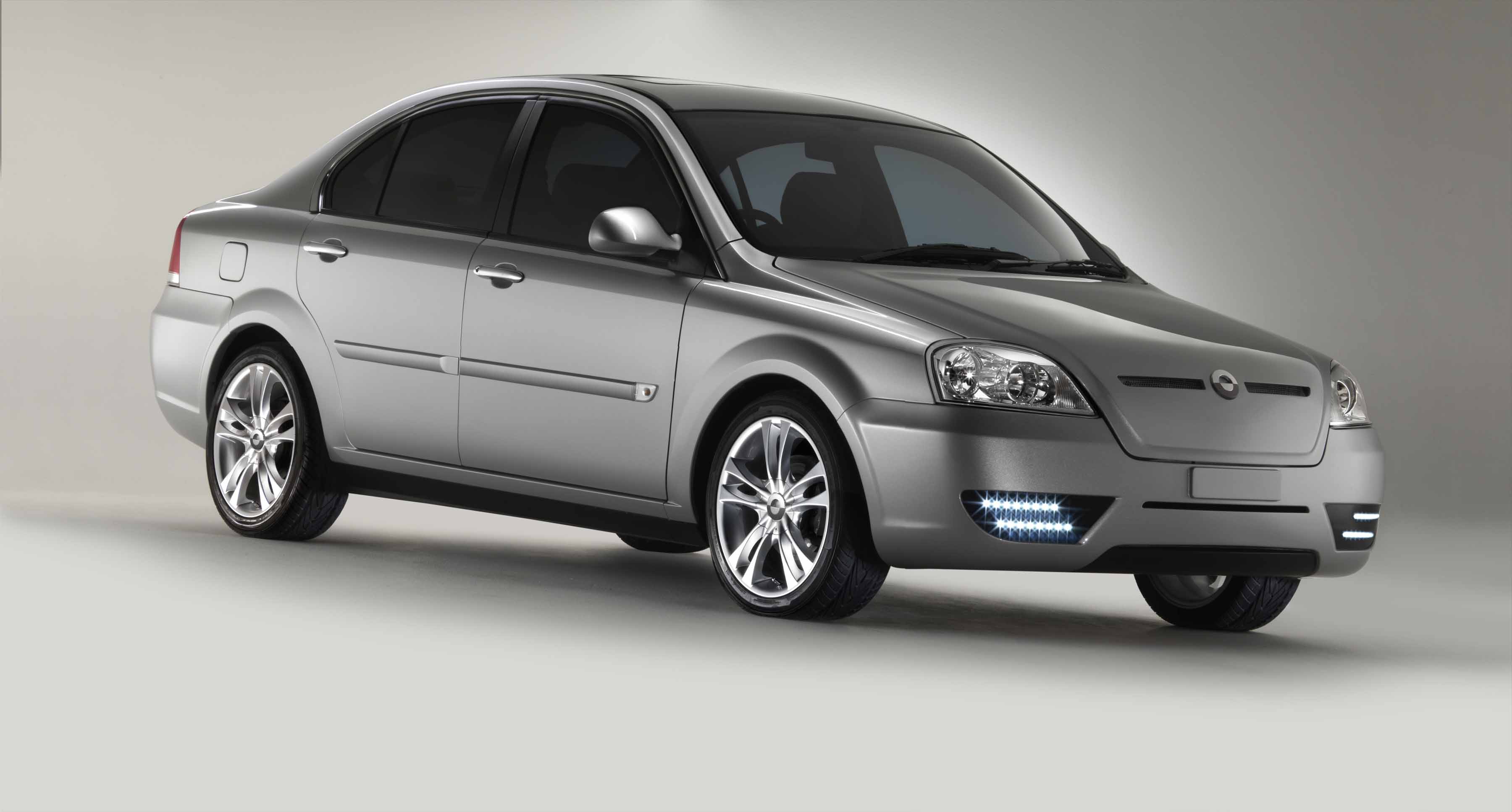
This morning, an example of that American innovation appeared as an advertisement for the CODA, an all-electric car.  Usually, I ignore the Ads, which often are pains slightly below the tip of the spine.

The CODA, an all-electric car

This time, I clicked the Ad and discovered that the CODA was being manufactured mostly by a joint effort between China and a few of those American innovators Karabell mentioned.  To give you an idea of how global the CODA is, check out the following list.

“About 40 percent of the components in the car, when measured by monetary value, come from US manufacturers, such as Borg Warner. The battery inside Coda’s sedan comes from a joint venture owned by Coda and China’s Tianjin Lishen Battery Co. The electronics for thermal and battery management of the pack were designed and will be produced in the US and shipped to Asia. The car will be built on assembly lines in China, with Coda engineers remaining full-time on the manufacturing floor to oversee production. Maybe ten percent of the original [Chinese] design is left.” Source: Matter Network

Also see Holding a Vital Key to Humanity’s Future

Lloyd Lofthouse is the author of the award winning novels My Splendid Concubine and Our Hart. He also Blogs at The Soulful Veteran and Crazy Normal.

Sign up for an RSS Feed for iLook China


The Power of Debate in China

April 29, 2010

“The news triggered a heated debate that was played out all over the Chinese-language media and on the Internet. Eventually, the government backed down, and it’s been left up to industry groups to figure out new guidelines.” Source: Gr-r-r-r! Why I hate China’s e-bikes

This quote from Adrienne Mong, an NBC News Producer, caught my eye. Gasp! Is this evidence from a Western Media source that the people of China have a voice and use it? I hope Adrienne doesn’t lose her job for this slip.

This sounds like America where public debates often have an impact on public policy even if that impact is negative since the majority rules—well, in theory, since in America the majority is often ignored while we constantly hear from “loud” minorities. Take the Tea Bag people, who represent less than 15% of the population, as an example. I wish they’d shut up.

Every time I’ve been in China, we walk, take taxis or use the subways.  We don’t bike, but I have admired the electric bikes.  This is the first I’ve heard of an e-bike without lights.

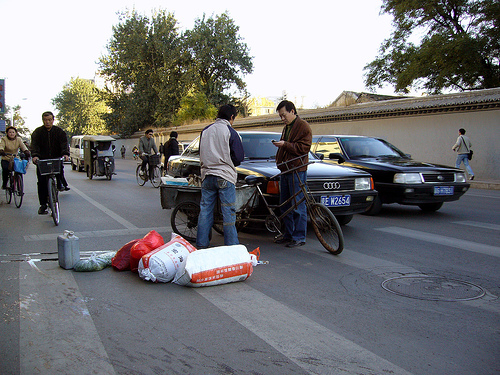
bicycle and an Audi 80 collide in China

Considering that America loses about 45,000 people a year to highway deaths and, according to Adrienne Mong, China loses twice that with almost five times the population, I’m surprised the numbers for road kill in China are not higher. Many of the drivers in China are crazy. The busy streets look more like an NFL game in the Super Bowl. I’ve often observed that red lights are ignored and crossing any street and sometimes even using sidewalks is risky.

Also see, Where Did All that Pollution Come From?

______________

Lloyd Lofthouse is the award-winning author of the concubine saga, My Splendid Concubine & Our Hart. When you love a Chinese woman, you marry her family and culture too. 

If you want to subscribe to iLook China, there is a “Subscribe” button at the top of the screen in the menu bar.


Water – Two Countries Tell a Tale

April 19, 2010

The National Geographic special issue, “Water, Our Thirsty World” (April 2007) compares the world’s largest democracy, India, with China. In “The Big Melt” by Brook Larmer, we see a convincing reason why China’s mix of socialism and capitalism may be the world’s answer to avoid future calamities. Where Western style democracies stall due to partisanship, special interests, religious beliefs and political agendas, China’s government, ruled by engineers and scientists, appears to be planning decades ahead.

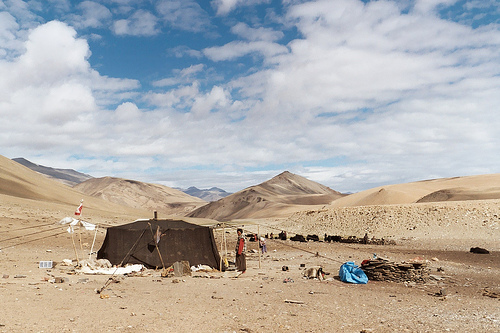
The claims by Tibetan separatists and their supporters that China rules over Tibet with an iron dictatorial fist also appears to be wrong when Larmer visits a family of Tibetan nomads. He writes, “There is no sign of human life on the 14,000 foot high prairie that seems to extend to the end of the world.” Larmer sees “the NOMADS’ tent as a pinprick of white against a canvas of brown.”
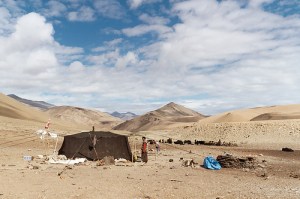
Tibetan Nomads

We meet Ba O, a Tibetan nomad. In Ba O’s tent, “there is a small Buddhist Shrine: a red prayer wheel and a couple of smudged Tibetan texts…” A few years earlier, Ba O had several hundred sheep and the grass was plentiful. Now the Tibetan nomad has about a hundred left and fears this way of life is ending.

Ba O says, “This is the way we’ve always done things. And we don’t want that to change.”

However, change is coming, and there is nothing Ba O can do to stop it. The change is not from China’s government. It is from global warming. The Tibetan grasslands are dying and a way of life that has existed for thousands of years may be dying too.
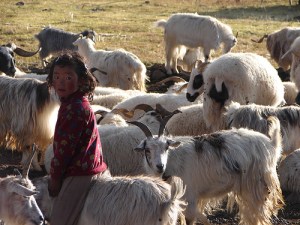
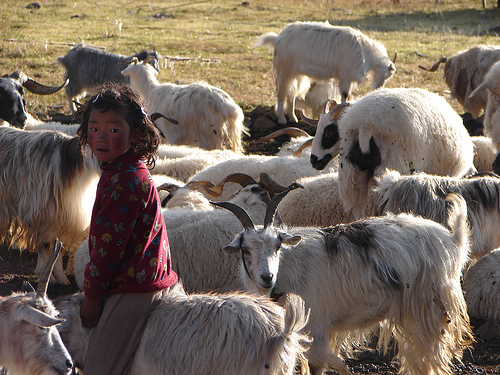
Tibetan girl tending sheep

To insure that the Tibetan nomads will have a place to live, China’s government has been building resettlement villages. The “solid built” houses are subsidized. When the Tibetan nomads can no longer survive on the open Tibetan prairie, it is the nomad’s choice to move into the new villages. The government does not force them to give up their old way of life. Nature does that.

Along with the house comes a small annual stipend for each family so they can eat as they find another way to earn a living. The home Larmer visited had a Buddhist shrine and a free satellite dish for a TV and maybe an Internet connection. In addition, the one child policy does not apply to the Tibetan people since they are a minority in China.

To make sure there will continue to be water to drink, China is planning to build 59 reservoirs in Tibet to capture and save glacial runoff.

In India, the young wife of a fortuneteller spends hours each day searching for water. She lives with her husband and five children in Delhi, India‘s capital. There are fights over water. In a nearby slum, a teenage boy was beaten to death for cutting into a water line.  The demand for water in Delhi exceeds the supply by more than 300 million gallons a day.

What happens to life when there is no water?

See Dictatorship Defined

______________

Lloyd Lofthouse is the award-winning author of the concubine saga, My Splendid Concubine & Our Hart. When you love a Chinese woman, you marry her family and culture too. 

If you want to subscribe to iLook China, there is a “Subscribe” button at the top of the screen in the menu bar.


Twin Disasters Shine a Light on Bias

April 10, 2010

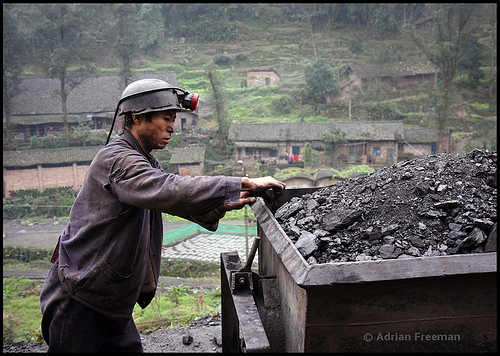
In China, a coalmine is flooded and traps more than a hundred. The Huffington Post reports this and says, “The real issue for the government (China’s) is to learn the lessons from this…The fundamental issue is, the miners should never have been put in this situation in the first place.”

In another piece, “A West Virginia coal mine explosion demands action”, Washington Post. “A huge explosion at the Upper Big Branch coalmine…claimed the lives of 25 miners.” This happened even after Congress passed the Mine Improvement and New Emergency Response act to make it safer.

After the US Congress passed this tougher law, the company that owned the West Virginia mine was cited with several safety violations prior to the explosion but was allowed to continue operating.

It seems the miners didn’t speak out for fear of losing their jobs. True Slant.com said, “Interesting how the West Virginia state police are necessary to allow the mining company CEO to speak now. He probably wouldn’t need them if the miners had been allowed to speak months ago.”

The US Bill of Rights protects freedom of speech but that freedom was written to protect US citizens from the government—not to protect people from corporations. The Huffington Post was right about one thing, “The miners should have never been put in this situation in the first place.”

See Human Rights the Chinese Way http://wp.me/pN4pY-m7

Sign up for an RSS Feed for  iLook China