The World was Warned. Is anyone listening?
April 23, 2025
 Leave a Comment » |
  America, capitalism, censorship, crime, cultural differences, democracy, environment, government, history, human rights, Lloyd Lofthouse, media, propaganda, United States, Who is the real Donald Trump | Tagged: Hitler, Lloyd Lofthouse, MAGA, Nazi, Trump, United States, World War II, World War III |
  Permalink
 Posted by Lloyd Lofthouse
China’s Heritage Sites Growing in Popularity
June 24, 2020China has 55 World Heritage Sites, and I have been to four of the top ten: the Great Wall, Temple of Heaven, Forbidden City, and the Terracotta Warriors. I have also been to the Ming and Qing Dynasties Imperial Tombs, South China Karst region along the Li River near Guilin, the West Lake Cultural Landscape of Hangzhou, the Grand Canal, and possibly a few others I did not recognize when I was looking at the list while writing this post.
In 2012, CNN.com reported, “Tourism boom threatens China’s heritage sites. … Places that were previously very remote and didn’t see a lot of (Chinese) tourists are now seeing enormous numbers arriving because they have the money to travel,” says Neville Agnew, group director of the Getty Conservation Institute, which has worked in China since 1989. “It’s an interesting phenomenon because it’s in complete contrast to the experience in Egypt, where almost all the visitors are foreigners.”
World Atlas.com also reports, “China’s Forbidden City gets more visitors (15 million) than any other UNESCO World Heritage Site.” The Great Wall had ten million.
World Atlas also said, “Although the high number of tourists visiting these UNESCO World Heritage Sites translates to high revenue for the receiving country, the cost of maintaining these sites is also significantly high.”
In 1971, the United States was central to UNESCO’s mission, and the People‘s Republic of China was isolated from the world. China had no world heritage sites and showed no evidence of public religious activity. That all changed after U.S. President Richard Nixon visited China in 1971. The Berkeley Center said, “By the 1980s, China had been recognized with its first World Heritage site and a massive religious revival was underway.”
Tragically, “Nearly half a century later, the United States (with 23 UNESCO World Heritage Sites) has withdrawn from UNESCO (because of President Donald Trump who values nothing but his power, his fame or infamy, as long as he is getting attention from the media, and money even when he has to cheat people to get it), and China eagerly seeks a greater role in the organization, which has recognized China with the second-highest number of World Heritage sites in the world.”
中
Lloyd Lofthouse is the award-winning author of My Splendid Concubine, Crazy is Normal, Running with the Enemy, and The Redemption of Don Juan Casanova.
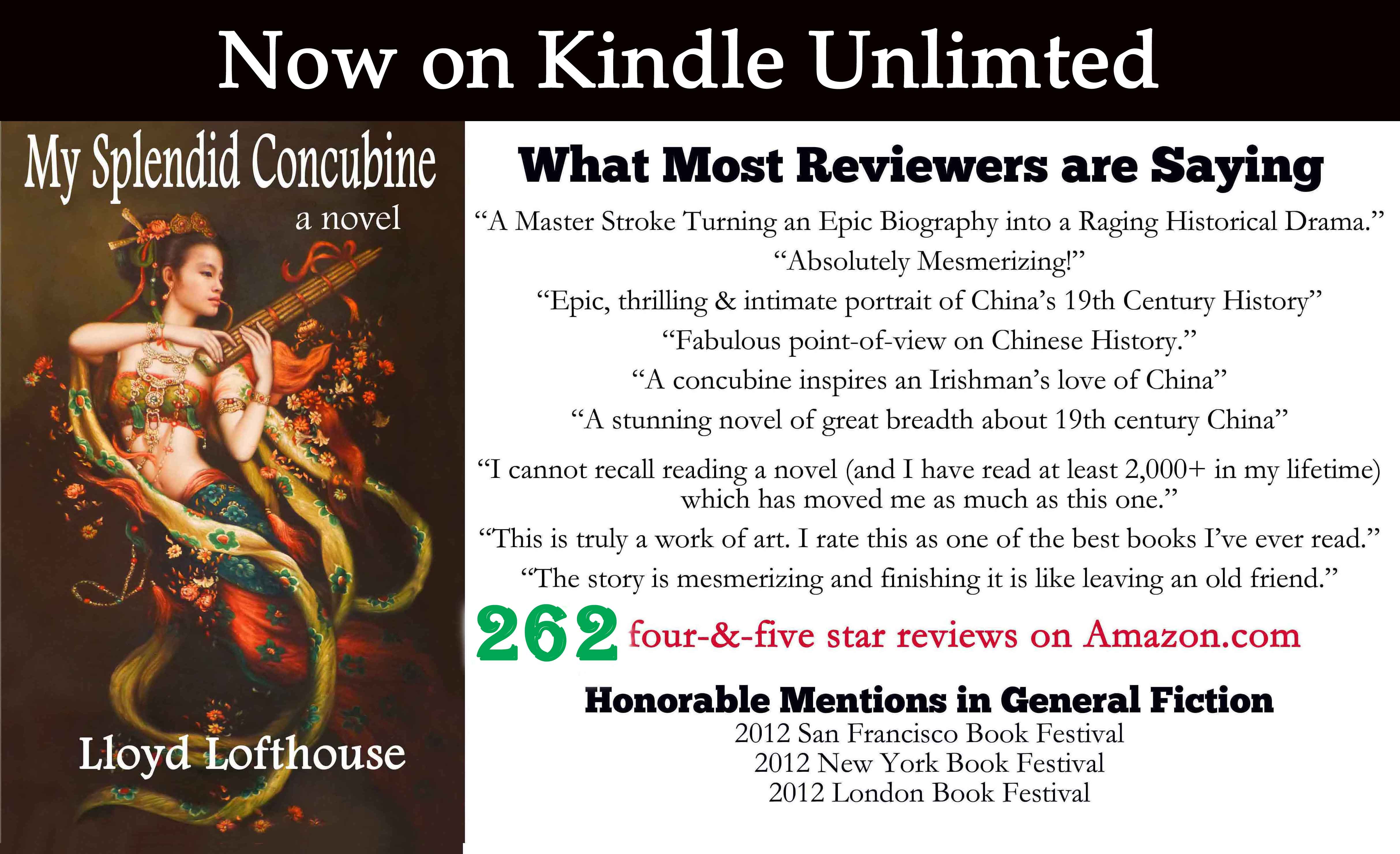
My Splendid Concubine is now available to read through Kindle Unlimited.
Leave a Comment » | China, Chinese Culture, Chinese history, cultural differences, education, environment, history, Tibet, tourism | Tagged: How many World Heritage Sites does China have, What are the top ten most popular World Heritage Sites in China, What did President Donald Trump do about UNESCO, When did China get its first World Heritage Site, Who is the American President responsible for isolating the country, Who is the American president that helped open China | Permalink
Posted by Lloyd Lofthouse
When it comes to World Heritage Sites, China and Italy are tied for First Place
June 17, 2020When it comes to World Heritage Sites, China is tied with Italy for first place. Each country has 55 World Heritage Sites. China has 14 natural and 37 cultural sites vs Italy’s five natural and 50 cultural.
A World Heritage Site is a landmark or area, selected by the United Nations Educational, Scientific and Cultural Organization (UNESCO) for having cultural, historical, scientific or other form of significance, which is legally protected by international treaties. The sites are judged to be important for the collective and preservative interests of humanity.
To be selected, a World Heritage Site must be an already-classified landmark, unique in some respect as a geographically and historically identifiable place having special cultural or physical significance (such as an ancient ruin or historical structure, building, city, complex, desert, forest, island, lake, monument, mountain, or wilderness area). It may signify a remarkable accomplishment of humanity, and serve as evidence of our intellectual history on the planet.
The sites are intended for practical conservation for posterity, which otherwise would be subject to risk from human or animal trespassing, unmonitored/uncontrolled/unrestricted access, or threat from local administrative negligence. Sites are demarcated by UNESCO as protected zones. The list is maintained by the international World Heritage Program administered by the UNESCO World Heritage Committee, composed of 21 “states parties” that are elected by their General Assembly.
The reason Italy and China are tied for 1st place is because Italy was home to the Roman Empire (27 BC to 1453 AD) and China to the Han (206 BC – 280 AD), Tang (618 – 907 AD), and Qing (1368 – 1644 AD) Dynasties.
National Interest.org says, “Contrary to the common perception of China being historically isolated and weak, many Chinese dynasties were very powerful and have had a profound impact on global history. … The Han Dynasty ruled China for a solid four centuries, from 206 B.C.E. to 220 C.E. Although the preceding Qin Dynasty unified China, it was the Han Dynasty that kept it together and developed the institutions that characterized most of Chinese history since. …
“After the Han Dynasty collapsed due to civil war, China entered a period of disunity until being reunited by the Sui Dynasty, which was subsequently succeeded by the Tang Dynasty, which ruled China from 618-907 C.E. The Tang Dynasty was one of China’s most cosmopolitan and urbane dynasties, opening China up to a period of foreign influences. The Tang Dynasty was also likely China’s largest and most powerful dynasty in history and is considered the golden age of imperial China.”
The Qing Dynasty was China’s last and one of its greatest from 1644 to 1911. The National Interest explains why, “The Qing were the first Chinese state to effectively control regions like Tibet, Xinjiang, Manchuria, and Mongolia, peripheral regions that were inhabited by people that had always harassed China.”
中
Lloyd Lofthouse is the award-winning author of My Splendid Concubine, Crazy is Normal, Running with the Enemy, and The Redemption of Don Juan Casanova.
Leave a Comment » | China, Chinese Culture, Chinese history, cultural differences, education, environment, history, Lloyd Lofthouse, tourism | Tagged: What are the requirements to become a World Heritage Site, What are World Heritage Sites, What did the Roman Empire and Han Dynasty have in common, What does it take to get a World Heritage Sites, What two countries have the most World Heritage Sites, Who decides what a World Heritage site is, Why does China have the same number of World Heritage Sites that Italy has | Permalink
Posted by Lloyd Lofthouse
The World’s Favorite Dessert is Not Chocolate
May 27, 2020I am a chocoholic. I’m very fond of chocolate and eat or drink some every day. In fact, I usually start my day with some chocolate, and I was enjoying some really-dark chocolate when I started writing this blog post ten hours later in the early evening.
If world civilization collapsed and global trade suffered, I would not miss most of the luxuries I take for granted, but I would miss chocolate. The World Atlas says, “Unsurprisingly, most of the top 10 cocoa-producing countries come from warm, wet climates similar to where the bean originated.”
You might not find this surprising, but the countries that consume the most chocolate do not produce it.
How about China? If world trade suffered because of the COVID-19 pandemic, would the Chinese miss chocolate?
Chocolate wasn’t introduced to China until the 1980s. China Business Review reports, “Thirty years ago, most Chinese had never eaten a piece of chocolate; their taste for chocolate was ready to be shaped by whichever company entered the country with a winning combination of quality, marketing savvy, and manufacturing and distribution acumen. For chocolate companies, China was the next great frontier—a market of almost limitless potential to be unlocked through a battle between the world’s leading chocolate companies for the hearts, minds, taste buds, and ultimately the wallets of China’s consumers.”
Those chocolate companies failed.
“Even today, the amount of chocolate sold in China is relatively small, accounting for less than 2 percent of total global consumption. Most Chinese would not be able to find chocolate in their vicinity even if they were willing to buy it.”
Why chocolate never caught on in China should be obvious. The favorite dessert in China, Japan, and most, if not all of Southeast Asia is mochi, and that is made from rice.
Mochi is the most popular dessert in the world, but only because there are more Asians than any other ethnic group on the planet. Caucasians (found mostly in North America, Russia, and Europe) only make up 11.5% (850,000,000) of the world’s 7.8 billion people. The Han Chinese, by themselves, represent more than 20%, and that is not counting the populations of Japan and the other countries in that area of the world that love mochi.
Taste Atlas says, “Mochi, the tiny cakes made out of glutinous rice, are an important part of Japanese cuisine and culture (and the rest of East and Southeast Asia). The preparation of mochi starts with a time-consuming process of pounding boiled or steamed rice, usually the glutinous mochigome variety until it forms into a thick and homogenous paste. …The most common confectionery is referred to as daifuku-round cakes filled with different ingredients such as the traditional red bean paste, strawberries, or ice cream. … Due to its chewy texture, it is important to be extra careful and attentive while eating mochi and to take tiny bites of this glutinous treat.”
What ten countries produce the most rice?
The answer is revealed in the last video. If global trade suffers due to the COVID-19 pandemic, China, Japan, and Southeast Asia will not have to give up their favorite dessert. I live in the United States, and I am not a mochi fan.
What is your favorite dessert?
中
Lloyd Lofthouse is the award-winning author of My Splendid Concubine, Crazy is Normal, Running with the Enemy, and The Redemption of Don Juan Casanova.
Leave a Comment » | China, Chinese Culture, Chinese food, cultural differences, economy, environment, food, Lloyd Lofthouse | Tagged: what countries consume the most chocolate, what countries consume the most rice, what countries produce the most chocolate, what countries produce the most rice, What is mochi, what is the most popular dessert in the world, Why is mochi the world's favorite desert | Permalink
Posted by Lloyd Lofthouse
The COVID-19 Warning
May 6, 2020If it is possible to learn from history, the world may be fortunate that the stability of Chinese civilization for several thousand years left behind a well-documented historical record.
In 2017, Scientific American reported, “Records from Ancient China reveal link between Epidemics and Climate Change. By analyzing Chinese records throughout nearly 2,000 years of history, researchers have found that climate-driven disturbances like floods, droughts and locust outbreaks were associated with disease epidemics. …
“The new research underscores the idea that climatic changes may affect human health in a variety of ways. Present-day concerns about climate change and infection often focus on the potential of higher temperatures to facilitate the spread of disease vectors, like mosquitoes.”
Contagion Live reports on The Ripple Effect of Climate Change on Epidemic Risk. “Increases in extreme weather events, as predicted by climate scientists, may also lead to increases in infectious disease outbreaks. Epidemics have previously been seen in the wake of natural disasters, which can lead to displaced and crowded populations, hotbeds for infection transmission. Severe rainfall or flooding is particularly effective at creating environments suitable for the transmission and propagation of infectious diseases such as measles or cholera. Conditions, as currently seen on the devastated island of Puerto Rico, are often more amenable for mosquitoes to breed in flood-affected regions and as a result, may increase disease risk in those areas.”
What did China learn over the centuries?
The Journal of Biosafety and Biosecurity reports, “Since ancient times, China has acquired a rich experience in both the prevention and cure of infectious diseases. As early as in the Warring States period (475 BC – 221 BC), China began to develop theories on epidemic diseases. In the Qin Dynasty (221 BC – 206 BC), an integrated response system, including prevention, diagnosis, and isolation, was established.
“Later, during the Han Dynasty (206BC – 220 AD), people began to pay attention to the control of infection sources. Whereas, vaccination methods were created in the Song Dynasty (960 – 1270 AD, composed by the Northern Song Dynasty and Southern Song Dynasty), they were popularized throughout the Ming (1368 – 1644 AD) and Qing (1644 – 1912) Dynasties.
“However, at that time, China had not established a biosafety prevention system based on modern microbiological studies on infectious diseases, lacking a comprehensive scientific understanding of them. It was in the middle and late Qing Dynasty, with the arrival of missionaries and the return of overseas students, that advanced western science and technology were introduced into China, allowing the implementation of scientific infectious disease prevention and control measures and giving rise to modern biosafety means.”
For modern civilization to survive, the world’s leaders must cooperate, and that includes the United States. However, current President Donald Trump is always looking for someone else to blame. For sure, Donald Trump is not a role model for how to survive a pandemic. That is not how to survive climate change and the epidemics to come. COVID-19 might be just the beginning. Are you ready?
中
Lloyd Lofthouse is the award-winning author of My Splendid Concubine, Crazy is Normal, Running with the Enemy, and The Redemption of Don Juan Casanova.
Leave a Comment » | China, Chinese Culture, Chinese history, environment, health care, history, politics, science | Tagged: How do the politics in a democracy make it harder to survive a pandemic, How long has China been learning how to survive an epidemic, What can we learn from China's history when it comes to surviving a pandemic, What did China do during its Warring States period to fight epedimcs, What has China learned about epidemics over the centuries, When did China first start to experiment with vaccines, Why is Donald Trump a dangerous leader during a pandemic | Permalink
Posted by Lloyd Lofthouse
 iLook China