One Step from the Global Gold Medal

April 30, 2010

Globally, China’s buying power has increased to the number two spot. Source: World Bank

Salary gaps still existed. In Beijing, people working in industries such as securities, banking and air transport obtained more than 100,000 yuan (14,245 U.S. dollars). While workers in the textile and agriculture industries had less than 20,000 yuan (2,849 U.S. dollars). source: Sina.com

Olympic Medal

An argument could be made that Americans earn more.  However, “The average annual income of Chinese farmers hit a record 5,000 yuan (732 dollars) this year as increased demand for migrant workers saw more money sent back to rural areas, state media reported Monday. Source” France 24 International News.” Source: France 24

With 1.3 billion people, a slight increase in earnings means more spending. China’s GDP to overtake U.S. by early 2020s, says analyst. Mainland to become world’s largest in about a decade, says Deutsche Bank. Source: Market Watch

See “Deng Xiaoping’s 20/20 Vision” http://wp.me/pN4pY-2o


I Miss the Smell of China

April 27, 2010
Bob Grant

Originally Published at Speak Without Interruption on April 16, 2010 by Bob Grant — publisher/editor for Speak Without Interruption. Posted on iLook China, April 27, 2010 at 12:00 PM

 For various reasons, my business in China declined a little over two years ago, and I have not had occasion to visit there during that time period. A lot has happened—both within the U.S. and China—since my business went south.

I do miss China – its people – its culture – its smell. This might seem like an irrational statement since China is suppose to be one of the most polluted countries in the world, but it is not the smell of pollution that sticks in my memory.

Our China office was located in Guangdong Province, which is in the southern part of China near Hong Kong. Traveling around that province, I always remember the fresh scents of flowers, rain, trees, grass, and meals being prepared for daily consumption.

I tended to visit factories that were in outlying areas—their conference rooms, factories, reception rooms, and gardens all had a smell that I grew to welcome during each of my visits. As I made trips and visits to other parts of China, I felt they each had their own unique smells and aromas that I have not found any other place in the world that I have traveled.

I have written other posts regarding my feelings about the Chinese people—those have not changed.  I am not certain that I will ever have occasion to visit China again but the smells and memories of that country and its people will remain with me forever.

Follow this link to see more by Bob Grant “Transporting Goods by Road in China” http://wp.me/pN4pY-jf


A Story about Corruption

April 23, 2010

National Library Week was April 11 – 17.  Friday, I attended the Golden Leaves event at Cal Poly Pomona’s University Library. Afterwards, I joined a conversation about China, and one American Caucasian mentioned the corruption in China and how flawed their legal system was. He was adamant that China had to change and become more democratic like Taiwan was. He also said there were a lot of angry people in China who wanted change.

However, there are two sides to every coin, and there are times when I’m slow to respond.  I have to think about the issue first. Now, I’m ready.

“While the true extent and cost of white-collar crime (in the United States) are unknown, it is estimated to cost the United States more than $300 billion annually, according to the FBI.”

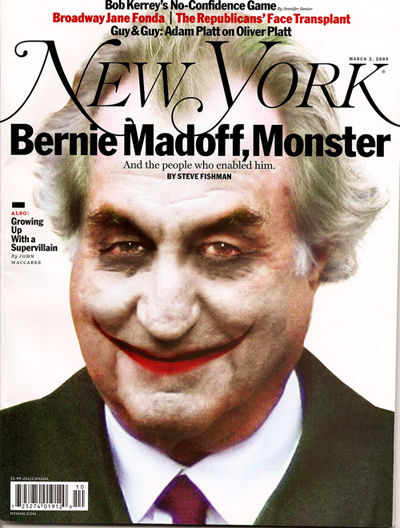
“According to experts, the actual amount investors gave to (Bernard) Madoff over the years is probably closer to $20 billion. But even that outlandish sum will never be found; it was chipped away year after year after year. That, after all, is the definition of a Ponzi scheme: Most of the cash put up by new investors went to pay the old ones.” Source: CNN.com
“Enron was the largest company ever to go bankrupt in U.S. history.… Enron gave over $5 million to campaigns since 1998. Out of the 248 elected officials investigating Enron’s collapse, 212 received campaign contributions from Enron or its accounting firm, Arthur Andersen.

“Enron donated money to George W. Bush’s campaign and Kenneth Lay was a close friend. This week, a congressional watchdog agency announced that it will sue Vice President Cheney to get records of meetings he had with Enron officials. The agency is investigating whether the company was able to influence the energy policies of the United States government.” Source: pbs.org

“WASHINGTON—The Securities and Exchange Commission suspected Texas financier R. Allen Stanford of running a Ponzi scheme as early as 1997 but took more than a decade to pursue him seriously, according to a report further tarring the agency that missed Bernard Madoff’s huge fraud.… Mr. Stanford was indicted last June and accused of orchestrating a Ponzi scheme that swindled investors out of $7 billion.

“The report by the SEC’s inspector general says SEC examiners concluded four times between 1997 and 2004 that Mr. Stanford’s businesses were fraudulent, but each time decided not to go further. It singles out the former head of the SEC’s enforcement office in Fort Worth, Texas, accusing him of repeatedly quashing Stanford probes and then trying to represent Mr. Stanford as a lawyer in private practice.” Source: Wall Street Journal

“The US sub-prime mortgage crisis has led to plunging property prices, a slowdown in the US economy, and billions in losses by banks. It stems from a fundamental change in the way mortgages are funded.”

“On Thursday, Sept. 18, 2008, the astonished leadership of the U.S. Congress was told in a private session by the chairman of the Federal Reserve that the American economy was in grave danger of a complete meltdown within a matter of days. “There was literally a pause in that room where the oxygen left,” says Sen. Christopher Dodd (D-Conn.)

“FRONTLINE then chronicles the disaster that followed. Within 24 hours, the stock market crashed, and credit markets around the world froze. “We’re no longer talking about mortgages,” says economist Gertler. “We’re talking about car loans, loans to small businesses, commercial paper borrowing by large banks. This is like a disease spreading.”
Sources:  BBC and PBS-Frontline

 What about China?

“For one thing, the Chinese trust their government more. According to a recent World Values Survey, 96.7 percent of Chinese expressed confidence in their government, compared to only 37.3 percent of Americans.

“Likewise, 83.5 percent of Chinese thought their country is run for all the people, rather than for a few big interest groups, whereas only 36.7 percent of Americans thought the same of their country. With this relatively higher trust, China’s government and enterprises are better able to enact and implement strict policies that promote saving and growth.” Source: The Economist’s View

I wonder if the corruption in China will ever threaten the world’s economies? I’ll let China speak for itself, Economists defend China’s high savings rate.

See Peter Hessler, an expatriate, on China http://wp.me/pN4pY-kI


Investing BIG in Education

April 21, 2010

China is making HUGE investments in education. In 1998, then-President Jiang Zemin called for a massive increase in enrollment in higher education. Since then, high school and college enrollments in China grew. Source: FP-Foreign Policy, April 14, 2010

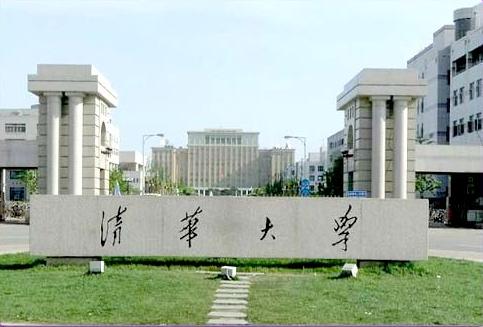
Tsinghua University's east gate

In China, more than thirty percent graduate with degrees in engineering or technology. In the United States, only five percent of university students graduate in these fields, while U.S. universities produce more psychologists.

That is why President Obama has encouraged American students to study science. Source: White House

What’s going to happen if American students do not start working hard to become engineers and scientists?

Tsinghua University

In 2040, the Chinese economy will reach $123 trillion, or nearly three times the economic output of the entire globe in 2000.  It’s a fact that people with an education in engineering and science earn more and are more productive.  China and India combined are turning out more than 600,000 engineers a year—ten times that of the United States. Source: Rocketry Planet

To see the results of this push in education, discover Adding to Honor in One Lunar Leap

______________

Lloyd Lofthouse is the award-winning author of The Concubine Saga. When you love a Chinese woman, you marry her family and culture too. This is the love story Sir Robert Hart did not want the world to discover.

To subscribe to “iLook China”, look for the “Subscribe” button at the top of the screen in the menu bar, click on it then follow directions.


China’s Middle Class Expanding

April 20, 2010

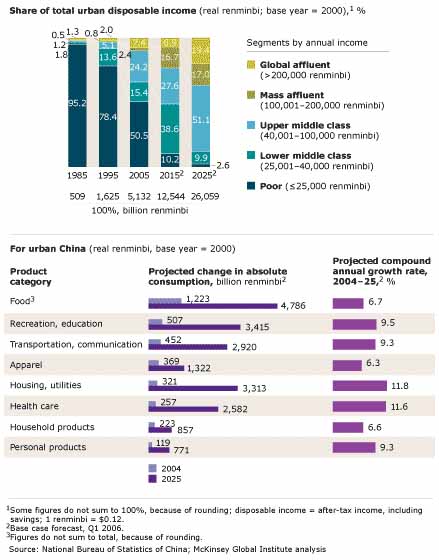
“Present estimates of “middle class” in China range from 100 million to 247 million… Estimates of the size and growth rate of China’s middle class vary. Roughly half of China’s projected urban population will be middle class in 2025.

“Unlike the United States, where income typically peaks between the ages of 45 to 54, it is predicted that the wealthiest consumers in China will be between 25 to 44 years old because the younger generation will be more highly educated.” Source:  Rise of China’s Middle Class

Buying Cars:
“In the first quarter of 2010, Chinese bought 4.61m units, up 71.78 percent year on year, according to the CAAM.” Source: The Truth About Cars

Buying Houses:
“…demand is still strong. A recent survey by the Hong Kong-based brokerage CLSA found that 56 percent of China’s middle-class families are considering buying a new home.” Source: Sinocism

“Furthermore, homebuyers in China put down at least 20 percent as a down payment (30 percent for a first-time buyer and 40 percent for a second-home buyer to damp down speculation). These buyers rarely fall behind on their mortgage payments.” Source: No Housing Bubble in China

Food:
“China’s mass grocery retail is booming and the turnover of both Chinese and foreign supermarket chains are growing.  The middle class’ new consumption patterns and increasing income has been a catalyst for growth and creates new export opportunities for Danish food companies.” Source: Renmin Shimbun

Discover The Reasons Why China is Studying Singapore

_______________

Lloyd Lofthouse is the award-winning author of My Splendid Concubine [3rd edition]. When you love a Chinese woman, you marry her family and culture too. This is the love story Sir Robert Hart did not want the world to discover.

Subscribe to “iLook China”!
Sign up for an E-mail Subscription at the top of this page, or click on the “Following” tab in the WordPress toolbar at the top of the screen.

About iLook China