Jobless in America and Angry at China

May 17, 2010

When the economy tanks and Americans lose jobs, I often read or hear that it’s China’s fault.  Timothy V, a typical China basher that I’ve been debating on Gather, is an example. Using China as a scapegoat for lost jobs in America appears to be a popular pastime.  After all, many in America need someone to blame for the hard times.

The truth is that more jobs have been lost to Mexico and Canada than to China. Citizen.org says that because of NAFTA, Americans lost 3 million manufacturing jobs to Mexico and Canada…

The Economic Policy Institute says that between 1997 and 2006, the trade deficit between the U.S. and China could have supported 2,166,000 jobs. This report doesn’t say that manufacturing jobs were lost in America to China. It means that when China joined the WTO (World Trade Organization), jobs were created for Chinese workers that might have gone to the United States. 

What happened after America’s economic bubble popped in 2008? CNN reported that 2009 was the worst year for jobs lost in the United States since 1945.  A sobering U.S. Labor Department jobs report showed the economy lost 1.9 million jobs in the year’s final four months.

Do not forget who caused the current global economic crises and those job losses. “Global Issues.org” describes the crisis that was caused by greed in America.

If you believe someone like Timothy V, those job losses should be blamed on China, but he is wrong. The BBC reported that Chinese migrant factory job losses mount. A Chinese government official, Ma Jian Tang, told reporters in January (2009) he thought roughly 5% of the country’s 130 million migrant workers had returned to their villages after losing jobs. (Note: I wonder why I couldn’t easily find this from an American news source.)
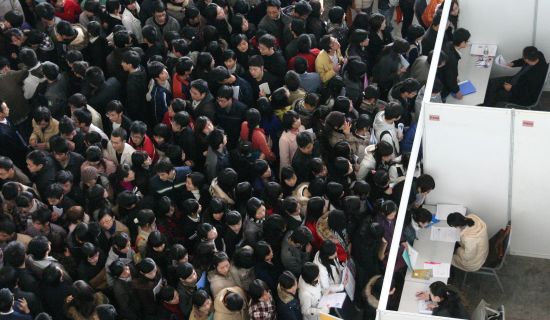
Out of work in China

In fact, a Chinese government survey revealed that 20 million migrant (factory) workers lost jobs, posing a risk for social instability. Some 15.3 percent of China’s 130 million migrant factory workers became jobless. Since the American induced global economic crisis in 2008, Beijing says about 70,000 factories nationwide have closed.

How can anyone in China be stealing jobs from Americans? Do I need to mention the millions of jobs lost to illegals that cross America’s Southern border and take hard, low-paying jobs that Americans don’t want? According to this report from NPR, that number is about 12 million.

When I was fifteen, I started my first job washing dishes in a department store coffee shop that served lunch and dinner and I worked nights and weekends there for three years while attending high school. There were several of us doing that job, and we were all American born teens. Before I joined the US Marines, I worked in a car wash, a McDonald’s and other jobs that most Americans won’t touch today. In Steinbeck’s novels, the farm workers he writes about were mostly poor Americans who went into the fields to plant and pick—not illegals from south of the border.

In fact, the jobs are there but too many Americans won’t consider them because they won’t pay for an American middle-class credit card driven, consumer lifestyle where people eat out more than they eat in and everyone “has” to have the American dream.  Can’t buy that with low wages.

This has happened before. After World War II, American jobs were lost to Japan and Germany.  Then after the Korean War, more jobs were lost to South Korea and Taiwan as they built factories.  In the 1950s, GM, Ford and Chrysler were building and selling about 90% of the cars and trucks globally.  Then Toyota and VW arrived in the United States. Who was stealing US jobs then?  It wasn’t China.

In reality, it’s all about finding a scapegoat to slaughter while the guilty quietly slip away.

Read about American Hypocrisy

____________________________

Lloyd Lofthouse is the author of the award winning novels My Splendid Concubine and Our Hart. He also Blogs at The Soulful Veteran and Crazy Normal.

Sign up for an RSS Feed for iLook China


Another Opinion about China’s Trade Surplus

May 14, 2010

China has an estimated 2.4 trillion in foreign reserves and recently, there have been accusations from American politicians and in the Western media, that China has been manipulating the exchange rate and costing Americans their jobs.

In a report on Vox (Research-based policy and commentary from leading economists), Zheng Song, Kjetil Storesletten and Fabrizio Zilibotti claim they can prove that China did not gain this huge trade surplus from manipulation of the exchange rate.

Chinese Currency

Instead, they will offer proof from similar economic growth in South Korea and Taiwan that both resulted in large surpluses from trade.

The three economists wrote that in the second half of the 1980s, South Korea saw booming growth and a series of large current account surpluses. In addition, Taiwan experienced large trade surpluses in the 1980s. Since both South Korea and Taiwan are smaller than China, their trade surpluses did not draw as much attention as China’s trade surplus has.

The authors of the study concluded that the call for trade sanctions against China might be unwarranted as well as dangerous.

Read more about America’s Assault on China’s Currency.

______________

Lloyd Lofthouse is the award-winning author of the concubine saga, My Splendid Concubine & Our Hart. When you love a Chinese woman, you marry her family and culture too.

If you want to subscribe to iLook China, there is a “Subscribe” button at the top of the screen in the menu bar.


Anger, Oppression, and Courage

May 12, 2010

In the West, it is common to air public or private corruption so the world sees. In China, it is best not to talk about embarrassing problems publicly. Unfortunately, this practice allows individuals in public office to spend lavishly.

When China considers reforms that go against cultural habits, the government moves cautiously and studies the results. Why experiment with change at all?  Because the people show courage and demand changes and this noise cannot be ignored for long.

In Chongqing, an experiment in rural land reform is taking place designed to lift economic oppression from the backs of the rural poor so they benefit from the growing economy. This is the only province where rural land reforms are being tested on a provincial scale. If this works, these reforms may spread to other provinces calming rural anger.

Baimiao, a Sichuan township, is experimenting with financial transparency that has been termed “Naked Government.” So far, results look promising.  For China to combat political corruption, financial transparency is necessary.

In another test, a Cultural Revolution museum in Shantou (Guangdong district) is a message that history is a warning not to make the same mistakes twice. The museum gets about 1,000 visitors a day.

The size of each experiment may signal the importance of each. One covers a province. Two are only in towns. The first experiment took place soon after Mao died. That test was an open market leading to China’s ever changing, booming economy. Maybe these latest tests, if successful, will lead to similar results.

____________________________

Lloyd Lofthouse is the author of the award winning novels My Splendid Concubine and Our Hart. He also Blogs at The Soulful Veteran and Crazy Normal.

Sign up for an RSS Feed for iLook China


China’s Stick People

May 11, 2010

I’m always looking for information about China, and I hit gold with the May 8 The Economist. Click the link to read the entire piece or read this summary. I bought the magazine.

China has two classes—rural and urban.  The urban people have prospered for the last thirty years as China built a middle class.  Most rural Chinese have not been able to benefit from the booming economy and are getting restless.

Rural China

Rural land outside China’s cities belongs to collectives. When Mao won China, the Communists divided the land among villages—not individuals. Individuals do not hold title to farmland and cannot sell land that no one owns.

China saw what was happening in India when farmers sold their plots to developers.  Rural people in India flocked to the cities and built sprawling slums. To avoid that, the Chinese government created a system to keep rural people on their farms.  Another motivation was fear of another famine like the one that struck China from 1959 to 1961 killing millions from starvation. If farmers left the fields for a better lifestyle in cities, that nightmare might return.

Currently, an experiment is being tried in rural areas outside Chongqing to see if the land can be divided among individuals while increasing food production. Since the government still hasn’t figured out how to make the transition smoothly, don’t expect rural land reforms to happen quickly.

Discover China’s middle class expanding

_______________

Lloyd Lofthouse is the award-winning author of My Splendid Concubine [3rd edition]. When you love a Chinese woman, you marry her family and culture too. This is the love story Sir Robert Hart did not want the world to discover.

Subscribe to “iLook China”!
Sign up for an E-mail Subscription at the top of this page, or click on the “Following” tab in the WordPress toolbar at the top of the screen.

About iLook China


Food and China’s Eating Culture

May 10, 2010

China is an eating culture and always has been.  Although Today’s Chinese do not eat the quantities of meat the average American does, China accounts for half of global pig production because pork is the popular meat to eat.  Small farmer producers raise ninety-nine percent of pork in China. Source: China Translated

Chinese Farmer

Even when grain production falls in China that does not translate into a shortage since China has historically kept large food-grain stockpiles and those individual small farmer/producers help ensure food security. Source : China Through a Lens

As China’s economy continues to grow a spreading middle class with money to spend, food demand and eating habits are changing along with waistlines.  To meet this demand, Chinese have set up large pork and chicken operations in Australia to meet the growing demand for meat on the mainland. Source: Food Crisis

To insure a dependable supply of food to feed 1.3 billion people, Chinese companies have also bought or leased land in Africa sending Chinese laborers to produce crops for sale on the world market – and back home.  Source: Telegraph.co.uk

Discover Tofu

______________

Lloyd Lofthouse is the award-winning author of the concubine saga, My Splendid Concubine & Our Hart. When you love a Chinese woman, you marry her family and culture too. 

If you want to subscribe to iLook China, there is a “Subscribe” button at the top of the screen in the menu bar.