Linking the Dragon Boat Festival to Rice Cakes

June 10, 2011

A friend reminded me of the Dragon Boat and Rice Cake Festivals that took place in China earlier this month.

These festivals came about because of the suicide of Ch’u Yuan (343 – 289 BC), an aristocrat of the Ch’u State. He is considered one of ancient China’s greatest and earliest recognized poets.

History/myth tells us that the festival celebrates and honors Ch’u Yuan, who drowned himself in the Mi Lo River as a protest against his government’s actions.

What we do know is that when he was banished from his home, he left in despair feeling his exile was unjust. As he traveled about, he wrote poetry, observed shamanistic folk rites, and learned of legends that influenced his work.

The Dragon Boat Festival, held on the fifth month of the Chinese lunar year, originates from the search for the poet’s body. A popular legend says villagers raced in their boats to the middle of the river and desperately tried to save him, but were unsuccessful. They threw the rice filled dumplings or rice cakes into the water as a food offering to distract the river’s god and the fish away from his body.

The Dragon Boat Festival is also celebrated in San Francisco (and many other cities around the world) and I learned that a Dragon Boat race takes place in San Francisco Bay. While Dragon Boat races are being held in China this month, San Francisco holds its races in September 17-18, 2011 from Treasure Island.

In Beijing, China, the Dragon Boat Festival, also known as Duanwu Festival, was celebrated early in June.

As for the rice cakes, I suggest watching the embedded YouTube video to see how they are made, which demonstrates a process similar to how my wife makes them.

However, besides the essential sticky rice, the other ingredients are optional.  Sticky rice cakes may also have raisins and black beans added. For centuries, Silk Road caravans leaving China carried rice cakes as rations since they have a long shelf life.

When I checked a list of China’s Public Holidays, the only one listed for June was the Dragon Boat Festival. Then I read that “Zongzi”, traditional rice cakes wrapped in bamboo leaves, are eaten during the Dragon Boat Festival, which is a three-day holiday.

Discover more about Chinese dragons

______________

Lloyd Lofthouse is the award-winning author of the concubine saga, My Splendid Concubine & Our Hart. When you love a Chinese woman, you marry her family and culture too.

To subscribe to “iLook China”, look for the “Subscribe” button at the top of the screen in the menu bar, click on it then follow directions.


The Chinese in America – Part 3/3

June 9, 2011

Almost half a century after her death, Anna May Wong (1905 to 1961) has not been forgotten.

In fact, her life is another example of the continued discrimination against Asian-Americans and Chinese in the US by other ethnic groups, which includes Caucasions, African Americans and Latinos.

The first indication of this discrimination and racisim in the US against Chinese and/or Asian Americans appeared during the  California Gold Rush, which John Putnam wrote of in Chinese in the Gold Rush.

As a child, Anna loved going to the movies and even cut school to go to the show.

Between 1919 and 1961, she acted in 62 films. The Internet Movie Data Base says she was the “first Chinese-American movie star”.

However, to act, Anna had to play the roles she was given. The Western stereotype cast her as a sneaky, untrustworthy woman that always fell for a Caucasian man. The dark side of achieving her dream of acting in movies was that Anna had to die so the characters she played got what they deserved.

Anna often joked that her tombstone should read, “Here lies the woman who died a thousand times.”

Until Chinese started to emigrate to the U.S. in the mid-19th century, they had never encountered a people who considered them racially and culturally inferior.

The discrimination against the Chinese in America was only exceeded by the racism and hatred directed at African-Americans.

Then in the 1960s, many of the anti racist laws enacted during the Civil Rights era focused on protecting African-Americans, which created a protected class.

Since the Chinese—due to cultural differences—often did not complain, they were left behind.

In many respects, racism toward the Chinese still exists in the US and manifests itself through the media as China bashing, which supports the old stereotype.

When Anna May Wong visited China in 1936, she had to abandon a trip to her parent’s ancestral village when a mob accused her of disgracing China.

After her return to Hollywood, she was determined to play Chinese characters that were not stereotypes, but it was a losing battle. To escape the hateful racism, she lived in Europe for a few years.

Since U.S. law did not allow her to marry the Caucasian man she loved, and she was afraid that if she married a Chinese man he would force her to give up acting since Chinese culture judged actresses to be the same as prostitutes, she never married.

Anna May Wong smoked and drank too much. She died of a heart attack in Santa Monica, California at age 56.

Return to Part 2 or start with The Chinese in America – Part 1

This post first appeared on November 10, 2010 as Anna May Wong – The Woman Who Died a Thousand Times

______________

Lloyd Lofthouse is the award-winning author of the concubine saga, My Splendid Concubine & Our Hart. When you love a Chinese woman, you marry her family and culture too.

To subscribe to “iLook China”, look for the “Subscribe” button at the top of the screen in the menu bar, click on it then follow directions.


The Chinese in America – Part 2/3

June 8, 2011

This was the second post from 2010 that I remembered after reading John Putnam’s guest post of the Chinese during the California Gold Rush.

Angel Island in San Francisco Bay was America’s west coast Ellis Island.

From 1919 to 1940, mostly Asian immigrants entered the US through Angel Island.

After 1940, the immigration station on Angel Island was forgotten until a California Park Ranger, Alexander Weiss, discovered the stories carved in the walls.

He thought that there were stories here as if there were ghosts waiting to be heard.

Over half of the Angel Island immigrants came from China and Japan and most of the carvings on the walls were poems written in Chinese.

A former detainee, Dale Ching, went through the station in 1937 when he was sixteen. Even though Dale’s father was born in the United States, he still had to go through the immigration station.

While the East Coast’s Ellis Island welcomed immigrants, Angel Island’s story was one of sadness and suffering.

Most European immigrants who went through Ellis Island stayed a few hours, but immigrants on Angel Island were kept locked up under armed guard with barbed-wire fences surrounding the buildings and some people stayed for days, weeks, months and years.

The park service wanted to tear the Angel Island buildings down but Weiss found supporters and they struggled to preserve this history. They succeeded and the restoration project was challenging.

Alexander Weiss sums up the video saying we should know both the right and the wrong from U.S. history.

Continued on June 9, 2011 in The Chinese in America – Part 3 or return to Part 1

This post first appeared on September 8, 2010 as America’s Angel Island

_______________

Lloyd Lofthouse is the award-winning author of the concubine saga, My Splendid Concubine & Our Hart. When you love a Chinese woman, you marry her family and culture too.

To subscribe to “iLook China”, look for the “Subscribe” button at
the top of the screen in the menu bar, click on it then follow directions.


The Chinese in America – Part 1/3

June 7, 2011

While reading John Putnam’s guest post of the Chinese during the California Gold Rush, I thought of several other posts I wrote about the Chinese in America.

Putnam wrote, “White miners soon arrived and pushed the Chinese out…”

The first major wave of Chinese immigrants came to the US after the California gold rush of 1849.

Then in 1882, The Chinese Exclusion Act formalized an ugly American prejudice. In fact, there are still Americans who feel this way evidenced by a few comments left on this Blog. However, we are fortunate that more Americans appear open minded and accepting than those who do not feel that way.

This act stayed in effect de facto until 1965, when racist provisions of U.S. immigration law were removed during the Civil Rights era, liberalizing immigration by all non-European groups.

Most of these Chinese immigrants worked hard in industries like railroads, mines and canneries. The Chinese were willing to work for lower wages than European immigrants were demanding.

When there were labor strikes, companies often used Chinese workers as strikebreakers. This led to hate among European immigrants and demands that led to the Chinese Exclusion Act, which banned Chinese laborers from entering the US.

This was the first time the US passed a law to bar a specific race or ethnicity from entering the country. Source: Tenement Museum

Continued on June 8, 2011 in The Chinese in America – Part 2

This post first appeared on August 30, 2010 as Discrimination Against the Chinese in America

_______________

Lloyd Lofthouse is the award-winning author of the concubine saga, My Splendid Concubine & Our Hart. When you love a Chinese woman, you marry her family and culture too.

To subscribe to “iLook China”, look for the “Subscribe” button at
the top of the screen in the menu bar, click on it then follow directions.


Chinese in the Gold Rush – Part 2/2

June 6, 2011

Guest post by John Putnam

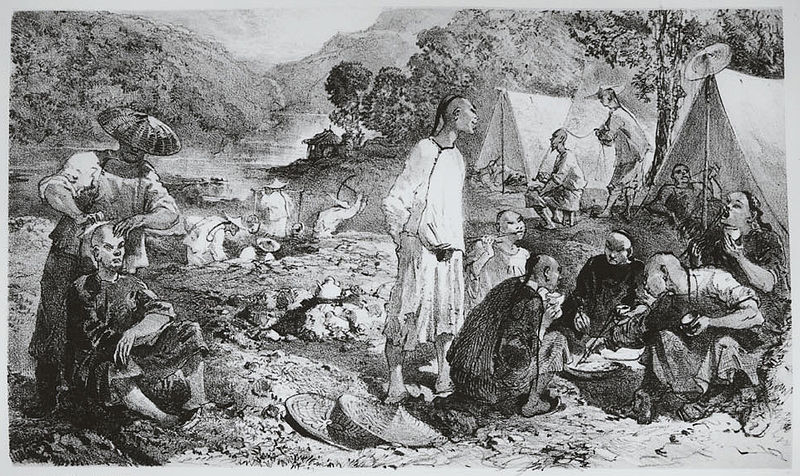
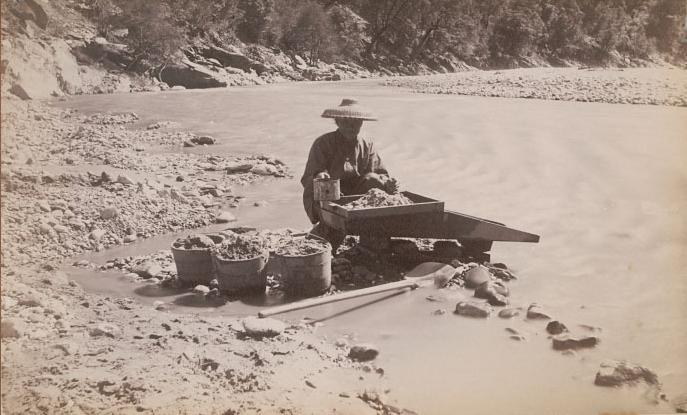
In the mines the Chinese were often forced to work sites that others had abandoned as no longer productive and, by hard work, made these claims pay.

As more men arrived in the gold fields and the amount of surface gold dwindled, tensions increased. Thirty-five Chinese showed up at Camp Salvado in 1849 where men from El Salvador had worked and here they found rich placer deposits.

White miners soon arrived and pushed the Chinese out, but they were taken in at another nearby site called Camp Washington where still more gold was found

Chinese flocked to a place where they were accepted and Tuolumne County’s Chinese Camp survives to this day.

But by 1850, a $20 per month tax on each foreign miner was imposed.

By 1852 Chinese were forced from Mormon Island and Horseshoe Bar along the American River, then from Colombia in the southern mines and Yuba City in the northern.

In 1856 Chinese paid $70,000 for the right to mine in Mokelumne Hill.

By 1868 almost all Chinese had left the mines to work on the transcontinental railroad or in Chinese operated businesses.

Return to Chinese in the Gold Rush – Part 1

____________________

Reprinted by permission. First published May 23, 2011 in My gold rush tales John Putnam is the author of Hangtown Creek, a thrilling saga of the early California gold rush.

To subscribe to “iLook China”, look for the “Subscribe” button at the top of the screen in the menu bar, click on it then follow directions.