Closed Minds and Culturally Blind Missionary Zeal

June 21, 2011

Recently, my wife bought me a copy of Henry Kissinger On China. She said if you read anyone that is not Chinese writing about China, Henry Kissinger is the only Westerner to trust.  The reason, she explained, was that the leaders of China trust and respect few in the West.

However, Kissinger is the exception, and from what I’ve discovered since 1999, I don’t blame most Chinese or China’s leaders.

I haven’t read that far into the book but Kissinger’s Preface has a revealing quote in it.

Kissinger said, “American exceptionalism is missionary. It holds that the United States has an obligation to spread its values to every part of the world. China’s exceptionalism is cultural. China does not proselytize; it does not claim that its contemporary institutions are relevant outside China.”

What Kissinger didn’t say, which I may discover later as I read further into the book, is that America is spreading more than its spiritual, ethical, and moral values but is also importing its middle class unsustainable, consumer, debt-ridden, fast food, disease ridden lifestyle, which is more popular outside America than US cultural values.

The Economist for May 21, 2011 reviewed Kissinger’s book and said, “The Western politician who understands China best tries to explain it–but doesn’t quite succeed.”

In fact, it isn’t easy to overcome the Western prejudices that refuse to accept that people from other cultures are different from America and the West, which may be one reason why The Economist is so cynical and critical of almost everything they write about that does not fit their British cultural bias.

Another example is when a friend and expatriate living in China sent me a link to a Site called The Middle Kingdom Life written by a person that lived and taught at universities in China for seven years then left feeling bitter and disappointed, because China didn’t measure up to what he felt it should be, which is a reaction that has a lot to do with that American obligation to spread its values to every part of the world (even when other countries and cultures are not interested in those American and/or Western values).

Then another Blog I follow (but hold little respect for) sent me a notice that someone had left a similar comment.

That other Blog is called Understanding China, One Blog at a Time (should be “One Post” at a Time).

One Blog at a Time doesn’t understand China or the Chinese and is another emotional, biased rant criticizing China for not being a mirror image of American culture and does not take into account that China is a different culture with a different history and is still a developing third-world country with a large segment of its population that, until a few years ago (as early at the 1980s), lived as people had for centuries with a medieval lifestyle—meaning no electricity, no running water, no schools, no toilets, no sewers, or paved roads, etc.

It seems that little has changed from the 19th century when Robert Hart was the same as Kissinger is today to the Chinese except that today China stands on its own feet and is powerful enough militarily not to be bullied to cave in to Western demands to change the Chinese culture due to that American (and Western) obligation to spread its values to every part of the world, which may explain why we are fighting Islamic fundamentalists that wants to destroy Western Civilization.

That same Western missionary zeal (from Europe) that drives America today destroyed the Aztecs and Incas, enslaved tens of millions of Africans, colonized North America leading to the American Indian Wars of the 19th century, started two Opium Wars in China, killed a quarter of a million in the Philippines, meddled with Japan’s culture leading to World War II in the Pacific and China where The Rape of Nanking  took place, invaded Vietnam where millions died, fought the Korean Conflict, and imported American values with nation building by invading Iraq and Afghanistan.

What’s next?

______________

Lloyd Lofthouse is the award-winning author of the concubine saga, My Splendid Concubine & Our Hart. When you love a Chinese woman, you marry her family and culture too.

To subscribe to “iLook China”, look for the “Subscribe” button at the top of the screen in the menu bar, click on it then follow directions.


The “Vanishing” Street Art of Chinese Calligraphy

June 19, 2011

Chinese calligraphy is not vanishing. What I’m talking about is demonstrated in the videos included with this post. In China, many artists use sidewalks as a canvas and a brush with water to paint the beauty of calligraphy. As the water evaporates, the art vanishes.

In fact, calligraphy is more popular than ever. After the Cultural Revolution, many people turned to calligraphy in the hope of finding solace in the calm repetition of its exercises. Then, in 1981, the authorities took the lead in setting up a Chinese Calligraphers’ Association, the first such nationwide body ever to be established in the country. Source: Fathom.com, The British Museum

Both a language and an art, Chinese calligraphy has been traced back more than 4,000 years to the crude form called “Jia Gu Wen” found on turtle shells from the Shang Dynasty.

Calligraphy first bloomed as an art during the Han Dynasty but by the time of the Tang Dynasty, it had declined as an art. Source: Chinese Calligraphy History

It would be difficult to talk about Chinese art without understanding Chinese calligraphy and its artistic inspiration. A painting has to convey an object, but a well-written character conveys only its beauty through line and structure.

In Shanghai on sidewalks, or Beijing at The Summer Palace, I’ve watched men with long handled brushes, as seen in the first video, using water for ink and concrete for paper. With grace, they exhibit the skills of a Rembrandt breathing life into the characters.

America’s so called street artists should copy the Chinese that practice calligraphy and trade in their cans of spray paint for brushes and water, which would save US taxpayers much money.

Lin Yutang writes in My Country and My People that Western art is more sensual, more passionate, fuller of the artist’s ego, while the Chinese artist and art-lover contemplates a dragonfly, a frog, a grasshopper or a piece of jagged rock—more in harmony with nature.

Owing to the use of writing calligraphy with a brush, which is more subtle and more responsive than the pen, calligraphy as art is equal to Chinese painting.

Through calligraphy, the scholar is trained to appreciate, as regards line, qualities like force, suppleness, reserved strength, exquisite tenderness, swiftness, neatness, massiveness, ruggedness, and restraint or freedom.

Maybe this helps explain why the Chinese are not as warlike as Christian and Islamic cultures.

This revised and edited post first appeared on July 3, 2010 as Caressing Nature with Chinese Calligraphy

______________

Lloyd Lofthouse is the award-winning author of the concubine saga, My Splendid Concubine & Our Hart. When you love a Chinese woman, you marry her family and culture too.

To subscribe to “iLook China”, look for the “Subscribe” button at the top of the screen in the menu bar, click on it then follow directions.


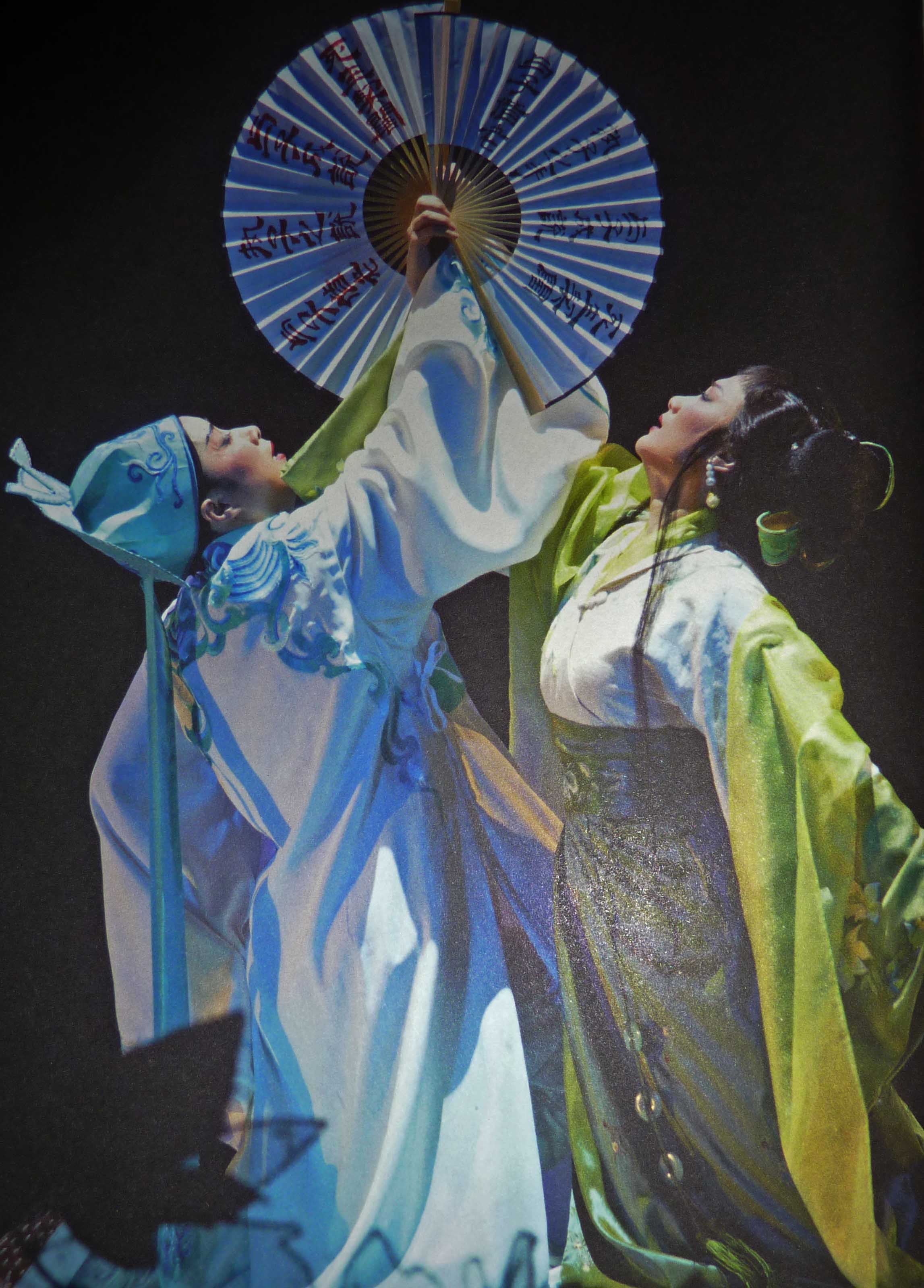
Chinese Opera and Mao Wei Tao, China’s Living Treasure

June 18, 2011

Mao Wei Tao is considered a living treasure in China. She imitates men in the opera roles she plays—a reversal from Imperial China when women were not allowed on stage so men played female roles.

“In 1923, the training of female actors for this art form was set up. Since 1928, the Shaoxing opera troupes, consisting of solely female actors, began their performances in Shanghai. In a few years, females impersonating males had become the most important feature of this opera form, and at the same time the Yue opera became well known all over China.”

East China’s Zhejiang province gave China Shaoxing Opera’s Mao Wei Tao.

In her thirty-year career on the stage, she’s best known as an outstanding male impersonator with a cult following of women.

I was introduced to Yue Opera in Hangzhou, Zhejiang Province about a decade ago.

Mao Wei Tao and her husband have a theater company near the shores of the famous Westlake. My wife translated while I watched the live-opera performance in fascination.

The costumes were lavish and the acting and opera was dramatic while classical Chinese music played in the background.

The challenge today is to keep this form of Chinese opera alive. The audience for opera is shrinking dramatically in China while remaining popular with the older generation.

Television, movies and the Internet are claiming the shorter attention spans of younger Chinese

Mao Wei Tao, considered an innovative genius on stage, adapts and works to keep the art form alive. According to her husband, no two performances are exactly alike.

In November 2010, she performed in Taiwan as a cultural ambassador from the mainland.

This revised and edited post first appeared on March 14, 2010 as Mao Weitao and Yue Opera

______________

Lloyd Lofthouse is the award-winning author of the concubine saga, My Splendid Concubine & Our Hart. When you love a Chinese woman, you marry her family and culture too.


To subscribe to “iLook China”, look for the “Subscribe” button at the top of the screen in the menu bar, click on it then follow directions.


A Brief History of Parenting – Part 3/3

June 13, 2011

As you may have learned in Part One and Two, Old-World parenting was an improvement over the way children grew up before the 18th century and the Chinese may have learned this parenting method from the invading Western nations after The Opium Wars.

However, parenting methods developed further and by the 1960s, according to research, the best method of parenting is not Authoritarian but Authoritative, which is characterized by moderate demands with moderate responsiveness.

The authoritative parent is firm but not rigid, willing to make an exception when the situation warrants. The authoritative parent is responsive to the child’s needs but not indulgent. Baumrind makes it clear that she favors the authoritative style.

The worst parenting style represents what studies show are the “average” child and parent in the United States today.  These parents are Permissive, Uninvolved or a combination of both.

Since the “average” parent in the US today talks to his or her child less than five minutes a day and the “average” child spends more than 10 hours a day dividing his or her time between watching TV, playing video games, listening to music, social networking on sites such as Facebook, or sending hundreds of text messages monthly, it is obvious what the results are. Source: Media Literacy Clearinghouse

Since the Permissive and/or Uninvolved parent has few requirements for mature behavior, children may lack skills in social settings. While they may be good at interpersonal communication, they lack other important skills such as sharing. The child may also fear becoming dependent on other people, are often emotionally withdrawn, tend to exhibit more delinquency during adolescence, feels fear and anxiety or stress due to lack of family support and had an increased risk of substance abuse.

Return to A Brief History of Parenting – Part 2 or start with Part One.

______________

Lloyd Lofthouse is the award-winning author of “The Concubine Saga”, My Splendid Concubine & Our Hart. When you love a Chinese woman, you marry her family and culture too.

To subscribe to “iLook China”, look for the “Subscribe” button at the top of the screen in the menu bar, click on it then follow directions.


A Brief History of Parenting – Part 2/3

June 12, 2011

Amy Chua’s so-called Chinese parenting style, identified as mostly Authoritarian, is the “CLASSIC” no nonsense do as I say, not as I do parenting style that first developed during Victorian England in the 18th century. The other parenting methods did not materialize until the 20th century, so how Amy Chua raised her two daughters had been in practice for more than two centuries.

Amy Chua says, “I believed that raising my two daughters the same way my Chinese immigrant parents raised me was the right way and that I had nothing to learn from the laxer parenting I saw all around me.” Source: USA Today

Positive Parenting Ally.com (PPA) says, “I think we can see the early seeds of the authoritarian parenting style in the 18th century. At that point in time, parents in the Western world (particularly the British) began taking the first steps toward a mind shift and become more involved in their children’s upbringing.”

PPA also says, “The mind of an authoritarian parent likes order, neatness, routine and predictability.… Children of authoritarian parents tend to do well in school and are said to generally not engage in drinking or drug use. They know the consensus rules and follow them.”

Instead of calling this method of parenting authoritarian or Chinese, I’ve used the term Old-World, which fits and is an acceptable choice of parenting

Authoritarian parenting was a vast improvement over how children had been raised (or not raised) before the 18th century. Prior to the authoritarian parent, children were mostly treated as adults and faced severe punishments such as mutilation, slavery, servitude, torture, and death. In fact, the US has a long history of treating children this way. Source: Child Labor in U.S. History

It was in the 18th century that Western parents stopped seeing their child as a potential representation of dark and evil forces that had to be kept in check physically (harsh beatings etc.) and instead attempted controlling their minds, their feelings, and their needs.

Continued on June 13, 2011 in A Brief History of Parenting – Part 3 or return to Part One

______________

Lloyd Lofthouse is the award-winning author of “The Concubine Saga”, My Splendid Concubine & Our Hart. When you love a Chinese woman, you marry her family and culture too.

To subscribe to “iLook China”, look for the “Subscribe” button at the top of the screen in the menu bar, click on it then follow directions.