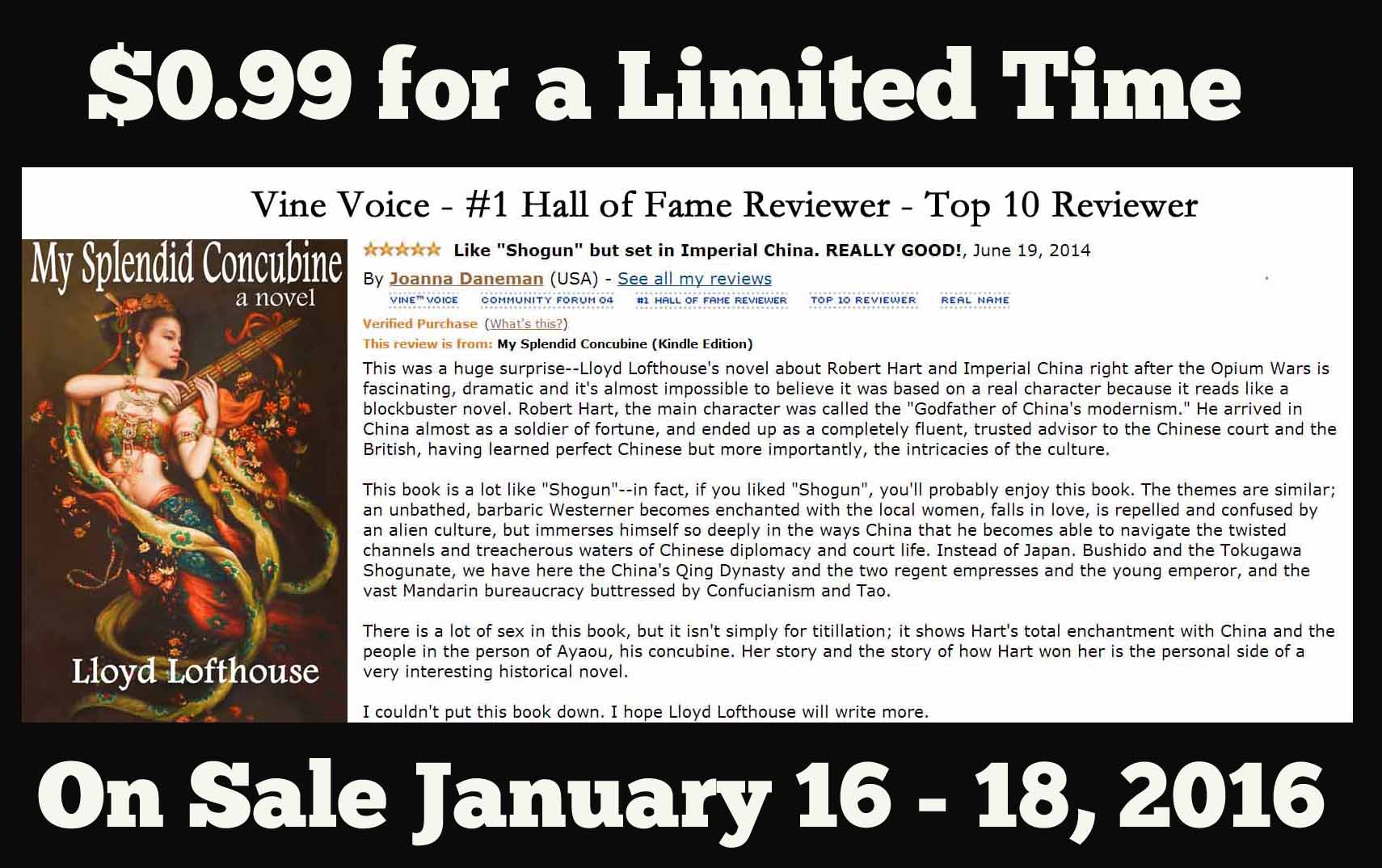
“My Splendid Concubine” is based on a true story. A larger-than-life bronze statue of Robert Hart, ordered by the Emperor of China, was placed on the Bund in Shanghai, China to honor this Irishman, and it stood for several decades before the Japanese removed it during World War II and turned the metal into bullets. It took almost a decade to research and write this novel.
Lloyd Lofthouse is the award-winning author of My Splendid Concubine [3rd edition]. When you love a Chinese woman, you marry her family and culture too. This is the unique love story Sir Robert Hart did not want the world to discover.
Subscribe to “iLook China”!
Sign up for an E-mail Subscription at the top of this page, or click on the “Following” tab in the WordPress toolbar at the top of the screen.
This post at History World.org explains The Spread of Chinese Civilization to Japan.
“Although its full impact on global history has not been felt until the last century or so, the transmission of key elements in Chinese culture to the offshore islands that came to make up Japan clearly provides one of the most important examples of the spread of civilization from a central core area to neighboring or overseas peoples. In the 1st centuries A.D., the peoples of Japan imported a wide range of ideas, techniques of production, institutional models, and material objects from the Chinese mainland. After adapting these imports to make them compatible with the quite sophisticated culture they had previously developed, the Japanese used what they had borrowed from China to build a civilization of their own.”
Japan, the Philippines, Vietnam, Singapore, Korea, India, Malaysia, Bangladesh, Indonesia, Afghanistan, and Pakistan are also collective cultures like China is. You can see the complete list here:Collectivist and individualist cultures
For instance, Japan’s written language, ancient architecture and religions originated in and/or spread from China.
For Thailand, the CIA Fact book lists 14% of Thai people are of Chinese origin. They don’t have Chinese surnames anymore because in the 1920s, the Thai king issued a royal decree to erase their last names. Thailand was going through sort of an ethnic cleansing at the time and I recall reading that they also made it illegal for Chinese to own businesses, but that didn’t last long because the Chinese owned so many businesses and banks that business came to a stop when they were forced to close their doors. In addition, through the centuries, significant intermixing has taken place such that there are few pure ethnic Chinese anymore, and those of partially mixed Chinese ancestry account for as much as a third to a half of the Thai population.
In Burma, known today as Myanmar, it is estimated that Burmese Chinese form about 3% of the population.
Chinese Filipinos are one of the largest overseas Chinese communities in Southeast Asia. Sangleys—Filipinos with at least some Chinese ancestry—comprise 27-35% of the Philippine population totaling up to 30 million people. There are approximately 2 million Filipinos with pure Chinese ancestry, or around 2.5% of the population.
Singapore is a multiracial and multicultural country with a majority population of Chinese (75.9% of the resident population).
Vietnam was ruled by China for more than a 1,000 years (111 BC – 1427 AD) before the Vietnamese finally succeeded in driving them out after a 1,000 years of rebellion to regain their homeland, and that had an impact on Vietnamese culture.
In fact, before the Chinese actually colonized Vietnam by force, groups from southern China began to move into the Tonkin Delta in order to start new lives after being forced to leave their homelands. Thus, around the 3rd century BC, changes in China began to heavily influence the Đông Sơn culture which was thriving in Vietnam. Ten centuries of Chinese colonization left a substantial demographic footprint, with settlement by large numbers of ethnic Chinese
In conclusion, what happens when civilizations influenced by individualism attempt to influence and/or control collectivist cultures?
Lloyd Lofthouse is the award-winning author of My Splendid Concubine [3rd edition]. When you love a Chinese woman, you marry her family and culture too. This is the lusty love story Sir Robert Hart did not want the world to discover.
Subscribe to “iLook China”!
Sign up for an E-mail Subscription at the top of this page, or click on the “Following” tab in the WordPress toolbar at the top of the screen.
In the West, and the United States in particular, few know that China was the wealthiest—and after the Roman Empire fell—the most powerful and technologically advanced civilization in the world for about 1,000 years until the 15th and 16th centuries and the rise of the Western colonial empires: the British, French, German, Italian, Netherlands, Portugal, Belgium, Spain, Russia, and, yes, the United States.
In fact, Global Research.ca reports “The study of world power has been blighted by Eurocentric historians who have distorted and ignored the dominant role China played in the world economy between 1100 and 1800. … As early as 1078, China was the world’s major producer of steel (125,000 tons); whereas Britain in 1788 produced 76,000 tons.
“China was the world’s leader in technical innovations in textile manufacturing, seven centuries before Britain’s 18th century ‘textile revolution’.
“China was the leading trading nation, with long distance trade reaching most of Southern Asia, Africa, the Middle East and Europe. China’s ‘agricultural revolution’ and productivity surpassed the West down to the 18th century.
“Its innovations in the production of paper, book printing, firearms and tools led to a manufacturing superpower whose goods were transported throughout the world by the most advanced navigational system.
“China possessed the world’s largest commercial ships. In 1588 the largest English ships displaced 400 tons, China’s 3,000 tons. Even as late as the end of the 18th century China’s merchants employed 130,000 private transport ships, several times that of Britain. China retained this pre-eminent position in the world economy up until the early 19th century.
“British and Europeans manufacturers followed China’s lead, assimilating and borrowing its more advanced technology and were eager to penetrate China’s advanced and lucrative market.
“Banking, a stable paper money economy, manufacturing and high yields in agriculture resulted in China’s per capita income matching that of Great Britain as late as 1750.
“China’s dominant global position was challenged by the rise of British imperialism, which had adopted the advanced technological, navigational and market innovations of China and other Asian countries in order to bypass earlier stages in becoming a world power.”
It is safe to say that the concept of ‘face’ is similar throughout most of Asia. China was a regional super power for more than 1,500 years starting before the Han Dynasty in 206 BC to the Qing Dynasty’s collapse in 1911 AD. In addition, Chinese merchants sailed to and traded with most if not all of the nations in Asia during that period and Chinese merchants and business people migrated to many of those areas spreading the influence of a collective culture—Europe and North America, for instance, are individualist cultures.
Lloyd Lofthouse is the award-winning author of My Splendid Concubine [3rd edition]. When you love a Chinese woman, you marry her family and culture too. This is the lusty love story Sir Robert Hart did not want the world to discover.
Subscribe to “iLook China”!
Sign up for an E-mail Subscription at the top of this page, or click on the “Following” tab in the WordPress toolbar at the top of the screen.
In the United States, if a public school were to attempt teaching young, deaf and/or disabled students in the art of an intricate dance and required them to drill repeatedly as if they were in the Marine Corps, humanitarians and feminists—due to the attractive young women—would cry foul and soon there would be pressure to cancel it, make it illegal, or hold investigations. There might even be boycotts and protests.
As for autocratic corporate Charter schools that are stealing money from the community-based, democratic public schools in the United States, forget it. Corporations are in it for the higher test scores so they can brag and hijack more children from the public schools to boost profits.
In addition, critics of China infected with the Racist Sinophobia Virus (RSV), a mental illness learned while growing up, might chime in to crucify the Middle Kingdom once again for crimes against humanity reminding us—with more lies and exaggerations—of Tibet, censorship, and more.
But when it was established in 1987, the China Disabled People’s Art Troupe (CDPAT) was an amateur performance troupe supported by the government with members recruited from around the country.
In 2002, that all changed, after the troupe’s first commercial performance. The China Daily reported, “After its first commercial performance, in 2004, the troupe made 10 million yuan (US$1.21 million).”
Tai Lihua, the lead dancer and captain of the CDPAT, has visited many countries with her troupe. For instance, they have performed at the John F. Kennedy Centre in New York City and the Teatro alla Scala in Venice, two of the world’s most prestigious theatres.
The dance of the Thousand-Hand Guan Yin is named after the Bodhisattva of compassion, revered by Buddhists as the Goddess of Mercy, who is a compassionate being that watches for and responds to the people in the world who cry out for help such as the deaf and disabled members of the CDPAT.
Being deaf and mute, these disabled performers endured pain and suffering in vigorous training simply to deliver a message of love, and when you watch the embedded videos and see close ups of the performers’ faces, you will see their dedication.
When I first watched this video, I was reminded of Amy Chua, the Tiger Mother, and how she relentlessly drilled her daughters in piano and violin. US critics raged at this after Chua’s memoir Battle Hymn of the Tiger Mother was published. However, the oldest daughter, Sophia, went to Harvard and enjoys playing the piano.
Often, the rewards of enduring the pain and suffering it takes to achieve near perfection in an art such as playing piano or learning intricate dances comes only after years of challenging and demanding repetition.
What’s amazing about this dance troupe is that all the performers are deaf, making the choreography to the music even more incredible, and the difficulties encountered in training are beyond imagining.
However, four instructors, who can hear and speak, signal the rhythm of the music from four corners of the stage/room, and with repetition and diligent practice, the performance is nearly flawless.
______________________________
Lloyd Lofthouse is the award-winning author of My Splendid Concubine [3rd edition]. When you love a Chinese woman, you marry her family and culture too. This is the lusty love story Sir Robert Hart did not want the world to discover.
Subscribe to “iLook China”!
Sign up for an E-mail Subscription at the top of this page, or click on the “Following” tab in the WordPress toolbar at the top of the screen.
The earliest recorded festivities in honor of a new year’s arrival date back some 4,000 years to ancient Babylon. For the Babylonians, the first new moon following the vernal equinox—a day in late March with an equal amount of sunlight and darkness—heralded the start of a new year.
If the first recorded New Year’s celebration was in March, how did it move to January 1st? The answer may be found at History.com where we discover that Emperor Julius Cesar introduced the Julian calendar, which closely resembles the more modern Gregorian calendar that most countries use today, and Cesar made January 1st the first day of the year, partly to honor the month’s namesake, Janus, the Roman god of beginnings.
Therefore, if you celebrate the New Year on January 1st, you are celebrating a pagan holiday. But all is not lost. Later, after the fall of the Roman Empire, Christian leaders in medieval Europe during the Dark Ages replaced January 1st as the first day of the year with days carrying more religious significance such as December 25, the anniversary of Jesus’s birth—until Pope Gregory XIII (Born 1502 – Died 1585) reestablished January 1st as New Year’s Day in 1582.
Countries that do NOT celebrate the New Year on the first of January
For China, the first day of the New Year falls between January 21 and February 20. The Chinese New Year is celebrated at the turn of the Chinese calendar, also known as the Spring Festival.
The Chinese New Year gained significance because of several myths and traditions. History.com says, “The ancient Chinese calendar, on which the Chinese New Year is based, functioned as a religious, dynastic and social guide. Oracle bones inscribed with astronomical records indicate that it existed as early as the 14th century BC, when the Shang Dynasty was in power.”
Traditionally, the festival was a time to honor deities (gods) as well as ancestors. The Chinese New Year is celebrated in countries and territories that have significant Chinese populations, including Mainland China, Hong Kong, Macau, Taiwan, Singapore, Thailand, Cambodia, Indonesia, Malaysia, Mauritius, and the Philippines.
In 2015, China witnessed 261 million people on the move to celebrate the Lunar New Year holiday, and they traveled by road, rail and air—all over a short period of time. The Chinese Lunar New Year for 2016 takes place on Monday, February 8, and it is a national holiday that runs from February 7 – 13.
When we visited China in 2008 during this holiday, the Lunar New Year on February 7, the Year of the Rat, and 2016 will be the Year of the Monkey. Each year is related to an animal sign according to a 12-year-cycle. Years of the Monkey include 1920, 1932, 1944, 1956, 1968, 1980, 1992, 2004, 2016, and 2028.
Back during the Year of the Rat in 2008, my sister and her youngest daughter traveled with us as we toured China—and both are evangelical Christians who did not agree with China’s one-child policy. I heard this more than once but after they arrived in China and experienced that migration, they both stopped preaching about why the one-child policy was wrong.
At times, it was so crowded that it felt as if we were swimming upriver through an ocean of people minus the water—just people packed tight like sardines in a can.
That’s when I decided that my next trip to China will not be during any of China’s national holidays—especially the Lunar New Year.
For readers who haven’t been to China, this may be your only chance to experience a taste of what it is like to live in a country with more than 1.3 billion people. By the way, 261 million people are more than 82% of the population of the United States. Imagine the gridlock if that many Americans took to the roads and air all at once.
In China, it is so crowded on trains and busses during this holiday, that it’s possible for a passenger to end up standing for a trip that might take 16 to 48 hours.
For the United States in 2014, the Automobile Club reported that 98.6 million Americans traveled during the Christmas to New Year holiday season, a four percent increase over 2013.
2014 Lunar New Year in Beijing, China
Sounds like a War!
In 9th century China during the Tang Dynasty, Chinese alchemists, searching for the elixir of immortality, because the emperor wanted to live forever, accidently created gunpowder instead and then the invention of fireworks followed in the 10th century.
______________________________
Lloyd Lofthouse is the award-winning author of My Splendid Concubine [3rd edition]. When you love a Chinese woman, you marry her family and culture too. This is the lusty love story Sir Robert Hart did not want the world to discover.
Subscribe to “iLook China”!
Sign up for an E-mail Subscription at the top of this page, or click on the “Following” tab in the WordPress toolbar at the top of the screen.



 Posted by Lloyd Lofthouse

 iLook China