Celebrating the New Year but not always on the same Day or Month

December 30, 2015

The earliest recorded festivities in honor of a new year’s arrival date back some 4,000 years to ancient Babylon. For the Babylonians, the first new moon following the vernal equinox—a day in late March with an equal amount of sunlight and darkness—heralded the start of a new year.

If the first recorded New Year’s celebration was in March, how did it move to January 1st? The answer may be found at History.com where we discover that Emperor Julius Cesar introduced the Julian calendar, which closely resembles the more modern Gregorian calendar that most countries use today, and Cesar made January 1st the first day of the year, partly to honor the month’s namesake, Janus, the Roman god of beginnings.

Therefore, if you celebrate the New Year on January 1st, you are celebrating a pagan holiday. But all is not lost. Later, after the fall of the Roman Empire, Christian leaders in medieval Europe during the Dark Ages replaced January 1st as the first day of the year with days carrying more religious significance such as December 25, the anniversary of Jesus’s birth—until Pope Gregory XIII (Born 1502 – Died 1585) reestablished January 1st as New Year’s Day in 1582.


Countries that do NOT celebrate the New Year on the first of January

For China, the first day of the New Year falls between January 21 and February 20.  The Chinese New Year is celebrated at the turn of the Chinese calendar, also known as the Spring Festival.

The Chinese New Year gained significance because of several myths and traditions. History.com says, “The ancient Chinese calendar, on which the Chinese New Year is based, functioned as a religious, dynastic and social guide. Oracle bones inscribed with astronomical records indicate that it existed as early as the 14th century BC, when the Shang Dynasty was in power.”

Traditionally, the festival was a time to honor deities (gods) as well as ancestors. The Chinese New Year is celebrated in countries and territories that have significant Chinese populations, including Mainland China, Hong Kong, Macau, Taiwan, Singapore, Thailand, Cambodia, Indonesia, Malaysia, Mauritius, and the Philippines.

In 2015, China witnessed 261 million people on the move to celebrate the Lunar New Year holiday, and they traveled by road, rail and air—all over a short period of time. The Chinese Lunar New Year for 2016 takes place on Monday, February 8, and it is a national holiday that runs from February 7 – 13.

When we visited China in 2008 during this holiday, the Lunar New Year on February 7, the Year of the Rat, and 2016 will be the Year of the Monkey. Each year is related to an animal sign according to a 12-year-cycle. Years of the Monkey include 1920, 1932, 1944, 1956, 1968, 1980, 1992, 2004, 2016, and 2028.

Back during the Year of the Rat in 2008, my sister and her youngest daughter traveled with us as we toured China—and both are evangelical Christians who did not agree with China’s one-child policy. I heard this more than once but after they arrived in China and experienced that migration, they both stopped preaching about why the one-child policy was wrong.

At times, it was so crowded that it felt as if we were swimming upriver through an ocean of people minus the water—just people packed tight like sardines in a can.

That’s when I decided that my next trip to China will not be during any of China’s national holidays—especially the Lunar New Year.

For readers who haven’t been to China, this may be your only chance to experience a taste of what it is like to live in a country with more than 1.3 billion people. By the way, 261 million people are more than 82% of the population of the United States. Imagine the gridlock if that many Americans took to the roads and air all at once.

In China, it is so crowded on trains and busses during this holiday, that it’s possible for a passenger to end up standing for a trip that might take 16 to 48 hours.

For the United States in 2014, the Automobile Club reported that 98.6 million Americans traveled during the Christmas to New Year holiday season, a four percent increase over 2013.

 
2014 Lunar New Year in Beijing, China


Sounds like a War!

In 9th century China during the Tang Dynasty, Chinese alchemists, searching for the elixir of immortality, because the emperor wanted to live forever, accidently created gunpowder instead and then the invention of fireworks followed in the 10th century.

______________________________

Lloyd Lofthouse is the award-winning author of My Splendid Concubine [3rd edition]. When you love a Chinese woman, you marry her family and culture too. This is the lusty love story Sir Robert Hart did not want the world to discover.

#1 - Joanna Daneman review posted June 19 2014

Where to Buy

Subscribe to “iLook China”!
Sign up for an E-mail Subscription at the top of this page, or click on the “Following” tab in the WordPress toolbar at the top of the screen.

About iLook China

China’s Holistic Historical Timeline


What does it mean to Eat Bitterness and be Asian in the United States?

December 8, 2015

On April 25, 2011, Nadra Kareem Nittle wrote, Are U.S. Universities Discriminating Against Asian Students? The answer to Nittle’s question was and still is YES.

In the US, since the Civil Rights era preferential treatment favored African-Americans and Latinos since Asian-Americans tend to swallow their bitterness instead of protesting violently as the other minorities have done.

For example, the NAACP says it fights for social justice for all Americans. However, facts demonstrate that the NAACP tends to favor legislation that focuses on benefits for African Americans. If this were not true, there would be no need for political organizations to serve Latinos and Asian-Americans.

In fact, Africana Online said, “The National Association for the Advancement of Colored People (NAACP) has been instrumental in improving the legal, educational, and economic lives of African Americans.” There was no mention of the other minorities that suffer from racism in the U.S.

However, Latino Political Clout is growing in the U.S. to challenge the NAACP’s clout. The recent US Census indicated Latinos continue to become a larger ratio of the American population. With growing numbers will come political and social changes to the country.

But we know that the number of votes a minority such as African-Americans, Latinos and Asian-Americans deliver during an election results in political influence, and it’s obvious that blacks are winning when it comes to clout because a higher ratio of blacks vote than whites, Latinos and Asians.

For instance, in 2012, a larger percentage of blacks—66% of eligible black voters—voted than whites (64.1%). In contrast, Latino voters tend to turn out in slightly lower ratios than blacks or whites. Asians, on the other hand, are not voting like they could. According to Pew Research.org, only three in ten Asian American eligible voters cast ballots in midterm elections.

As demonstrated, Asian American political organizations have a long way to go to catch up to African-American and Hispanic or Latino political influence.

Is this because Asian and Chinese Americans are crippled by the influence of their cultures when it comes to increasing political influence in the U.S. since Chinese parents teach their children to eat bitterness?

In China, the tradition to “eat bitter” has been passed down from generation to generation. “Eat bitter” is a literal translation of Chinese "吃苦", which refers to endure hardship including discrimination without complaint or protest.

The 2014 Census 2014 census revealed that minority influence is not equal since there are about 42.1 million African-Americans, 55.5 million Hispanic or Latino Americans and only 17.1 million Asian Americans, who turn out to vote in lower ratios. Numbers count and it helps that Latinos and African-Americans do not eat bitterness like most Asians do.

I think that the Asian cultural aspect of “eating bitterness” has been influenced by Taoism, Buddhism and Confucius while in the West the warlike and often-violent religions of Christianity and Islam did not follow the same path.

______________________________

Lloyd Lofthouse is the award-winning author of My Splendid Concubine [3rd edition]. When you love a Chinese woman, you marry her family and culture too. This is the lusty love story Sir Robert Hart did not want the world to discover.

IMAGE with Blurbs and Awards to use on Twitter

Where to Buy

Subscribe to “iLook China”!
Sign up for an E-mail Subscription at the top of this page, or click on the “Following” tab in the WordPress toolbar at the top of the screen.

About iLook China

China’s Holistic Historical Timeline


The Popular Street Art of Chinese Calligraphy

December 2, 2015

Chinese calligraphy is demonstrated in the videos included with this post. In China, many artists use sidewalks as a canvas and a brush with water to paint the beauty of calligraphy. As the water evaporates, the art vanishes.

In fact, calligraphy is more popular than ever. After the Cultural Revolution (1966 until 1976 when Mao died), many people turned to calligraphy in the hope of finding solace in the calm repetition of its exercises. Then, in 1981, the Chinese government took the lead in setting up a Chinese Calligraphers Association, the first such nationwide body ever to be established in the country.

Both a language and an art, Chinese calligraphy has been traced back more than 4,000 years to the crude form called “Jia Gu Wen” found on turtle shells from the Shang Dynasty.

Calligraphy first bloomed as an art during the Han Dynasty but by the time of the Tang Dynasty, it had declined as an art. > Chinese Calligraphy History

It would be difficult to talk about Chinese art without understanding Chinese calligraphy and its artistic inspiration. A painting has to convey an object, but a well-written character conveys only its beauty through line and structure.

In Shanghai on sidewalks, or Beijing at The Summer Palace, I’ve watched men with long handled brushes, as seen in the first video, using water for ink and concrete for paper. With grace, they exhibit the skills of a Rembrandt breathing life into the characters.

America’s so called street artists should copy the Chinese that practice calligraphy and trade in their cans of spray paint for brushes and water, which would save US taxpayers a lot of money.

Lin Yutang writes in My Country and My People that Western art is more sensual, more passionate, fuller of the artist’s ego, while the Chinese artist and art-lover contemplates a dragonfly, a frog, a grasshopper or a piece of jagged rock—more in harmony with nature.

Owing to the use of writing calligraphy with a brush, which is more subtle and more responsive than the pen, calligraphy as art is equal to Chinese painting.

Through calligraphy, the scholar is trained to appreciate, as regards line, qualities like force, suppleness, reserved strength, exquisite tenderness, swiftness, neatness, massiveness, ruggedness, and restraint or freedom.

Maybe this helps explain why the Chinese are not as warlike as Christian and Islamic cultures.

______________________________

Lloyd Lofthouse is the award-winning author of My Splendid Concubine [3rd edition]. When you love a Chinese woman, you marry her family and culture too. This is the lusty love story Sir Robert Hart did not want the world to discover.

#1 - Joanna Daneman review posted June 19 2014

Where to Buy

Subscribe to “iLook China”!
Sign up for an E-mail Subscription at the top of this page, or click on the “Following” tab in the WordPress toolbar at the top of the screen.

About iLook China

China’s Holistic Historical Timeline


California’s Chinese during the Gold Rush: Part 2 of 2

November 25, 2015

Guest post by John Putnam

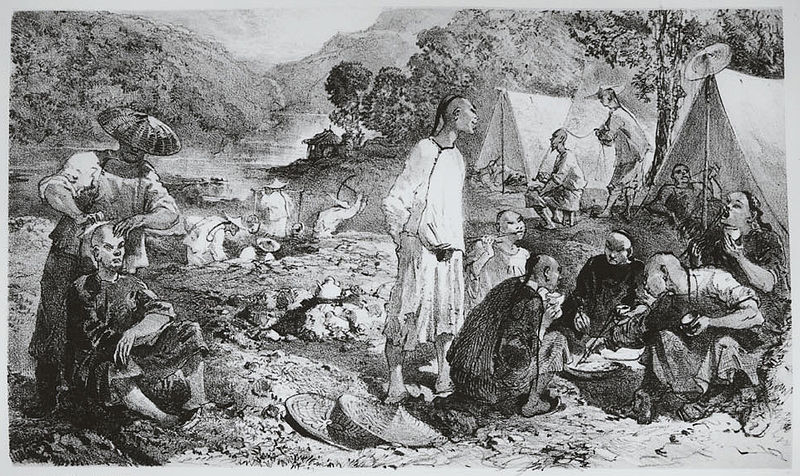
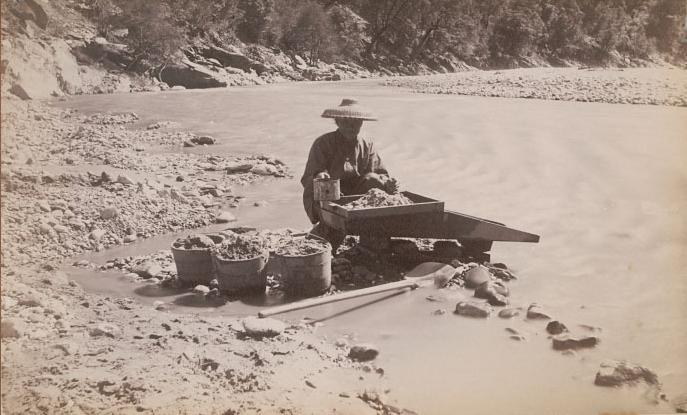
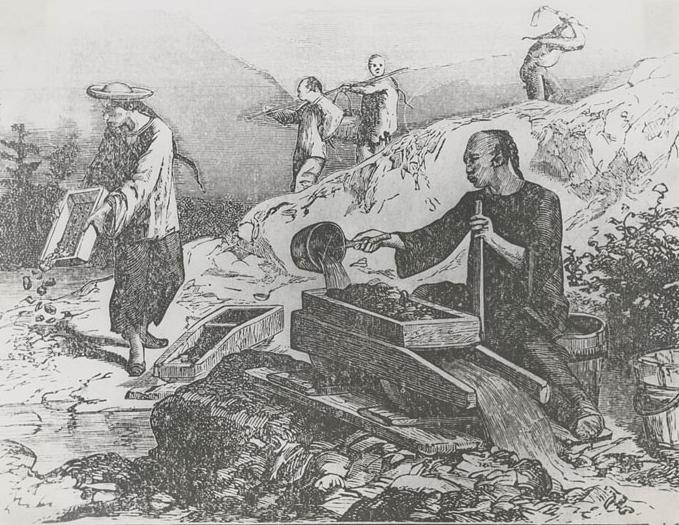
In the mines the Chinese were often forced to work sites that others had abandoned as no longer productive and, by hard work, made these claims pay.

As more men arrived in the gold fields and the amount of surface gold dwindled, tensions increased. Thirty-five Chinese showed up at Camp Salvado in 1849 where men from El Salvador had worked and here they found rich placer deposits.

White miners soon arrived and pushed the Chinese out, but they were taken in at another nearby site called Camp Washington where still more gold was found

Chinese flocked to a place where they were accepted and Tuolumne County’s Chinese Camp survives to this day.

But by 1850, a $20 per month tax on each foreign miner was imposed.

By 1852 Chinese were forced from Mormon Island and Horseshoe Bar along the American River, then from Colombia in the southern mines and Yuba City in the northern.

In 1856 Chinese paid $70,000 for the right to mine in Mokelumne Hill.

By 1868 almost all Chinese had left the mines to work on the transcontinental railroad or in Chinese operated businesses.

Return to or start with  Part 1

____________________

Reprinted by permission.
First published May 23, 2011 in My gold rush tales.
John Rose Putnam is the author of four novels.

The River of Corn

Where to Buy

To subscribe to “iLook China”, look for the “Subscribe” button at the top of the screen in the menu bar, click on it then follow directions.


California’s Chinese during the Gold Rush: Part 1 of 2

November 24, 2015

Guest post by John Putnam

Of all the diverse peoples that poured into California after the discovery of gold, none stood out more than the Chinese. Radically different in dress, language and culture these new men were first welcomed because of their willingness to work hard for low wages at any task presented them.

John McDougall, the 2nd Governor of California, described them as “one of the most worthy of our newly adopted citizens.”

At the start of 1849 only 54 Chinese were in California. By1852 there were nearly 12,000 living here and only seven of them women. Because of turmoil in Canton another 20,000 would arrive that same year.

A community of Chinese Americans quickly grew in San Francisco. They marched in Fourth of July parades and rejoiced at California’s statehood, but celebrated their lunar new year in their traditional way.

In 1852 a Cantonese opera was performed at the American Theater and in 1854 a Chinese language newspaper began publishing.

The Kong Chow Association formed to help the new arrivals adapt to their new home. Then another, the Chew Yick, elected Norman As-sing, an English speaking owner of the Macao and Woosung Restaurant as their leader. Soon there were six associations called tongs that combined to form the Six Companies to better represent Chinese interest.

Continued on November 25, 2015 in Part 2

____________________

Reprinted by permission.
First published May 23, 2011 in My gold rush tales.
John Rose Putnam is the author of four novels.


The River of Corn

Where to Buy

To subscribe to “iLook China”, look for the “Subscribe” button at the top of the screen in the menu bar, click on it then follow directions.