The mainland Chinese have many choices to choose from when it comes to a democracy. They could copy the first democracy in Athens, but the Athenian democracy had slavery and women couldn’t vote. In the 4th and 5th century BC, all male citizens (about 40,000 to 60,000) in Athens had equal political rights, freedom of speech, and the opportunity to participle directly in the political arena, but women, slaves (as many as 80,000) and foreign residents were excluded. – Athenian Democracy: a brief overview
What about the United States at its birth as a republic? Well, only white men who owned property and were not Jews were allowed to vote. That was about 10 percent of the population, and in 1790 there were 697,897 slaves in America. – Slave Population of United States: 1790 – 1860
Around that time, the U.S. resident population in 1790 was about 3.9 million. If we subtract the slaves, that leaves 3.2 million meaning that about 300,000 men were allowed to vote.
There are 192 countries in the world and only 123 (or 64 percent) are considered democracies, but China is often criticized the most for not being what is considered a democracy. Why aren’t the other 68 countries that are not democracies criticized: for instance, Saudi Arabia, Turkmenistan, Uzbekistan, Tajikistan, Bahrain, Oman, Jordan, the United Arab Emirates, Equatorial Guinea, Chad, Uganda, Rwanda, Thailand, Vietnam, Brunei, Singapore, Kazakhstan, and Azerbaijan – maybe it is because these authoritarian regimes are all supported by the United States but mainland China isn’t?
However, China might already be a democratic republic, because few if any outside of China considers that the political structure of today’s China might be closer to Sun Yat-sen’s vision than the democracy we find in the United States. After all, Sun Yat-sen is considered the father of China’s republic by both Taiwan and Beijing. In fact, mainland China, ruled by the Chinese Communist Party (CCP), may offer the Chinese people more of a voice than the republic Sun Yat-sen was building before his death.
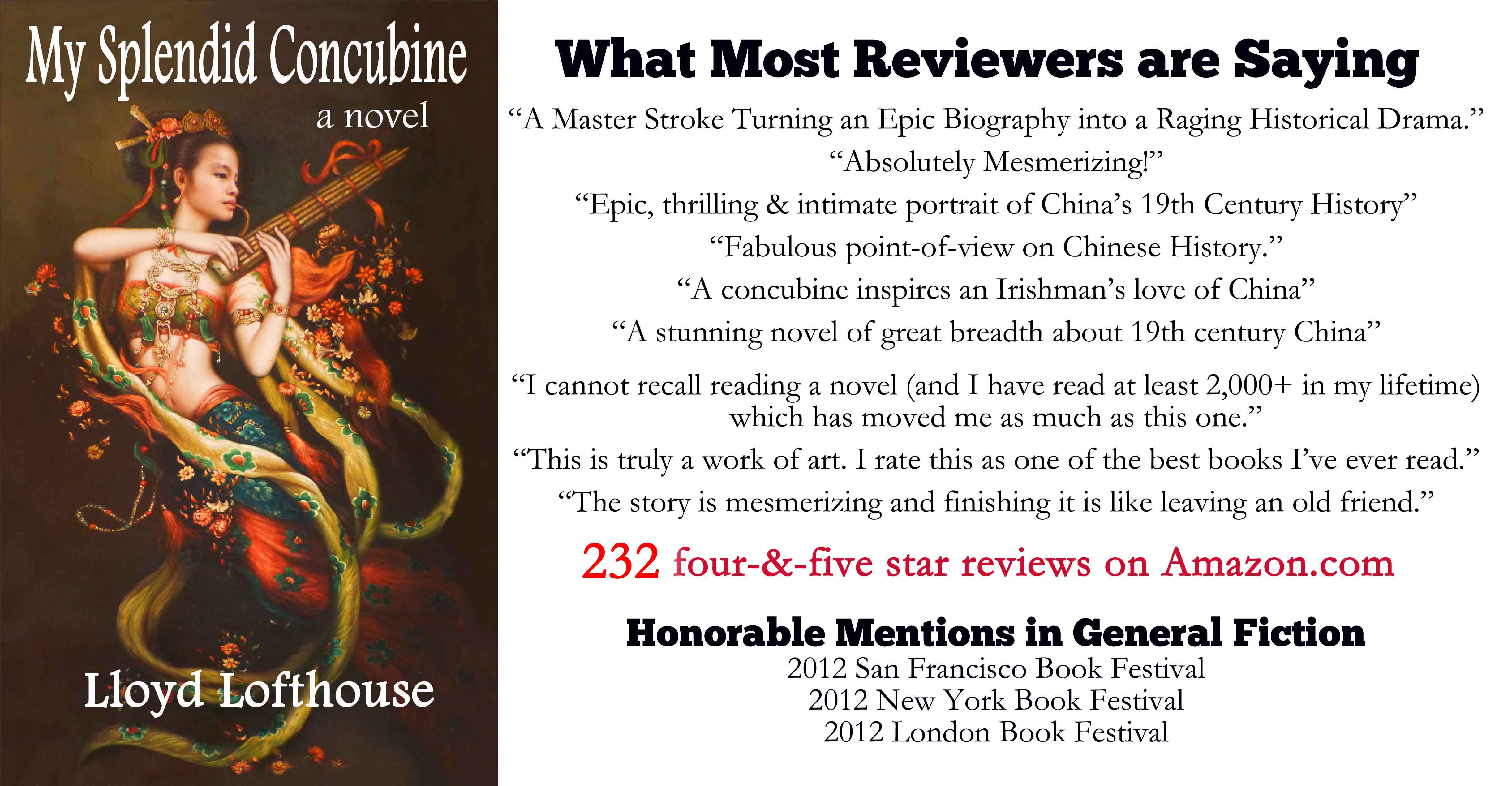
Lloyd Lofthouse is the award-winning author of My Splendid Concubine [3rd edition]. When you love a Chinese woman, you marry her family and culture too. This is the lusty love story Sir Robert Hart did not want the world to discover.
Subscribe to “iLook China”!
Sign up for an E-mail Subscription at the top of this page, or click on the “Following” tab in the WordPress toolbar at the top of the screen.
Mao born in 1893 grew up during a period of madness in China’s history. To learn more, I suggest reading The Roots of Madness.
The Chinese Civil War lasted from 1926 to 1949 with a few years out to fight the horrors of the Japanese invasion of China during World War II.
The horrors of Mao’s Long March by itself was enough to cause PTSD in all 6,000 of its survivors from the more than 80,000 troops that started the year-long journey of retreat, battle, and severe suffering that was threatened by death on a daily basis.
After Mao was China’s leader, there was an assassination attempt by one of his most trusted generals, Lin Biao, a man Mao had named as his successor after he died. In addition, during China’s Civil War, Chiang Kai-shek ordered more than one failed assassination attempt on Mao.
However, the threats and violence that shaped Mao’s life began before The Long March and before he was a leader in the Chinese Communist Party.
As a child, he grew up among farmers and peasants with an average expected life span in China of 35 years. In the 1920s, as an idealist and a sensitive poet, he believed in helping the worker and led several labor movements that were brutally subdued by the Nationalist government led by Chiang Kai-shek.
Once, Mao barely escaped with his life.
In 1930, Yang Kaihu, his wife at the time — Mao was married four times — was arrested and executed. In addition, Mao had two younger brothers and an adopted sister executed by Chiang Kai-shek’s troops.
If you had several close calls with death; lost a wife, two younger brothers and an adopted sister in this way, how would that affect you?
To judge Mao by today’s Politically Correct Western values is wrong, because he grew up in a world ruled by a completely different set of values that shaped him to be tough enough to survive.
Anyone that survived and went on to rule China at that time would have been judged as brutal by today’s Politically Correct Western values. In fact, Chiang Kai-shek was a brutal dictator who ruled Taiwan — after he fled mainland China in 1949 — under military marshal law until his death in 1976. But Chiang didn’t have as many people to rule over so the death count he caused was smaller but no less significant.
The History of Humanitarianism shows us that this concept was born and nurtured in the West and developed slowly over centuries with the result that the individual was made more important than the whole.
However, in China, the whole is still more important than one person as it was during Mao’s time. If you were to click on the link to the History of Humanitarianism and read it, you would discover that China was not part of this movement while Mao lived. (Discover more about China’s Collective Culture)
PTSD as a war wound and a trauma was not recognized or treated until well after America’s Vietnam War. Prior to its discovery, it was known as shell shock. The diagnosis of PTSD first appeared in the 1980s, and Mao died in 1976.
In fact, if Mao were alive today he would not be alone. In the United States, it is estimated that 7.8% of all Americans suffer from PTSD, and among that segment of the population, more than 300,000 Iraq and Afghanistan military veterans have PTSD in addition to 1.7 million Vietnam veterans.
Lloyd Lofthouse, a former U.S. Marine and Vietnam combat vet, is the award-winning author of My Splendid Concubine [3rd edition]. When you love a Chinese woman, you marry her family and culture too. This is the unique love story Sir Robert Hart did not want the world to discover.
Subscribe to “iLook China”!
Sign up for an E-mail Subscription at the top of this page, or click on the “Following” tab in the WordPress toolbar at the top of the screen.
Was Mao the monster that the Western media often makes him out to be, or was he just a product of his environment and life?
Mao has been judged by a Western value system that did not exist in China or the United States during his lifetime. In addition, it is now known that who we grow up to become as adults is partially due to genetics but mostly from environmental and lifestyle influences.
Mao grew up in a world nothing like most in the West have ever experienced. He was born into China’s collective culture where the individual was not more important than the whole.
There is a strong possibility that Mao also suffered from Post Traumatic Stress Disorder (PTSD), and this may have influenced his behavior and decisions during the years he ruled China [1949 – 1976].
Helping Psychology reports, “PTSD victims tend to be in a continuous state of heightened alertness. The trauma that precipitates the disorder essentially conditions them to be ever-ready for a life threatening situation to arise at any moment … But the continuous releases of brain chemicals that accompany this reaction time – and their inability to control when this heightened reactivity will occur – take psychological and biological tolls on PTSD victims over time.”
Then Medicine Net.com reports, “Complex posttraumatic stress disorder (C-PTSD) usually results from prolonged exposure to a traumatic event or series thereof and is characterized by long-lasting problems with many aspects of emotional and social functioning.”
American combat veterans are not the only people on this planet to suffer from PTSD. Every person is susceptible to the ravages of a violent trauma, and if we examine Mao’s life, it could be argued that PTSD played a strong role in the decisions he made as he aged.
We will examine Mao’s long history as a victim of violence in Part 2
Lloyd Lofthouse, a former U.S. Marine and Vietnam combat vet, is the best-selling, award-winning author of My Splendid Concubine [3rd edition]. When you love a Chinese woman, you marry her family and culture too. This is the unique love story Sir Robert Hart did not want the world to discover.
Subscribe to “iLook China”!
Sign up for an E-mail Subscription at the top of this page, or click on the “Following” tab in the WordPress toolbar at the top of the screen.
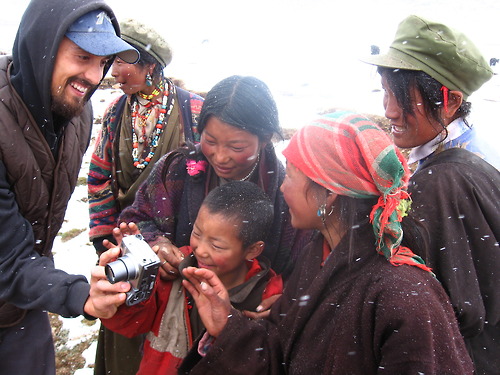
Photo by Eelco Florijn. The picture was taken in Kham, Tibet, at the Dongdola pass.
There have been expats in China since the first Jesuit missionaries started arriving in the 16th century. But what characterizes the hundreds of thousands of Westerners who call China home today? And what are the challenges and identity issues that they face?
Tom Carter, originally from San Francisco, has been living in China for a decade. He did a well received book of photography [China: Portrait of a People] based on trekking 35,000 miles through 33 provinces for two years. More recently he edited a collection of true stories from expat China called Unsavory Elements, which has generated both praise and controversy.
I sat down with him over lunch in Shanghai, and followed up with questions over email, to dig deeper.
Alec Ash [AA]: Why did you feel there was a need for a collection of stories and anecdotes by Westerners living in China? What is it about that experience that interests you?
Tom Carter [TC]: It was a project whose time had come. The past decade has seen an unprecedented number of new books and novels about China, but aside from a handful of mass-market memoirs there was nothing definitive about its expatriate culture. As an editor and avid reader, I had this grand vision of an epic collection of true short stories from a variety of voices that takes the reader on a long, turbulent arc through the entire lifetime of an expat – bursting with ephemera and memories from abroad. That’s how Unsavory Elements was conceived.
Of course, the landscape of China in 2013 is vastly different than 2008 – generally considered the new golden age for laowai (foreigners) – and virtually unrecognizable from 2004, which is when I first arrived. Such rapid changes are the subject of just about every book on China these days. But swapping stories with other backpackers I bumped into on the road while photographing my first book, I noticed that there was something profound about our experiences and adventures – the tales we told might just as well have occurred in the 1960s or even the 1860s. And that’s when it struck me: the more China changes the more it stays the same. So I wanted to switch up the trends of this genre and feature stories that were not only timely but timeless.
AA: But how has the foreigner community in China changed over the past decades? Do you feel there’s anything Westerners in China have in common, among all the diverse reasons that people have to end up here?
TC: Expatriates in China are certainly a motley crew. I’ve lived and traveled extensively across many countries in the world, but none seem to have attracted such a diverse crowd as China, this eclectic mix of businessmen and backpackers, expense-account expats and economic refugees. It really could be the 1800s all over again, like some scene out of James Clavell’s novel Tai-Pan [about the aftermath of the Opium War] except now with neon lights and designer clothes. What we’ve seen this past decade surrounding the Beijing Olympics is history repeating itself. The Western businessmen who have come and gone these past ten years during the rise of China’s economy are the exact same class of capitalists who populated Shanghai and Hong Kong in the 1800s. They’ve come to make their fortunes and then get out – which is what we are witnessing with the recent expat exodus [now that China’s economy shows signs of faltering].
The darker side of China’s history also seems to be repeating itself. The Communist-conducted purges of “foreign devils” and foreign-owned enterprises that occurred in the Cultural Revolution are happening all over again – perhaps not as violently (with the exception of the looting of Japanese businesses during the Diaoyu Islands dispute in 2012) but certainly with as much vitriol. There was last year’s poster depicting a fist smashing down on the characters for “foreigner” and various video footage (possibly staged) of foreigners behaving badly, used to justify their Strike Hard crackdowns [against foreigners in China with black market visas]. The title Unsavory Elements is a playful homage to Communist terminology. To be sure, China has a love-hate relationship with outsiders – our success and our status here rises and falls on the whims of the government. In spite of this, as many foreigners continue to arrive in China as leave (or are expelled). So what do we all have in common? If nothing else, a degree of masochism.
AA: And how, if at all, does living in China long-term change you?
TC: I expect it’s tempered me, much like in metallurgy, from the constant pounding and heating and cooling and reheating of my patience. Suan tian ku la (sour sweet bitter spicy) is an old Chinese adage, and this country definitely serves up its share. But it hasn’t been easy to swallow. Westerners tend to arrive in China a bit hot-headed, and we’ve all had our explosive moments: with the taxi driver who runs his meter fast or takes us the long way, at a train ticket office jostling with queue jumpers, due to endless red tape, or when you are ripped off by your business partners.
Few foreign writers ever admit to having these moments so I encouraged my anthology contributors to be more forthcoming about their darker feelings – seeing red, so to speak. Alan Paul, writing in the book about a stressful family road trip across Sichuan, has a line: “I stood there bitterly looking down into that hole, silently damning New China’s incessant construction.” I can relate to that every time I hear a jackhammer. Even the famously mild-mannered Peter Hessler confesses in his essay to going ballistic with his fists on a thief he catches in his hotel room. I’ve been there as well, taking out all my pent-up frustrations on some poor pickpocket who wasn’t quick enough to escape the reach of this 6’4” foreign devil. I expect that having had my patience tried so often here has forged me into a calmer, more levelheaded person than the clenched-fisted, teeth-gnashing, Thundarr the Barbarian in Beijing I arrived as.
AA: A foreigner also has special status and perks from being in China – for instance, they always stand out, whereas back home they’re just another face in the crowd.
TC: Special status, yes, but not in the way it’s been mythologized. Sure, in the countryside it’s nice to be invited in for tea by villagers who’ve never encountered a Westerner before, but in Shanghai you’re bumped into and cut in front of and run over by cars like any other laobaixing or common person. That oft-eulogized “rock star status” was more of a vague concept that the Chinese used to have about the West – the branded clothing, the rebellious music, the casual sex. But actually there’s nothing special about being gawked at, openly talked about and cheated because it’s assumed that you’re wealthy. And there’s certainly nothing special about the hell-like bureaucracy foreigners are burdened with, or not having access to basic public services like hospitals, schools and even hotels, or the frequent suspicions that the government casts over us.
In fact, in just the past five years following the global recession of 2008 – during which nearly every world economy collapsed except for China’s – our collective esteem in the eyes of the Chinese has plummeted from superstar status to that of some invasive species, a metaphor which the environment journalist Jonathan Watts also makes in the book, comparing non-indigenous plants with foreigners. And there’s a wholesale fumigation of Western corporations [that exploit China’s low labor costs], which the Communist government now considers a threat, like the imperialist military incursions of centuries past. They want and need our business, but they are no longer going to make it easy for us. As a result, the Xi Jinping administration is coming down hard on foreign firms that have historically gotten away with shady practices like price fixing, influence buying and general non-compliance.
AA: Do you think it’s hard to adjust to life back home if you return? With no cheap taxis, eating out, cleaners, massages…
TC: I honestly couldn’t tell you. I’ve only been back to the States once in nearly a decade; China is “home” now. I’m not that laowai who skips out on China when it’s convenient, or because living here is no longer convenient. I’m also not that Westerner who has a driver or only takes taxis – I ride public transportation and my rusty trusty 40-year-old 40-kilogram Flying Pigeon bike. Nor do I hire old ayis [housekeepers] to do my dirty work – my wife and I raise our child ourselves, make our own meals, and clean our home ourselves. I can just hear all the gasps from colonialist-minded “enclave expats” who could never conceive a life in Asia without servants.
I did live in Japan for a year after four straight years in China, and found the orderliness and politeness and emotionlessness of it all quite difficult to adjust to. So I spent the following year wandering around India, which provided me with a much-needed dose of dust and disorder. After that I returned to China and for the following few years lived in my wife’s native farming village in rural Jiangsu province. That to me was like an epiphany, as if I had finally found home. But for my wife – who in her youth had strived to escape the countryside and eventually made her way up to Beijing, where we met – it was coming full circle back to where she started. So now we divide our time between Jiangsu and Shanghai, which I guess gives each of us the best of both worlds.
AA: I’ve had friends who went back home after living in China, but missed the excitement and buzz so much they couldn’t help but come back. Is China a drug?
TC: I should first disclaim that the Ministry of Public Security takes drug dealing in China very seriously, as Dominic Stevenson, who wrote about his two-year incarceration in a Chinese prison for dealing hash, can attest. But I’d venture to say that, like any drug, it depends entirely on the user’s own state of mind. If we’re making metaphors, for old China hands I’d imagine their time here draws parallels with the soaring euphoria and bleak depths of smoking opium, while China for the uninitiated is probably a bit like bath salts: the constantly convulsing nervous system, the paranoia, the god-complex, the rage.
I’d liken my own China experience to a decade-long acid trip. It began with liberating my mind from the restraints of Western society. Then I departed on an odyssey that took me tens of thousands of miles across China, experiencing various metaphysical and spiritual states as my journey progressed, punctuated by periods of intense creativity due to my heightened sensory perceptions. To a background score of warped erhu and guzheng [classical Chinese instruments], and the looped calls of sidewalk vendors echoing into the void, the kaleidoscopic chaos of this culture surged around me like the Yangtze river – in outer space. Now I’m one with China’s cosmic consciousness. I want to reeducate the communists with love. Or maybe I’m not even here. Maybe I really did perish during my Kora around Mount Kailash and none of this ever happened …
AA: Ground control to Major Tom. Your own story in the book is about a visit to a brothel with two lecherous laowai. How representative do you feel that this kind of foreigner in China is, especially those who come to try and pick up Chinese girls?
TC: It’s been fascinating for me to see how much polemic this single story has stirred. I kind of knew I’d be martyring myself when I decided to include my account of a boy’s night out at a brothel in the anthology instead of, say, a story about my marriage in a rural village, or about delivering our firstborn son at a public People’s hospital in the countryside. My publisher, Graham Earnshaw, even tried to warn me about the inevitable ire that would follow and suggested I pull the piece for my own well-being. His forecast was unfortunately accurate. Immediately following a Time Out review that dedicated most of its page space to criticizing my brothel story, certain women’s reading groups called for my arrest and deportation from China because, they said, I “patronized teenaged prostitutes”.
And yet, the story has received as much praise as it has hate. An equal number of readers seem to find it refreshing that a foreigner is finally writing about experiences many single males in the Orient have had but never dared admit – especially not in print. And considering the Party’s penchant for keeping extensive dossiers on Chinese and foreigners alike, I can understand their reticence. But I can’t help but consider as downright disingenuous the glaring omissions of any situation involving prostitution – an impossible-to-overlook trade found in nearly every neighborhood in every city and town – by certain best-selling Western authors in China. Do they not consider the women of this profession worthy of writing about? Or are they simply lying?
I’m not saying I had some altruistic intention with my story – it was just an absurd situation that my friends and I got ourselves into that also happened to make for ribald writing. But the truth is, I conceptualized the entire anthology around that brothel incident, because I wanted to compile a collection of candid and truthful experiences that left nothing out, including visits to your neighborhood pink-lit hair salon. Only the discerning reader can tell you how representative it is of them, but maybe, nay, hopefully, my story will kick off a new era of honesty by Western writers in China. We’ll see.
From the title, Shanghai Love, we already know that Layne Wong’s story is about love in Shanghai, and it doesn’t take long to discover who the two main characters are.
It is 1938, and in chapter one in China we are introduced to Peilin. In chapter two we meet Henri in Nazi Germany.
The love story isn’t what made this novel worth reading. It was the journey the two characters take to find each other. They are both doctors. Henri is Jewish and trained in western medicine. He has to leave his family behind in Germany and flee to China to avoid Hitler’s Nazis who are hunting for him because he dared to love a woman who was not Jewish.
Peilin was trained by her grandfather in Chinese herbal medicine, and by the time Henri meets her, she has already been married to a ghost.
As a young girl, a marriage was arranged to a boy almost twice Peilin’s age, but when he was a young man—before the marriage—he was killed in combat fighting the Japanese who invaded China in July of 1937. By the time Pearl Harbor is bombed by the Japanese in December 1941, China has already been fighting Japan for more than four years. To give you an idea of how horrible it was, by the end of World War II, China had lost ten to twenty million people (troops and civilians) to the war compared to 418,500 for the United States.
One would think with her fiancé dead, Peilin would be free to move on with her life, but no—because in China at the time it was expected that Peilin must still marry the man’s ghost, stay a virgin for life and live with her in-laws who bought a baby for her to raise as if she was its biological mother and the dead man its father.
In addition, the story is set in an era when both the Chinese and Europeans disapproved of interracial relationships. In Germany, there was racism against the Jews. But in China, there is prejudice from some Chinese because Henri is white. In addition, many of the Jewish refugees look down on the Chinese culture and disapprove of Henri spending time with Peilin. It seems that these two can’t win and are fated to be star-crossed lovers.
I recommend reading this story because it offers a reminder of the horrors of war and racism. During World War II, more than 20,000 European Jews fled to Shanghai, one of the few places in the world that put no limits on the number of Jews it accepted.
Another plot thread that runs through the novel is the focus on Chinese herbal medicine and how different it is from the western concept of medical care. The Chinese were studying advanced medical care long before the West. In fact, Chinese medical tradition is more than 5,000 years old including herbal medicine, acupuncture, massage, exercise and dietary therapy—concepts that the West didn’t pay serious attention to until near the end of the 20th century.
I’m not going to tell you how the love story turns out between Henri and Peilin. You’ll have to buy and read the novel to discover what happens.
中
Lloyd Lofthouse is the award-winning author of My Splendid Concubine [3rd edition]. When you love a Chinese woman, you marry her family and culture too. This is the unique love story Sir Robert Hart did not want the world to discover.
Subscribe to “iLook China”!
Sign up for an E-mail Subscription at the top of this page, or click on the “Following” tab in the WordPress toolbar at the top of the screen.


 Posted by Lloyd Lofthouse
 iLook China