Shanghai Love – a book review

June 15, 2016

From the title, Shanghai Love, we already know that Layne Wong’s story is about love in Shanghai, and it doesn’t take long to discover who the two main characters are.

It is 1938, and in chapter one in China we are introduced to Peilin. In chapter two we meet Henri in Nazi Germany.

The love story isn’t what made this novel worth reading. It was the journey the two characters take to find each other. They are both doctors. Henri is Jewish and trained in western medicine. He has to leave his family behind in Germany and flee to China to avoid Hitler’s Nazis who are hunting for him because he dared to love a woman who was not Jewish.

Peilin was trained by her grandfather in Chinese herbal medicine, and by the time Henri meets her, she has already been married to a ghost.

As a young girl, a marriage was arranged to a boy almost twice Peilin’s age, but when he was a young man—before the marriage—he was killed in combat fighting the Japanese who invaded China in July of 1937. By the time Pearl Harbor is bombed by the Japanese in December 1941, China has already been fighting Japan for more than four years. To give you an idea of how horrible it was, by the end of World War II, China had lost ten to twenty million people (troops and civilians) to the war compared to 418,500 for the United States.

One would think with her fiancé dead, Peilin would be free to move on with her life, but no—because in China at the time it was expected that Peilin must still marry the man’s ghost, stay a virgin for life and live with her in-laws who bought a baby for her to raise as if she was its biological mother and the dead man its father.

In addition, the story is set in an era when both the Chinese and Europeans disapproved of interracial relationships. In Germany, there was racism against the Jews. But in China, there is prejudice from some Chinese because Henri is white. In addition, many of the Jewish refugees look down on the Chinese culture and disapprove of Henri spending time with Peilin. It seems that these two can’t win and are fated to be star-crossed lovers.

I recommend reading this story because it offers a reminder of the horrors of war and racism. During World War II, more than 20,000 European Jews fled to Shanghai, one of the few places in the world that put no limits on the number of Jews it accepted.

Another plot thread that runs through the novel is the focus on Chinese herbal medicine and how different it is from the western concept of medical care. The Chinese were studying advanced medical care long before the West. In fact, Chinese medical tradition is more than 5,000 years old including herbal medicine, acupuncture, massage, exercise and dietary therapy—concepts that the West didn’t pay serious attention to until near the end of the 20th century.

I’m not going to tell you how the love story turns out between Henri and Peilin. You’ll have to buy and read the novel to discover what happens.

中

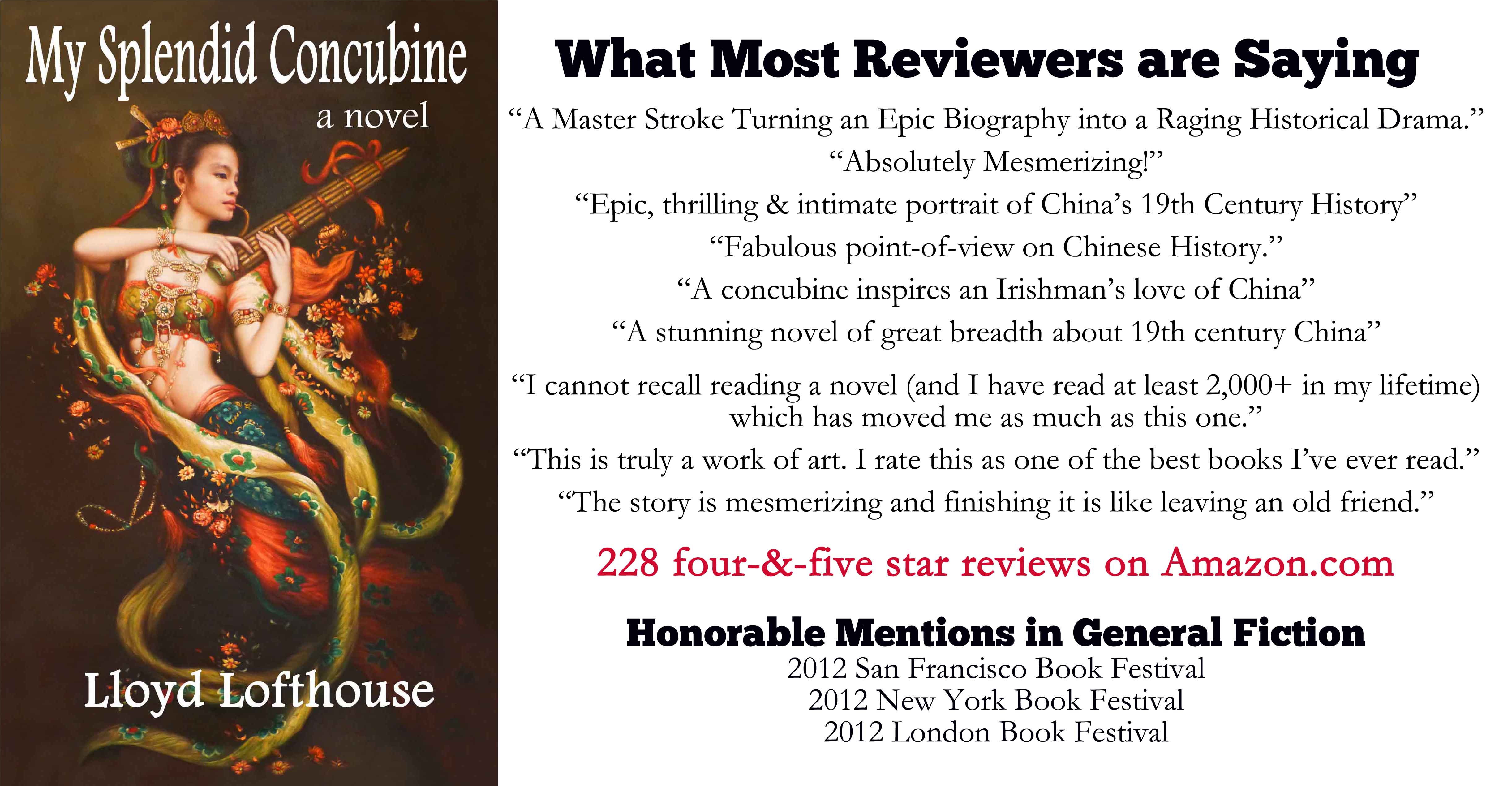
Lloyd Lofthouse is the award-winning author of My Splendid Concubine [3rd edition]. When you love a Chinese woman, you marry her family and culture too. This is the unique love story Sir Robert Hart did not want the world to discover.

#1 - Joanna Daneman review posted June 19 2014

Where to Buy

Subscribe to “iLook China”!
Sign up for an E-mail Subscription at the top of this page, or click on the “Following” tab in the WordPress toolbar at the top of the screen.

About iLook China

China’s Holistic Historical Timeline


Why do most Chinese save so much?

May 25, 2016

Hung Huang, one of China’s four Opras, and the CEO of China Interactive Media Group, the host of China’s TV talk show Crossing Over and one of the top-five most popular Bloggers in China wrote a post for the New York Times Economix Blog about why the Chinese save so much.

She thinks the Chinese save out of fear.

I don’t agree, because China is not unique when it comes to Asians saving money. Galbi Think.org says, “Savings rates for East Asian economies averaged about 35% of GDP.

For a comparison, the long term saving rate in the US has dropped to 5.4% for the last three years. – YCHARTS.Inc.

Another study reported by All Business.com says, “The fact that the saving rate of rural households (in China) is considerably higher than that of urban households—even though their income levels are so much lower—is surprising.”

That isn’t so surprising to me. I married into a Chinese family, and I’ve come to believe the Chinese can out frugal anyone. The less earned, the more the Chinese save.  All it takes is saying no to buying frivolous junk and eating out when the money isn’t there.

In fact, I found the comments to Huang’s New York Times Economix Blog post to be more convincing than what she thinks.

Melvin Chin said in a comment, “Asians, including Chinese, Japanese, and Koreans, are predominantly brought up with the concepts of frugality and saving from very young. … Saving teaches them to be proud of what is accumulated, enjoy the fruits of abundance, and cherish the habit as a virtue.”

Ray said, “The strong family connection is the reason for Chinese to save. It is the same in Taiwan. Almost every elder person I know saves for their descendants.”

Fei said, “Simply look at the generations of Chinese who live in North America, you’ll find out that the majority of them still maintain a lifelong enthusiasm of saving … because saving is a habit that’s deeply rooted in the Chinese culture.”

If all Asian cultures are so good at saving money and are all collective cultures, what does that say about self-centered individualistic cultures like the U.S.?

中

Lloyd Lofthouse is the award-winning author of My Splendid Concubine [3rd edition]. When you love a Chinese woman, you marry her family and culture too. This is the unique love story Sir Robert Hart did not want the world to discover.

#1 - Joanna Daneman review posted June 19 2014

Where to Buy

Subscribe to “iLook China”!
Sign up for an E-mail Subscription at the top of this page, or click on the “Following” tab in the WordPress toolbar at the top of the screen.

About iLook China

China’s Holistic Historical Timeline


Falling in Love with Stinky Tofu

March 29, 2016

China has a unique food culture compared to the West. For instance, my wife loves noodles. I’ve followed her down narrow Shanghai streets to a well-known won-ton and noodle shop on the corner of Chang-le and Shang-yang Road. The front is open and the ceiling low with each narrow table crowded with Chinese sitting on small chairs shoveling noodles in with chopsticks.

My wife orders a small bowl of noodles with peanut sauce for me and a bowl of blood soup and another bowl of noodles with spicy hot Sichuan peppercorn sauce for her.  As she eats, sweat beads her face but there is not one word of complaint—not one sign that she is suffering. Instead, this seriously satisfied look spreads across her face as if she has entered a Chinese noodle heaven.

When visiting Nanjing Road in Shanghai between People Square and the Bund, we always stop at the same food shop where my wife orders steaming hot noodles with the same peppercorn sauce, and I order deep fried, fresh chou dofu (stinky tofu) with the same sauce that causes me to sweat too.

At celebration feasts, a wider variety of food will be served from whole fish, crab, a variety of vegetable dishes and tofu.

中

Lloyd Lofthouse is the award-winning author of My Splendid Concubine [3rd edition]. When you love a Chinese woman, you marry her family and culture too. This is the unique love story Sir Robert Hart did not want the world to discover.

A1 on March 13 - 2016 Cover Image with BLurbs to promote novel

Where to Buy

Subscribe to “iLook China”!
Sign up for an E-mail Subscription at the top of this page, or click on the “Following” tab in the WordPress toolbar at the top of the screen.

About iLook China

China’s Holistic Historical Timeline


The Statutory Woman

March 15, 2016

An honest comment for my first novel My Splendid Concubine gave me the idea for this post on the history of the changing attitudes of when a female child becomes a woman. The comment said, “The girls (the two concubines in the story) were younger than 15, for goodness sake. I had a hard time getting past that.”

According to Live Science.com, “A woman can get pregnant and have a baby as soon as she begins ovulating, or producing eggs. This typically occurs about a year after they first begin menstruating, which for North American women, usually happens between the ages of 11 and 12.”

But according to the law in the United State, a female child isn’t legally a woman until age 16, 17 or 18 depending on which U.S. state you live in.

But the age of consent laws in China in the middle of the 19th century, the time period of My Splendid Concubine, that was based on a real-life story, were not the same as they are today, and China is not the United States.

To understand the difference between now and then, today in the People’s Republic of China, the age of consent for sexual activity is 14, regardless of gender and/or sexual orientation. In Hong Kong, it is 16 and 17 in Macau.

In fact, “Depictions of ‘child-romance’ in ancient or modern Chinese literature are not difficult to find. They include passages on joyous heterosexual or homosexual activities by children as young as 12 to 13 years old with one another or with adults. Children are usually described as natural sexual beings and erotic stimulation and sex-play are seen as beneficial to their healthy development (Chen 2000). … For most of Chinese history, the minimum marriage age suggested by the government had ranged between 12 and 16.” – Department of Psychiatry, University of Hong Kong

What about the United Kingdom around the time period of my historical novel? In 1875, a concern that young girls were being sold into brothels caused Parliament to change the age of consent to 13. Prior to that, the age of consent was 12.

However, in the United States in 1875, each state determined its own criminal laws and the age of consent ranged from 10 to 12 years of age. It would not be until after the 1930s that the term jailbait came into use in America as the age of consent laws changed.

I could have sanitized My Splendid Concubine and made both Ayaou and her sister Shao-mei much older to fit the politically correct attitudes of today, but that would have been historically incorrect. Sterling Seagrave in his book Dragon Lady, the Life and Legend of the Last Empress of China, wrote, “He (Robert Hart) had just turned twenty. Ayaou was barely past puberty but was wise beyond her years.”

If Ayaou, one of the concubines in the novel, was barely 14, then there was only a six-year gap between the two, while Hart’s arranged marriage to a young Irish woman named Hester Jane Bredon a decade later sees the gap double to twelve years when he was thirty and she was eighteen. Seagrave says, “He (Hart) sought a wife as straightforwardly as he had bought a concubine.” After returning to Ireland for a brief stay in 1866, Robert proposed marriage to Hester five days after he met her. The courtship lasted three months before they were married.

Should authors ignore historical fact and rewrite history to reflect the moral sensitivities of today’s readers?

中

Lloyd Lofthouse is the award-winning author of My Splendid Concubine [3rd edition]. When you love a Chinese woman, you marry her family and culture too. This is the unique love story Sir Robert Hart did not want the world to discover.

A1 on March 13 - 2016 Cover Image with BLurbs to promote novel

Where to Buy

Subscribe to “iLook China”!
Sign up for an E-mail Subscription at the top of this page, or click on the “Following” tab in the WordPress toolbar at the top of the screen.

About iLook China

China’s Holistic Historical Timeline


Is the Nap at risk in China?

March 9, 2016

Napping is a custom in much of China. My father-in-law, for instance, who is 84, naps every afternoon, and I thought it was due to his age.

Then after more than a decade of marriage, I asked my wife if her father had always taken afternoon naps. She said yes and that even at work in Shanghai during the Cultural Revolution, the Chinese Communist Party bosses made everyone take a long nap after lunch—about two hours every day.

Deciding to learn more, I turned to Google and found that “The Chinese, particularly those in the southern and south-eastern regions, take what could be called an afternoon siesta that lasts from approximately 12 noon to 2:30 p.m.”

I learned that afternoon naps in China are common, but that doesn’t mean everyone does it.  I also learned that the Internet and the modern-urban lifestyle have cut into the old habit of napping.

In fact, micro-blogging in China has had an impact on this centuries old custom. MSNBC.com reported that the Chinese government “sensitive to public opinion, especially stories of lazy or corrupt bureaucrats carried by massively popular micro-blogging sites,” cracked down on napping at meetings in an attempt to “instill a greater sense of duty into its officials.”

If this trend continues, this might seriously impact public health, creativity and learning in China.

Han Fang, a professor at Peking University People’s Hospital, says, “Lack of sleep can cause a significant lowering of immunity…”

In addition, the New York Times reported, “New research has found that young adults who slept for 90 minutes after lunch raised their learning power, their memory apparently primed to absorb new facts.”

“Other studies have indicated that sleep helps consolidate memories after cramming, but the new study suggests that sleep can actually restore the ability to learn,” and that might explain why “most Chinese schools have a scheduled half-hour nap right after lunch.” – Wiki.answers.com

“According to the advocates, a short 10-20 minute nap in the middle of a working day can increase productivity by over 30 percent and alertness by 100 percent as well as improve memory and concentration. They also claim that it can reduce stress and the risk of heart disease by 34 percent.”

I’m struggling to cultivate the habit of napping, but it’s hard to break old habits when you grew up in the United States where it is customary to make people work long hours for poverty wages even when they are exhausted.

______________________________

Lloyd Lofthouse is the award-winning author of My Splendid Concubine [3rd edition]. When you love a Chinese woman, you marry her family and culture too. This is the unique love story Sir Robert Hart did not want the world to discover.

IMAGE with Blurbs and Awards to use on Twitter

Where to Buy

Subscribe to “iLook China”!
Sign up for an E-mail Subscription at the top of this page, or click on the “Following” tab in the WordPress toolbar at the top of the screen.

About iLook China

China’s Holistic Historical Timeline