
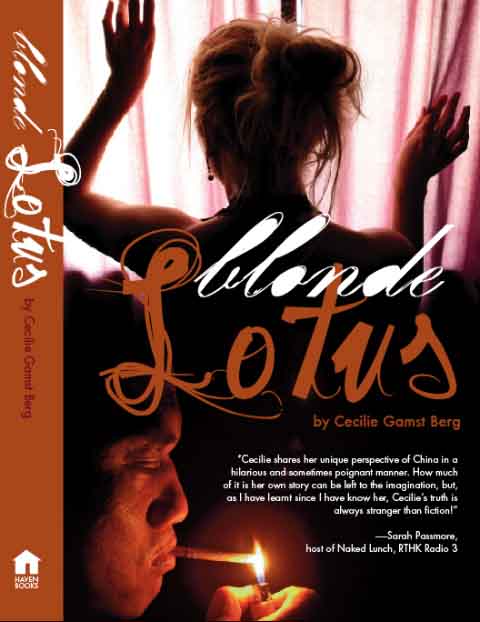
Blonde Lotus

October 11, 2010

Guest Post (book review) by Tom Carter

If there ever was an expat author in the Middle Kingdom whose enthusiasm and love of life was as contagious as Cecilie Gamst Berg’s, then that person has yet to be published.

Part travelogue of a directionless backpacker, part bedtime stories of a frisky European babe who enjoys seducing young Chinese guys “out of the festering prison of virginity,”

Blonde Lotus is in fact one in the same person.  Gamst Berg, via her alter-ego protagonist Kat Glasø, accidentally arrives in late-1980’s China (“all I wanted was to be on the train; I had no interest in the journey’s destination, Beijing”), back when the mighty bicycle was still king of Peking and foreign tourists were a rare sighting.
Expecting a people with “long, billowing sleeves, reciting poetry and plucking at stringed instruments,” what Kat finds in New China instead are street corners populated with shady money changers and young hipsters whose knowledge of English is limited to the words ‘Okay-la’ and ‘Sex!’  Lulled by their charming incessancy, Kat shrugs her shoulders and good-naturedly gives it to them – the money AND the sex.  “How could so many men find the women of a race attractive, and so few women find the men the same,” she ponders postcoitally over a shared Zhongnanhai cigarette.

Queen gweipo (devil woman in Cantonese) Gamst Berg is an unpretentious, fun-loving writer with nothing to prove.  She’s not out to save China as so many a self-righteous foreigner here are (“I hope this country never modernizes” Kat admits in one of her many blunt moments of sincerity), she’s not trying to force feed them Faulkner (“I loved books and he never read one”), nor is she out to land a career in journalism like the rest of us.

No, the author is clearly just looking to have a good time (“We were young, stoned and in China”), and maybe learn some Putonghua while doing it, and therefore spares us the sappy, sympathetic observations and “deep understanding” of life in China that makes most Laowai Literature such a torture to read.

Conversely, nor is Gamst Berg out to tear Communism apart, vilify Chinese people or point and laugh at the “strangeness” of their culture, a common last-resort for some western travel writers (whom I refrain from naming as a professional courtesy) who don’t want to admit that they have learned nothing about the Chinese during their stay here.

Indeed, while her fellow expats spend their time in China sitting around at bars “shouting out orders in English, and when they weren’t understood, complained loudly to each other about how stupid the Chinese were,” rather than join in, Kat moves tables, literally and figuratively, to the Chinese side of the bar.

Instead of whining about China’s infamously filthy public toilets, Kat hangs out in them (smoking dope), then laughs when there’s a line of squeaming girls waiting to use the stall. 

Rather than bitch about the People’s Republic’s chaotic queues at its railway stations, she jumps right in, elbows swinging, with the rest of the seething proletariat.

Our Blonde Lotus ain’t no saint, and she would laugh in your face if you dared suggest it.  “I wanted to experience everything and sleep with everybody…” confesses, nay, asserts the Norwegian-born Kat Glasø – and then proceeds to actually do so, from coal-and-petrol-scented industrial North China all the way down to the steamy islands of Hong Kong, her final destination.

Throughout her candid memoir, the author employs an uproarious combination of reluctant intellectualism (“learning Chinese was better than being in love because there was no danger of waking next to the Chinese language wanting to kick the f*cker out of bed”) and ribald hedonism (“I felt something push into me, shudder and expire. Was it an asparagus?”) that is sure to win Gamst Berg as many fans as frighten them away.

If Blonde Lotus is a window into China, then that window has been fogged with the sultry breathe of its occupants.  If it is a work of reportage; then the author was too distracted by eating, drinking, smoking and playing cards with the peasantry to be concerned about making the front page.  And that nonchalance, that self-depreciating humor, is exactly this novel’s charm.

Blonde Lotus is a refreshingly unserious memoir of an infectiously upbeat young woman (this reviewer’s favorite line in the whole book: “Ha ha, life was perfect and made for me!”) who, lost in China and unsure of what she wants to do with said life – as many of our kind are – inadvertently ends up making a new, better one for herself.

__________________

Travel photographer Tom Carter is the author of China: Portrait of a People (San Francisco Chronicle Book Review), a 600-page China photography book, which may be found at Amazon.com.

Discover more “Guest Posts” from Tom Carter with Is Hong Kong Any Place for a Poor American?

If you want to subscribe to iLook China, there is a “Subscribe” button at the top of the screen in the menu bar.


Nobel Peace Prize goes to Liu Xiaobo

October 8, 2010

Democratic trumpets are sounding the charge against China.

Sinophobes are shouting, “I told you so!”

The Western media is splashing the news on the Internet, across the front pages of newspapers and reporting it on TV and radio.

For example, The Huffington Post says, “Imprisoned Chinese democracy campaigner Liu Xiaobo on Friday won the Nobel Peace Prize, an award that drew furious condemnation from the authoritarian government and calls from world leaders including President Barack Obama for Liu’s quick release.”

Outside the Middle Kingdom, the government of China cannot win this public relations battle against democratic nations unified in their condemnation of non-democratic governments—at least those governments that do not have lots of underground oil as the authoritarian government in Saudi Arabia.

I’m sure that Liu Xiaobo believes in his mission as many in the West do that live in democracies.

However, I agree with America’s Founding Fathers, who in 1776 founded a republic—not the democracy the U.S. has today.

President John Adams (1735 – 1826), the second president of the U.S., said, “That the desires of the majority of the people are often for injustice and inhumanity against the minority is demonstrated by every page of the history of the whole world,” and “Democracy … while it lasts is more bloody than either [aristocracy or monarchy]. Remember, democracy never lasts long. It soon wastes, exhausts, and murders itself. There is never a democracy that did not commit suicide.”

Mao was a dictator known as China’s modern emperor.

A few years after coming to power in 1949, Mao launched the disastrous Great Leap Forward followed by the infamy of The Cultural Revolution—both were driven by the mob and the results were about 30 million dead from famine, disease and tyranny.

In fact, before the communists came to power in China, there was more than a century of madness that almost destroyed China, which was caused by the West.

Soon after Mao died, Deng Xiaoping launched China’s capitalist revolution.

Then in 1982, China wrote the first draft of a constitution designed to build a republic – not a democracy.

Since then, China has been moving slowly down a road toward a more representative republic that fits China’s culture, which will probably never include democratic activists like Liu Xiaobo.

I hope China never becomes the kind of democracy President John Adams warned America against. It may be too late for the U.S. to return to the republic America’s Founding Fathers built, but it isn’t too late for China to avoid the same trap as they mature into a freer republic for the Chinese people.

Right or wrong, China’s central government does not want mob rule and that is the reason they locked up Liu Xiaobo and silenced his voice in China.

It is obvious that The Nobel Peace Prize has become a political tool to spread the mob rule of democracy that America’s Founding Fathers warned us about.

I urge China to release Liu Xiaobo from prison then send him to the democracy of his choice and never let him return.

Once living in Norway or France, maybe Liu Xiaobo will write a book about his experiences then win the Noble Prize for Literature.

I wonder what America’s Founding Fathers would have done with a Liu Xiaobo – probably ignored him as most Americans would have done then.

Nobel Prizes are awarded by the Norwegian Nobel Committee, which has been accused of having a political agenda. They have also been accused of Eurocentrism.

For the 2010 Nobel Prizes, there were five committee members, one man and four women.

______________

Lloyd Lofthouse is the award-winning author of the concubine saga, My Splendid Concubine & Our Hart. When you love a Chinese woman, you marry her family and culture too. 

If you want to subscribe to iLook China, there is a “Subscribe” button at the top of the screen in the menu bar.


Understanding the Party that Rules China

October 3, 2010

People tend to distrust and fear that which they do not understand, and the roots of American Sinophobia go deep.

The 1882, the Chinese Exclusion Act was directed solely against Chinese. Today, the Chinese in America are still often treated as if they are outsiders.

The Washington Post published a piece in February 2010 on “Polls show growing American resentment and fear of China.”

In fact, it doesn’t matter how anyone feels about China. China is here to stay. For more than two millennia, China has demonstrated an ability to burn and rise like the phoenix to be reborn again.

That’s why Richard McGregor’s book, The Party: The Secret World of China’s Communist Rulers is vital for understanding what is going on in today’s China.

McGregor not only shows how the Party works, but why the Party fears  losing control and helplessly watching China revert back into the pre-revolutionary chaos and anarchy which almost destroyed the nation when Chiang Kai-shek’s Nationalists ruled the mainland.

As an organization with more than seventy million members, the Party has a grip on every aspect of government, from the largest, richest cities to the smallest villages. It also presides over all official religions, the media, the military and large state-owned businesses.

The picture that emerges is of a creative, adaptable, self-aware and resilient social network that is alert to the internal and external dangers it faces and has proven able to respond to challenge with remarkable agility, creativity and effectiveness.

 ______________

Lloyd Lofthouse is the award-winning author of the concubine saga, My Splendid Concubine & Our Hart. When you love a Chinese woman, you marry her family and culture too. 

If you want to subscribe to iLook China, there is a “Subscribe” button at the top of the screen in the menu bar.


Neo-Whatever

October 1, 2010

Until recently, I’d never heard of neo-Confucianism.  

My first thought was, “Is this some sort of twisted form of neo-Nazism or neo-conservatism that the West imported to China?”

Freedom to the extreme is the American way. In fact, most Americans may not realize that there is a Nationalist Socialist Movement (Nazis) in America that worships Hitler and annually gathers to protest.


An American Nazi

At this point, you may be having images of Nazi storm troopers invading France and Russia or Hitler promoting terrorism while gassing Jews by the millions in concentration camps.

To learn more about this American homegrown fascist group see Nazis Exposed.

Then there are America’s neo-conservatives. These people want to export America’s current form of democracy and commercialism to the world using the U.S. military along with bullets and missiles. They brought us the wars in Iraq and Afghanistan.

The good news is that there is nothing to worry about. Neo-Confucianism is not a radical threat to freedom leading to wars and concentration camps.

Leiden University says, “The rise and development of neo-Confucianism is the most important intellectual phenomena in China in the last millennium.”

Neo-Confucianism developed during the Song, Yuan, Ming and Qing Dynasties and still represents the core of ethics and attitudes toward life and even worldviews for modern Chinese in many fundamental ways.

Unlike the American neo-Nazis and American neo-conservatives, who are so much into violence and hate, Chinese neo-Confucianism is into keeping a good balance between the practical and the ideal, the secular and the holy.

See The Life of Confucius

______________

Lloyd Lofthouse is the award-winning author of the concubine saga, My Splendid Concubine & Our Hart. When you love a Chinese woman, you marry her family and culture too. 

If you want to subscribe to iLook China, there is a “Subscribe” button at the top of the screen in the menu bar.


The Sinophobia Epidemic

September 29, 2010

After being called “Pro China” and a “Panda Lover”, along with a few other tags, I wondered how many people in America have the mental illness called Sinophobia.

The Ramblings of a Political Psychology Major provided an answer. “There is a majority opinion in the US that China is a country we should be concerned with. In a February 2010 Gallup poll, 53% of Americans rated China as being unfavorable or very unfavorable.”

Sinophobia is especially common in Japan. If you don’t believe me, read what Japan did to the Chinese during World War II.

After that, check out what the British, French, Americans and a few others did to China in the 19th century during the Opium Wars.


Do you detect anger in this video?

The notion of “yellow peril” manifested itself in government policy with the U.S. Chinese Exclusion Act of 1882, which reduced Chinese immigration from 30,000 annually to 105.

Jack London’s 1914 story, The Unparalleled Invasion, takes place in a fictional 1975, and describes a China with an ever-increasing population taking over and colonizing its neighbors with the intention of eventually taking over the Earth. 

Correct me if I’m wrong, but I thought that was Hitler’s German Nazis who wanted to do that.

Fili’s World provides an example of Sinophobia in the Israeli media. “You know something is wrong when you hear everyone in the media quoting the exact same clichés, even if they sound so moral and enlightened.… The Chinese have no way of winning the PR battle. If they perform well, they’re described as machine-like and cold. If they mess things up a bit, they are described as losing control. If they tighten up security, they’re violating human rights. If they’re loosening it up a bit, then it’s a sign that China is breaking apart. If they’re on time, they’re fascists. If they’re late, they’re incompetent.”

The Glittering Eye says, “I think I could devote an entire Blog to Sinophobia rather than just to an occasional post seen in the news media.”

Most Chinese Americans I know say they are afraid to speak out about this illness, because a white-faced, round-eyed, big nosed Sinophobe will tell them to go home.

Sinophobia is so serious, it even appears on the Phobia List.

If 53% of Americans have this illness, it should qualify as an epidemic. Along with the annual flu shot, there should be an anti-Sinophobia injection.

______________

Lloyd Lofthouse is the award-winning author of the concubine saga, My Splendid Concubine & Our Hart. When you love a Chinese woman, you marry her family and culture too. 

If you want to subscribe to iLook China, there is a “Subscribe” button at the top of the screen in the menu bar.