She’s a Healer, but her body is death

October 14, 2025

The Tao of Poison is a powerful, believable story set in 18th century China during the White Lotus Rebellion. The nine-year conflict heavily impacted many districts in central China, leading to widespread losses in the mountainous regions separating Sichuan, Hubei, and Shaanxi provinces.

Qiezi, 17, has practiced mithridatism, a method of building poison resistance, for most of her life. Her body has become toxic. She also studied China’s famous encyclopedia of healing and learned from experts how to heal illness naturally.

Early in the story, a powerful Qing Dynasty official threatens her and her family if she won’t have sex with him. She warns the man that her body is poisonous. The man doesn’t believe her. After he dies, Qiezi and her family are blamed for the powerful official’s death and become fugitives.

Separated from her family while on the run, Qiezi eventually reunites with them after joining a group of Chinese Taoists. These Taoists practice consensual partnered or multi-partnered intimacy to harness sexual energy for self-improvement and spiritual development.

Still, what these Taoists practice is illegal. If caught, they will be executed.

This is a fascinating story of survival in a dangerous China.

The Author

Isham Cook is an American essayist and novelist based in China since 1994. His writing philosophy is big concept, discriminating, provocative. His influences are Ballard, Beckett, Borges, Dick, Kafka, Hesse, Melville, Mishima, Sade—authors and artists who fearlessly forge new territories.


The World was Warned. Is anyone listening?

April 23, 2025

Think Again About the Debate that wasn’t a Debate on June 27, 2024.

July 4, 2024

Interpreting Humor

July 29, 2020

Before I write about Chinese humor, I want to point out the difference between Chinese and Western thinking. Europeans and Americans tend to have a linear-thinking pattern compared to most Chinese that start with the specific and move to the abstract creating thought metaphors.

While metaphors exist in English and Chinese, they are seen differently. For instance, the Academic Exchange Quarterly says the Chinese people consider themselves descendants of dragons. These metaphorical expressions always carry positive meanings and attitudes. Although dragons can be found in English literature, they are often described as evil monsters. If someone is referred to as a dragon in English, it is always associated with the derogatory connotation, meaning “a fierce person”.

The FluentU Mandarin Chinese Language and Culture Blog offers “5 things You Need to know about Chinese Humor.”

“Comedy is a tricky thing!” FluentU continues, “What is funny in English may not be funny in Chinese. In fact, a lot of things we find humorous in our culture can be downright offensive in Chinese culture. Don’t worry—it’s actually not that hard to get a grasp on comedy in Mandarin. It just takes a little studying on the subject of faux pas in Chinese interactions to understand what’s funny and what’s not.”


Chinese Humor from a Western point of View


Why is this important?

Because understanding what a culture finds funny is important when making friends from other cultures. Humor is a very precise thing among cultures. For instance, FluentU says that depressing irony is kind of hilarious in Chinese culture.  This form of comedy is often dark, sarcastic, and very ironic. This may be funny to some Westerners, but it may come off as too dark to most.

Lacking facial expressions is pretty funny to Chinese people, too. Western comedians are quite expressive, both in their faces and bodies. In China, a lack of facial expressions while delivering witty one-liners is considered much more entertaining.

If you want to learn more about what works and what to avoid when it comes to Chinese humor, I urge you to visit FluentU.com.

Lloyd Lofthouse is the award-winning author of My Splendid Concubine, Crazy is Normal, Running with the Enemy, and The Redemption of Don Juan Casanova.

Where to Buy

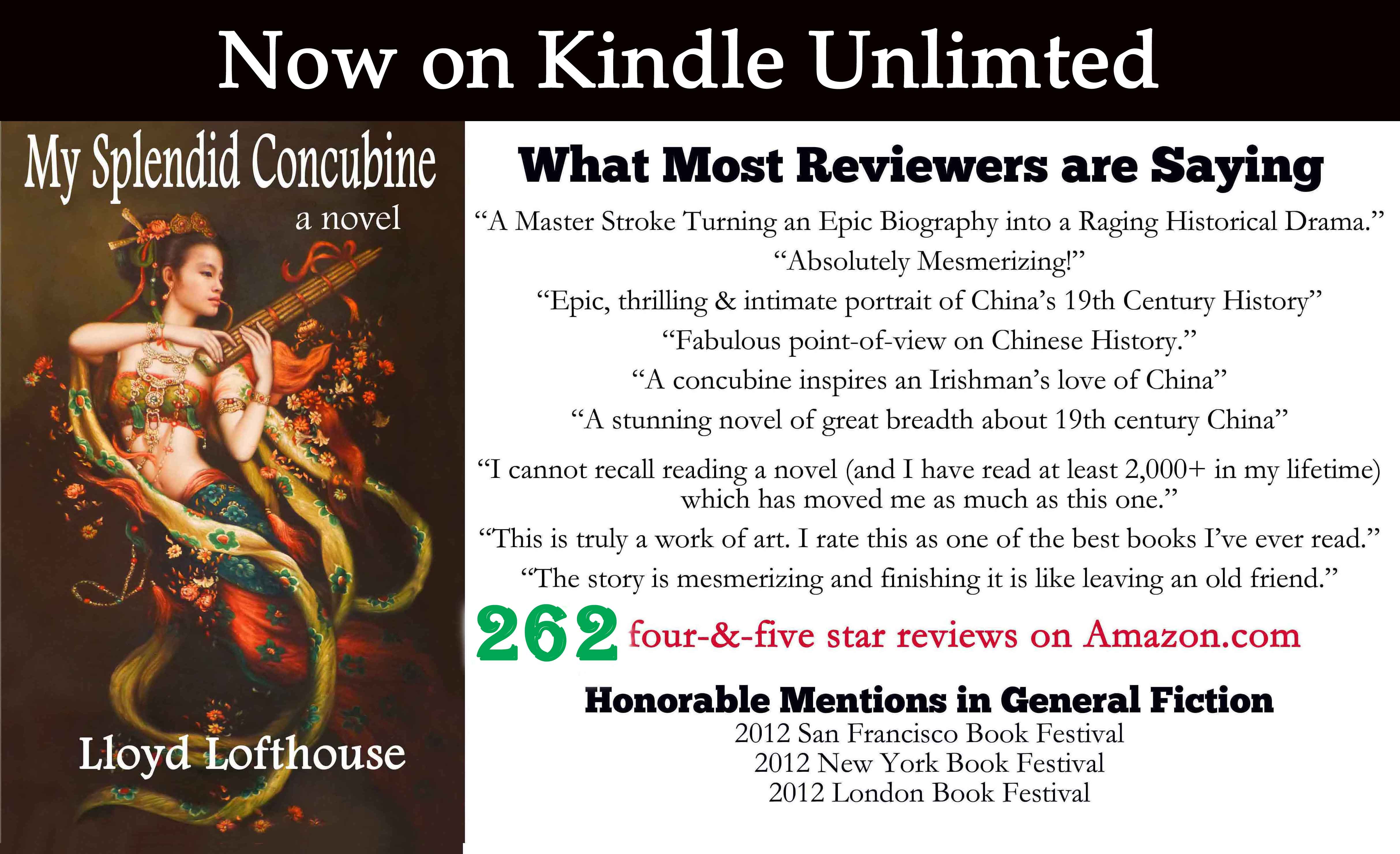
My Splendid Concubine is now available to read through Kindle Unlimited.

About iLook China


The Little Known History of Racism in the United States against the Chinese

July 15, 2020

Thirty-six years before the 1921 Greenwood Massacre of African Americans in Oklahoma, there was a similar incident in Wyoming but the victims were Chinese.

“On September 2, 1885, 150 white miners in Rock Springs, Wyoming, brutally attack their Chinese coworkers, killing 28, wounding 15 others, and driving several hundred more out of town,” History.com reported.

“The Rock Springs massacre was symptomatic of the anti-Chinese feelings shared by many Americans at that time. The Chinese had been victims of prejudice and violence ever since they first began to come to the West in the mid-nineteenth century, fleeing famine and political upheaval (the Christian led Taiping Rebellion and the English and French led Opium Wars). Widely blamed for all sorts of social ills, the Chinese were also singled-out for attack by some national politicians who popularized strident slogans like ‘The Chinese Must Go.’”

The Rock Springs massacre wasn’t the only incident of racism against Chinese immigrants in the United States.


The Chinese Exclusion Act, a United States federal law signed by President Chester A. Arthur on May 6, 1882, ended all immigration of Chinese laborers.  The African American Policy Forum says, “The Chinese Exclusion Act was an immigration law passed in 1882 that prevented Chinese laborers from immigrating to the United States. The Chinese Exclusion Act was the first immigration law that excluded an entire ethnic group. It also excluded Chinese nationals from eligibility for United States citizenship.”

“During their first few decades in the United States,” The Library of Congress informs, “they (Chinese immigrants to the United States) endured an epidemic of violent racist attacks, a campaign of persecution and murder that today seems shocking. From Seattle to Los Angeles, from Wyoming to the small towns of California, immigrants from China were forced out of business, run out of town, beaten, tortured, lynched, and massacred, usually with little hope of help from the law. Racial hatred, an uncertain economy, and weak government in the new territories all contributed to this climate of terror and bloodshed. The perpetrators of these crimes, which included Americans from many segments of society, largely went unpunished.”

Lloyd Lofthouse is the award-winning author of My Splendid Concubine, Crazy is Normal, Running with the Enemy, and The Redemption of Don Juan Casanova.

Where to Buy

My Splendid Concubine is now available to read through Kindle Unlimited.

About iLook China