“Detective Dee” Movie Review and other Thoughts

September 20, 2011

The first time I learned of the Emperor Wu Zetian, who was a woman, was when I wrote a four part series of her starting with Wu Zetian, China’s Female Emperor – Part 1, October 9, 2010.

In fact, while researching Emperor Wu, I learned that under her rule, the economy, culture, social and political affairs prospered. She was also a talented military leader who reformed the army. After the reforms, without leaving her palace, she managed victorious military conflicts with rival states.

If you decide to see the movie, you will discover that the film depicts her as a brutal, scheming tyrant. Historically, China’s historians often demonize powerful women. In reality, the facts say that she was no worse than most male emperors were and was more talented, open-minded in addition to being an early feminist.

The last time I attended the Los Angeles Times Festival of Books at UCLA, I had an opportunity to talk to a film agent that said Hollywood wasn’t making epic blockbusters anymore because they cost too much.

Consider that the 2004 Alexander the Great cost $155 million to produce and the gross box office was about $164 million and in 2007, Pirates of the Caribbean: At World’s End cost $300 million to produce.

However, according to Box Office Mojo, the budget for Detective Dee and the Mystery of the Phantom Flame was $13 million. Maybe all films should be made in China.

The film was based on the Chinese folk hero Di Renjie, popularized in the West by a series of detective novels written by Robert Van Gulik (1910 – 1967), who called him “Judge Dee“.

When I went to see the film, I discovered that it was an action mystery of epic proportions with classic palace intrigue that rivaled a Hollywood epic, which today would cost twenty times the estimated budget I mentioned earlier.


Tsui Hark Director of “Detective Dee” interviewed by Film Steve 3

I enjoyed the film and walked away thinking that anyone interested in a glimpse of how powerful China was thirteen hundred years ago, this lavish spectacle provides a hint of that former time.

The mystery that Dee solves is the spontaneous combustion of two high-ranking court officials that exploded in flame when exposed to sunlight.  Do not expect the ending to be the stereotypical Western conclusion.

These ‘murders’ take place before the coronation of Wu Zetian as China’s first female emperor.  Detective Dee, the films hero, is based on a real person but there is a lot of fiction and fantasy mixed into this epic film.

The real Detective Dee was originally Duke Wenhui of Liang, an official of the Tang Dynasty and of Emperor Wu Zetian’s Zhou Dynasty. He was one of the most celebrated officials of Wu Zetian’s reign.

Discover another classic/epic Chinese movie in Farewell My Concubine

______________

Lloyd Lofthouse is the award-winning author of The Concubine Saga. When you love a Chinese woman, you marry her family and culture too. This is the love story Sir Robert Hart did not want the world to discover.

To subscribe to “iLook China”, sign up for an E-mail Subscription at the top right-hand side of this page and then follow directions.


A Dramatic Shift in China’s Cultural Values

September 4, 2011

Before 1949, Chinese culture was heavily influenced by Confucian thought and poetry, and the arts were extremely popular for their aesthetic and moral importance.

The goal of Confucianism was to create gentlemen that carried themselves with grace, spoke correctly and demonstrated integrity in all things.

Confucius believed that the most important lessons for obtaining a moral education were to be found in the Book of Songs, because many of its poems were both beautiful and good.

In fact, to Confucius, the role of poetry and art played an important role in the moral education of a gentleman as well as that of society in general.

For this reason, before 1949, the cultivation of poetry and the arts was considered more important than that of science or business.

Prior to 1949, to have a son majoring in the arts was a source of pride for most Chinese parents.

However, today, if a parent says his or her son is majoring in the arts (such as poetry, literature, or painting) at this or that university, (shocked) silence is the usual response and many Chinese parents would not want a daughter to marry such a man since this career choice may often lead to a dismal future.

A better choice today might be to see one’s daughter marry a banker or an I.T. major working for Alibaba, China’s e-Bay, or Baidu, China’s Google.

This cultural shift may best be seen by popular majors in China’s modern universities.

According to a recent survey conducted by Beijing University, the 10 most popular college majors in China recently were I.T. (information technology, which refers to anything related to computing technology, such as networking, hardware, software, and the Internet), electronics, languages (study of foreign languages such as  English), law, mechanics, architecture, accounting and finance, journalism, medicine, environment and business management.

In comparison, according to College Stats.org , the most popular college majors in the United States are biology, business, communications (journalism), computer science, criminal justice (law), elementary education, marketing, nursing, psychology, and political science and/or sociology.

If we compare popular college majors in China to those in the United States, which country appears to be on the right track?

Discover China Investing BIG in Education

______________

Lloyd Lofthouse is the award-winning author of The Concubine Saga. When you love a Chinese woman, you marry her family and culture too. This is the love story Sir Robert Hart did not want the world to discover.

To subscribe to “iLook China”, look for the “Subscribe” button at the top of the screen in the menu bar, click on it then follow directions.


Why Asian-Americans and/or Chinese-Americans Cannot Eat Bitterness in America

July 6, 2011

On April 25, 2011, Nadra Kareem Nittle wrote, Are U.S. Universities Discriminating Against Asian Students? The answer to Nittle’s question is “YES”.

The reason I researched and wrote this post was because of John Putnam’s Chinese in the Gold Rush and my three part series on The Chinese in America.

After all, how many Caucasions, African Americans and Latino students would have to start at a two or four-year state college if Asians filled 40% of the seats at Ivy League universities? To understand what this means, discover the facts from Recognizing Good Parenting Parts 4 to 8 to learn who works harder (on average).

In The Chinese in America – Part 3, I wrote, “of the continued discrimination against Asian-Americans and Chinese in the US by other ethnic groups, which includes Caucasians, African Americans and Latinos.”

In the US, since the Civil Rights era preferential treatment favored African-Americans and Latinos since Asian-Americans tend to swallow their bitterness instead of protesting violently as the other minorities have.

For example, the NAACP says it fights for social justice for all Americans. However, facts demonstrate that the NAACP tends to favor legislation that focuses on benefits for African Americans. If this were not true, there would be no need for political organizations to serve Latinos and Asian-Americans.

In fact, Africana Online says, “The National Association for the Advancement of Colored People (NAACP) has been instrumental in improving the legal, educational, and economic lives of African Americans.” There is no mention of the other minorities that suffer from racism in the US.

However, Latino Political Clout is growing in America to challenge the NAACP’s voice.

The recent US Census indicated Latinos continue to become a bigger chunk of the American population. With growing numbers come a series of political and social changes to the country. The numbers indicate a growth in Latino political influence will change American politics. Source: rt.com (click on “Latino Political Clout”)

We know that the number of votes a minority such as African-Americans, Latinos and Asian-Americans deliver equals political influence.

African American political organizations demonstrate the power of this influence.

Congressional Black Caucus

California Legislative Black Caucus

Black Leadership Forum

Georgia Legislative Black Caucus

Louisiana Legislative Black Caucus

Oklahoma Legislative Black Caucus

South Carolina Legislative Black Caucus

Latino American political organizations are challenging African-American influence.

Congressional Hispanic Caucus

Congressional Hispanic Caucus Institute

League of United Latin American Citizens

National Association of Latino Elected and Appointed Officials

The National Association of Latino Elected and Appointed Officials (NALEO), the non-partisan leadership organization of the nation’s more than 6,000 Latino elected and appointed officials, which has the NALEO Educational Fund — the nation’s leading 501 (c)(3) non-profit, non-partisan organization that facilitates the full participation of Latinos in the American political process, from citizenship to public service.

Mexican American Political Association

California Latino Legislative Caucus

Southwest Voter Registration Education Project (SVREP)

As demonstrated, Asian American political organizations have a long way to go to catch up to African-American and Latino political influence. You may notice two of the Asian-American organization focus on Chinese-Americans, which represents about 3.5 million Chinese US citizens dividing the potential influence of 14.5 million Asian-Americans.


What has the NAACP done to end global slavery? Find the answer at NAACP International Affairs Goal

 Asian-Americans and Chinese-Americans are crippled by their cultures when it comes to increasing political influence in the US since Chinese parents teach their children to eat bitterness.

In China, the tradition of “eat bitter” has been passed down from generation to generation. “Eat bitter” is a literal translation of Chinese "吃苦", which refers to endure hardship including discrimination.

Chinese American Political Association

Chinese American Democratic Club

Congressional Asian Pacific American Caucus

80-20 Initiative

Asian Pacific Americans for Progress

The 2010 census shows us minority influence is not equal since there are 40 million African-Americans, 26.7 million Hispanic or Latino Americans but only 14.5 million Asian Americans.  Numbers count since more people shout louder.

Elected officials from local, state and national levels would rather have Asian-Americans claiming racism than the larger ethnic populations that often act out their rage at not getting what they believe they are entitled through violence such as burning and looting businesses and wrecking vehicles during riots.

Discover the Timeline of Race Riots from 1980.

When has the US seen a race riot caused by a mob of Asian Americans? Instead, the few times any action has been taken, Asian-Americans resort to the legal system that may favor the larger, more vocal and violent minorities in America.

I suspect that “Eating Bitterness” was influenced by Taoism, Buddhism and Confucius while in the West the warlike and often-violent religions of Christianity and Islam do not follow the same path.

______________

Lloyd Lofthouse is the award-winning author of the concubine saga, My Splendid Concubine & Our Hart. When you love a Chinese woman, you marry her family and culture too.

To subscribe to “iLook China”, look for the “Subscribe” button at the top of the screen in the menu bar, click on it then follow directions.


The Ugly Face of Intolerance – Part 3/3

July 5, 2011

Then on April 22, 2011, Patrick Mattimore (chinadaily.com.cn) wrote Do ‘Tiger Moms’ make the best parents?

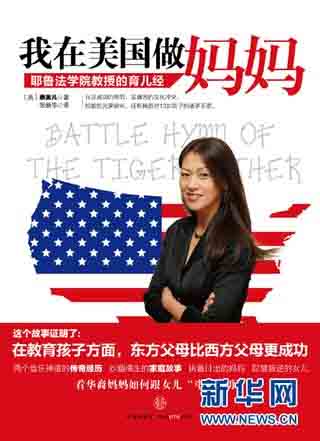
The question was, “So what is Chinese mothering and is it superior to Western parenting? Should all moms ascribe to be Amy Chua?”

What follows are a few excerpts from the China Daily opinion piece.

“First, Chua is using the terms ‘Chinese mothers’ and ‘Western parents’ loosely. The Tiger Mother/Chinese Mother can be found in many cultures and is not exclusive within any culture….”

“Unlike in the West where children are encouraged to experiment and develop their own individual talents, Chinese parents believe the child is an extension of oneself. Chinese parents believe they know what is best for their children and therefore override the child’s preferences. Chua concludes that it may come down to a matter of choice. Westerners believe in allowing children a large measure of freedom to choose their own paths while the Chinese parent makes choices for her children.…”


Amy Chua’s daughter Sophia as seen on her Blog

”Trying to untangle Chinese mothering and Western parenting and pick one style of raising a child or the other as the exclusively right way is ultimately a fool’s errand. Certainly, there are elements from both that are worth adopting. Parents can be consistent without being inflexible. They can have high expectations and demand that children work hard without setting up gulag conditions. They can listen and adapt to their children without giving up control or responsibility for raising them.…”

“In the final analysis, Amy Chua has provided readers with a provocative memoir about how she raised her daughters. Certainly, her ideas are worth considering and many are worth adopting. However, no parent should believe that Tiger Mothers have infallible blueprints for raising successful children. Parents still need to chart their own course and be prepared to vary the course according to the needs of each child.”

Instead of listening to the intolerant opinions of inflexible fools from America, why not read what Sophia, Amy Chua’s oldest daughter, has to say in her letter to the New York Post or go to her Blog and discover for yourself that her tiger mother has not damaged her.

Sophia Chua-Rubenfeld’s Blog may be found at new tiger in town.

Return to The Ugly Face of Intolerance – Part 2 or start with Part 1

______________

Lloyd Lofthouse is the award-winning author of the concubine saga, My Splendid Concubine & Our Hart. When you love a Chinese woman, you marry her family and culture too.

To subscribe to “iLook China”, look for the “Subscribe” button at the top of the screen in the menu bar, click on it then follow directions.


The Ugly Face of Intolerance – Part 2/3

July 4, 2011

I first ran into this particular wall of intolerance on the Amazon Forum where Amy Chua’s critics left reviews and comments about her parenting methods in a hate fest that had mostly nothing to do with the memoir.

What these critics write are attacks on Chua accusing her of being a child molester, a sociopath, or a narcissist, etc.  Often, these critics do not know what they are talking about and the biased ignorance runs deep.

One claim I have been struggling to disprove was the one that said, “Amy Chua does not represent the average mainland Chinese parent and had no right to claim that her parenting methods were Chinese.”

After more than four months, the evidence I have been looking for appeared in China when the China Daily published Tiger Moms’ Popular in China on April 14, 2011.

The China Daily said, “The strict parenting style advocated by Amy Chua, the Yale law professor, in her latest book, Battle Hymn of the Tiger Mother, is still popular in the country today, according to a recent survey.”

“Among 1,795 people polled online by China Youth Daily‘s social research center, 94.9 percent said they know women who are strict mothers, and 55.1 percent said they see merit in Chua’s parenting.…”

“A Beijing high school teacher, surnamed Liu, was quoted as saying that his wife had enrolled their daughter in violin and ballet classes at an early age and had resorted to scolding and spanking when the girl refused to go.

“Strict parenting is also a tradition in other Asian countries, such as Japan and South Korea,” Liu said. “It has merits in raising smarter children and preparing them better for harsh competition in the future.”

In addition, a critic of Chua’s on the Amazon Forum referred to an opinion piece posted on the Psychology Today Blog where Peter Gray, a research professor of psychology at Boston College claimed that 42 one-star reviews from anonymous people that identified themselves as Chinese was enough to conclude that the majority of Chinese (there are more than 1.3 billion Chinese and almost four million are in the US) were critical of Amy Chua’s parenting methods.

When we compare Peter Gray’s opinion in the Psychology Today Blog with information from almost 2,000 people polled online in China, which source do you think is more credible?

Continued on July 5, 2011 in The Ugly Face of Intolerance – Part 3 or return to Part 1

______________

Lloyd Lofthouse is the award-winning author of the concubine saga, My Splendid Concubine & Our Hart. When you love a Chinese woman, you marry her family and culture too.

To subscribe to “iLook China”, look for the “Subscribe” button at the top of the screen in the menu bar, click on it then follow directions.