Chinese Opera and Mao Wei Tao, China’s Living Treasure

June 18, 2011

Mao Wei Tao is considered a living treasure in China. She imitates men in the opera roles she plays—a reversal from Imperial China when women were not allowed on stage so men played female roles.

“In 1923, the training of female actors for this art form was set up. Since 1928, the Shaoxing opera troupes, consisting of solely female actors, began their performances in Shanghai. In a few years, females impersonating males had become the most important feature of this opera form, and at the same time the Yue opera became well known all over China.”

East China’s Zhejiang province gave China Shaoxing Opera’s Mao Wei Tao.

In her thirty-year career on the stage, she’s best known as an outstanding male impersonator with a cult following of women.
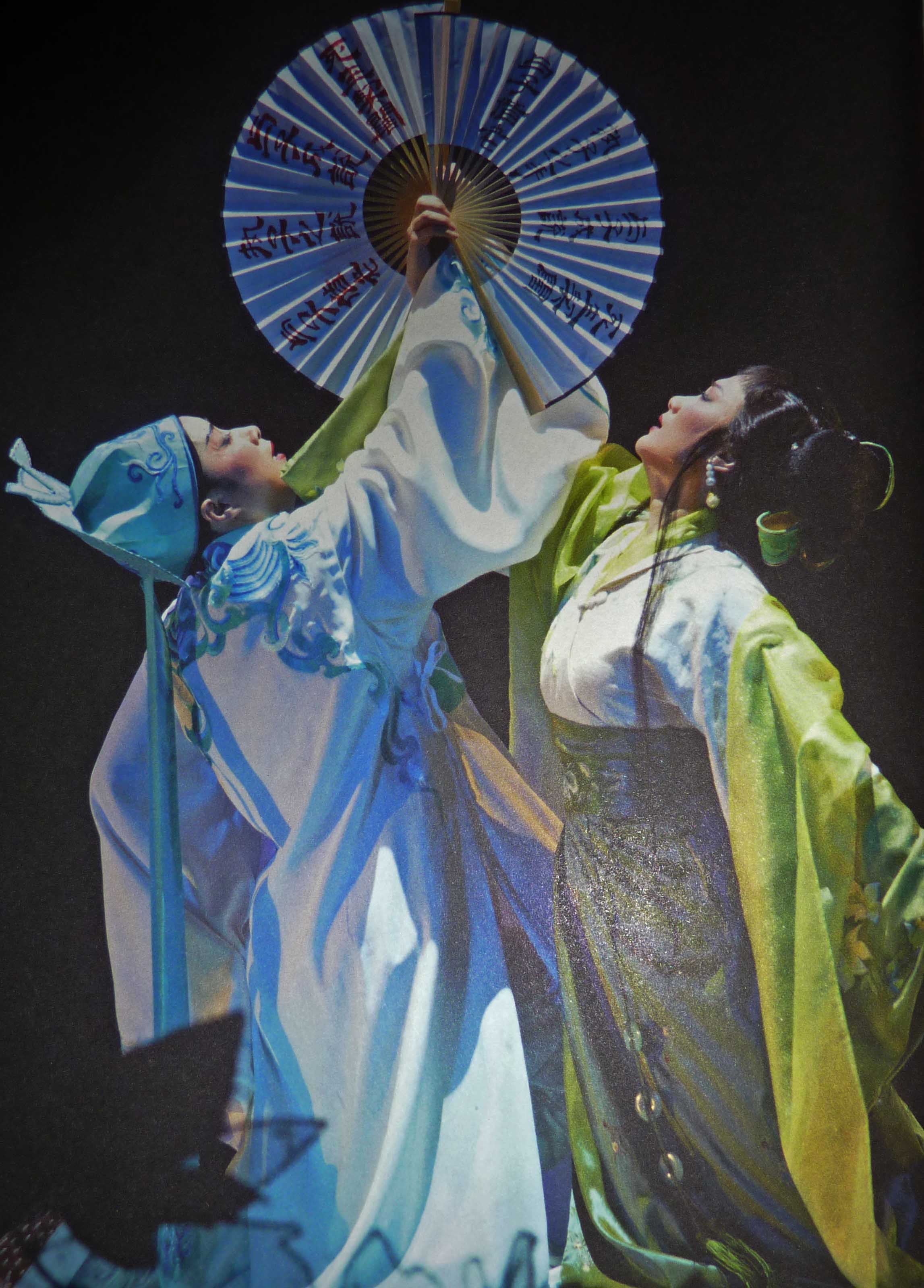
I was introduced to Yue Opera in Hangzhou, Zhejiang Province about a decade ago.

Mao Wei Tao and her husband have a theater company near the shores of the famous Westlake. My wife translated while I watched the live-opera performance in fascination.

The costumes were lavish and the acting and opera was dramatic while classical Chinese music played in the background.

The challenge today is to keep this form of Chinese opera alive. The audience for opera is shrinking dramatically in China while remaining popular with the older generation.

Television, movies and the Internet are claiming the shorter attention spans of younger Chinese

Mao Wei Tao, considered an innovative genius on stage, adapts and works to keep the art form alive. According to her husband, no two performances are exactly alike.

In November 2010, she performed in Taiwan as a cultural ambassador from the mainland.

This revised and edited post first appeared on March 14, 2010 as Mao Weitao and Yue Opera

______________

Lloyd Lofthouse is the award-winning author of the concubine saga, My Splendid Concubine & Our Hart. When you love a Chinese woman, you marry her family and culture too.


To subscribe to “iLook China”, look for the “Subscribe” button at the top of the screen in the menu bar, click on it then follow directions.


A Brief History of Parenting – Part 3/3

June 13, 2011

As you may have learned in Part One and Two, Old-World parenting was an improvement over the way children grew up before the 18th century and the Chinese may have learned this parenting method from the invading Western nations after The Opium Wars.

However, parenting methods developed further and by the 1960s, according to research, the best method of parenting is not Authoritarian but Authoritative, which is characterized by moderate demands with moderate responsiveness.

The authoritative parent is firm but not rigid, willing to make an exception when the situation warrants. The authoritative parent is responsive to the child’s needs but not indulgent. Baumrind makes it clear that she favors the authoritative style.

The worst parenting style represents what studies show are the “average” child and parent in the United States today.  These parents are Permissive, Uninvolved or a combination of both.

Since the “average” parent in the US today talks to his or her child less than five minutes a day and the “average” child spends more than 10 hours a day dividing his or her time between watching TV, playing video games, listening to music, social networking on sites such as Facebook, or sending hundreds of text messages monthly, it is obvious what the results are. Source: Media Literacy Clearinghouse

Since the Permissive and/or Uninvolved parent has few requirements for mature behavior, children may lack skills in social settings. While they may be good at interpersonal communication, they lack other important skills such as sharing. The child may also fear becoming dependent on other people, are often emotionally withdrawn, tend to exhibit more delinquency during adolescence, feels fear and anxiety or stress due to lack of family support and had an increased risk of substance abuse.

Return to A Brief History of Parenting – Part 2 or start with Part One.

______________

Lloyd Lofthouse is the award-winning author of “The Concubine Saga”, My Splendid Concubine & Our Hart. When you love a Chinese woman, you marry her family and culture too.

To subscribe to “iLook China”, look for the “Subscribe” button at the top of the screen in the menu bar, click on it then follow directions.


A Brief History of Parenting – Part 2/3

June 12, 2011

Amy Chua’s so-called Chinese parenting style, identified as mostly Authoritarian, is the “CLASSIC” no nonsense do as I say, not as I do parenting style that first developed during Victorian England in the 18th century. The other parenting methods did not materialize until the 20th century, so how Amy Chua raised her two daughters had been in practice for more than two centuries.

Amy Chua says, “I believed that raising my two daughters the same way my Chinese immigrant parents raised me was the right way and that I had nothing to learn from the laxer parenting I saw all around me.” Source: USA Today

Positive Parenting Ally.com (PPA) says, “I think we can see the early seeds of the authoritarian parenting style in the 18th century. At that point in time, parents in the Western world (particularly the British) began taking the first steps toward a mind shift and become more involved in their children’s upbringing.”

PPA also says, “The mind of an authoritarian parent likes order, neatness, routine and predictability.… Children of authoritarian parents tend to do well in school and are said to generally not engage in drinking or drug use. They know the consensus rules and follow them.”

Instead of calling this method of parenting authoritarian or Chinese, I’ve used the term Old-World, which fits and is an acceptable choice of parenting

Authoritarian parenting was a vast improvement over how children had been raised (or not raised) before the 18th century. Prior to the authoritarian parent, children were mostly treated as adults and faced severe punishments such as mutilation, slavery, servitude, torture, and death. In fact, the US has a long history of treating children this way. Source: Child Labor in U.S. History

It was in the 18th century that Western parents stopped seeing their child as a potential representation of dark and evil forces that had to be kept in check physically (harsh beatings etc.) and instead attempted controlling their minds, their feelings, and their needs.

Continued on June 13, 2011 in A Brief History of Parenting – Part 3 or return to Part One

______________

Lloyd Lofthouse is the award-winning author of “The Concubine Saga”, My Splendid Concubine & Our Hart. When you love a Chinese woman, you marry her family and culture too.

To subscribe to “iLook China”, look for the “Subscribe” button at the top of the screen in the menu bar, click on it then follow directions.


A Brief History of Parenting – Part 1/3

June 11, 2011

The Chinese did not develop the parenting style Amy Chua described in her memoir, Battle Hymn of the Tiger Mother. In fact, the Chinese may have learned this method of parenting from the British, French, Germans, Russians, Portuguese and Americans since this method of parenting was first developed in the West in the 18th century.

The 19th century invasion of China by Western powers during The Opium Wars explains what happened, and it was a British citizen from Northern Ireland that may have introduced this style of parenting to the Chinese.

This man was Sir Robert Hart, known as the godfather of China’s modernization. It was Hart, the main character in The Concubine Saga that guided the Qing Dynasty to restructure China’s educational system to compete with the superior, Western style of education of the time.

If you recall, the  West was going through the Industrial Revolution then.

Recently, I discovered that the one-star critic’s reviews of Amy Chua memoir of raising children the Chinese way had gone too far when another anonymous reviewer calling itself Tiger Indeed left this one-star review, “There once was a nation that fully endorsed these principals (referring to Amy Chua’s parenting methods). It was called the Soviet Union. Enough said.”

This wasn’t a book review. It was an ignorant, opinionated condemnation of the way Amy Chua raised her children.

Digging further, I discovered that Tiger Indeed has only reviewed one book. I’m sure you guessed the title: Battle Hymn of the Tiger Mother.

Then I discovered Diana Baumrind, a developmental psychologist who’s pioneering work in the 1940s – 1960s identified the different methods of parenting.

Baumrind described Amy Chua’s parenting method but the way Chua raised her daughters wasn’t from one method as there is some crossover between Authoritarian and Authoritative.

Continued on June 12, 2011 in A Brief History of Parenting – Part 2

______________

Lloyd Lofthouse is the award-winning author of “The Concubine Saga”, My Splendid Concubine & Our Hart. When you love a Chinese woman, you marry her family and culture too.

To subscribe to “iLook China”, look for the “Subscribe” button at the top of the screen in the menu bar, click on it then follow directions.


Renewing Pride One Win at a Time

June 10, 2011

Recently a Chinese friend was proud to announce that Li Na won the French Open in Tennis on June 6.

Li Na is the first Chinese woman ever to win an Open Tennis women’s final title and become a world champion.

My friend watched it on a Chinese language cable news station the morning Li Na won, and said, “I bet the American media will not report this, and we won’t see it on the evening sports news.”  The Chinese news anchor said that all of China would have been watching the game even if they had to give up sleep.

However, my Chinese friend was wrong. I Googled “Li Na wins the French Open” and discovered that ESPN, Yahoo Sports, the San Francisco Chronicle, the Huffington Post, the Wall Street Journal, CBS News, Fox Sports, CNN, the Los Angeles Times, The Washington Post, ABC News, etc. had reported Li Na’s win. The comment my friend made reflects an attitude among many in China.

In fact, there may be a little truth to what the said. After I searched the first two pages of Google hits, I still hadn’t seen the New York Times and I’m not surprised. Over time, I have discovered that the New York Times along with The Economist in the UK seems to be particularly antagonistic toward mainland China in the way the news is reported about The Middle Kingdom.

The morning before Li Na won the French Open, I heard from the same Chinese language news source that Chinese military and police snipers had won four out of five events at the 10th Military and Police Sniper World Cup in Budapest. The Chinese snipers placed first in four of the five events winning four gold medals. Source: The Firearm Blog

For those that watched the 2008 Beijing Olympics, you may remember that although America won the most medals at 110, the Chinese were a close second at 100 and China won 51 gold medals to America’s 36.

What Li Na accomplished at the French Open and what the Chinese military and police snipers won is a sign that the Chinese are regaining confidence and rebuilding the pride that was lost after Western imperial powers won two Opium Wars, destroyed the emperor’s Summer Palace in 1860, the failure of the Boxer Rebellion by Chinese peasant in 1900, the collapse of the Qing Dynasty and the anarchy that followed, the invasion by Japan during World War II, the loss of Taiwan to an American supported dictator, and the fact that the Western media won’t stop criticizing China over Tibet or let the world forget 1989 and what happened in Tiananmen Square.

What angers most Chinese is the Western media criticizing China over Tibet and Tiananmen Square based on falsehoods (you know—half lies).  Most Chinese know the whole truth but many Westerners don’t and do not care to know.

______________

Lloyd Lofthouse is the award-winning author of the concubine saga, My Splendid Concubine & Our Hart. When you love a Chinese woman, you marry her family and culture too.

To subscribe to “iLook China”, look for the “Subscribe” button at the top of the screen in the menu bar, click on it then follow directions.