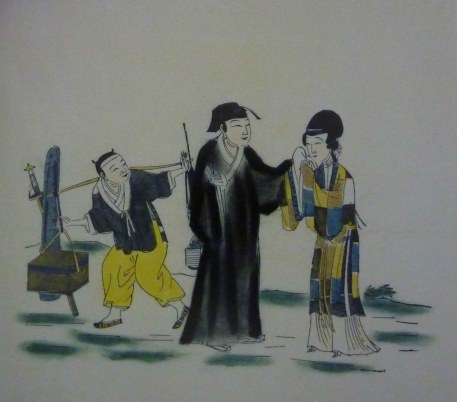
Three Journeys to the West from China

December 30, 2014

No, this post is not about immigrants, tourists or Chinese armies invading America, because Chinese troops would have to swim the Pacific Ocean since China’s navy isn’t large enough to move a military force of that size.

For instance, China has one 26-year-old used, conventional aircraft carrier with 54 aircraft. The U.S. has twenty with three under construction with almost 100 aircraft on one carrier.

But this post is about China’s classic novel, “Journey to the West”, also known “The Monkey King”.

There are four novels that are considered Chinese classics—Romance of the Three Kingdoms, Dream of Red Chamber, Journey to the West and The Outlaws of the Marsh (some of these classics have been released with other titles), and there are three Chinese books titled “Journey to the West”.

One Journey to the West is nonfiction about K’iu Ch’ang Ch’un, who visited Genghis Khan in Persia between 1221 and 1224.

The second Journey to the West is another nonfiction account about Hsuan-Tsang (Xuanzang,  602  – 664 AD), a Buddhist monk who traveled to India to bring back Buddhist scriptures.

The third Journey to the West is the fictional romance that introduces the Monkey King and his friend the Pig. This Journey to the West is a classic Chinese mythological novel. It was written during the Ming Dynasty based on traditional folktales. Consisting of 100 chapters, this fantasy relates the adventures of a Tang Dynasty (618-907) priest Sanzang and his three disciples, Monkey, Pig and Friar Sand, as they travel west in search of Buddhist Sutra.

_______________

Lloyd Lofthouse is the award-winning author of My Splendid Concubine [3rd edition]. When you love a Chinese woman, you marry her family and culture too. This is the love story Sir Robert Hart did not want the world to discover.

Low-Res_E-book_cover_MSC_July_24_2013

Subscribe to “iLook China”!
Sign up for an E-mail Subscription at the top of this page, or click on the “Following” tab in the WordPress toolbar at the top of the screen.

About iLook China

China’s Holistic Historical Timeline


The Private and Passionate Poetry of China

November 19, 2014

The Golden Age of Poetry in China was during the Tang Dynasty (618-906 AD).  One book of Chinese Love Poetry edited by Jane Portal (© 2004) was published by Barnes & Noble Books (ISBN 0-7607-4833-0).

I’m sure that most people outside of China don’t think of love poems when they think of China. However, there has to be a reason for more than 1.3 billion people, other than the Great Wall of China, the Pacific Ocean and the biggest mountain range on the planet, the Himalayas, which helped shelter China from some of the violence that rocked the rest of the world for centuries—at least until the Opium Wars.

For poetry lovers, Chinese Love Poetry imparts a sense of the private passion that beats in the Chinese heart. The three arts of poetry, calligraphy and painting, the Triple Excellence, are represented on the pages.

The following painting, lady weeping at parting from husband, 17th century, comes from the Qing Dynasty and the book says it is a color woodblock print on paper.

Chinese poetry is frequently personal and often linked to a particular occasion (page 9).

Deeply in love, but tonight
we seem to be passionless;
I just feel, before our last cup of wine
a smile will not come.
The wax candle has sympathy ­­–
weeps at our separation:
Its tears for us keep rolling down
till day breaks.

by Du Mu (803-852 AD)

As you can see, the Chinese are a passionate people—they just don’t dramatize these passions publicly as many Westerners do—at least until the West invaded China to force—if possible—a different set of values on China’s collective culture.

_______________

Lloyd Lofthouse is the award-winning author of My Splendid Concubine [3rd edition]. When you love a Chinese woman, you marry her family and culture too. This is the love story Sir Robert Hart did not want the world to discover.

Low-Res_E-book_cover_MSC_July_24_2013

Subscribe to “iLook China”!
Sign up for an E-mail Subscription at the top of this page, or click on the “Following” tab in the WordPress toolbar at the top of the screen.

About iLook China

China’s Holistic Historical Timeline


Why bother to censor anything in China?

June 11, 2014

There are hundreds of thousands of expatriates in China. They come from all over the globe, as the Middle Kingdom is becoming the center of the world again.

Alexandra Pearson, one of those expatriates, originated from the south coast of England, and she has lived in Beijing for almost twenty years.

Pearson is the daughter of a British diplomat and first lived in Beijing in 1982. She speaks fluent Mandarin and has traveled extensively in China.

In fact, Pearson earned a degree in Chinese at the University of Westminster then returned to Beijing in 1992 to study at the Central Conservatory of Music.

However, in 2004, she opened The Bookworm in Beijing—a bookstore, lending library, literary venue and restaurant. Today, there are locations in Beijing, Chengdu and Suzhou.

In 2006, Pearson gained a business partner in Peter Goff, an Irish journalist and another expatriate. He opened the Chengdu and Suzhou Bookworms. In recent years, there have also been literary festivals organized by The Bookworms in all three cities.

In fact, books banned in Mandarin are often available in English and/or other languages and the Chinese Communist Party does nothing to censor banned books published in those other languages. Consider the fact that learning how to read and speak English is mandatory in China’s public schools, and one has to wonder why bother to censor anything unless its another way to generate jobs and keep the people busy.

_______________

Lloyd Lofthouse is the award-winning author of My Splendid Concubine [3rd edition]. When you love a Chinese woman, you marry her family and culture too. This is the love story Sir Robert Hart did not want the world to discover.

His latest novel is the multiple-award winning Running with the Enemy.

Subscribe to “iLook China”!
Sign up for an E-mail Subscription at the top of this page, or click on the “Following” tab in the WordPress toolbar at the top of the screen.

About iLook China

China’s Holistic Historical Timeline


Adam & Eve, Ancient Astronauts and China’s Yellow Emperor

October 16, 2013

“And Moses brought forth the people out of the camp to meet with God; and they stood at the nether part of the mount. And Mount Sinai was altogether on a smoke, because the Lord descended upon it in fire: and the smoke thereof ascended as the smoke of a furnace, and the whole mount quaked greatly.”  Exodus 19:17, 18

In China no one knows for certain where the Yellow Emperor came from.… He was known as the Yellow Emperor in honor of his contributions to agriculture and the Chinese calendar. In addition to farming, his wife, Lei Zu, is credited with developing the idea of growing silkworms and creating silk. The Yellow Emperor is also noted as the creator of Chinese medicine, and the origins of Taoism and Confucianism trace their roots back to this mythical Emperor, who may have lived almost 5,000 years ago.

“Then one day, a yellow dragon descended from the sky to take the Yellow Emperor back to heaven…. Myth says, he ruled for a hundred years before leaving.”  Source: The Yellow Emperor

Is the Old Testament’s description in Exodus a space ship landing on Mount Sinai, and is the Yellow Emperor returning to heaven [on what sounds like another space ship] a myth or reality?

In addition, consider that the Biblical Moses and the Yellow Emperor were both on the earth about the same time.

Learn about ShangDi – China’s God of Creation

_______________

Lloyd Lofthouse is the award-winning author of My Splendid Concubine [3rd edition]. When you love a Chinese woman, you marry her family and culture too. This is the love story Sir Robert Hart did not want the world to discover.

His latest novel is the multiple-award winning Running with the Enemy.

Subscribe to “iLook China”!
Sign up for an E-mail Subscription at the top of this page, or click on the “Following” tab in the WordPress toolbar at the top of the screen.

About iLook China

China’s Holistic Historical Timeline


The History of Chinese Poetry

October 2, 2013

Traditional Chinese Poetry is very similar to Western poetry.  Lines in Chinese poetry may have a fixed number of syllables and rhyme was required, so ancient Chinese poetry resembles traditional English verse and is not at all like the free verse in today’s Western culture.

Modern Chinese poets have written in free verse, but many still write with a strict form.

In the end, the form is not as important as what the poem says. Western poetry often focuses on love while painting an image of the poet as a lover.

Influenced by Confucius and Taoism, the ancient Chinese poet shows he or she is a friend—not a lover and often paints a picture of a poet’s life as a life of leisure without ambitions beyond writing poetry and having a good time.

According to legend, this Chinese poet killed himself to protest the corruption of the time, and it is said that the Dragon Boat Festival was named to honor his sacrifice.

Battle
By Qu Yuan (332-295 B.C.)

We grasp our battle-spears: we don our breastplates of hide.
The axles of our chariots touch: our short swords meet.
Standards obscure the sun: the foe roll up like clouds.
Arrows fall thick: the warriors press forward.
They menace our ranks: they break our line.
The left-hand trace-horse is dead: the one on the right
is smitten.
The fallen horses block our wheels: they impede the
yoke-horses?”

Translated by Arthur Waley 1919

Note: The translation process from Mandarin to English would insure that the fixed number of syllables and rhyme required  of a traditional Chinese poem in its original language would not survive, but the contextual meaning should.

Discover China’s Holistic Historical Timeline

_______________

Lloyd Lofthouse is the award-winning author of My Splendid Concubine [3rd edition]. When you love a Chinese woman, you marry her family and culture too. This is the love story Sir Robert Hart did not want the world to discover.

His latest novel is the multiple-award winning Running with the Enemy.

Subscribe to “iLook China”!
Sign up for an E-mail Subscription at the top of this page, or click on the “Following” tab in the WordPress toolbar at the top of the screen.

About iLook China

China’s Holistic Historical Timeline