China’s Vampires

December 25, 2010

Belief in vampires is not confined to the people of Transylvania, and half humans able to transform themselves into monsters are no strangers to Chinese folklore. Some tales may be traced back to the third century AD.

Since Bram Stoker’s Dracula was published in 1897, this makes a case that vampire folklore may have originated in China and traveled west along the Silk Road almost two thousand years ago.

The Chinese vampire is called a Jiang-shi (also spelled Kaing-shi or Chiang-shih). However, Chinese vampires are different from Dracula or Anne Rice’s vampires.

Chinese folklore says the Jiang-shi is stiffened by rigor mortis and these vampires have to hop to get around.  The Jiang-shi also finds its victims by smelling your breath, so if a hungry Jiang-shi is about, it is best to stop breathing.

In the 1980s, there was a series of vampire movies produced in Hong Kong. The first in the series was Mr. Vampire (you may watch Mr. Vampire here. For parts two through ten, scroll down to the embedded YouTube series at the bottom of this post).

 
Mr. Vampire – Part 1/10
with English subtitles

Ricky Lau directed Mr. Vampire and the producer was Sammo Hung.

Chopper Time says, “Almost all of these movies are pretty watchable, but the best of the bunch was the first one, an expert horror-comedy called Mr. Vampire.

There were a few Taiwanese vampire films, which include The Vampire Shows His Teeth (a series of three films (1984-1986), New Mr. Vampire (1985), Elusive Song of the Vampire (1987) and Spirit versus Zombie (1989).

Today, Vampires stories are becoming popular in mainland China. Tom Carter, an American author and expatriate living in China, says Twilight is a popular pirated novel and some Twilight fans are now writing their own fan-fiction and vampire stores in Chinese on their Blogs.

In fact, a shop called the Vampire opened its doors recently in Beijing to sell vampire, zombie, and werewolf blood along with Satan poison and UFO fuel.

In November 2010, the China Daily reported Blood Shop drawing a thirsty Crowd.

“The shop, which opened September 20, is reportedly the first of its kind in Beijing. The storefront also has a stained-glass window adorned with a miniature vampire model sucking blood from a cup held in his skeletal hand.”

Another excellent Chinese movie is Farewell My Concubine but there are no vampires in this film.

______________

Lloyd Lofthouse is the award-winning author of the concubine saga, My Splendid Concubine & Our Hart. When you love a Chinese woman, you marry her family and culture too.

If you want to subscribe to iLook China, there is a “Subscribe” button at the top of the screen in the menu bar.

______________

Mr. Vampire continued
with English subtitles


Mr. Vampire – Part 2/10


Mr. Vampire – Part 3/10


Mr. Vampire – Part 4/10


Mr. Vampire – Part 5/10


Mr. Vampire – Part 6/10


Mr. Vampire – Part 7/10


Mr. Vampire – Part 8/10


Mr. Vampire – Part 9/10


Mr. Vampire – Part 10/10


The First Cinderella

December 23, 2010

Since I wrote about fairy tales yesterday, I thought I’d write about a fairy tale today and let you know that the first known literary version of Cinderella in the world was published in China.

There is a myth that an earlier version existed in Egypt around the first century. If true, since Egypt did not have printing presses then, this may have been an oral story told around camp fires.

However, in 850 AD during the Tang Dynasty, the Chinese version of Cinderella was about a girl called Yeh-hsien. Source: Tales of Faerie

Although this video claims the Chinese Cinderella had bound feet, according to Bound Feet Women, foot binding didn’t appear in China until the Sung Dynasty (960-1276 AD), more than a century after Cinderella was first published.

The French version of Cinderella wouldn’t be published by Charles Perrault until 1697.  Then another version of Cinderella would appear in 1867 and again in 1894 in England.

In 1945, the Bolshoi Theatre in Moscow would present the premiere of Sergei Prokofiev’s ballet of Cinderella.

Walt Disney wouldn’t publish a version of Cinderella until 1946, more than a thousand years after Cinderella first appeared in China.

______________

Lloyd Lofthouse is the award-winning author of the concubine saga, My Splendid Concubine & Our Hart. When you love a Chinese woman, you marry her family and culture too.

If you want to subscribe to iLook China, there is a “Subscribe” button at the top of the screen in the menu bar.


Cinema Romance Gaining Popularity in China

December 9, 2010

Romance is in the air in China’s cinemas, and Tom Carter showed us how the Western Romeo and Juliet concept of romance got its start in China in 1995 when Harlequin (US  Romance publisher) received permission “to bring romance to millions of Chinese women”.

That beginning grew to more than a thousand romance novels written by mainland Chinese authors last year.

The growing interest in fictional romance has also spilled seriously into mainland Chinese film.

Cfensi (a source for Chinese entertainment news) says that recently, modern day romance movies in China have taken off. “Cinema goers in China want the choice of light-hearted entertainment from the cinema, and the Chinese film industry is rapidly accommodating that niche in the market.”


Interview with Tony Leung, who often plays the leading man in movies with beautiful actresses.

In fact, one star benefiting from this demand for romance may be “Tony Leung (who) has been called the Clark Gable of Asia, and it’s not hard to see why: he’s handsome, with the enviable frame of a man who can put on anything knowing it will both flatter him and fit him.” Source: The Times.uk

Then Tiger Cinema offers a list of Chinese Romance movies with links to “try now”. The titles for a few of these movies are revealing: If You Are the One, Some Like It Hot, All About women, L For Love – L For Lies, Call For Love, and My DNA Says I Love You.

The summary for If You Are the One says, “A story about love in comical situations depicts how difficult it often is to find the right person, but also how often we don’t realize it when love hits us at the most unexpected times.”

Cfensi says, “With China’s total box office up 44% in 2009, and 1.65 cinema screens added per day, with no signs of slowly down, this should only be one sign to look forward to of the growing diversification of China’s rapidly rising film industry.”

______________

Lloyd Lofthouse is the award-winning author of the concubine saga, My Splendid Concubine & Our Hart. When you love a Chinese woman, you marry her family and culture too.

If you want to subscribe to iLook China, there is a “Subscribe” button at the top of the screen in the menu bar.


China Bookworms

November 9, 2010

There are hundreds of thousands of expatriates in China. They come from all over the globe, as the Middle Kingdom is becoming the center of the world again.

Alexandra Pearson, one of those expatriates, originated from the south coast of England, and she has lived in Beijing for about 16 years.

Pearson is the daughter of a British diplomat and first lived in Beijing in 1982. She speaks fluent Mandarin and has traveled extensively in China.

In fact, Pearson earned a degree in Chinese at the University of Westminster then returned to Beijing in 1992 to study at the Central Conservatory of Music.

However, in 2004, she opened The Bookworm in Beijing—a bookstore, lending library, literary venue and restaurant. Today, there are locations in Beijing, Chengdu and Suzhou.

In 2006, Pearson gained a business partner in Peter Goff, an Irish journalist and another expatriate. He opened the Chengdu and Suzhou Bookworms. In recent years, there have also been literary festivals organized by The Bookworms in all three cities.

Discover more about China from another expatriate with Tom Carter’s China: Portrait of a People

______________

Lloyd Lofthouse is the award-winning author of the concubine saga, My Splendid Concubine & Our Hart. When you love a Chinese woman, you marry her family and culture too.

If you want to subscribe to iLook China, there is a “Subscribe” button at the top of the screen in the menu bar.


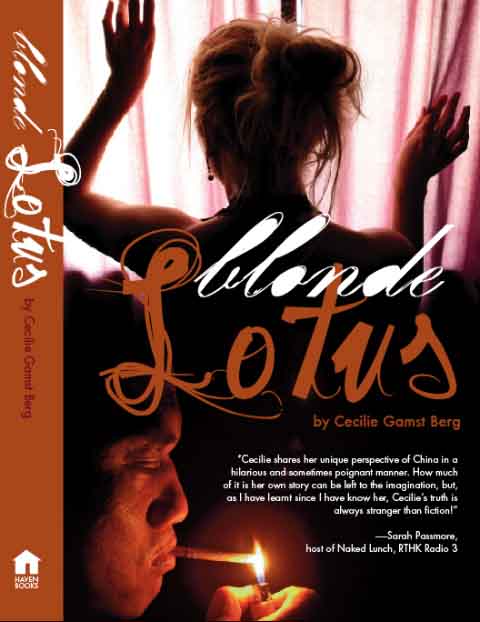
Blonde Lotus

October 11, 2010

Guest Post (book review) by Tom Carter

If there ever was an expat author in the Middle Kingdom whose enthusiasm and love of life was as contagious as Cecilie Gamst Berg’s, then that person has yet to be published.

Part travelogue of a directionless backpacker, part bedtime stories of a frisky European babe who enjoys seducing young Chinese guys “out of the festering prison of virginity,”

Blonde Lotus is in fact one in the same person.  Gamst Berg, via her alter-ego protagonist Kat Glasø, accidentally arrives in late-1980’s China (“all I wanted was to be on the train; I had no interest in the journey’s destination, Beijing”), back when the mighty bicycle was still king of Peking and foreign tourists were a rare sighting.

Expecting a people with “long, billowing sleeves, reciting poetry and plucking at stringed instruments,” what Kat finds in New China instead are street corners populated with shady money changers and young hipsters whose knowledge of English is limited to the words ‘Okay-la’ and ‘Sex!’  Lulled by their charming incessancy, Kat shrugs her shoulders and good-naturedly gives it to them – the money AND the sex.  “How could so many men find the women of a race attractive, and so few women find the men the same,” she ponders postcoitally over a shared Zhongnanhai cigarette.

Queen gweipo (devil woman in Cantonese) Gamst Berg is an unpretentious, fun-loving writer with nothing to prove.  She’s not out to save China as so many a self-righteous foreigner here are (“I hope this country never modernizes” Kat admits in one of her many blunt moments of sincerity), she’s not trying to force feed them Faulkner (“I loved books and he never read one”), nor is she out to land a career in journalism like the rest of us.

No, the author is clearly just looking to have a good time (“We were young, stoned and in China”), and maybe learn some Putonghua while doing it, and therefore spares us the sappy, sympathetic observations and “deep understanding” of life in China that makes most Laowai Literature such a torture to read.

Conversely, nor is Gamst Berg out to tear Communism apart, vilify Chinese people or point and laugh at the “strangeness” of their culture, a common last-resort for some western travel writers (whom I refrain from naming as a professional courtesy) who don’t want to admit that they have learned nothing about the Chinese during their stay here.

Indeed, while her fellow expats spend their time in China sitting around at bars “shouting out orders in English, and when they weren’t understood, complained loudly to each other about how stupid the Chinese were,” rather than join in, Kat moves tables, literally and figuratively, to the Chinese side of the bar.

Instead of whining about China’s infamously filthy public toilets, Kat hangs out in them (smoking dope), then laughs when there’s a line of squeaming girls waiting to use the stall. 

Rather than bitch about the People’s Republic’s chaotic queues at its railway stations, she jumps right in, elbows swinging, with the rest of the seething proletariat.

Our Blonde Lotus ain’t no saint, and she would laugh in your face if you dared suggest it.  “I wanted to experience everything and sleep with everybody…” confesses, nay, asserts the Norwegian-born Kat Glasø – and then proceeds to actually do so, from coal-and-petrol-scented industrial North China all the way down to the steamy islands of Hong Kong, her final destination.

Throughout her candid memoir, the author employs an uproarious combination of reluctant intellectualism (“learning Chinese was better than being in love because there was no danger of waking next to the Chinese language wanting to kick the f*cker out of bed”) and ribald hedonism (“I felt something push into me, shudder and expire. Was it an asparagus?”) that is sure to win Gamst Berg as many fans as frighten them away.

If Blonde Lotus is a window into China, then that window has been fogged with the sultry breathe of its occupants.  If it is a work of reportage; then the author was too distracted by eating, drinking, smoking and playing cards with the peasantry to be concerned about making the front page.  And that nonchalance, that self-depreciating humor, is exactly this novel’s charm.

Blonde Lotus is a refreshingly unserious memoir of an infectiously upbeat young woman (this reviewer’s favorite line in the whole book: “Ha ha, life was perfect and made for me!”) who, lost in China and unsure of what she wants to do with said life – as many of our kind are – inadvertently ends up making a new, better one for herself.

__________________

Travel photographer Tom Carter is the author of China: Portrait of a People (San Francisco Chronicle Book Review), a 600-page China photography book, which may be found at Amazon.com.

Discover more “Guest Posts” from Tom Carter with Is Hong Kong Any Place for a Poor American?

If you want to subscribe to iLook China, there is a “Subscribe” button at the top of the screen in the menu bar.