Ah Bing and “Reflection of the Moon”

October 26, 2011

To understand another country’s history and culture, one should listen to the music, read that country’s novels and watch its films.

This summer, my wife and daughter returned from China with dozens of original Chinese films on DVD.

Then I saw Reflection of the Moon, (ISBN: 7-88054-168-3), which is about Ah Bing (1893 – 1950), a famous master of the Chinese Erhu, who overnight—in 1950 shortly before his death—became a national sensation as radios throughout China played his music.

Fortunate for me, Ah Bing’s story had English subtitles, which were not of the best quality and true to form for a Chinese movie filmed in 1979 (shortly after the end of the Cultural Revolution in 1976), the plot was melodramatic with traces of propaganda that favored the Chinese Communists.

However, to be fair, in 1950, the Civil War was over and the Communists, with support from several hundred million peasants, had won.

Mao’s Great Leap Forward and the Cultural Revolution would not begin for years and for those that survived the purges in 1949 and 1950 (mostly abusive land owners and drug dealers accused of crimes by the people they may have abused and victimized), Mao fulfilled his promises of land reforms.

To understand the era of Ah Bing’s life, much of China (including Tibet) was still feudal in nature, and the upper classes often took advantage of the peasants and workers as if they were beasts of burden treated as slaves.


This is one of Ah Bing’s masterpieces for the Erhu—Moon Reflected in the Second Spring (二泉映月)

Ah Bing’s real name was Hua Yanjun. His knowledge of traditional Chinese music and his talent as a musician went mostly unnoticed until the last year of his life in 1950, shortly after the establishment of the People’s Republic of China.

In 1950, two musicologists were sent to his hometown of Wuxi to record and preserve his music. At the time, he was ill and hadn’t performed for about two years. Six of his compositions were recorded that are considered masterpieces. It is said that he knew more than 700 pieces—and most were his compositions.

As “Reflection of the Moon” shows, the lyrics of some of his music criticized the KMT (Chiang Kai-shek’s Nationalist government), and he was often punished for speaking out through his music. If you have read of The Long March, you know that the peasants did not trust the KMT, but they did trust the Communists and that trust was earned between 1926 and 1949—a period covering twenty-three years, and most rural Chinese of that era still think of Mao as China’s George Washington.

Before the Great Leap Forward and the Cultural Revolution, China’s Communist Party treated the peasants and workers with respect while the KMT did not earn that trust.

In fact, Ah Bing’s story and music is still so popular that the Performing Arts Company of China’s Air Force performed Er Quan Yin, an original Western-style Chinese opera, in 2010. Source: China Daily

To discover more of the time-period that Ah Bing lived, see The Roots of Madness.

______________

Lloyd Lofthouse is the award-winning author of The Concubine Saga. When you love a Chinese woman, you marry her family and culture too. This is the love story Sir Robert Hart did not want the world to discover.

To subscribe to “iLook China”, look for the “Subscribe” button at the top of the screen in the menu bar, click on it then follow directions.


Snow Flower and the Secret Fan – a movie review

July 16, 2011

This film (based on a novel by Lisa See) is the story of four women and of the complexities of China — Lily and Snow Flower live in 19th century Southwest China, while Nina and Sophia live in 21st century Shanghai.

The characters of Lily and Nina are played by Bingbing Li and Sophia and Snow Flower by Gianna Jun. The director is Wayne Wang, who worked on The Joy Luck Club among other films.

Even in the 19th century, Shanghai was a world apart from Southwest China and still is.  It is safe to say that the day-to-day grind of life probably hasn’t changed much (except for foot binding and more freedom for women) in remote rural villages in Southwest China, which is off the beaten track of most foreign tourists that visit China on fast-paced packaged tours.

I read Lisa See’s novel soon after it came out and although I enjoyed the book and felt it was well written, I couldn’t understand why it stayed on the New York Times Bestseller List as long as it did.  And to be honest, I still don’t. However, if there was a formula to predict why a few books are wildly successful and many fail, no one has discovered it yet.

The original story Lisa See wrote shows a small part of China and in no way represents all of China and all things Chinese. That would be a challenge since China is a diverse land with many spoken languages and cultures and one written language and a very long history.

From what I recall, Snow Flower and Lili, the characters in 19th century China, live in Southwest China and belong to one of China’s fifty-six minorities, which have unique cultures apart from China’s Han majority, and as children these two girls are sworn to be loyal friends for life.

Considering what life was like in China for woman in the early 19th century, it is understandable why such a custom would have evolved.  However, to be clear, I will remind the reader that women were mostly treated this way everywhere in the world at that time, and many still are outside the US, Europe and China. Sex slavery and abuse of women still exists in many countries such as Africa, Southeast Asia and the Middle East.

Fortunate for me, I read the reviews of this film in the New York Times and the San Francisco Chronicle after I saw the film.

These reviews, written by Sino-blind Americans, demonstrate no clue that the real purpose of this movie may have been to highlight China’s past and present and not as another cloned US movie such as two I saw recently, which reflect what is mostly popular in America. Both of these American movies, Transformers 3: Dark of the Moon and Horrible Bosses, lacked depth without a soul, and I cannot recommend them to anyone. However, I must admit that I’m capable of enjoyed both depthless movies and films with depth such as Snow Flower and the Secret Fan.

I’ve been to China many times and sat in movie theaters watching movies made in China for a Chinese audience and this movie, to me, is a Chinese film with Chinese actors and actresses set in China.  After all, a Chinese film company was behind its production and the director is Chinese.

Most Chinese do not think like the average American that is often stuck on a linear path incapable of seeing the meaning between the lines. However, Chinese think metaphorically meaning if you want to understand and enjoy this film, look between the lines and learn from what is hidden in sight?

As we travel with the ancient (19th century) and modern (21st century) sworn sisters with scenes that shift from past to present, we discover that although there is more personal freedom in China today than there was almost two centuries ago, life still comes with no guarantees.  The scenes in modern Shanghai show a city in transition with old being torn down being replaced by new as if China is emerging from a cocoon. I saw this transition as a metaphor.  The scene where Nina is taking off her high heels and rubbing her feet compared to the ancient Lili (both played by the same actress) taking off her three-inch shoes and rubbing her bloodied, painful bound feet demonstrates how far China has evolved.

In fact, because this film is more Chinese than the novel written by American born and raised Lisa See, I feel it captured more of a sense of China than the novel did.

For those reasons, I cannot agree with most of the American media critics that trashed the film.  Of course, to be fair, Snow Flower and the Secret Fan would be considered a failed and flawed film to most Western critics because it is a Chinese film adapted from a Western book.

Snow Flower and the Secret Fan is more than just a disjointed film jumping clumsily between centuries. This film represents China and the complexity of Chinese civilization and it demonstrates how much China has changed while so much that is often out of sight of most foreigners stays the same.

If you have the patience to suspend your Western values and expectations of what movies should offer and want to discover something new, I recommend seeing this film. But be warned, since this film is Chinese (in my opinion), it pushes the melodramatic envelope beyond what most Americans are comfortable with.

Shallow thinkers that flock to see movies such as Transformers 3, Horrible Bosses, The Zookeeper, and Cars 2, etc. may want to avoid Snow Flower and the Secret Fan.  However, if you are an individual that enjoys learning and expanding your horizons, go — and take a box of tissues.

Also discover Balzac and the Little Chinese Seamstress and/or Farewell My Concubine

______________

Lloyd Lofthouse is the award-winning author of The Concubine Saga. When you love a Chinese woman, you marry her family and culture too. This is the love story Sir Robert Hart did not want the world to discover.

To subscribe to “iLook China”, look for the “Subscribe” button at the top of the screen in the menu bar, click on it then follow directions.


Linking the Dragon Boat Festival to Rice Cakes

June 10, 2011

A friend reminded me of the Dragon Boat and Rice Cake Festivals that took place in China earlier this month.

These festivals came about because of the suicide of Ch’u Yuan (343 – 289 BC), an aristocrat of the Ch’u State. He is considered one of ancient China’s greatest and earliest recognized poets.

History/myth tells us that the festival celebrates and honors Ch’u Yuan, who drowned himself in the Mi Lo River as a protest against his government’s actions.

What we do know is that when he was banished from his home, he left in despair feeling his exile was unjust. As he traveled about, he wrote poetry, observed shamanistic folk rites, and learned of legends that influenced his work.

The Dragon Boat Festival, held on the fifth month of the Chinese lunar year, originates from the search for the poet’s body. A popular legend says villagers raced in their boats to the middle of the river and desperately tried to save him, but were unsuccessful. They threw the rice filled dumplings or rice cakes into the water as a food offering to distract the river’s god and the fish away from his body.

The Dragon Boat Festival is also celebrated in San Francisco (and many other cities around the world) and I learned that a Dragon Boat race takes place in San Francisco Bay. While Dragon Boat races are being held in China this month, San Francisco holds its races in September 17-18, 2011 from Treasure Island.

In Beijing, China, the Dragon Boat Festival, also known as Duanwu Festival, was celebrated early in June.

As for the rice cakes, I suggest watching the embedded YouTube video to see how they are made, which demonstrates a process similar to how my wife makes them.

However, besides the essential sticky rice, the other ingredients are optional.  Sticky rice cakes may also have raisins and black beans added. For centuries, Silk Road caravans leaving China carried rice cakes as rations since they have a long shelf life.

When I checked a list of China’s Public Holidays, the only one listed for June was the Dragon Boat Festival. Then I read that “Zongzi”, traditional rice cakes wrapped in bamboo leaves, are eaten during the Dragon Boat Festival, which is a three-day holiday.

Discover more about Chinese dragons

______________

Lloyd Lofthouse is the award-winning author of the concubine saga, My Splendid Concubine & Our Hart. When you love a Chinese woman, you marry her family and culture too.

To subscribe to “iLook China”, look for the “Subscribe” button at the top of the screen in the menu bar, click on it then follow directions.


The Butterfly Lovers

March 25, 2011

Recently, I received a comment on my Romeo and Juliet in China post. Y Chan wrote that there were two Chinese tragic love stories similar to Romeo and Juliet.

Chan said, “You probably cannot be regarded as knowing Chinese culture if you do not know these two love stories.”

One of the stories Chan mentioned was The Butterfly Lovers. The other was “the story of Lady White Snake“, which first appeared in 618 AD during the Tang Dynasty.

I’ve heard of The Butterfly Lovers before. The basic premise is of a young woman in China wanting to go to school. Since boys were the only ones allowed to attend school, this young woman, like Barbara Streisand in the movie Yentl (1983), disguised herself as a boy.

Yentl was based on Isaac Bashevis Singer’s (1902 – 1991) short story Yentl the Yeshiva Boy.

When I mentioned what Chan wrote in the comment, my wife found her copy of a popular theme song of The Butterfly Lovers played as a violin solo by Yu Lina. As the house filled with the music, which may also be found on the following embedded YouTube video, my wife started to dance.

She said, “This is one of my favorites. I cannot resist dancing when I hear it.”

In fact, Yentl the Yeshiva Boy and Shakespeare’s (1564 – 1616) Romeo and Juliet must be combined to become The Butterfly Lovers. In The Butterfly Lovers what begins as a charade becomes a love story ending in the suicide of two young lovers.

The legend of The Butterfly Lovers first appeared during the Jin Dynasty 1600 years ago. The love story of Liang Shanbo and Zhu Yingtai is one of four Chinese folk legends and one of the most influential and best known in China.

China has traded with the West since the Han Dynasty (206 BC – 219 AD). There was an overland route in the north and a sea route in the south, which the Roman Empire used around the time of Christ.

Since China has traded with the West for more than two thousand years, it is conceivable The Butterfly Lovers reached the West and was adapted by Shakespeare and Singer after being exposed to the plot.

______________

Lloyd Lofthouse is the award-winning author of the concubine saga, My Splendid Concubine & Our Hart. When you love a Chinese woman, you marry her family and culture too.

If you want to subscribe to iLook China, there is a “Subscribe” button at the top of the screen in the menu bar.


“The Altethlon Chronicles” – China’s Answer to Harry Potter

February 8, 2011

Guest review by Tom Carter

China’s love affair with superstition, pseudoscience and the fantastical may be traced back over five millennia, whence some of history’s oldest myths and legends originated.

Journey to the West (Xi You Ji), published anonymously by scholar Wu Cheng’en in the 16th century Ming Dynasty, remains China’s most beloved fantasy story.  Considered one of the “Four Great Classical Novels” of Chinese literature, the 100 chapters of ‘Journey’ are replete with monkey kings, flesh-eating demons, immortal sages and celestial battles.

When science fiction became all the craze in 1950’s America, Red China followed suit by founding its first sci-fi periodical.

However, unlike the west, where rapid advances in the tech sector fueled science fiction, China promoted sci-fi to help inspire its own dormant technological progress.

Conversely, about the same time during the 70s when American director George Lucas was preparing to film a little space opera called Star Wars, the Cultural Revolution was banishing all China’s scientists to hard-labor communes.

Indeed, where the Chinese have categorically failed in speculative fiction (programming on the Communist-controlled CCTV is evidence enough that future perspective is held in little regard here: of China’s 19 official television channels, all feature serials set in olden times, some in the present, none about the future), they remain masters of mythology and purveyors of the past.

Present-day PRC is seeing a renaissance of the fantasy genre.  The wuxia-inspired Chinese film Crouching Tiger, Hidden Dragon was a critical and commercial success, generations of young, Chinese cyber-punks are hopelessly addicted to the virtual sorcery of World of Warcraft, and Harry Potter remains China’s “most pirated novel ever”.

Even so, no Chinese author has ever been able to replicate the success of Journey to the West; as a result, publishing houses in the Middle Kingdom prefer to translate western best-sellers such as Lord of the Rings and Narnia rather than take their chances on local fantasy fiction writers.

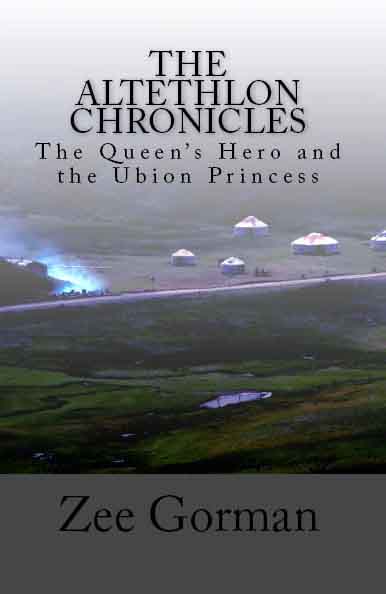
Enter Zee Gorman (nee Yan Zi-hong) China’s response to J.K. Rowling.

Born in Guangdong province during the Cultural Revolution (both her parents were exiled to the countryside for being “intellectuals”), Zee was raised on a literary diet of propaganda and scar literature.

Rather than publish a clichéd daughter-of-the-Revolution memoir about her hardships, the aspiring author opted for the escapism of fantasy. Hence, her decades-in-the-making debut novel, The Altethlon Chronicles.

A high-fantasy fiction set in a parallel universe either far in China’s future or in its past, The Altethlon Chronicles is a complex blend of military, history, romance and sorcery.

Leading the rich cast of green-eyed, purple-skinned characters is the royal yet rebellious teen Ximia (“what kind of princess are you anyway, running around like a wildcat?”) and her forbidden lover, Nikolas, the leader of a rival tribe – a tumultuous relationship most likely inspired by Zee’s own experience with cultural clash when she immigrated to the U.S. and married an American.

Ximia is misled into believing that Nikolas has been killed during an escape attempt, whereby the princess is married off by her father to a dastardly lord.  The two young warriors go on to lead their respective armies until the day when destiny arranges for them to meet again in battle.

Lots of magic, weird names and epic battles of Tolkien proportions (note: this reviewer has never actually read a J. R. R. Tolkien book; I just thought it sounded cool to say that) ensue.

In creating this alternate world, Zee draws heavily on her Chinese heritage.

Kingdoms such as Manchuli, Dalong and Taklaman are each reminiscent of real regions in China.

Nonetheless, Zee, who is bi-lingual and holds dual degrees in English Literature, chose to write The Altethlon Chronicles in her second language and self-publish in America rather than risk having it pirated in China’s nascent fantasy market.

Some realities are worth escaping.

Discover Blond Lotus, another book review by Tom Carter.

____________________

Travel photographer Tom Carter is the author of CHINA: Portrait of a People, a 600-page book of photography from the 33 provinces of China, which may be found on Amazon.com.

If you want to subscribe to iLook China, there is a “Subscribe” button at the top of the screen in the menu bar.