The Double Menu Caper

April 3, 2010

Our hotel was outside Xian’s city walls.  We had a view of the battlements that were centuries old. At night, the walls and towers were outlined with white Christmas lights.  I ached to get up there and walk those walls.  It was 1999, and I’d wait more than nine years before that happened.

Our second day in the city, we walked from the hotel into the city to a Xian restaurant. I went in first and the hostess, who didn’t speak a word of English, handed me a menu written in English.

This is a different restaurant from the one I mention.

My wife, dressed more like a Chinese peasant than an American, came in after me and she was handed a menu in Chinese. My wife glanced at my menu. She took it out of my hands and gave it back to the hostess.

“We’ll use the Chinese menu,” she said. The prices in Mandarin were less than half the English version.  A stunned look appeared on the hostesses face.  It was a Candid Camera moment, and it was all I could do to avoid laughing.

See I ate no Dog, I Ate no Cat, Guest post by Bob Grant http://wp.me/pN4pY-8y


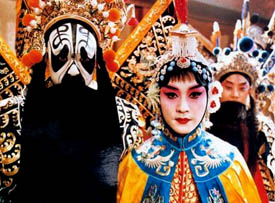
Farewell, My Concubine

April 2, 2010

Chen Kaige, self-trained as a filmmaker, was the director for this award winning 1993 film. Prior to “Farewell, My Concubine“, Chen received modest acclaim for the “Yellow Earth” and “The Big Parade”. With “Farewell, My Concubine,” he won the Palme d-or in Cannes.

Farewell, My Concubine

Although the film is in Mandarin with English subtitles, the story captured me from the beginning. If you are interested in Chinese history, this film spans several decades beginning near the end of the Ch’ing Dynasty. On the surface, it is just a story of two boys who happen to become famous, but have their difficulties like most of us lesser mortals do. However, the setting shows the  transformation of a nation from the Ch’ing Dynasty to a warlord dominated republic, the Japanese invasion of World War II and then Mao’s Cultural Revolution.

I saw this movie a decade ago and I remember this powerful, dramatic story of one man’s life from the day his mother took a knife and chopped off an extra finger on each hand so he would have five instead of the six he was born with.

The main character is apparently modeled after an actual person—Peking Opera superstar Mei Lanfang—some may imagine that Lanfang was ‘gay’. However, he only specialized in male roles. He was married at least three times and had children.

Discover Not One Less

______________

Lloyd Lofthouse is the award-winning author of The Concubine Saga. When you love a Chinese woman, you marry her family and culture too.  This is the love story Sir Robert Hart did not want the world to discover.

To subscribe to “iLook China”, look for the “Subscribe” button at the top of the screen in the menu bar, click on it then follow directions.


The Orphan’s Life

April 2, 2010

More than 90% of babies in Chinese orphanages are girls. Prior to 1949, it was common for parents to murder girl infants. From the 1950s to the end of the 1970s, due to Mao’s leadership and a tough stance for women’s equality, the death rate went down. Then in the 1980s, with the population growing too fast, a desperate government implemented the one-child policy.

After that, many girl babies went missing or were abandoned to state-run orphanages. To end this tragedy, the government eventually allowed rural families to have two children per family—hoping for a boy.

The conditions in these rural, state-run orphanages are often not ideal. Girls, who are not adopted, usually end up being the caregivers for the younger children. Since these orphan caregivers were raised without the love of parents and siblings, they may not be loving themselves creating a cold environment to grow up in.
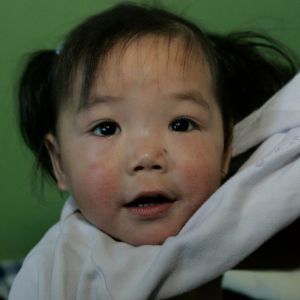
abandoned at birth

It isn’t as if China’s government has done nothing to stop a practice that has been around for thousands of years. During the 90s, tougher laws were passed but often ignored. Government inspectors were sent to rural areas to enforce these laws, but it isn’t easy controlling a population of 1.3 billion scattered over a mountainous country almost the size of the United States.

I will not criticize the Chinese government for these conditions. I’ve been to China and understand the challenges. What would you do if you had inherited a medieval country in 1949 that was bankrupt due to the Kuomintang looting the banks and treasury as they fled to Taiwan under American protection? Then there is a culture reaching back thousands of years where girls were considered worthless. That is a lot to overcome.

Discover Gendercide in China and India, and also see the conclusion of one orphan’s journey in Saying Goodbye

______________

Lloyd Lofthouse is the award-winning author of The Concubine Saga. When you love a Chinese woman, you marry her family and culture too. This is the love story Sir Robert Hart did not want the world to discover.

To subscribe to “iLook China”, look for the “Subscribe” button at the top of the screen in the menu bar, click on it then follow directions.
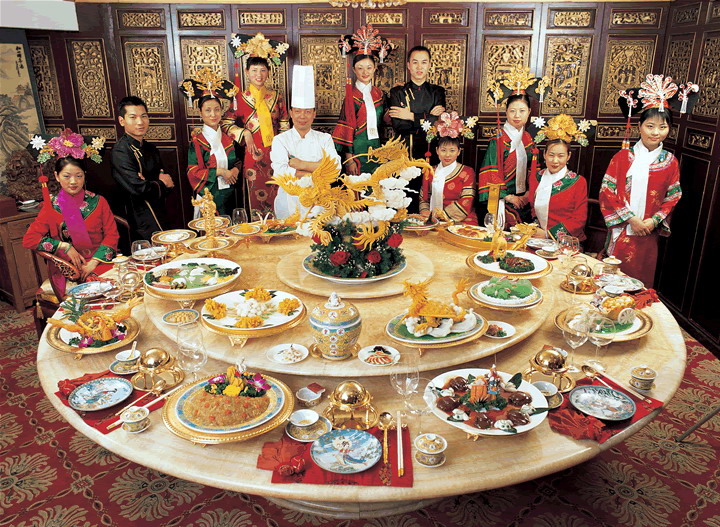

Peking Opera

April 1, 2010

Peking Opera is a combination of several styles of Chinese opera.

The metamorphosis started during the Qing Dynasty (1644-1911), about two hundred years ago.

Peking Opera focuses on historical events, legends about emperors, ministers, generals, geniuses and great beauties.

Performances are a combination of singing, dialogue, pantomime and acrobatic fighting and dancing.

Today, Peking Opera is considered the highest expression of Chinese culture.

The origins of Peking Opera did not begin in Peking (Beijing).  The opera had its start in the Chinese provinces of Anhui and Hubei.

Experts say the opera was born in 1790 and was originally staged for the royal family and then the public.

There are thousands of these operas that cover the history and literature of China. Peking operas can be divided into two categories.

“Civil” operas focus on singing while “Martial” operas feature acrobatics and stunts.  Some are a combination of both.

If Peking Opera interests you, see Chinese Yu Opera with Mao Wei-tao

______________

Lloyd Lofthouse is the award-winning author of The Concubine Saga. When you love a Chinese woman, you marry her family and culture too. This is the love story Sir Robert Hart did not want the world to discover.

Subscribe to “iLook China”!
Sign up for an E-mail Subscription at the top of this page, or click on the “Following” tab in the WordPress toolbar at the top of the screen.

About iLook China


Flexible China – Inflexible America

April 1, 2010

Imagine a piece in the Op-Ed section of the NY Times, a media bastion for liberal democracy, saying China is more open to change than the United States.

“China may be more open to fundamental political reform than the United States. Since the rule of law in America is based upon the notion that the state itself is constrained by a body of pre-existing law that is sovereign, any thought of rewriting the Constitution is anathema.” Source: The Fault Lines of Democracy

Changes in the United States often end up mired in partisanship between the two major political parties. Consider that the Equal Rights Amendment (proposed in 1921) in America still is not part of the Constitution. The movement to gain freedom for women started in 1841 while changes in China to improve women’s lives started in 1949, when Mao said, “Women hold up half the sky.”

Consider that the juvenile justice system in China is considering changes after a delegation from China came to America to examine what the United States juvenile justice system was like.

Discover more about China Law and Justice System

_______________

Lloyd Lofthouse is the award-winning author of the concubine saga, My Splendid Concubine & Our Hart. When you love a Chinese woman, you marry her family and culture too. 

Sign up for an RSS Feed for iLook China