The Three Key Principals of Sun Tzu’s “The Art of War”

August 19, 2010

1. Know your enemy and know yourself and in 100 battles, you will never be in peril.  In the Art of War, understanding your opponent is crucial to victory.

2. To win 100 battles is not the height of skill – to subdue the enemy without fighting is.  Fighting costs lives and money.  Sun Tzu prizes the general who can outwit instead of outfight his opponent.

3. Avoid what is strong.  Attack what is weak. Throughout history, armies battle to show their strength and courage. However, Sun Tzu does not care about glory.  His only goal is to win.

For more than a thousand years, Sun Tzu’s secrets were kept hidden and made available only to Chinese emperors and authorized scholars. The Art of War surfaced in eighth-century Japan and spread throughout the world from there.

Today, what can be learned from The Art of War also applies to sports, politics, education and business.

Continued in Sun Tzu’s The Art of War – Part 1 or discover Dictatorship Defined

______________

Lloyd Lofthouse is the award-winning author of The Concubine Saga. When you love a Chinese woman, you marry her family and culture too. This is the love story Sir Robert Hart did not want the world to discover.

Subscribe to iLook China — there is an “E-mail Subscription” link at the top of the screen.

About iLook China


Sun Tzu’s “The Art of War” – 1/10

August 18, 2010

Around 500 BC, the King of Wu summons Sun Tzu, one of the greatest military minds in history, to save his kingdom from a more powerful enemy.

Sun Tzu was a warrior, a philosopher and the author of The Art of War.

Sun Tzu is important because he had a cohesive, holistic philosophy on strategy.  Sun Tzu tells the King of Wu he can defeat the enemy with a smaller army.  Doubting him, the king challenges Sun Tzu to turn the palace concubines into a fighting force and Sun Tzu accepts.

Sun Tzu shows the concubines what to do, selects the best two students and puts them in charge of the others.  When Sun Tzu orders the exercise to begin, the woman laugh.

He tries again but the concubines laugh again.

Sun Tzu says, “If instructions are not clear and commands not explicit, it is the fault of the general.  But if the orders are clear, and my orders are clear, it is the fault of the subordinate officers.”

Without warning, Sun Tzu beheads the two concubines he had selected to lead the others.  To Sun Tzu, war is a matter of life and death. This is the key principal of his teachings.  Once understood, everyone from the general to the solider will be motivated to win.

While the bodies of the first two concubines are still warm, Sun Tzu appoints two new concubines to lead the others. This time the concubines follow his orders without hesitation. The king of Wu is convinced and  appoints Sun Tzu commander of the Wu army.

Sun Tzu now must train an army of 30 thousand troops to fight a force ten times larger.

Go to Sun Tzu’s “The Art of War” – Part 2

Lloyd Lofthouse is the award-winning author of My Splendid Concubine [3rd edition]. When you love a Chinese woman, you marry her family and culture too. This is the unique love story Sir Robert Hart did not want the world to discover.
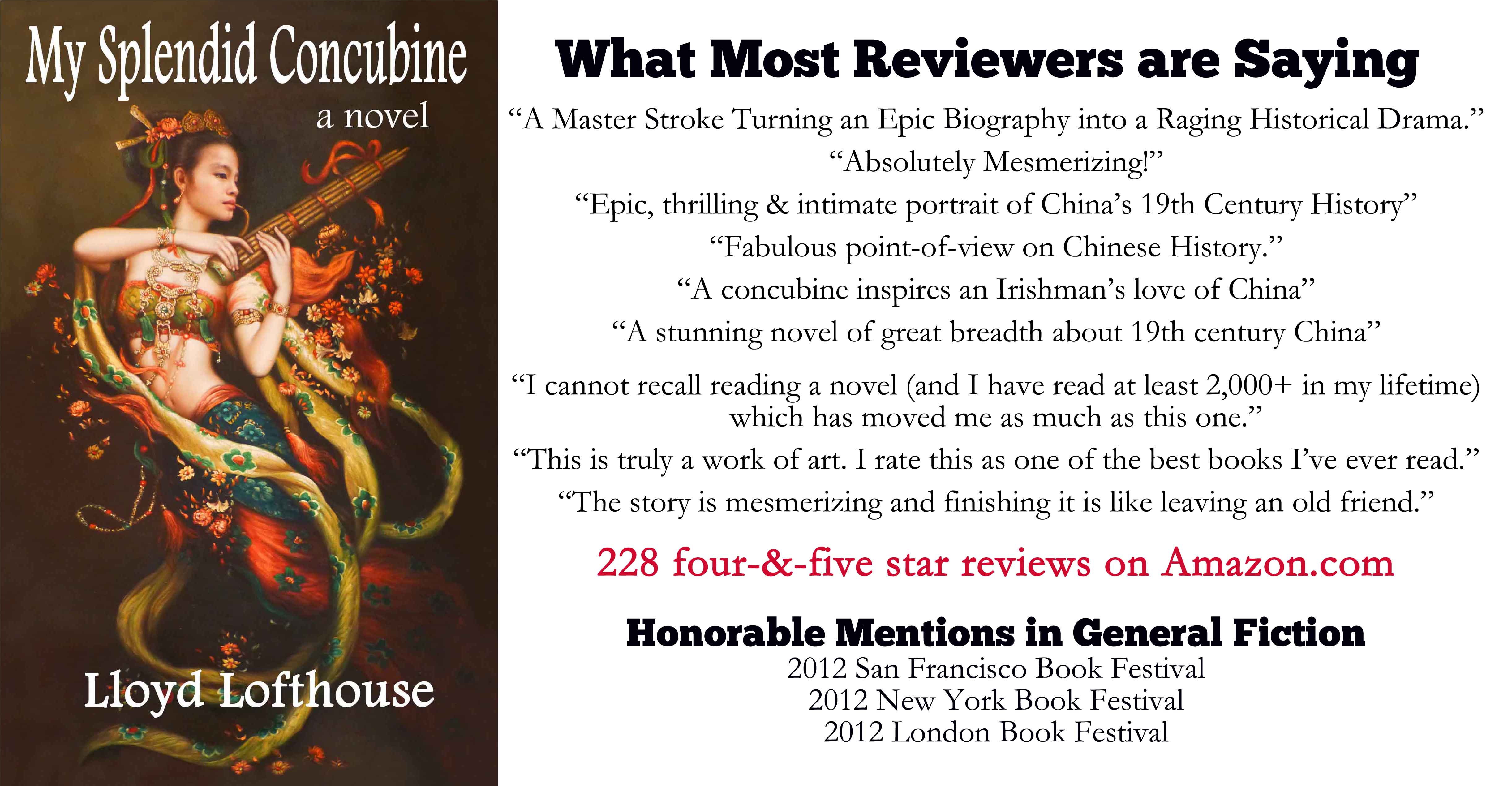
A1 on March 13 - 2016 Cover Image with BLurbs to promote novel

Where to Buy

Subscribe to “iLook China”!
Sign up for an E-mail Subscription at the top of this page, or click on the “Following” tab in the WordPress toolbar at the top of the screen.

About iLook China

China’s Holistic Historical Timeline


The Danger of Arrogance (5/5)

August 18, 2010

In the 18th century, China had no competition, and the Qianlong Emperor was not alone in his belief that China was too civilized and powerful to worry.

However, in less than a century, China would face defeat during the Opium Wars caused by England and France. The century that followed would devastate China until Deng Xiaoping’s rise to power after Mao died.

Other factors that weakened China during the 19th century, were the rebellions caused by converted Chinese Christians and Muslims that would cause more than 30 million deaths.  

Now that China has recovered its power, it would be interesting to see if the Chinese have learned from the Qing Dynasty’s mistakes.  America could also learn something from the British Empire’s arrogance and why the sun stopped shinning twenty-four hours a day on that empire.

I’m not going to hold my breath.

Return to the Danger of Arrogance – Part 4

_______________

Lloyd Lofthouse is the award-winning author of the concubine saga, My Splendid Concubine & Our Hart. When you love a Chinese woman, you marry her family and culture too. 

Sign up for an RSS Feed for iLook China


The Danger of Arrogance (4/5)

August 17, 2010

China’s 18th century arrogance is evident in the letter the Qianlong Emperor wrote to King George III.

Emperor Qianlong’s letter to King George III says, “As your Ambassador can see for himself, we possess all things. I see no value on objects strange or ingenious, and have no use for your country’s manufactures.…

“Hitherto, all European nations, including your own country’s barbarian merchants, have carried on their trade with our Celestial Empire at Canton. Such has been the procedure for many years, although our Celestial Empire possesses all things in prolific abundance and lacks no product within its own borders.

“There was therefore no need to import the manufactures of outside barbarians in exchange for our own produce. But as the tea, silk and porcelain which the Celestial Empire produces, are absolute necessities to European nations and to yourselves, we have permitted, as a signal mark of favour, that foreign hongs should be established at Canton, so that your wants might be supplied and your country thus participate in our beneficence.”

At the end of the letter, Emperor Qianlong warns King George III what will happen to any merchants who try to circumvent his laws and says, “Do not say that you were not warned in due time! Tremblingly obey and show no negligence! A special mandate!”

This exchange took place in 1793.  At that time, the Chinese didn’t need anything from any country.  In fact, for more than a thousand years, the Chinese had been more technologically advanced in printing, paper production, weaponry, etc than any country on the planet.

See Foreign Devils and Barbarians or return to the Danger of Arrogance – Part 3

_______________

Lloyd Lofthouse is the award-winning author of the concubine saga, My Splendid Concubine & Our Hart. When you love a Chinese woman, you marry her family and culture too. 

Sign up for an RSS Feed for iLook China


China Securing Its Future (3/3)

August 14, 2010

Between 1950 and 1955, Mao said that Korea and Vietnam were the gums to China’s teeth, which meant China was next.

After all, China had already lost more than 50 million people due to the West’s meddling in Asia, which started with the first Opium War.

About 5 million civilians and military died in Korea and another 5 million in Vietnam—started by Western nations that took part in the Opium Wars in China and had carved off pieces of China’s territory.

What are Americans and other Westerners going to think when they read Eric Talmadge of the Associated Press, who writes that China is developing  a missile, the Dong Feng 21D (DF21D), which will be designed to get past the defenses of the most advanced American aircraft carriers at a distance of about 1,500 kilometers or 900 miles from China’s shores? 

Since Los Angeles is more than 5 thousand miles from China’s eastern coast, the DF21D is no threat to American noncombatants.

It’s obvious that all China wants is breathing room and the ability to conduct their affairs without interference from the West which caused so much suffering and death for more than a century.

So far, China only shows signs that they take their security seriously.

If America had lost 60 million people due to invasions and war, wouldn’t the American people feel the same way?

See The Long March or return to China Securing Its Future – Part 2

_______________

Lloyd Lofthouse is the award-winning author of the concubine saga, My Splendid Concubine & Our Hart. When you love a Chinese woman, you marry her family and culture too. 

Sign up for an RSS Feed for iLook China