China Following Tradition — Part 2/4

November 6, 2010

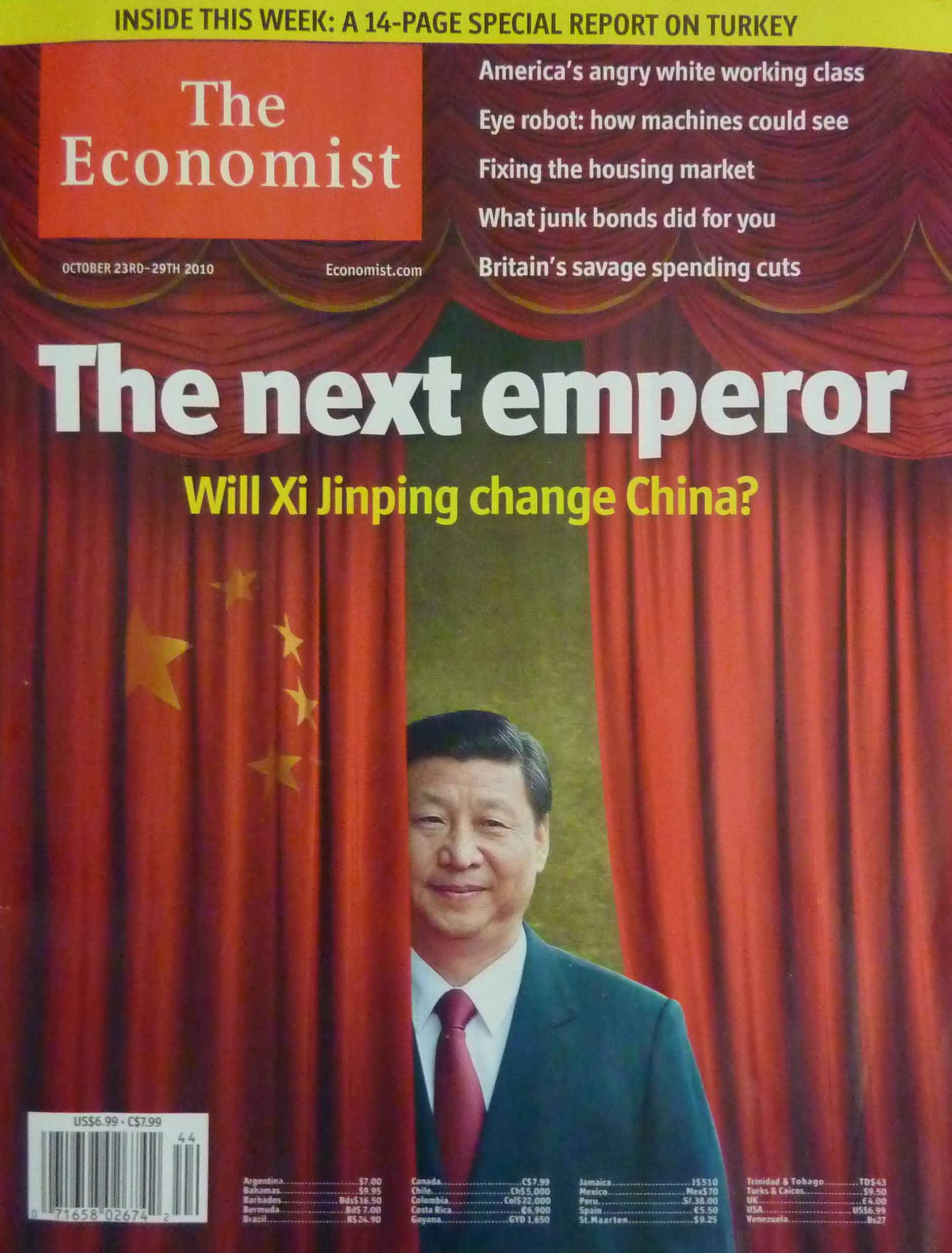
The Economist implied in the feature for the October 23 issue of the magazine, that China is a monarchy.

However, China is not a monarchy as the Kim Dynasty in North Korea has become or a dictatorship as many in the West believe.

In North Korea, what started as a Socialist Dictatorship modeled on Maoism has become a Socialist Maoist Monarchy.

China, on the other hand, started as a Socialist Dictatorship under Mao (1949 to 1976) and is becoming a fledgling republic with Western critics looking for cockroaches and slugs under rocks.

In fact, Dr. Sun Yat-sen, the father of China’s Republic, wrote that he wanted to model China’s government after America but by combining Western thought with Chinese tradition.

He did not say he wanted China to be a clone of America’s Republic.

America was still a Republic prior to World War II. The US wouldn’t become a full-fledged democracy until the 1960s.

Unfortunately, Dr. Sun died in 1925 before he could finish what he started.

It wouldn’t be until after Mao died in 1976, that the leaders of the Communist Party under Deng Xiaoping would start the long journey to implement Sun’s dream of a Republic against great pressure from Western democracies to copy them.

In Part three, I will talk about what happened after Mao died and explain what “Chinese tradition” means.

Return to China Following Tradition — Part 1

______________

Lloyd Lofthouse is the award-winning author of the concubine saga, My Splendid Concubine & Our Hart. When you love a Chinese woman, you marry her family and culture too.

If you want to subscribe to iLook China, there is a “Subscribe” button at the top of the screen in the menu bar.


China Following Tradition — Part 1/4

November 5, 2010

Three times George Washington acted in a way that would insure the newly born US Republic would survive.

His first act was in 1782, when Colonel Lewis Nicola wrote a letter to Washington suggesting that Washington should set up a constitutional monarchy because of the inefficiency of the Continental Congress.

Washington was offended at such a suggestion and wrote to Nicola telling him to banish such thoughts from his mind. Source: George Washington – Legends and Myths

His second act took place in 1783, when he stepped in and saved the republic by ending the Newburgh Conspiracy, a plot in the military to seize power and create a military dictatorship. Source: Early America

The third act was when Washington stepped down as President (1789 – 1797) and returned to his farm.

When King George III asked his American painter, Benjamin West, what Washington would do after wining independence, West replied, “They say he will return to his farm.”

“If he does that,” King George said, “he will be the greatest man in the world.” source: Cato Institute

A few days ago while at Costco, I paid for a copy of The Economist for October 23, 2010.  The cover ( in the tradition of Yellow Journalism ) promised great topics to write about.

The headline on the cover read, “The next emperor – Will Xi Jinping change China?”

As I read the feature article on page 13, I laughed when I saw, “Mr. Xi’s appointment was eerily similar to the recent anointment of Kim Jong-un in North Korea.”

The reason I saw humor in this absurd statement was that there is nothing similar. Kim Jong Un inherited his for-life position as Supreme Leader of North Korea. He is the son of Kim Jong-il, and the grandson of Kim Il-sung, the founder of North Korea.

In Part Two, I will explain the difference between China’s Republic, a dictatorship and a monarchy.

______________

Lloyd Lofthouse is the award-winning author of the concubine saga, My Splendid Concubine & Our Hart. When you love a Chinese woman, you marry her family and culture too.

If you want to subscribe to iLook China, there is a “Subscribe” button at the top of the screen in the menu bar.


Jack London in China

November 1, 2010

This October at the Northern California Independent Booksellers Trade Show (NCIBA), I stopped at the University of Georgia Press booth searching for a book about Jack London (1876 – 1916).

In fact, Jack London, Photographer (ISBN 978-0-8203-2967-3) by Jeanne Campbell Reesman, Sara S. Hodson and Philip Adam was there, and I have a copy in front of me as I’m writing this post.

It is a beautiful book and proves that London had talent beyond writing stories such as White Fang or Call of the Wild.

London took photos in 1904 during the Russo-Japanese War in Korea and Manchuria.

On page 57, the caption says, “London had his camera confiscated in Japan and was often detained by Japanese officials when he got too close to the front lines, especially as the war spread to the Yalu River, the boundary between Korea and Manchuria.” 

The experiences London had in Korea and China would lead to an essay and a story that ignited a debate that he was a racist.


Jack London, Socialist-Capitalist

He wrote the The Unparalleled Invasion, which takes place in a fictional 1975, when the West decides to destroy China (for no good reason) by using biological warfare. I guess the West couldn’t sell opium to China anymore.

While at the NCIBA, I had two conversations about London. One editor said she had heard that London was a racist and she had trouble believing that.  Later, another editor from the University of George Press also said he didn’t believe London was a racist.

London’s 1904 essay, The Yellow Peril, may have contributed to the claim that he was a racist. Using Google, I found sites that support this theory.

However, after seeing the pictures in Jack London, Photographer (Amazon link), it is hard to believe he was a racist.

There have also been rumors that London committed suicide but there is no evidence to support that theory either.

If London were a racist, why did his Japanese servant Tokinosuke Sekine stay loyal to the end even after London was bankrupt and his “fair weather” friends had abandoned him?

See China: Portrait of a People

______________

Lloyd Lofthouse is the award-winning author of the concubine saga, My Splendid Concubine & Our Hart. When you love a Chinese woman, you marry her family and culture too. 

If you want to subscribe to iLook China, there is a “Subscribe” button at the top of the screen in the menu bar.


Global Ignorance of Innovation

October 31, 2010

Many who live in Western democracies love patting themselves on the back and feeling superior to the rest of the world.

In The Economist for October 16, I found Innovation in China — Patents, yes; ideas, maybe, which demonstrates how ignorant some are about China. 

Since The Economist’s home office is in London, the magazine represents more than the American media—it represents the Western media and this piece was written in Hong Kong.

This isn’t the first time I’ve read about China’s reputation for trampling intellectual-property rights and that an authoritarian government couldn’t possibly compete with a democracy when it comes to innovation.

However, the conclusion points out that China is becoming more innovative and is starting to be serious about protecting intellectual property rights through China’s changing legal system.

What The Economist piece misses is that democracies do not hold a patent on innovation. For more than two millennia, innovations were rampant in an authoritarian China ruled by emperors without much of a legal system. The usual form of punishment was decapitation.

In fact, the list of innovations from ancient China is long and historians are starting to revise the textbooks to show that most of what we have today came from an authoritarian China.

To learn more about the innovations that originated in Imperial China then found a way to the West centuries later, I suggest reading Paper, Printing, Gunpowder, Crossbow and other Inventions, Machines of China, and China Points the Way.

I’m sure there are those who will deny the West “borrowed” these innovations from China and claim that the West reinvented them, but the evidence shows that these ideas traveled West along both the north and south Silk Roads as early as the Roman Empire more than two millennia ago. It just took time for the West to learn how to copy what the Chinese invented then claim it was the West that came up with the ideas.

Too bad that the patent laws, lawyers and courts of today didn’t exist then. Imagine the settlements over these ancient Chinese innovations, which revolutionized the world we live in today.

______________

Lloyd Lofthouse is the award-winning author of the concubine saga, My Splendid Concubine & Our Hart. When you love a Chinese woman, you marry her family and culture too. 

If you want to subscribe to iLook China, there is a “Subscribe” button at the top of the screen in the menu bar.


Chinese Drums

October 30, 2010

The earliest evidence of the use of drums in China was found in Oracle inscriptions from the Shang Dynasty (1783-1123 BC).

Drums were used to motivate troops, set a marching pace and for sending orders or announcements.

The drum had a purpose in almost all elements of Chinese life. Copper drums come from southern China and date to almost a thousand years before Christ.  The copper drum was also called the war drum.

The Han Dynasty used copper drums for war too.

The Fengyang Drum Dance originated in Anhui Province and was used by traveling musicians and dancers in the streets of villages and towns. In time, it would represent poverty.

Tibetan drums are part of the Sholdon (Yogurt) Festival, which occurs in late August.

Drums are also used for the traditional Chinese New Year’s Lion Dance.

Learn more about Chinese music — The Ancient Yue – 9,000 Years Old

______________

Lloyd Lofthouse is the award-winning author of the concubine saga, My Splendid Concubine & Our Hart. When you love a Chinese woman, you marry her family and culture too. 

If you want to subscribe to iLook China, there is a “Subscribe” button at the top of the screen in the menu bar.