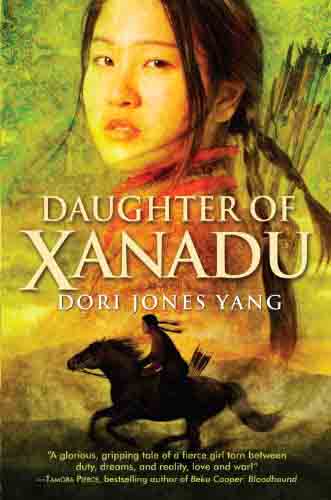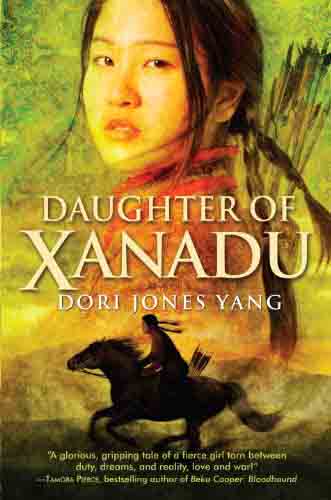
Daughter of Xanadu – Part 4/4

April 20, 2011


A review (guest post) by Tom Carter of Daughter of Xanadu by
Dori Jones Yang

By story’s conclusion, Messer Polo, who witnessed and wrote about the Mongols’ real-life battle against the Burmese in his book, The Travels of Marco Polo, has elevated “Emmajin the Brave” into the living legend she wanted to be, though she now regrets it.

“These men needed a hero, but I no longer needed to be one.” She resigns her sword and rank, and departs with Polo back to Europe as the Khan’s emissary of peace, leaving the literary door wide open for a sequel.

Dori Jones Yang, who also penned the best-selling Pour Your Heart Into It: How Starbucks Built a Company One Cup at a Time, is a skilled historian.

In researching Daughter of Xanadu, Yang, fluent in Putonghua, traveled all the way to the ruins of Xanadu in remote Inner Mongolia, which this itinerant backpacker can personally attest is no easy journey.

The short chapters and brief sentences, edited with razor precision for a younger audience, along with a helpful glossary for ESL students, make reading Daughter of Xanadu a breeze, though adults will admittedly want to beg this book back afterwards from their tweens.

Return to Daughter of Xanadu – Part 3 or start with Part 1

View as Single Page

______________

Travel photographer Tom Carter is the author of China: Portrait of a People (San Francisco Chronicle Book Review), a 600-page China photography book, which may be found at Amazon.com.

Discover more “Guest Posts” from Tom Carter with Is Hong Kong Any Place for a Poor American?

If you want to subscribe to iLook China, there is a “Subscribe” button at the top of the screen in the menu bar.


Daughter of Xanadu – Part 3/4

April 19, 2011


A review (guest post) by Tom Carter of Daughter of Xanadu by
Dori Jones Yang

Authoress Dori Jones Yang is a Caucasian American, yet she is no stranger to writing from the perspective of conflicted adolescent Chinese girls, as evinced in her previous, award-winning novel, The Secret Voice of Gina Zhang.

In Daughter of Xanadu, she hones in even deeper into the physiological confusion and emotional conflictions that make youth such a joy, turning Emmajin into such a hormonal wreck that this male reviewer often found himself gritting his teeth in frustration at such contradictive revelations as, “if he had pursued me, I would have rebuffed him. By holding himself aloof, he challenged me to win back his esteem.”

Daughter of Xanadu is not all-teenage angst.  As our protagonist matures, so does the content of the story.

Emmajin eventually persuades Khubilai Khan to allow her to train for war against the Burmese at the Battle of Vochan (present-day Yunnan province), where the embarrassment of getting her period in front of the all-male troops is a bloody omen for what’s to come.

Upon seeing her cousin slain, innocent Emmajin is transformed into a “mindless killer.”

  Bloodlust unleashed, the young princess swings her sword indiscriminately (“the hatred pounded in my ears…killing him felt good”), resulting in hundreds of men dead by her hand alone.

One can only imagine all the Mulan vs. Emmajin fan fiction that this novel will inspire!

Continued on April 20, 2011 in Daughter of Xanadu – Part 4 or return to Daughter of Xanadu – Part 2

View as Single Page

______________

Travel photographer Tom Carter is the author of China: Portrait of a People (San Francisco Chronicle Book Review), a 600-page China photography book, which may be found at Amazon.com.

Discover more “Guest Posts” from Tom Carter with Is Hong Kong Any Place for a Poor American?

If you want to subscribe to iLook China, there is a “Subscribe” button at the top of the screen in the menu bar.


Daughter of Xanadu – Part 2/4

April 18, 2011

A review (guest post) by Tom Carter of Daughter of Xanadu by Dori Jones Yang

The merchants’ young son turns out to be one Marco Polo, the now-legendary Venetian journeyer credited for introducing Asian culture to the west.

To Emmajin, however, he is just another “colored-eye man,” a court curiosity from Christendom whose gallantry and romantic gestures are as ridiculous to the manly Mongolians as his facial hair (“his beard was so thick I could imagine food sticking in it”).

Try as she might, however, Emmajin, caught in the peak of puberty, is unable to resist Marco’s western charm, and quickly finds herself enamored by his worldly vision (“I had learned to see the world through Marco’s eyes”) as well as his pelt.

“What would the hair on his arm feel like?” she often fantasized about at night.

But she was a Mongolian first, and reluctantly sacrifices her blossoming relationship with the foreigner to complete her spy mission (“He was not a friend but a source of information.”).

Continued on April 19, 2011 in Daughter of Xanadu – Part 3 or return to Part 1

View as Single Page

______________

Travel photographer Tom Carter is the author of China: Portrait of a People (San Francisco Chronicle Book Review), a 600-page China photography book, which may be found at Amazon.com.

Discover more “Guest Posts” from Tom Carter with Is Hong Kong Any Place for a Poor American?

If you want to subscribe to iLook China, there is a “Subscribe” button at the top of the screen in the menu bar.


Daughter of Xanadu – Part 1/4

April 17, 2011


A review (guest post) by Tom Carter of Daughter of Xanadu by
Dori Jones Yang

Who would win in a fight: Mulan or Emmajin Beki or Teenage Angst, Mongolian-style? “Can you imagine, a mere girl fighting on the battlefield?”

The role of females in combat is a debate as timeless as war itself, and one that remains divisive and unresolved to this century.

While present-day arguments for and against allowing women in the military revolve around psychological and biological issues, back in olden times, one needed only cite “tradition” and “familial roles” to silence  the detractors.

The teenaged heroine of Dori Jones Yang’s new 13th-century historical fiction novel, Daughter of Xanadu, is one such detractor, albeit immutable.


Often imagining herself on the battlefield, “the son my father never had,” Emmajin Beki, the granddaughter of Mongolian king (and emperor of China’s Yuan Dynasty) Khubilai Khan (1215-1294), learned to ride a horse before she could walk and can outshoot all her cousins in archery.


She confidently and outspokenly aspires to emulate her female ancestors who assisted Chinggis Khan in conquering Asia (“the blood of all these earlier strong women flowed in my veins”).

Unfortunately, for this princess, “the days of strong women had ended once luxurious court life had begun.”

The Mongols, fattened, lazy and resting on their laurels, now prefer to tell stories of battles-past over lavish “orgies of excess” rather than engage in new wars, much to Emmajin’s restless discontent.

When she makes known her desire to “become a legend” like real-life women warriors Aiyurug Khutulun and Hua Mulan of China, the great Khan placates her by sending her on a secret mission to spy on a family of foreign merchants currently visiting the Mongol court.

Continued on April 18, 2011 in Daughter of Xanadu – Part 2

View as Single Page

______________

Travel photographer Tom Carter is the author of China: Portrait of a People (San Francisco Chronicle Book Review), a 600-page China photography book, which may be found at Amazon.com.

Discover more “Guest Posts” from Tom Carter with Is Hong Kong Any Place for a Poor American?

If you want to subscribe to iLook China, there is a “Subscribe” button at the top of the screen in the menu bar.


My Mother Would Have Burned this Book – Part 1/5

March 30, 2011

The reason my mother would have burned “The Concubine Saga” was because she grew up in a country with the soul of a church. After my mother died, I found a video collection of the Bible, an audio version and about thirty different published versions.

I didn’t know then that there was that many ways to speak for one God.

After my father died, mother spent her last decade to the age of eighty-nine studying the Bible several hours a day. This was her attempt to discover the answer to salvation that haunted her most of her life.

My mother loved to read other books too, as did my father, who was not a religious person. However, if my mother ran into a vivid sex scene in a novel, she threw the book in the fireplace.

Since I was born and raised a Catholic and when I was twelve my mother switched to the Jehovah Witnesses, I know why she would have burned my book.

To Catholics, Jehovah Witnesses, and most devout Christians of all sects, lust is a mortal sin.

In fact, Catholic Questions in a Secular World says, “The seven deadly sins are pride, avarice, envy, wrath, gluttony, sloth and lust.… Lust is the self-indulgent desire for gratification … without the sanctifying graces of marriage.”

When I was single in my thirties, I had a lusty relationship with a lawyer, who ended the relationship due to Christian guilt. She wasn’t a Catholic but she attended two different Christian churches on Sundays, and she made it clear that it was the guilt that drove her to stop seeing me.

By the way, the “Concubine Saga” is historical fiction about a real man that went to China in 1854, bought a concubine and stayed until 1908 to become the most powerful Westerner in China’s history and the only foreigner trusted by the Emperor.

To be continued on March 31, 2011 in Part 2 or View as Single Page

_______________

Lloyd Lofthouse is the award-winning author of My Splendid Concubine [3rd edition]. When you love a Chinese woman, you marry her family and culture too. This is the love story Sir Robert Hart did not want the world to discover.

Subscribe to “iLook China”!
Sign up for an E-mail Subscription at the top of this page, or click on the “Following” tab in the WordPress toolbar at the top of the screen.

About iLook China