Shakespeare’s drama Romeo and Juliet is often taught to ninth graders in US high schools. Other Shakespeare plays are studied at other grade levels and in college.
However, you may be surprised to discover Shakespeare is probably more popular in China since his work is taught in most Chinese universities, both in English and in Chinese, and Shakespearean texts are easily available in China in both languages.
When Mao ruled China (1949 to 1976), Shakespeare was banned as was Aristotle and other Western philosophers. Mao died in 1976, and that ban was lifted in 1978.
In fact, according to Cheng Zhaoxiang, the author of Teaching Shakespeare in China, “It is no exaggeration to say that every educated Chinese knows something about Shakespeare.”
However, when produced in China on stage, the plot may not stay true to the original Shakespeare.
Writing for the The People’s Republic of Shakespeare, Adventures in Chinese Research, Meammi says, “My interest in this topic started when I noticed that many of the Romeo and Juliets performed in China are either parodies or rewrites where one of the lovers survives in the end.
“China has their own pair of star-crossed lovers (The Peony Pavilion – 1598 AD), who tragically die for love and their plight is described in a much more mournful tone than Shakespeare’s version.
“Some Chinese theater companies state in interviews that their audiences have too much sadness in their lives so Romeo just can’t die in the end of their performance.”
______________________________
Lloyd Lofthouse is the award-winning author of My Splendid Concubine [3rd edition]. When you love a Chinese woman, you marry her family and culture too. This is the lusty love story Sir Robert Hart did not want the world to discover.
Subscribe to “iLook China”!
Sign up for an E-mail Subscription at the top of this page, or click on the “Following” tab in the WordPress toolbar at the top of the screen.
September is right around the corner and that means Mooncake Mania in China.
Back in 2010, I wrote a post about China’s Mid-Autumn Festival, which is also the time of year for giving and eating mooncakes. At the time, I had no idea that Haagen-Dazs sold the most sought after modern version of this Chinese traditional treat.
My wife learned from a friend in China of the popularity of Haagen-Dazs and mentioned the mooncakes, so I did some scooping for this post. Mooncakes are traditional gifts to friends, family and clients during the Chinese mid-autumn festival, and Haagen-Dazs’s Mooncakes have shown a 25% annual growth in sales since they were first introduced in 1997 and represented 28% of Haagen-Dazs’s revenue every year!
Fast forward to 2015 and over 50% of the Chinese people have now heard of Haagen-Dazs—that’s more than 650 million people or more than twice the population of the United States.
Mooncake Mania for China’s September Holiday
Kai Ryssdal reported for American Public Media’s Marketplace that China’s mid-Autumn Festival and tradition of eating mooncakes has become an underground business possibly worth billions.
Marketplace’s Shanghai correspondent Rob Schmitz says mooncakes carry about a thousand calories and most of the cakes bought are gifts as a way to show respect to business partners and people you want to be close to.
Imagine the size of the market—more than 1.3 billion people, which explains why Starbucks, Nestle and Dairy Queen got into the business of selling mooncakes in China too. In fact, Starbucks offers espresso and hazelnut mooncakes; Godiva promotes a chocolate variety; Häagen-Dazs features cookies-and-cream ice cream mooncakes.
2009 Haagen-Dazs Chinese Mooncake Commercial
Industry groups estimate that mooncakes bring in $2 billion in annual sales in greater China, accounting for 200,000 metric tons (about 220,400 tons) of production each season. – New York Times
______________________________
Lloyd Lofthouse is the award-winning author of My Splendid Concubine [3rd edition]. When you love a Chinese woman, you marry her family and culture too. This is the lusty love story Sir Robert Hart did not want the world to discover.
Subscribe to “iLook China”!
Sign up for an E-mail Subscription at the top of this page, or click on the “Following” tab in the WordPress toolbar at the top of the screen.
In fact, at the time Schmitt was a Shanghai-based writer whose work had appeared in the Wall Street Journal, The Economist’s Business China, Marie Claire, World Hum, Afar Magazine, and Backpacker. I haven’t read all of her work, but this piece was worth sharing.
If you want to learn about China, you would have to travel to China often or live there as an expatriate as Schmitt did. Marrying into a Chinese family like I did also works.
While living in China, Schmitt moonlighted as a restaurant reviewer for City Weekend Shanghai. She went falcon hunting in Yunnan, drank fermented mare’s milk in a Mongolian yurt, and attended a mail-order bride’s wedding and donned qipaos with Shanghai’s senior citizens.
Another example of being young in urban China. The world this generation knows is not the world their parents grew up in.
Instead of playing it safe and staying primarily in modern China around other foreigners and expatriates as many do, Schmitt “tasted” what being Chinese really means, and she wrote often of China from Shanghai’s lesbian sub-culture to debates held at the 15th century Sera Monastery by Lhasa monks.
As for young love, Kellie Schmitt writes, “In Shanghai, teachers and parents widely prohibit dating in high school, urging students to study instead.”
But for Enid and Michael—the Chinese couple Schmitt writes about—their love was “worth a little sneaking around” when they were sixteen.
When they turned 22, they were still together and got married. When Schmitt wrote the post for CNN Go Asia, Enid and Michael were 26. Today, they would be in their thirties. As in all marriages, Enid and Michael have had challenges but it appears that love kept them together. I recommend Schmitt’s story to learn more about how China is changing.
Kellie Schmitt now lives in California’s Central Valley.
______________________________
Lloyd Lofthouse is the award-winning author ofMy Splendid Concubine [3rd edition]. When you love a Chinese woman, you marry her family and culture too. This is the lusty love story Sir Robert Hart did not want the world to discover.
Subscribe to “iLook China”!
Sign up for an E-mail Subscription at the top of this page, or click on the “Following” tab in the WordPress toolbar at the top of the screen.
It’s been more than four years since Amy Chua’s memoir Battle Hymn of the Tiger Mother launched a vicious tsunami of words that swept across the United States. Critics judged the book largely by asking the following questions: Should self-esteem come before accomplishment, or accomplishment before self-esteem? The logical answer, I think, is that a child’s self-esteem must develop naturally and organically and not through the efforts of helicopter parents pressuring teachers to dumb down the curriculum and inflate grades.
The bad news is that helicopter parenting might be getting worse if Psychology Today.com is right.
About the same time that Chua’s memoir came out, research into parenting styles revealed that “almost 49% of the European-American parents used authoritative parenting (alleged to be the best parenting style), as did about 46% of the Asian-American parents. Both groups revealed about the same number of parents using authoritarian (Tiger Mom-style) parenting (23% for European-Americans, and 26% for Asian-Americans). In other words, the number using authoritative parenting was virtually the same for both groups. – Psychology Today.com
In addition, Pew Research.org reported “Fully 94% of parents say it is important to teach children responsibility, while nearly as many (92%) say the same about hard work. Helpfulness, good manners and independence also are widely viewed as important for children to learn, according to the survey.”
But work by Eva Pomerantz suggests that Chinese mothers think differently. They think “my child is my report card,” and they see the academic success of their children as a chief parenting goal. But the reasons why a particular type of parenting works in one cultural group may not translate to another cultural group, partly because parenting goals are different in different groups.
In early 2011, we went to see Amy Chua in Berkeley when she was on tour for her memoir. The room was packed with several hundred people and there was standing room only due to all the controversial attention the book was getting.
At the times, I thought that Amy Chua looked as if she were expecting an eighteen-wheeler to crash through the wall and flatten her. That is probably because I’d read that she’d received death threats from across the U.S. for revealing in her memoir that she had said NO to activities such as sleepovers, play dates, acting in school plays, and did not allow her daughters to watch endless hours of TV and/or play computer games like so many American parents do.
Imagine getting assassinated, not by your child but by a stranger, because you wouldn’t let your kid have a sleepover.
To many, Chua did the unthinkable and demanded excellence. Time magazine said, “Most surprising of all to Chua’s detractors may be the fact that many (but not all) elements of her approach are supported by research in psychology and cognitive science.”
And as Amy Chua sat in that tall chair on stage above the audience with her feet dangling a foot from the floor, the audience laughed, applauded and treated her as if she were a hero—not someone to condemn or shun.
In the Time magazine piece, Chua said, “I know some Korean, Indian, Jamaican, Irish and Ghanaian parents who qualify too. The tiger-mother approach isn’t an ethnicity but a philosophy: expect the best from your children, and don’t settle for anything less.”
The American Psychological Association defines tiger parents as those who practice positive and negative parenting strategies simultaneously. Tiger parents are engaging in some positive parenting behaviors; however, unlike supportive parents, tiger parents also scored high on negative parenting dimensions. This means that their positive parenting strategies co-exist with negative parenting strategies.
Tiger parents and harsh parents are alike, in that both use negative parenting strategies. Unlike tiger parents, however, harsh parents do not engage in positive parenting strategies. Easygoing parents have a more hands-off approach, and do not engage as much with their children, either positively or negatively.
Another study out of the University of Michigan comparing U.S. and Chinese public school systems discovered parental involvement is a critical component to a child’s educational experience. If a child’s parents value education, then the child is more likely to value school as well. In China, parental involvement is higher than compared to the US, because Chinese parents accept the critical role of helping their students to learn concepts if they are lagging behind in school. Chinese parents also make sure that their children complete their homework. Parents in the U.S. typically play a more passive role in the education of their children. … It was also proven that greater involvement in a child’s education fosters more positive attitudes toward school, can improve homework habits, increase academic success and can reduce dropout rates.
What parenting style did your parents use on you? My parents were mostly hands off and that might explain why I barely made it through high school, but I did much better in college after the Marines applied their harsh methods of discipline.
______________________________
Lloyd Lofthouse is the award-winning author of My Splendid Concubine [3rd edition]. When you love a Chinese woman, you marry her family and culture too. This is the lusty love story Sir Robert Hart did not want the world to discover.
Subscribe to “iLook China”!
Sign up for an E-mail Subscription at the top of this page, or click on the “Following” tab in the WordPress toolbar at the top of the screen.
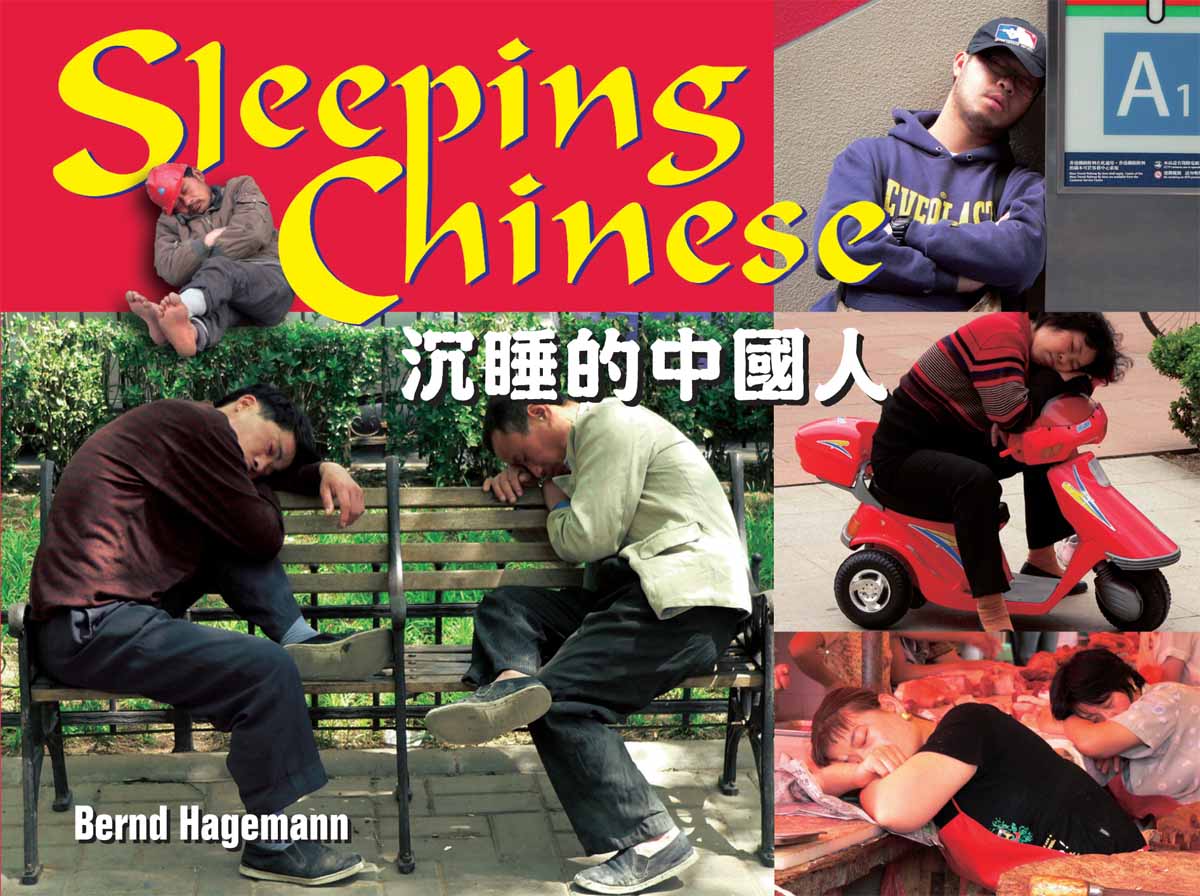
German businessman Bernd Hagemann arrived in China in 2002 amidst media reports of China’s impending rise to global domination. “News outlets around the world,” he writes, “were warning us about… how fast China is developing, how competitive it is, and what a tense life the Chinese people must live.”
Casual strolls down the streets of China in between boardroom meetings and networking, however, soon revealed to Hagemann a far less threatening side of China. So he took out his point-and-shoot camera and documented what he saw all around him. In just 148 pages, Hagemann’s debut photography bookSleeping Chineseswiftly dispels 9 years of chest-pounding by the PRC propaganda machine.
Sleeping Chineseis a fun little novelty item the exact same dimensions as a postcard that will leave you either laughing out loud or scratching your head in perplexity. The pages are divided into 3 parts: Hard Sleepers, Soft Sleepers and Group Sleepers, a clever allusion to China’s train carriage classification system.
Hard Sleepers: “Those who snooze in hard and uncomfortable places can fall asleep anywhere – even on a pile of bricks in a construction site!” Hagemann defines.
Witness, then, the dozens of people who have drifted into deep slumber atop stones, wood, mortar blocks, concrete and even cold slabs of raw meat. The most comical of the chapter being the dozing shoe repair man balancing precariously on a saw horse with an extra 2×4 for a pillow.
Soft Sleepers: “A little more fussy than their hard sleeper comrades,” the chapter intro explains, “fussy” meaning in plastic wash bins, hammocks slung under freight trucks, sleeping lengthwise across a motor scooter and even a laborer using a tape measure to cover his eyes.
Group Sleepers: “A traveling family needs no pillows when they have each other’s knees.” Truly, the photo of the family of five all huddled together like newborn puppies gives greater meaning to ‘jiating,’ China’s family unit.
Some Chinese might take offense to Hagemann’s photographic agenda, but anyone with a sense of humor will see that the book was made out of affection.
“I’d like to express my appreciation of the hard work and effort put in by migrant workers who play a central role in China’s success story but seldom receive the attention they deserve,” writes Hagemann.
Indeed, anyone who has spent quality time in China knows that these laborers, more than anyone else, deserve their rest — anywhere they can get it.
None of the snapshots inSleeping Chinesewere staged. Any foreign tourist in China who bothers to stray from his package tour group or get out of his hotel for a jaunt off the tourist trail will see these exact same sights, and more.
Incidentally, taking and publishing photos of sleeping Chinese people will often land a foreign tourist in hot water if caught by the authorities (the subjects themselves tend not to mind).
People’s Dailynewspaper, the official mouthpiece of the Politburo, even attempted to put a socialist spin on Hagemann’s revealing imagery in an article aboutSleeping Chinese: “If (we) are tired, (we) lie down anywhere and anytime and sleep. This shows (our) society’s accepting attitude.”
Regarding the western media’s scare tactics of China’s “waking dragon,” this reviewer is reminded bySleeping Chineseof a particular song from old-school hip-hop artists Public Enemy (who I had occasion to watch perform during their 2007 tour through Beijing): Don’t Believe the Hype!


 Posted by Lloyd Lofthouse

 iLook China