Even in individualist countries, we find collectivism at work. In business, the collective society is often seen in corporate structure.
New Yorker business columnist James Surowiecki says, “Under the right circumstances, groups are remarkably intelligent and are often smarter than the smartest people in them.”
An example used by Surowiecki shows that “the TV studio audience of Who Wants to Be a Millionaire guesses correctly 92 percent of the time, compared to ‘experts’ who guess only 65 percent correctly.” Source: Co-Society.com
What Surowiecki says explains why China’s top few-hundred officials use the “Red Machine”, an encrypted communication system, for making quick collective decisions.
In The Collective Will, I mentioned the author of a Wall Street Journal piece as an example of how most people in the West have trouble understanding what goes on in China.
Most Chinese understand their government’s actions and decisions even if a Westerner from an individualist culture doesn’t.
Some Chinese may not like it. Others may not agree with it.
However, Westerners are not always happy with their governments. Just look at Donald Trump in the United States to understand what this means.
Continued on March 16 in Part 3 or Start with Part 1
Subscribe to “iLook China”!
Sign up for an E-mail Subscription at the top of this page, or click on the “Following” tab in the WordPress toolbar at the top of the screen.
A few years ago, I debated another author on this site, and he rejected the scientific fact that there are different types of cultures on this planet. He said, ignoring all the studies on this topic, that there was no such thing as a collective or individualistic culture.
In this 5-part series, we will explore the differences between what it means to grow up in a collective versus an individualistic culture.
Sidney Rittenberg says China is a ‘we’ society while the West is a ‘me’ society.
China and America are not the same. China has a collective culture. The United States has an individualist culture.
I’ve discovered that some people from individualistic cultures don’t understand what a collective culture is, and some hate what they don’t understand. Even the Western media often shows its ignorance by how it reports events in China and by judging what happens in China as if it were an individualist culture.
It might surprise many in the West that China is not the only country with a collectivist culture.
Along with China, one list I saw had Argentina, Brazil, Vietnam, Egypt, Greece, India, Japan, Korea, Mexico, Scandinavia and Portugal on it.
For individualist cultures, there was Canada, Australia, England, France, Ireland, Italy, New Zealand and the United States.
In Chinese society, collectivism has a long tradition based on Confucianism, where being a community man or someone with a social personality is valued.
In a collective society such as China, each person is encouraged to conform to society, to do what is best for the group and to not openly express opinions or beliefs that go against it.
Group, family or rights for the common good are seen as more important than the rights of the individual. In a collective culture laws exist to promote stability, order, and obedience.
Working with others and cooperating is the norm. Being uncooperative is often seen as shameful. For instance, Psychology Today reports how to sell online to individualist vs collectivist cultures.
Nathalie Nahai, writing for Psychology Today, says, “A very individualist country (such as the USA) will tend to form loose-knit social groups, and value autonomy, freedom and personal time. They tend to proactively seek out challenge, and are often motivated by extrinsic factors such as material success.
“In comparison, countries that score highly in collectivism (such as China) tend to develop large cohesive social networks, valuing loyalty, good physical conditions and intrinsic rewards as motivating factors.”
Psychologists have found that intrinsic rewards, an outcome that gives an individual personal satisfaction such as that derived from a job well done can be more powerful motivators than an external reward system such as an employee bonus program.
Subscribe to “iLook China”!
Sign up for an E-mail Subscription at the top of this page, or click on the “Following” tab in the WordPress toolbar at the top of the screen.
Nation Master ranks countries by the per capita murder rate. For every one million people, China had 10.1 murders in 2010 and was ranked #167 out of 193 countries. The United States was ranked #99 in 2010 with 40.01 murders per one-million population.
That tells us that we are about four times safer from being murdered in China than in the United States. The #1 country for murders is Honduras where in 2011, more than 900 people were murdered for each one-million population.
Do you want to live in Honduras where the odds of being murdered are 90 times higher than China; 22 times higher than the U.S.?
How about the 98 countries with higher murder rates than the United States or the 166 countries ranked higher than China?
Let’s compare two news reports. One was in China and the other one took place in the U.S. In both reports elementary school children were the targets.
From China, the BBC News reported, “A man with a knife has wounded 22 children – at least two of them seriously – and an adult at a primary school in central China. The attack happened at the gate of a school in Chenpeng village in Henan province. … Security at China’s schools has been increased in recent years following a spate of similar knife attacks in which nearly 20 children have been killed.”
So far, in China’s most recent grade school assault, no one has been reported with firearms, but in the United States, in a similar incident, the death toll was shocking.
Fox News reported, “At least 26 dead in shooting at Connecticut elementary school. … Authorities say at least 26 people, including 18 children, were killed Friday when a gunman clad in black military gear opened fire inside a Connecticut elementary school.
“A law enforcement official said the shooter, who is dead, was from New Jersey and had ties to Sandy Hook Elementary School in Newtown. Authorities recovered a Glock and Sig Sauer 9mm handgun, but it was unclear who killed the shooter, who wore black combat garb and a military vest.”
To understand why, I Googled “profile of mass murderers” and discovered that unlike serial killers mass murderers are hard to profile and are unpredictable.
Dr. Michael Stone told The Daily Beast, “Usually you’re dealing with an angry, dissatisfied person who has poor social skills or few friends, and then there is a trigger that sets them off.” … adding that 96.5 percent of mass murderers are male, and a majority aren’t clinically psychotic. Rather, they suffer from paranoia and often have acute behavioral or personality disorders.
Infoplease.com lists the 100 worldwide mass and/or school shootings from 1996 to the present. There wasn’t one listed for China. If you click the link, you will discover that 79 of the 100 worldwide mass shootings took place in the United States.
If you are Donald Trump or a supporter of Donald Trump, before you blame immigrants for these shootings, click the Infoplease link in the previous paragraph first and discover who pulled the triggers. Always check the facts first before jumping to conclusions. If Donald Trump had done that when he publicly claimed that illegal immigrants were responsible for a terrorist attack in Sweden THAT NEVER HAPPENED, he wouldn’t have made a fool of himself again, and again, and again.
If the safety of your family and children was more important to you than Freedom of Speech and choice of religion, what country would you live in?
Subscribe to “iLook China”! Sign up for an E-mail Subscription at the top of this page, or click on the “Following” tab in the WordPress toolbar at the top of the screen.
Chinglish is a play by David Henry Hwan that first premiered at the Goodman Theater in Chicago. The play premiered on Broadway at the Longacre Theater. I saw it at the Berkeley Rep Theater, and it was a laugh-out-loud evening.
This is not a review of Hwan’s play as much as it is about how different cultures find common behaviors hard wired in our DNA to make connections.
To summarize Chinglish, this laugh-out-loud play was about Daniel, a former employee of Enron, who almost went to prison with the rest of the Enron crooks. Daniel not only lost his high paying job with Enron, but he’s broke due to the legal battle that kept him out of jail.
In a last desperate attempt at success, he goes to China to find customers for his American company (a business that’s been in his family since 1925), but Daniel does not speak a word of Mandarin. At the beginning of the play, he says, “If you are an American, it is safe to assume that you do not speak a single f*****g foreign language.”
That one line reveals how clueless most Americans are when it comes to other cultures and languages.
Chinglish, through humor, teaches us a lesson about the minefield of misunderstanding and manipulation that happens when people of different cultures attempt to do business with each other.
“An American businessman arrives in a bustling Chinese province looking to score a lucrative contract for his family’s sign-making firm. He soon discovers that the complexities of such a venture far outstrip the expected differences in language, customs and manners.”
There is another implied theme in this play, and that’s about why sex is important, something all cultures and races have in common that often transcends cultural differences.
In the play, Daniel, an unhappily married man has an affair with an unhappily married mainland Chinese woman. Without spoiling the story, this affair provides the link that Daniel needs to succeed in China, and that link is known as Guanxi.
Early in the play, Daniel’s British interpreter, a man who has lived in China for years and speaks Mandarin fluently, tells him he must stay at least eight weeks to have a chance to develop Guanxi, a system of social networks and influential relationships that facilitate business and other dealings. The British interpreter says that for millennia China has survived without a Western legal system of laws, lawyers, courts and judges, and that Guanxi was crucial for China’s success as the longest surviving civilization and culture on the planet.
Without understand how Guanxi works, Daniel struggles to cross the cultural divide, but fails until he has the affair with the wife of a Chinese judge. The sexual attraction and lust that led to the affair opens the door to the Guanxi network of his lover, and her husband.
Subscribe to “iLook China”!
Sign up for an E-mail Subscription at the top of this page, or click on the “Following” tab in the WordPress toolbar at the top of the screen.
Before moving on with China’s history in the 20th century, it’s important to understand that China has a rich and long history of the arts: for instance, literature, poetry, painting, opera, and music. China, after all invented the printing press during the Tang Dynasty (618 – 906 AD) and paper in 105 AD. This history reaches back thousands of years, from the earliest recorded dynastic court archives to fiction novels from the Ming Dynasty published to entertain the masses of literate Chinese.
For a comparison with European civilization, the printing press in the West wasn’t invented until after 1300 AD, centuries after China, and it’s possible that the west stole the technology for the printing press from China just like the British Empire stole the secrets of growing and brewing tea from China.
For literature, there are the four Chinese classics: “Outlaws of the Marsh” (set in the Sung Dynasty, 960 – 1279 AD), “Romance of the Three Kingdom” (set during the end of the Han Dynasty, BC 206 – 220 AD), Journey to the West, and The Dream of the Red Chamber (China’s Romeo and Juliet set in the 18th century in the middle of the Qing Dynasty).
Traditional Chinese Poetry is similar to Western poetry. Lines in Chinese poetry may have a fixed number of syllables and rhyme was required, so ancient Chinese poetry resembles traditional English verse and is not at all like the free verse in today’s Western culture.
Mao Zedong was more than just a revolutionary and the leader of China from 1949 to 1976. He was complex man who was also a poet. Anyone who studies all of Mao’s life instead of relying on his last decade would understand that he cared deeply about the common people. In addition, Mao is responsible for ridding China of illegal drugs like opium and cocaine, liberating women when he announced they were equal to men, and his health reforms almost doubled the average lifespan before he died.
Continued in Part 5 on January 17, 2017 or return to Part 4
中
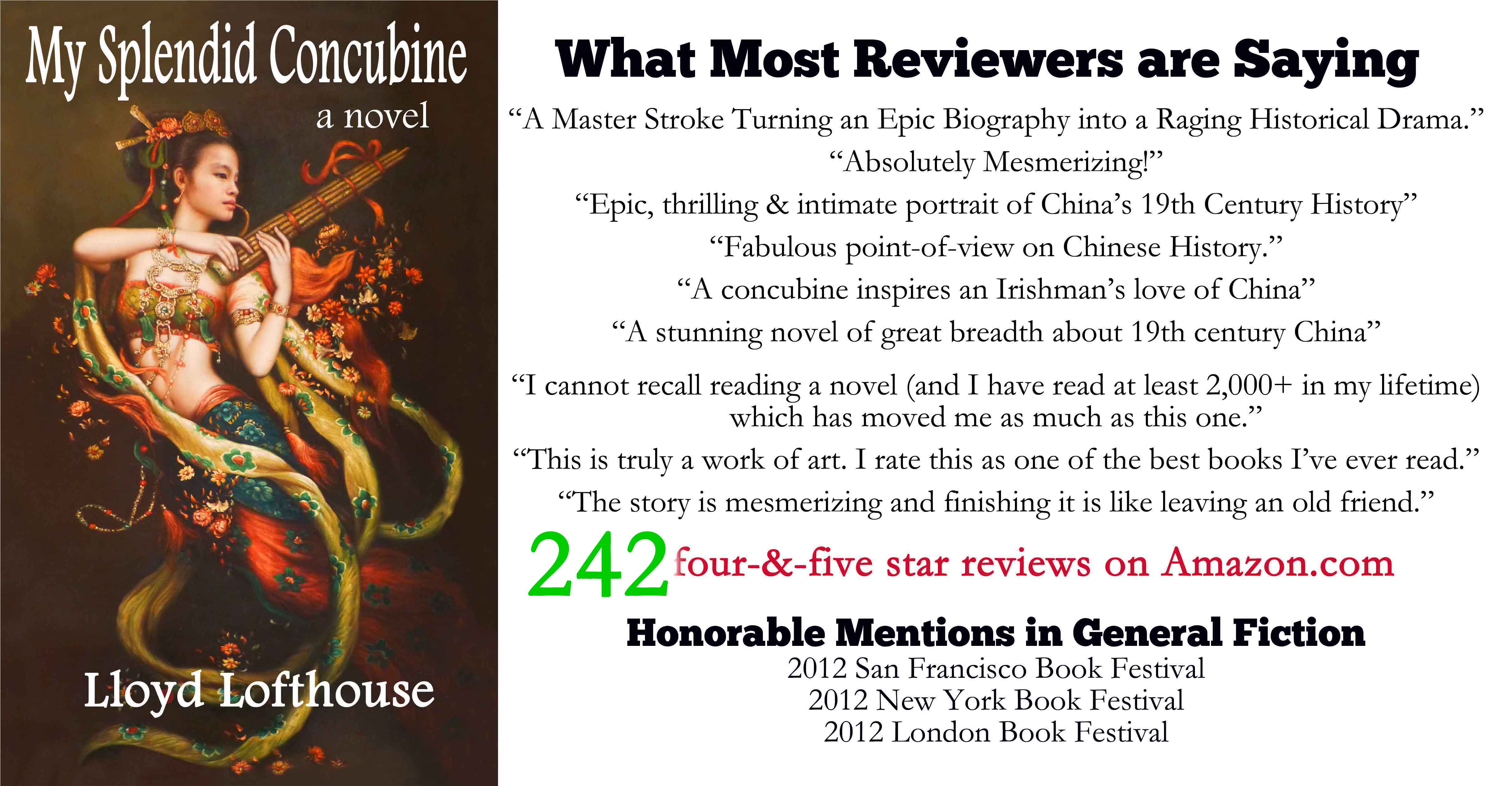
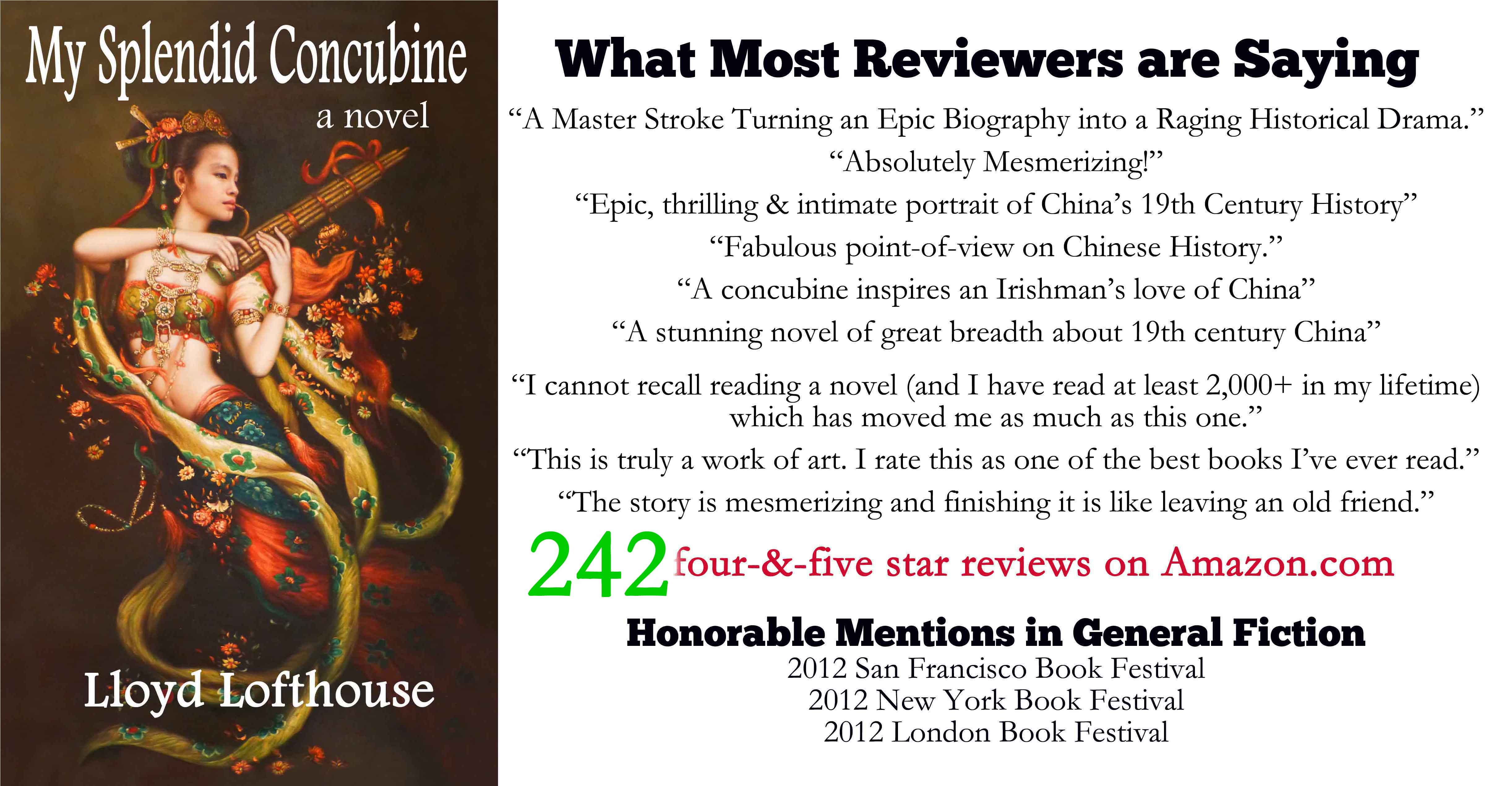
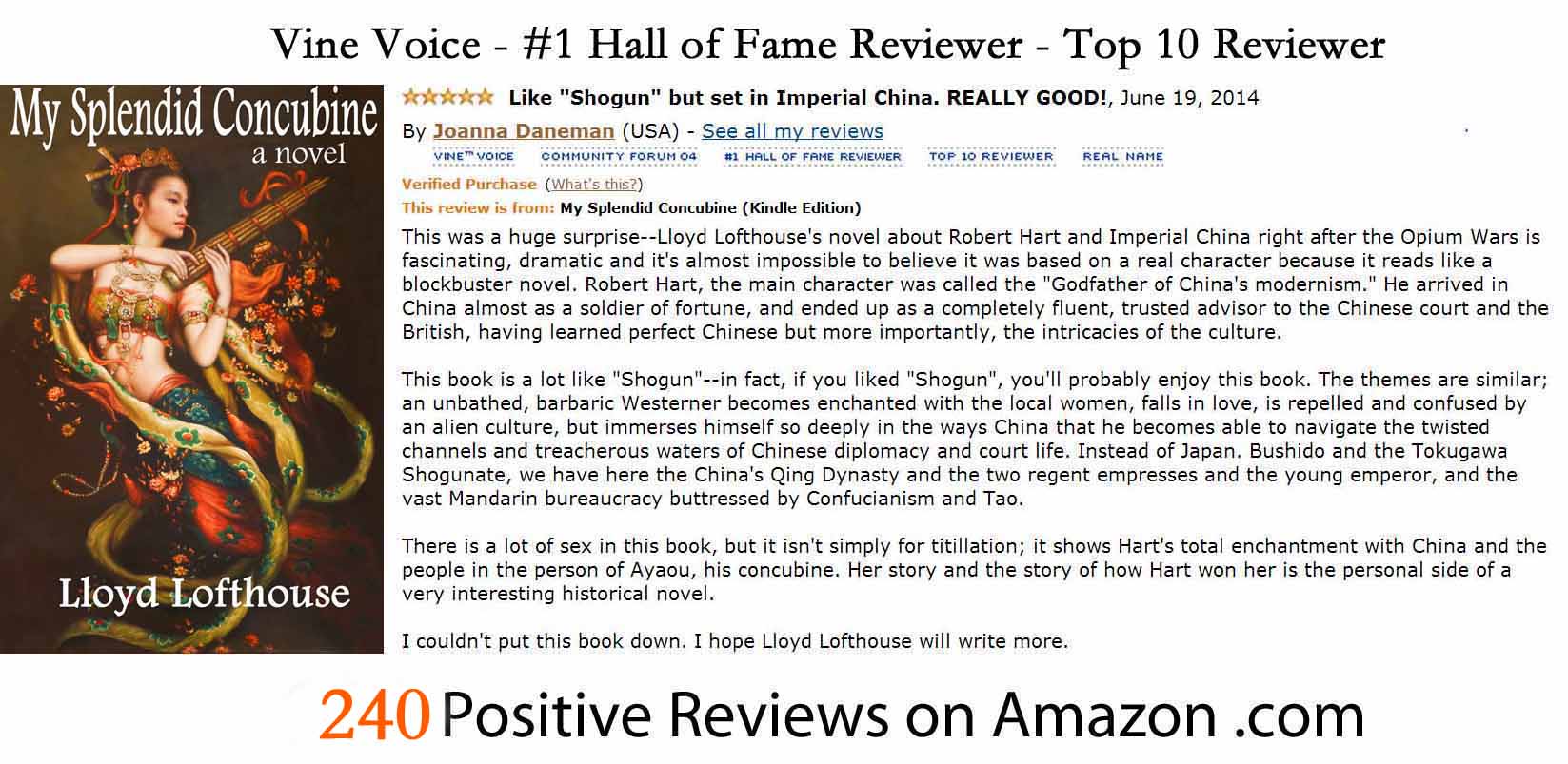
Lloyd Lofthouse is the award-winning author of My Splendid Concubine [3rd edition]. When you love a Chinese woman, you marry her family and culture too. This is the unique love story Sir Robert Hart did not want the world to discover.
Subscribe to “iLook China”!
Sign up for an E-mail Subscription at the top of this page, or click on the “Following” tab in the WordPress toolbar at the top of the screen.


 Posted by Lloyd Lofthouse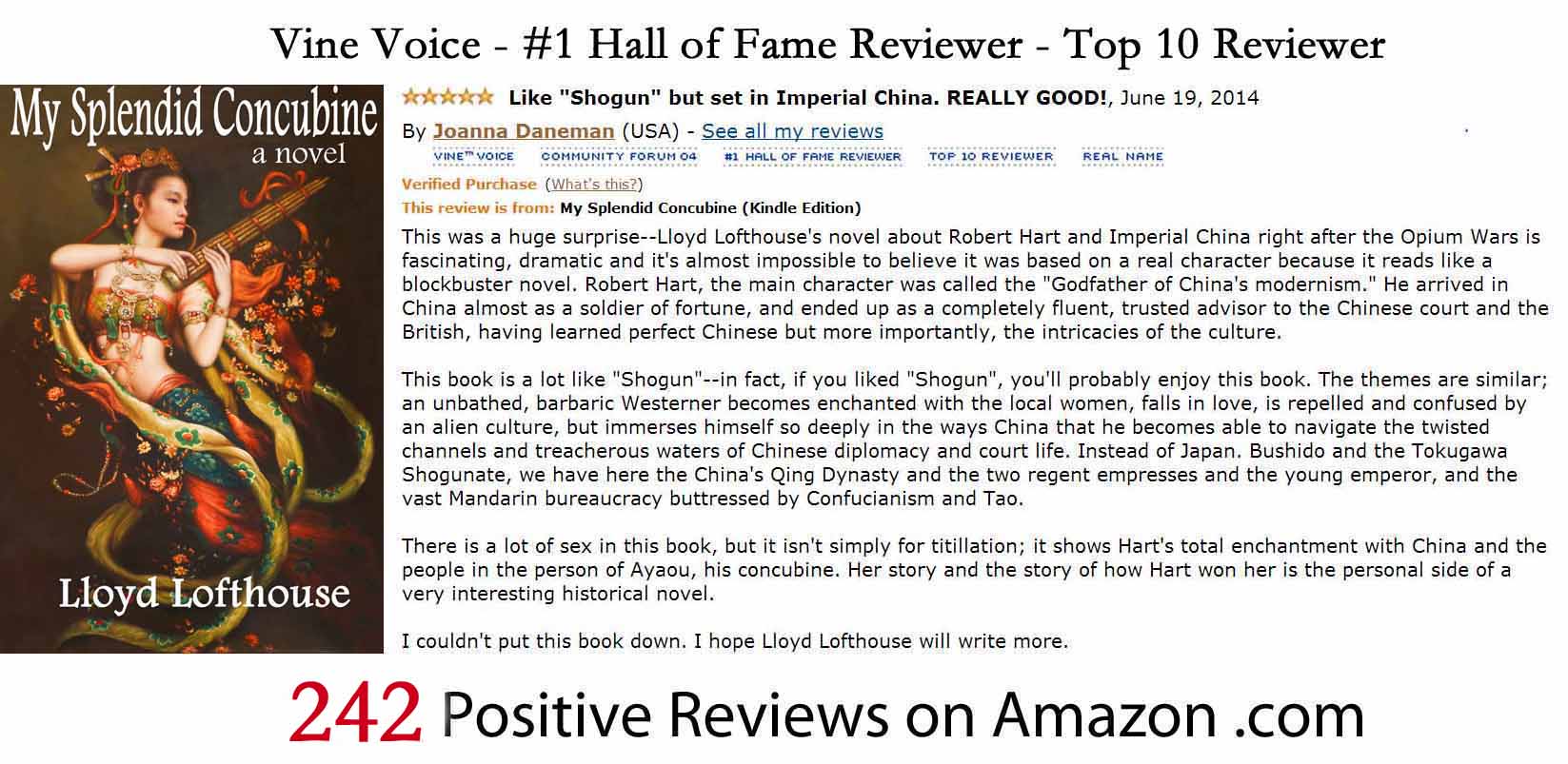
 iLook China