A Short History of China: part 4 of 6

January 11, 2017

Before moving on with China’s history in the 20th century, it’s important to understand that China has a rich and long history of the arts: for instance, literature, poetry, painting, opera, and music. China, after all invented the printing press during the Tang Dynasty (618 – 906 AD) and paper in 105 AD. This history reaches back thousands of years, from the earliest recorded dynastic court archives to fiction novels from the Ming Dynasty published to entertain the masses of literate Chinese.

For a comparison with European civilization, the printing press in the West wasn’t invented until after 1300 AD, centuries after China, and it’s possible that the west stole the technology for the printing press from China just like the British Empire stole the secrets of growing and brewing tea from China.

For literature, there are the four Chinese classics: “Outlaws of the Marsh” (set in the Sung Dynasty, 960 – 1279 AD), “Romance of the Three Kingdom” (set during the end of the Han Dynasty, BC 206 – 220 AD), Journey to the West, and The Dream of the Red Chamber (China’s Romeo and Juliet set in the 18th century in the middle of the Qing Dynasty).

Traditional Chinese Poetry is similar to Western poetry.  Lines in Chinese poetry may have a fixed number of syllables and rhyme was required, so ancient Chinese poetry resembles traditional English verse and is not at all like the free verse in today’s Western culture.

Mao Zedong was more than just a revolutionary and the leader of China from 1949 to 1976.  He was complex man who was also a poet. Anyone who studies all of Mao’s life instead of relying on his last decade would understand that he cared deeply about the common people. In addition, Mao is responsible for ridding China of illegal drugs like opium and cocaine, liberating women when he announced they were equal to men, and his health reforms almost doubled the average lifespan before he died.

Opera has a long history in China. To learn more, I suggest: Chinese Opera and Mao Wei Tao, China’s Living Treasure, and The Mother of Chinese Operas.

For brush painting (with a 6,000 year history) and calligraphy, I recommend: Gongbi Style Chinese Brush Painting, and Caressing nature with a long handled brush.

Last, there is China’s music. For instance, the Chinese mouth organ dates back to the Zhou Dynasty (BC 1111-222), and has been found in Han Dynasty tombs. Then there are the 2,553 year-old chimes of Marquis Yi.

Continued in Part 5 on January 17, 2017 or return to Part 4

中

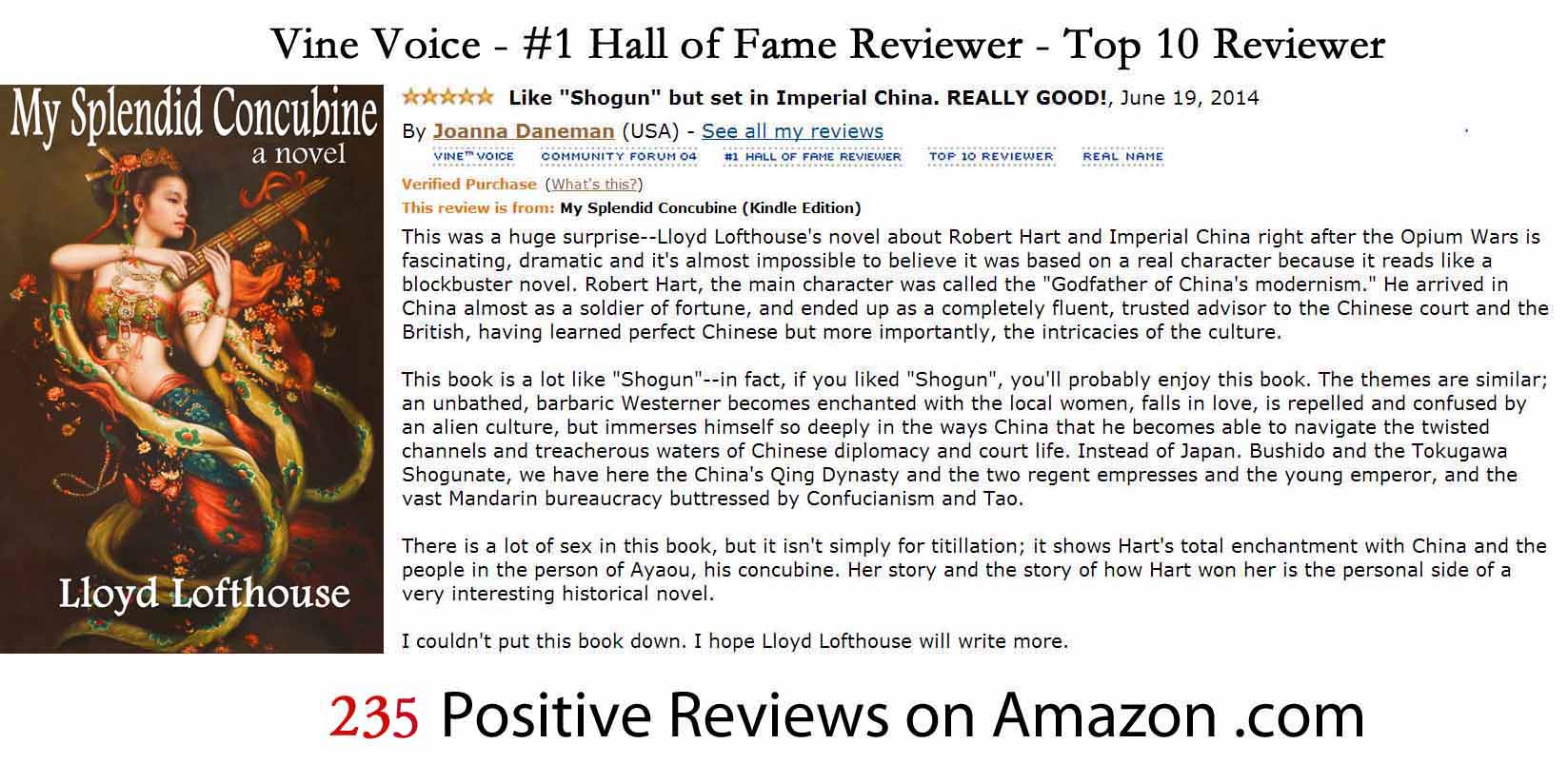
Lloyd Lofthouse is the award-winning author of My Splendid Concubine [3rd edition]. When you love a Chinese woman, you marry her family and culture too. This is the unique love story Sir Robert Hart did not want the world to discover.
2a-240-positive-reviews-dec-21-2016

Where to Buy

Subscribe to “iLook China”!
Sign up for an E-mail Subscription at the top of this page, or click on the “Following” tab in the WordPress toolbar at the top of the screen.

About iLook China


China’s Queen of the Golden Voice

December 7, 2016

Jingyun Dagu is a form of Chinese opera where stories are often sung in a Beijing dialect accompanied by a drum along with one or two other musical instruments.

The focus is on the singing that depicts stories in short episodes.

Dagu was first popular near the end of the Qing Dynasty (1644-1911).

One super star of Dagu was Luo Yusheng, who was born in 1914, and died at 89 in 2002. Her stage name was Xiao Caiwu. She studied under Su Huanting at the age of nine in order to play Laosheng (old man) roles in Peking Opera. At 14, she gave performances in singing without musical accompaniment in Nanjing, before she formally switched to Jingyun Dagu at the age of 17.

In 1934, Luo Yusheng studied at the Liu School of Jingyun Dagu (storytelling in Beijing dialect while beating a drum, accompanied by two or three persons who play three-stringed instruments).

At one time she was well known by most of China, and her fans called her the Queen of the Golden Voice.

After the PRC was founded in 1949, Dagu singers were regarded as people’s artists or actors, who sang traditional stories and new operas with themes reflecting contemporary life. For instance, patriotic Communist stories like Glorious Journey, Red Flag Over Mount Everest, and Patriotism and Roaring Waves.

The singer/drummer is often accompanied by the Sihu, a four-stringed instrument similar to an Erhu, and Pipa (lute) in addition to three-stringed lutes and wooden clappers.

Discover Wu Zetian, China’s only female emperor

中

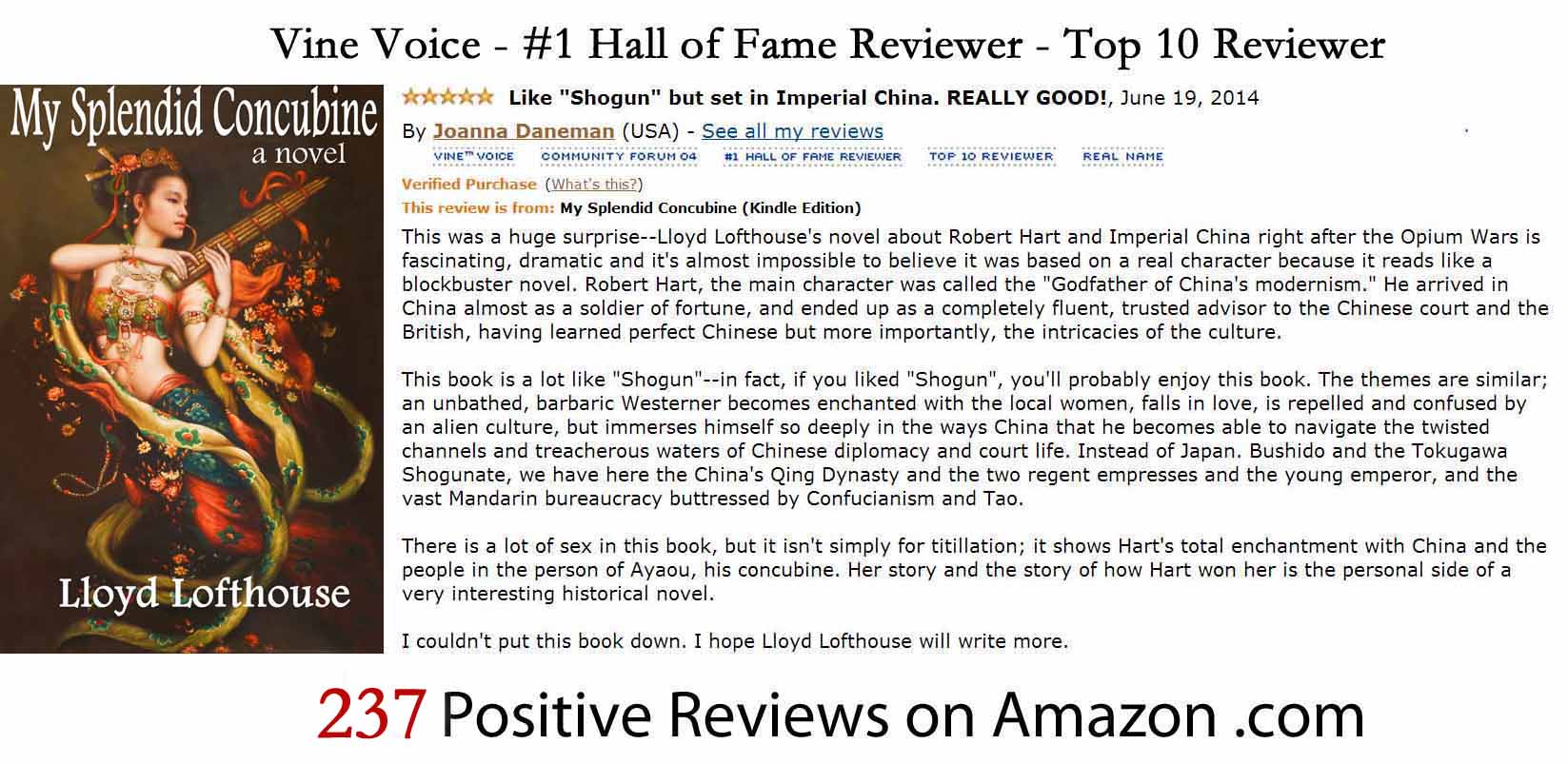
Lloyd Lofthouse is the award-winning author of My Splendid Concubine [3rd edition]. When you love a Chinese woman, you marry her family and culture too. This is the unique love story Sir Robert Hart did not want the world to discover.

1-joanna-daneman-review-updated-sept-21-2016_edited-3

Where to Buy

Subscribe to “iLook China”!
Sign up for an E-mail Subscription at the top of this page, or click on the “Following” tab in the WordPress toolbar at the top of the screen.

About iLook China

China’s Holistic Historical Timeline


Is There a Turkey Day in China Too?

November 23, 2016

Turkey is a fowl many Chinese seldom eat. However, eating duck and chicken is common. Duck is even considered a delicacy. In fact, the Unvegan says, “No trip to Beijing is complete without eating some Peking Duck.”

The Virtual Tourist says, “It is thought that Beijing roast duck, like the tradition of roast turkey in America and the UK, owes its origin to the roast goose that is still popular in Europe on festive occasions.”

Most Americans do not celebrate the Chinese New Year (the Spring Festival) and most Chinese do not celebrate Thanksgiving. After all, Thanksgiving is an American holiday that Canadians also celebrate, but on the second Monday in October.


Thanksgiving in Beijing with Peking Duck

CBS News.com reported, “America is the world’s biggest producer and exporter of turkeys. As a nation we’re also the largest consumers of turkey …” and “China is the second-largest market for U.S. turkey exports, reportedly buying more than $70.5 million in turkey meat in 2012.”

If you are visiting China during Thanksgiving, you have a choice between Peking Duck, which is easy to find, and turkey.

Go China says, “Just head to your local international grocery store (Jenny Lu’s in Beijing, Cityshop in Shanghai) and stock up on all the fixings: frozen Butterball turkeys, cranberry sauce and pumpkin pie makings. But you better do it fast, there tends to be a run on these items so if you’re shopping on the last Thursday in November, you’ll be out of luck.”

In fact, if you are visiting Shanghai, the Shanghai City Guide is there to help you find where to buy your favorite food. There are even three Walmarts in Shanghai, and Time Out Beijing provides a list for China’s capital city.

Discover Wu Zetian, China’s only female emperor

中

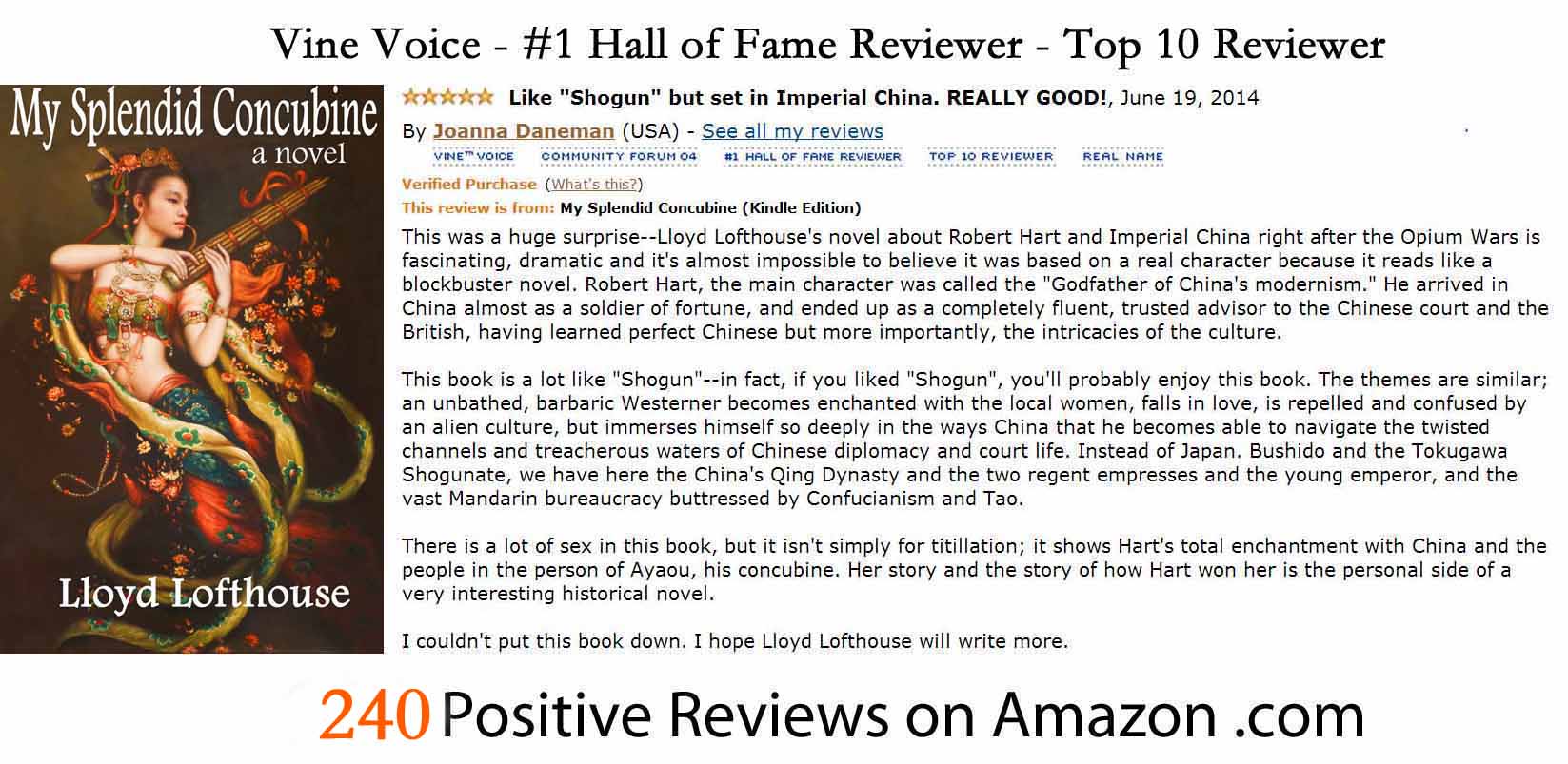
Lloyd Lofthouse is the award-winning author of My Splendid Concubine [3rd edition]. When you love a Chinese woman, you marry her family and culture too. This is the unique love story Sir Robert Hart did not want the world to discover.

a1-237-postive-reviews-october-8-2016_edited-5

Where to Buy

Subscribe to “iLook China”!
Sign up for an E-mail Subscription at the top of this page, or click on the “Following” tab in the WordPress toolbar at the top of the screen.

About iLook China

China’s Holistic Historical Timeline


China’s Laowai, their sexual fantasies, and The Exact Unknown

November 2, 2016

If God really thought sex was a mortal sin, why did He give young men so much testosterone? In fact, visit the Mayo Clinic.org to discover the facts. The Mayo Clinic says, “Testosterone is a hormone produced primarily in the testicles. Testosterone helps maintain men’s sex drive and sperm production.”

In addition, HealthDoc13.com reports that from age 18 to 30 “Your sexual appetite is prodigious (huge, enormous) and sex often occupies the front burners of your mind. It requires very little stimulation to achieve an erection.”

This post is a book review. The stories in Isham Cook’s collection, The Exact Unknown, reveal men driven by the often oppressed and censured male libido. These stories are not an author’s sex fantasy as some Puritanical minds might think, because many of the characters in these stories don’t achieve their goal, charming Chinese beauties that aren’t as easy to seduce as some think.

This collection is set in modern China where women are considered equal to men and are experimenting with that freedom and their sexuality. In case you are unaware of it, bound feet women in China and concubines as the property of men — you know, legal sex slaves — was officially ended by Mao after his famous liberating ‘Women hold up half the sky’ speech.

I think the best story in this 5-star collection of testosterone driven characters was Good Teacher, Bad Teacher starting on page 103 of the paperback.  John Cobalt is from Los Angeles and he’s teaching English in Guangzhou, China to Chinese college students. “This strange six-foot-five American dressed in what struck his employers as pajamas … went barefoot both in class and out on the street. … If that wasn’t bad enough, some students complained to the department head they could make out Cobalt’s penis against the flimsy fabric of his pants, in its flaccid state to be sure, yet they considered this to be highly improper nonetheless.”

To discover how Cobalt ends up with a devout and loyal following of Chinese college graduates, who are mostly female, you’ll have to read the book.

My second best choice would be The Curious Benefits of Neurosis starting on page 130 in the paperback that’s about a sex addict who sets out one night to visit as many massage parlors as possible with some surprising results.

I must warn you that there are a few well-written stories in this collection that have nothing to do with the out-of-control libidos of foreigners hoping to exploit the women of China.

The author sent me a complementary paperback copy of this book for my honest opinion that I’m sure modern, born-again Puritans will not approve of.

Discover China’s First Emperor Qin Shi Huangdi, the man that unified China more than 2,000 years ago.

中

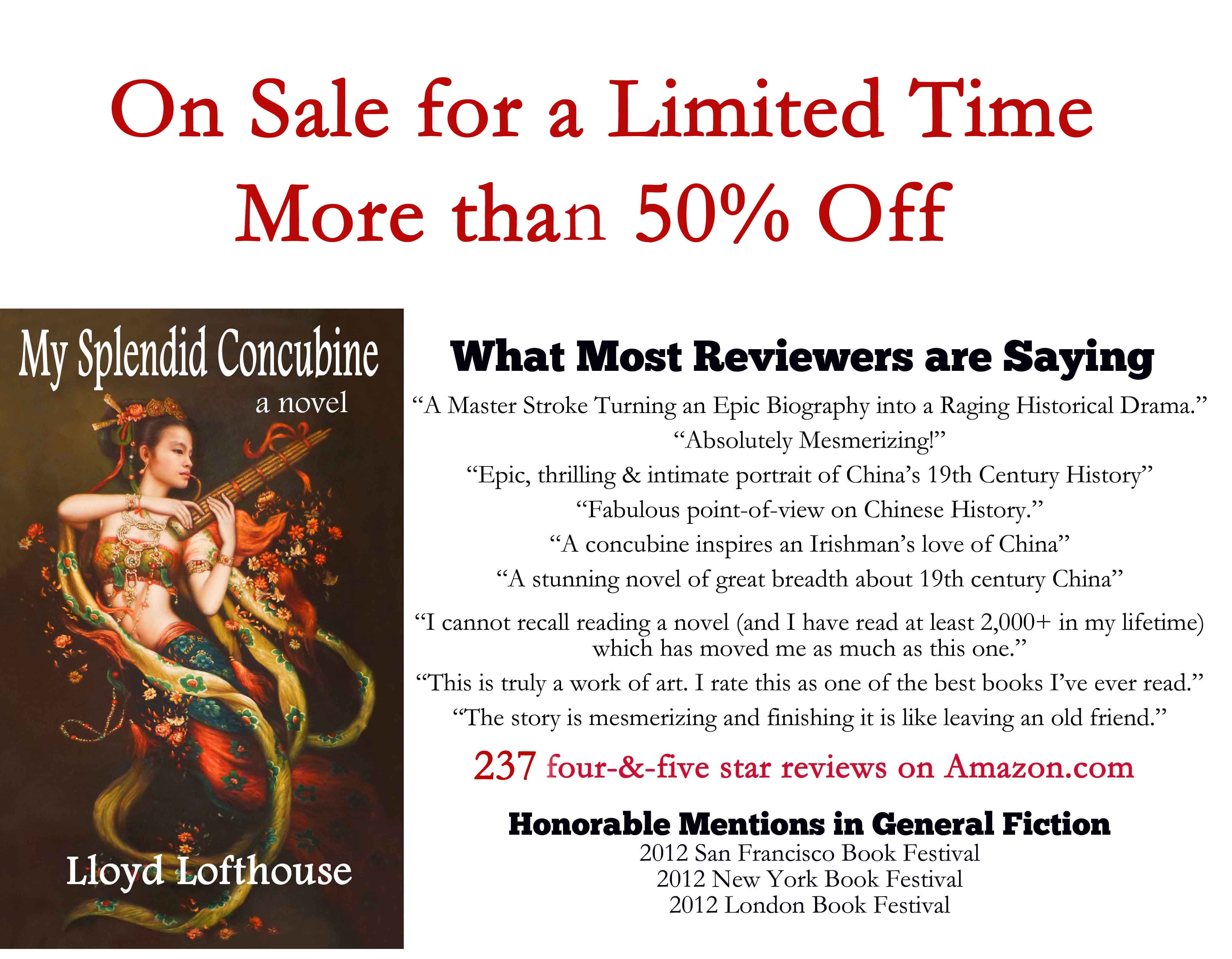
Lloyd Lofthouse is the award-winning author of My Splendid Concubine [3rd edition]. When you love a Chinese woman, you marry her family and culture too. This is the unique love story Sir Robert Hart did not want the world to discover.

on-sale-for-limited-time-oct-nov-2016

Where to Buy

Subscribe to “iLook China”!
Sign up for an E-mail Subscription at the top of this page, or click on the “Following” tab in the WordPress toolbar at the top of the screen.

About iLook China

China’s Holistic Historical Timeline


Does China have its own version of Halloween?

October 31, 2016

The closest celebration in China to Halloween in the United States is The Hungry Ghost Festival celebrated the 14th or 15th night of the 7th lunar month in July or August. This year that day fell on August 17th.

The Ghost Festival, also known as The Hungry Ghost Festival, is a traditional Chinese festival and holiday celebrated by Chinese in many countries, in which ghosts and/or spirits of deceased ancestors come from the lower realm and/or hell to visit the living.

Buddhists and Taoists in China claim that the Ghost Festival originated with the canonical scriptures of Buddhism, but many of the visible aspects of the ceremonies originate from Chinese folk religion, and other local folk traditions (The Ghost Festival in Medieval China by Stephen Teiser).

In America, most children wear costumes and go door to door collecting free candy.  In China, the opposite takes place; food is offered to dead ancestors, joss paper is burned, and scriptures are chanted.

Chinese Culture.net says the Hungry Ghost Festival is “Celebrated mostly in South China, Hong Kong, Taiwan and especially in Singapore and Malaysia.” It is believed by many Chinese that during this month, the gates of hell are opened to let out the hungry ghosts who want food.

By comparison, History.com says, “Halloween’s origins date back to the ancient Celtic festival of Samhain (pronounced sow-in). The Celts, who lived 2,000 years ago in the area that is now Ireland, the United Kingdom and northern France, celebrated their new year on November 1. This day marked the end of summer and the harvest and the beginning of the dark, cold winter, a time of year that was often associated with human death. Celts believed that on the night before the New Year, the boundary between the worlds of the living and the dead became blurred.”

I think it’s interesting that the dead linked both America’s Halloween and China’s Hungry Ghost Festival, at least historically.

As a child, I loved wearing a costume on Halloween and going out “trick-or-treating” at night to return home with a heavy bag (usually a pillowcase) filled with candy.

I still remember how much my stomach hurt and how terrible I felt after gorging myself on all that free processed sugar.

Today, due to the epidemic of diabetes and overweight or obese children in the United States (also in China mostly among its new middle class), I stopped celebrating Halloween years ago, and do not give candy to children. The last time I gave treats to children on Halloween, I handed out small boxes of raisins (sweet dried grapes) instead of candy, and one mother called me cheap.

But Science Daily.com comes to my defense with: “Teenagers who consume a lot of added sugars in soft drinks and foods may have poor cholesterol profiles—which may possibly lead to heart disease in adulthood, according to first-of-its-kind research reported in Circulation: Journal of the American Heart Association.”

In fact, the Centers for Disease Control and Prevention reports, “Teenagers and young adults consume more sugar drinks than other age groups and have been linked to poor diet quality, weight gain, obesity, and, in adults and children, type 2 diabetes.”

The American Diabetes Association says, “25.8 million children and adults in the US have diabetes while 79 million have prediabetes. Due to excessive sugar consumption, the risk of diabetes may lead to heart disease, stroke, high blood pressure, blindness, kidney disease, nervous system disease, and/or amputation of feet and legs.”

Maybe Americans should learn something from the Chinese Hungry Ghost Festival. Do not feed that sweet addictive candy to children.  Instead, give the sugar to the dead and have your children eat apples, because there’s a lot of truth to the old saying that if you eat an apple a day, it will help keep the doctor away. If you doubt that, read this from Science Daily.

Discover Anna May Wong, the woman that died a thousand times.

中

Lloyd Lofthouse is the award-winning author of My Splendid Concubine [3rd edition]. When you love a Chinese woman, you marry her family and culture too. This is the unique love story Sir Robert Hart did not want the world to discover.

on-sale-october-november-2016

Where to Buy

Subscribe to “iLook China”!
Sign up for an E-mail Subscription at the top of this page, or click on the “Following” tab in the WordPress toolbar at the top of the screen.

About iLook China

China’s Holistic Historical Timeline