The Millennium Cult

April 23, 2010

Religions, as Christians, Jews and Muslims practice them, have never played a “major” role in Chinese Culture and Politics. Even today, more than 800 million Chinese say they do not belong to any religion and the largest religion in China is Buddhism (about 10% of the population of China).  Even during Imperial times, most members of government did not belong to organized religions. The same is true today with the Communist government.

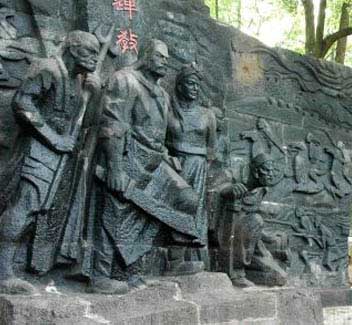
China’s struggle with pagan cults (like the White Lotus Society) reaches back almost a thousand years. The White Lotus Society appealed to poor Han Chinese peasants and more so to women, who found peace in worshiping the Eternal Mother. It was believed that this Eternal Mother would gather all her children at the millennium into one family.

The Eternal Mother

White Lotus Societies started out seeking tranquilly through a combination of Buddhism with some elements of Daoism (Taoism) and other native Chinese religions. Even in the 12th century, the Yuan Dynasty was distrustful of the Yellow Lotus Society, which didn’t fit comfortably with Confucianism and the five Great Relationships.

See A Visit from the Falun Gong

_________________________

Lloyd Lofthouse is the award winning author of the concubine saga, My Splendid Concubine & Our Hart. When you love a Chinese woman, you marry her family and culture too. 

Sign up for an RSS Feed for iLook China


Going through Customs in China

April 22, 2010

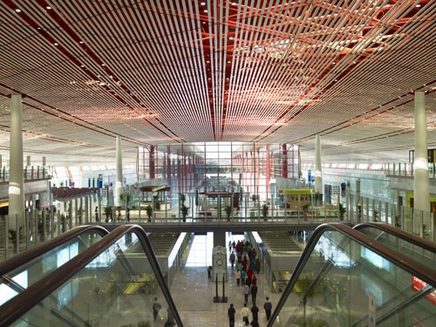
“Reach the head of the line at immigration at Beijing airport and you see something unexpected: On a little ledge just below the officer’s line of sight is a small machine showing an array of buttons. Atop the buttons is a legend inviting travelers to rate the work of the officer: very satisfactory / satisfactory / not satisfactory / slow or rude. As soon as the officer places his or her stamp in the passport, the buttons go active. The lines did move fast.” Source: Frum Forum

Beijing International Airport

I’ve pushed those buttons. Considering how rude the Chinese can be to each other (not foreigners like me­—we get the polite treatment), that was a good idea.

Beijing International Airport

Maybe rating systems like these also motivate China’s homeland security to be more efficient than what I’ve experienced in the US.  For example, I always carry a 16 GB USB thumb drive with me when I travel. All my backup files are on that drive. If the house burns down or is robbed, I won’t lose any of my computer files.

During our last trip to China, no one at San Francisco’s international airport asked to see the USB drive in my loose-change pocket. When I arrived in China, security at Pudong airport asked to see what I had in that pocket.

See “Dragon Air” http://wp.me/pN4pY-lD


The First Emperor: The Man Who Made China – Part 7/9

April 22, 2010

By 215 BC, Emperor Qin Shi Huangdi’s tomb is almost finished. The chamber where his body will rest is the size of a football field and will be hermitically sealed.  Then the tomb will be covered with a million tons of earth creating the hill we see today.

View of Qin Shi Huangdi's tomb

However, the Emperor doesn’t plan to die. Seeking advice from his doctor, he is given mercury capsules. At the time, it was believed that mercury would increase longevity.  Having lots of sex with multiple partners was also considered another way to increase life. The emperor follows the doctor’s advice and sends the doctor on an expedition to find an elixir for immortality.

The emperor isolates himself and delegates the power to rule the empire to those he trusts most. These men suppress free thought. Entire libraries are burned. Those who try to hide documents are branded on the face and sentenced to a life of force labor–mostly on The Great Wall. Anyone who resists is buried alive.

Professor Jeffrey Riegel, University of California, Berkeley, says that Chinese archeologists have no immediate plans to unearth the tomb, because there is no way to safeguard the contents from decay.

Go to Part 8 for The Man Who Made China or return to Part 6

View as Single Page

_________________________

Lloyd Lofthouse is the award-winning author of the concubine saga, My Splendid Concubine & Our Hart. When you love a Chinese woman, you marry her family and culture too. 

To subscribe to “iLook China”, look for the “Subscribe” button at the top of the screen in the menu bar, click on it then follow directions.


Blending the Law

April 21, 2010

The legal system in the United States comes primarily from English Common Law (influenced by Roman law and Greek teachings). English Common Law is a system based on the principle that the rulings made by the King’s courts were according to the common custom of the realm. Common law is grounded in precedent and local tradition stressing community and individualism.

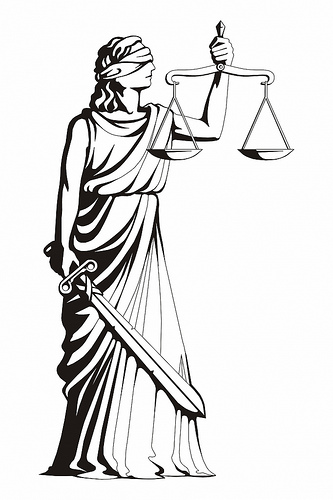
Is Justice Blind?

Legalism, the foundation of Chinese law, emphasizes the need for order above all other human concerns. The founder of the Legalistic school was Hsün Tzu (312–230 BC). He believed that humans are inherently evil and inclined toward criminal and selfish behavior. Since morality does not exist in nature and humans are part of nature, the only way to control behavior was through habit and harsh punishment. Without this, the result would be conflict and social disorder.

Even though both Confucianism and Legalism called for tradition and governmental control, the difference between the two is that Confucius (551–479 BC) advocated ruling benevolently by example. Both theories still play an important role in the cultural and legal development of China.

However, the legal system in the People’s Republic of China is currently undergoing gradual reform since international trade and globalization are influencing changes. What is evolving is a blending of English Common Law and Legalism.

Here is a good Blog to learn how to navigate through China’s legal system: http://www.chinalawblog.com/
See “China Law and Justice System” http://wp.me/pN4pY-hH

Sources used for this post:


China’s Middle Class Expanding

April 20, 2010

“Present estimates of “middle class” in China range from 100 million to 247 million… Estimates of the size and growth rate of China’s middle class vary. Roughly half of China’s projected urban population will be middle class in 2025.

“Unlike the United States, where income typically peaks between the ages of 45 to 54, it is predicted that the wealthiest consumers in China will be between 25 to 44 years old because the younger generation will be more highly educated.” Source:  Rise of China’s Middle Class

Buying Cars:
“In the first quarter of 2010, Chinese bought 4.61m units, up 71.78 percent year on year, according to the CAAM.” Source: The Truth About Cars

Buying Houses:
“…demand is still strong. A recent survey by the Hong Kong-based brokerage CLSA found that 56 percent of China’s middle-class families are considering buying a new home.” Source: Sinocism

“Furthermore, homebuyers in China put down at least 20 percent as a down payment (30 percent for a first-time buyer and 40 percent for a second-home buyer to damp down speculation). These buyers rarely fall behind on their mortgage payments.” Source: No Housing Bubble in China

Food:
“China’s mass grocery retail is booming and the turnover of both Chinese and foreign supermarket chains are growing.  The middle class’ new consumption patterns and increasing income has been a catalyst for growth and creates new export opportunities for Danish food companies.” Source: Renmin Shimbun

Discover The Reasons Why China is Studying Singapore

_______________

Lloyd Lofthouse is the award-winning author of My Splendid Concubine [3rd edition]. When you love a Chinese woman, you marry her family and culture too. This is the love story Sir Robert Hart did not want the world to discover.

Subscribe to “iLook China”!
Sign up for an E-mail Subscription at the top of this page, or click on the “Following” tab in the WordPress toolbar at the top of the screen.

About iLook China