Why did China stop being the most innovative country in the world

May 15, 2018

The Man Who Loved China is the biography of Joseph Needham’s life. In this biography, Simon Winchester, the bestselling author of The Professor and the Madman brings to life the extraordinary story of Joseph Needham, the brilliant Cambridge scientist who unlocked the most closely held secrets of China, long the world’s most technologically advanced country.

Joseph Needham’s Science and Civilisation in China deals with the history of science and technology in China, and the series is on the Modern Library Board’s 100 Best Nonfiction books of the 20th century.

In 1954, Needham—along with an international team of collaborators—initiated the project to study the science, technology, and civilization of ancient China. This project produced a series of volumes published by Cambridge University Press. The project is still continuing under the guidance of the Publications Board of the Needham Research Institute (NRI).

If you visit Cambridge.org, you will read: “Dr. Joseph Needham’s account of the Chinese achievement in science and technology will stand as one of the great works of our time. It has been acclaimed by specialists in both East and West and also by readers with wider and more general interests. The text, based on research of a high critical quality, is supported by many hundreds of illustrations and is imbued with a warm appreciation of China. … He begins by examining the structure of the Chinese language; he reviews the geography of China and the long history of its people, and discusses the scientific contacts which have occurred throughout the centuries, between Europe and East Asia.”

Needham left us with a question that he never answered, and China experts are still debating that answer today, an answer to the curious fact that after centuries of scientific and technological creativity, that activity suddenly came to an end in 1500 AD. Needham wanted to know what happened, but he never answered his own question.

Needham’s research on China discovered that the ancient Chinese led the world and accomplished an average of 15 important innovations a century for a total of more than fifteen hundred. Then came the sixteenth century, when the Renaissances was fully underway in Europe, and the creative passions of China dried up.

I think the answer to Needham’s question will be revealed in the posts that cover the rest of China’s history after the end of the Song Dynasty in 1279 AD up to Mao’s death in 1976. The decline was long, brutal, and bloody.

When Mao died in 1976, China’s education system was all but gone and had to be rebuilt from scratch, and many of the country’s public school teachers were dead from suicide or execution. If you read The Man Who Loved China, you will also discover that during World War II, one goal of the Japanese was to destroy China’s educational system, and the Japanese armies did all they could to destroy China’s universities, burn China’s libraries, and execute China’s scholars.

What happened to China after the Song Dynasty and in World War II reminds me of what is happening today in the United States where ignorant, arrogant individuals like Donald Trump, Betsy DeVos, Bill Gates, David and Charles Koch, the Wal-Mart Walton family and their autocratic, wealthy, old, white allies are slowly, systematically dismantling the community based, public education system of the United States.

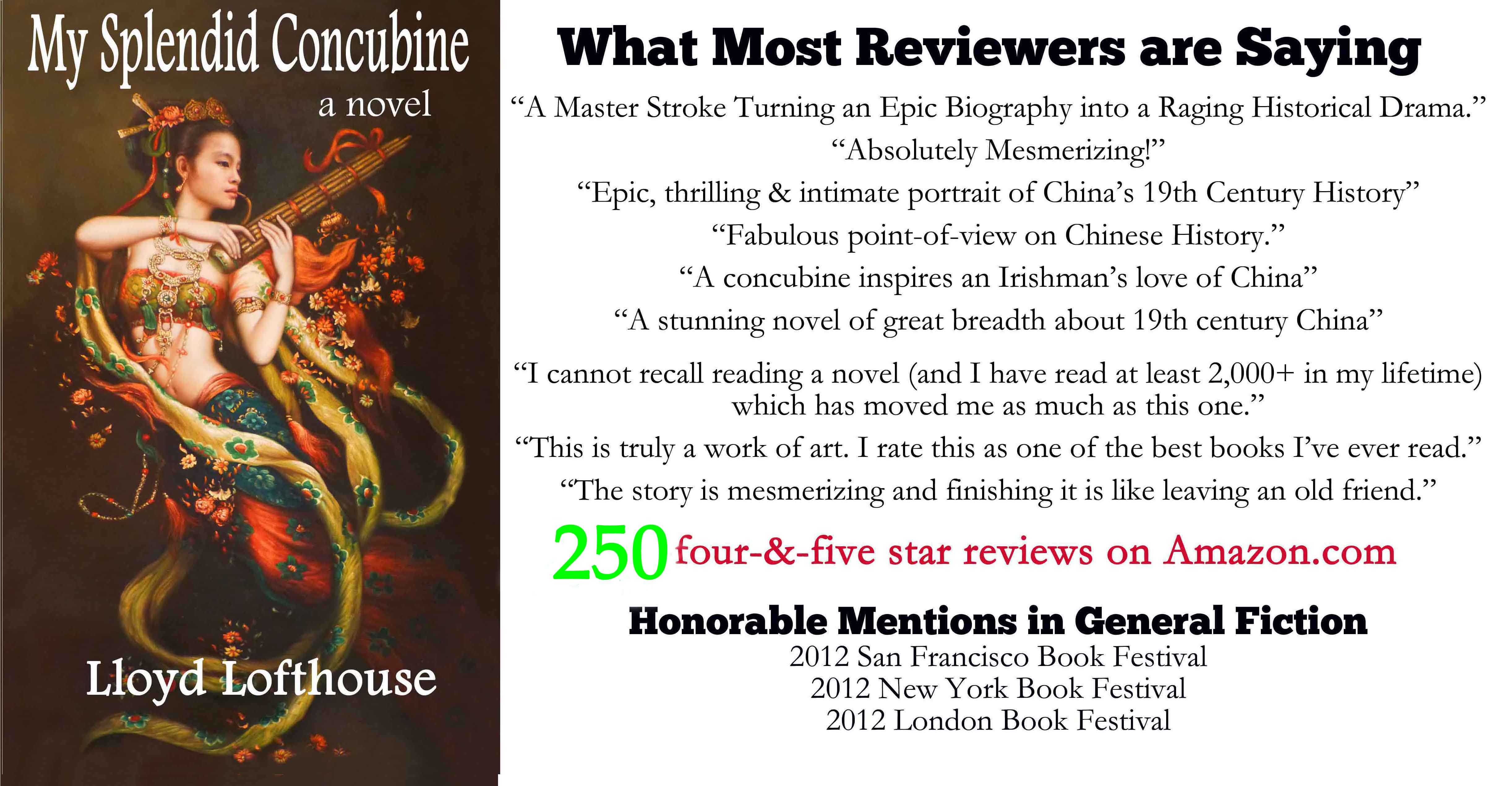
Lloyd Lofthouse is the award-winning author of My Splendid Concubine, Crazy is Normal, Running with the Enemy, and The Redemption of Don Juan Casanova.
Where to Buy

Subscribe to my newsletter to hear about new releases and get a free copy of my award-winning, historical fiction short story “A Night at the Well of Purity”.

About iLook China


China was the Most Innovative Country in the World for Fifteen Hundred Years: Part 3 of 3

May 10, 2018

Another Chinese inventor during the Song Dynasty created a machine known as the Cosmic Engine, the ancient world’s astronomical computer.

Su Song was the inventor.  The Cosmic Engine was so complicated that for centuries no one (even Westerners) understood how it worked. Today, few westerners know that it existed.

However, records show that the Cosmic Engine was created in 1092 AD.

The Cosmic Engine calculated time—not just hours and minutes but weeks, months and seasons reflecting how the earth moves around the sun. It also calculated how the earth and planets moved through space.

The Cosmic Engine was five stories tall and its working innards were complex.

Today, we know exactly how this device was created since Su Song left detailed blueprints and directions describing how it was built. Song’s Cosmic Engine worked from the eleventh century until enemies of the Song Dynasty destroyed it.

Using Song’s blueprints, the Science and Technology Museum in Beijing built a fully accurate reconstruction. Another reconstruction exists in London.

This ingenious device led to the invention of Western clocks hundreds of years later, and we now know that many of the inventions and discoveries the modern world was built on originated in ancient Imperial China.

The Confucian method of meritocracy was (and still is) the engine that led to the creation of all of the Chinese innovations mentioned in this series of posts and this is only a sample.

The Chinese system of meritocracy then and now makes it impossible that anyone as weak or ignorant as George W. Bush or Donald Trump could ever come close to a position of top leadership.

Return to Part 2 or start with Part 1

Lloyd Lofthouse is the award-winning author of My Splendid Concubine, Crazy is Normal, Running with the Enemy, and The Redemption of Don Juan Casanova.

Where to Buy

Subscribe to my newsletter to hear about new releases and get a free copy of my award-winning, historical fiction short story “A Night at the Well of Purity”.

About iLook China


China was the Most Innovative Country in the World for Fifteen Hundred Years: Part 2 of 3

May 9, 2018

Modern ironworkers of today use the same method that ancient Chinese did, but today there is automation and we use electrical air pumps to feed the fire.

How did the ancient Chinese develop a method to drive enough air into a furnace to heat it to the necessary high temperatures? The Chinese used water to drive the bellows for a blast furnace. With these inventions, the groundwork was laid for other sophisticated machinery used in mass production.

One such invention in ancient China was an odometer designed to measure distance.  This device was known as the rangefinder chariot. A cart that was rolling along with troops measured every five hundred meters by banging a drum automatically.

This device was used to measure the distance to enemy camps and measure how far the troops had marched from a royal city.

What is amazing about this ancient odometer is that the gears match exactly those found in modern motorcycle engines.

There is also evidence of the application of gear engineering in eastern China on a massive industrial scale during the Song Dynasty (960 – 1276 AD).

We now know that the Chinese had huge factories capable of mass production.

Another ancient machine recently discovered is the hydraulic trip hammer and it is believed to have been developed two millennia ago. The texts from that time tell us that the huge machine was used to crush grain but also to pound metal the same way metal is still developed today.

The ancient Chinese then invented a more efficient way to grind grain-using millstones. However, the Chinese took this machine to an advanced level known as a multiple geared gristmill, which was also powered by water.

Nearly a thousand years later, the industrial revolution started in England.

Part 3 continues on May 10, 2018, or return to Part 1

Lloyd Lofthouse is the award-winning author of My Splendid Concubine, Crazy is Normal, Running with the Enemy, and The Redemption of Don Juan Casanova.

Where to Buy

Subscribe to my newsletter to hear about new releases and get a free copy of my award-winning, historical fiction short story “A Night at the Well of Purity”.

About iLook China


China was the Most Innovative Country in the World for Fifteen Hundred Years: Part 1 of 3

May 8, 2018

It is a common assumption (a guess) in the West that Europe and The United States invented the machines that power our modern lifestyles.

However, new discoveries from ancient China are forcing us to rewrite history.

While Europe was mired in the so-called dark ages, ancient China ruled supreme as the world’s technological super power, and we are discovering that many of the inventions that have shaped our modern world had their beginning in ancient China.

There were complex geared machines that allowed production on an industrial scale such as precision seismographs that detected earthquakes, drilling machines that bored for natural gas hundreds of meters beneath the earth, or a super-scale Cosmic Engine that not only told the time but also predicted the passages of the planets and the stars.

Some of these technologies were so complex, they remained a mystery for centuries.

Two thousand year old books show in detail things that are still needed today.

Another discovery from ancient China was drilling for oil. We assumed it was modern engineers that developed oil-drilling techniques. It wasn’t. They improved the techniques but did not invent the method.

History Lines.net reports, “The Chinese have used oil and gas for many centuries. There is no record of when Chinese began using natural gas, but clearly in Szechuan the local people were drilling down hundreds of feet into the earth to get natural gas and brine before the start of the Han Dynasty, before 400 B.C. The Chinese used bamboo pipelines to carry natural gas and mix it with air to yield a usable source of fuel for fires. … By the first century B.C., the technology of well-drilling had advanced, and Chinese engineers were able to dig down over 800 feet …”

During the Song Dynasty, China’s innovations reached their peak. Inventers and engineers were creating machines that wouldn’t be seen in the West for another thousand years.

Part 2 continues on May 9, 2018

Lloyd Lofthouse is the award-winning author of My Splendid Concubine, Crazy is Normal, Running with the Enemy, and The Redemption of Don Juan Casanova.

Where to Buy

Subscribe to my newsletter to hear about new releases and get a free copy of my award-winning, historical fiction short story “A Night at the Well of Purity”.

About iLook China


How far are you willing to go to enhance your beauty?

May 2, 2018

In ancient China, the process of foot binding usually started between the ages of four and seven.  Feet were soaked in a blood and herb mixture. Toes were broken. Then the arch was broken. There was extreme pain since no drugs were used. It is estimated that in about a thousand year period about two billion Chinese women went through the process.

But China wasn’t always like this. According to historical accounts, foot binding appeared in China during the Song Dynasty (960 – 1276 AD). That means Chinese women before the Song Dynasty did not have their feet broken to keep them small. In fact, during the Tang Dynasty (618 – 907 AD), women gained more freedom that wouldn’t return until after the Civil War that the Chinese Communist Party won in 1949.

The Manchu leaders of the Qing Dynasty (1644 to 1911) attempted to stop foot binding, and Manchu women did not bind their feet, but many Han women continued the practice. More than 90-percent of China’s population is Han.

In 1928, the Nationalist government also attempted to end foot binding but with mixed success. In rural areas, large feet were still considered unattractive and unacceptable and the practice continued. Smithsonian Magazine says, “Despite the pain, millions of Chinese women stood firm in their devotion to the tradition.”

The Virtual Museum of the City of San Francisco reports, “Even in 19th century San Francisco, there were Chinese girls and women with bound feet.”

For millions of Chinese women, the practice of foot binding continued until 1949 when the Chinese Communist Party came into power and enacted laws that made women equal to men for the first time in China’s history.

And if you think the practice of foot binding in China was horrible, the BBC reports, “There are still plenty of fashion victims in the 21st Century. ‘Although we haven’t got corsets or crinolines anymore, there are now people having their ribs removed to get a smaller waist.’”

Lloyd Lofthouse is the award-winning author of My Splendid Concubine, Crazy is Normal, Running with the Enemy, and The Redemption of Don Juan Casanova.

Where to Buy

Subscribe to my newsletter to hear about new releases and get a free copy of my award-winning, historical fiction short story “A Night at the Well of Purity”.

About iLook China