Capturing a Vanishing China

June 23, 2011

I feel compelled to write about a one-star review that appeared recently of Tom Carter’s China: Portrait of a People.

In fact, as I write this post, Carter’s book has had 100 reviews. Eighty-eight earned five stars and eleven four-star reviews. There is only one one-star review.

My wife is Chinese and was born in Shanghai (discover the modern city) during Mao’s Great Leap Forward then was sent to a labor camp as a teen during The Cultural Revolution. When she first saw the photos in Tom Carter’s book, she said he is the first and only photojournalist to capture the heart and soul of China.

What she was talking about was the rural Chinese who have always been the invisible heart and soul of China. If it weren’t for those same rural Chinese, Mao and the Communist Party would have never won China’s Civil War.

What follows is the rambling, rant of a one star review written by someone calling him or herself Xuemin Lin.

Lin says, “Ignorance of all American who think that these photos show the reality China, you don’t know the truth. Tom Carter pictures can only show that poor farmers and rural areas. He ignoring the majority of China’s middle class and developed districts in urban life intentionally. We have a modern apartment and a beautiful new car and stylish clothes. Why Tom Carter just want to show the barefeet farmers and the minorities? His pictures make you believe we Chinese all are swarthy skin and the tooth is not good and make our homes in the mountains area. China’s economy has grown rapidly. The United States owes a debt to total billions of dollars to China. China will soon become a superpower in the world! Han people will lead Asia and then the world. So, do not believe that this book is shows the real China! Tom Carter in a planned way only want to show you the poor! I upload his video got from the Youku website so yourself can see his photos is not the good. Do not by this book I suggest!”

Lin claims that the majority of Chinese belong to the emerging middle class. Lin is wrong. China has a few decades to go until more than a billion people join the modern middle class lifestyle.

Even China’s leaders have admitted that China is not as developed as America or Europe and that China will never rival American super power status. The best China may attain is a regional military super power and a global economic super power.

To understand what I mean, you may want to read Amy Chua’s Day of Empire: How Hyperpowers Rise to Global Dominance–and Why They Fall.

It is a fact that China is modernizing at a pace never before seen in history and more than three hundred million Chinese now live in urban cities similar to Shanghai and Beijing and belongs to China’s middle class. However, that leaves about 1.2 billion people that have not yet joined that middle class and 800 million of those people still live as Carter shows us in his photos.

If China accomplishes its goal to modernize most of China and lift the majority of Chinese into the middle class, the world that Tom Carter captured with his photos will vanish. Our only reminder of that China will be his book.

What Lin’s one-star review really reveals is a shame among some Chinese that should not exist. China should be proud of its rural peasants because they have always been the backbone of China and those people deserve their moment in the sun or between the covers of China: Portrait of a People

When I visit China, I want to escape America for a few weeks but realize that I cannot escape the Golden Arches of McDonalds, or Starbucks, Pizza Hut and KFC, which is the worst thing China could adopt from America.  In addition, China has also inherited the obesity, diabetes, heart disease and cancer that come with this fast food, middle class, and motorcar culture invented in the West.


Some of America’s history captured in photos and song.

In addition, I’ve complained that China has no artist comparable to America’s Charles Russell or Bev Doolittle — great artists that captured the heart and soul of the America that existed before Europe and the industrial revolution arrived to fill the air with poison.

However, Tom Carter’s photos capture some of that world in China that will soon be lost. After China has paved over its past, without Tom Carter’s photos we would never know what that world was like.

Therefore, I ask the Xuemin Lins of China, “What is it you have against Tom Carter capturing what is fast disappearing as China becomes another middle class, smog choked clone of Los Angeles, London, Paris and New York?”

I prefer the China where people are practicing Tai Chi in the early morning fog.

______________

Lloyd Lofthouse is the award-winning author of the concubine saga, My Splendid Concubine & Our Hart. When you love a Chinese woman, you marry her family and culture too.

To subscribe to “iLook China”, look for the “Subscribe” button at the top of the screen in the menu bar, click on it then follow directions.


Closed Minds and Culturally Blind Missionary Zeal

June 21, 2011

Recently, my wife bought me a copy of Henry Kissinger On China. She said if you read anyone that is not Chinese writing about China, Henry Kissinger is the only Westerner to trust.  The reason, she explained, was that the leaders of China trust and respect few in the West.

However, Kissinger is the exception, and from what I’ve discovered since 1999, I don’t blame most Chinese or China’s leaders.

I haven’t read that far into the book but Kissinger’s Preface has a revealing quote in it.

Kissinger said, “American exceptionalism is missionary. It holds that the United States has an obligation to spread its values to every part of the world. China’s exceptionalism is cultural. China does not proselytize; it does not claim that its contemporary institutions are relevant outside China.”

What Kissinger didn’t say, which I may discover later as I read further into the book, is that America is spreading more than its spiritual, ethical, and moral values but is also importing its middle class unsustainable, consumer, debt-ridden, fast food, disease ridden lifestyle, which is more popular outside America than US cultural values.

The Economist for May 21, 2011 reviewed Kissinger’s book and said, “The Western politician who understands China best tries to explain it–but doesn’t quite succeed.”

In fact, it isn’t easy to overcome the Western prejudices that refuse to accept that people from other cultures are different from America and the West, which may be one reason why The Economist is so cynical and critical of almost everything they write about that does not fit their British cultural bias.

Another example is when a friend and expatriate living in China sent me a link to a Site called The Middle Kingdom Life written by a person that lived and taught at universities in China for seven years then left feeling bitter and disappointed, because China didn’t measure up to what he felt it should be, which is a reaction that has a lot to do with that American obligation to spread its values to every part of the world (even when other countries and cultures are not interested in those American and/or Western values).

Then another Blog I follow (but hold little respect for) sent me a notice that someone had left a similar comment.

That other Blog is called Understanding China, One Blog at a Time (should be “One Post” at a Time).

One Blog at a Time doesn’t understand China or the Chinese and is another emotional, biased rant criticizing China for not being a mirror image of American culture and does not take into account that China is a different culture with a different history and is still a developing third-world country with a large segment of its population that, until a few years ago (as early at the 1980s), lived as people had for centuries with a medieval lifestyle—meaning no electricity, no running water, no schools, no toilets, no sewers, or paved roads, etc.

It seems that little has changed from the 19th century when Robert Hart was the same as Kissinger is today to the Chinese except that today China stands on its own feet and is powerful enough militarily not to be bullied to cave in to Western demands to change the Chinese culture due to that American (and Western) obligation to spread its values to every part of the world, which may explain why we are fighting Islamic fundamentalists that wants to destroy Western Civilization.

That same Western missionary zeal (from Europe) that drives America today destroyed the Aztecs and Incas, enslaved tens of millions of Africans, colonized North America leading to the American Indian Wars of the 19th century, started two Opium Wars in China, killed a quarter of a million in the Philippines, meddled with Japan’s culture leading to World War II in the Pacific and China where The Rape of Nanking  took place, invaded Vietnam where millions died, fought the Korean Conflict, and imported American values with nation building by invading Iraq and Afghanistan.

What’s next?

______________

Lloyd Lofthouse is the award-winning author of the concubine saga, My Splendid Concubine & Our Hart. When you love a Chinese woman, you marry her family and culture too.

To subscribe to “iLook China”, look for the “Subscribe” button at the top of the screen in the menu bar, click on it then follow directions.


The “Vanishing” Street Art of Chinese Calligraphy

June 19, 2011

Chinese calligraphy is not vanishing. What I’m talking about is demonstrated in the videos included with this post. In China, many artists use sidewalks as a canvas and a brush with water to paint the beauty of calligraphy. As the water evaporates, the art vanishes.

In fact, calligraphy is more popular than ever. After the Cultural Revolution, many people turned to calligraphy in the hope of finding solace in the calm repetition of its exercises. Then, in 1981, the authorities took the lead in setting up a Chinese Calligraphers’ Association, the first such nationwide body ever to be established in the country. Source: Fathom.com, The British Museum

Both a language and an art, Chinese calligraphy has been traced back more than 4,000 years to the crude form called “Jia Gu Wen” found on turtle shells from the Shang Dynasty.

Calligraphy first bloomed as an art during the Han Dynasty but by the time of the Tang Dynasty, it had declined as an art. Source: Chinese Calligraphy History

It would be difficult to talk about Chinese art without understanding Chinese calligraphy and its artistic inspiration. A painting has to convey an object, but a well-written character conveys only its beauty through line and structure.

In Shanghai on sidewalks, or Beijing at The Summer Palace, I’ve watched men with long handled brushes, as seen in the first video, using water for ink and concrete for paper. With grace, they exhibit the skills of a Rembrandt breathing life into the characters.

America’s so called street artists should copy the Chinese that practice calligraphy and trade in their cans of spray paint for brushes and water, which would save US taxpayers much money.

Lin Yutang writes in My Country and My People that Western art is more sensual, more passionate, fuller of the artist’s ego, while the Chinese artist and art-lover contemplates a dragonfly, a frog, a grasshopper or a piece of jagged rock—more in harmony with nature.

Owing to the use of writing calligraphy with a brush, which is more subtle and more responsive than the pen, calligraphy as art is equal to Chinese painting.

Through calligraphy, the scholar is trained to appreciate, as regards line, qualities like force, suppleness, reserved strength, exquisite tenderness, swiftness, neatness, massiveness, ruggedness, and restraint or freedom.

Maybe this helps explain why the Chinese are not as warlike as Christian and Islamic cultures.

This revised and edited post first appeared on July 3, 2010 as Caressing Nature with Chinese Calligraphy

______________

Lloyd Lofthouse is the award-winning author of the concubine saga, My Splendid Concubine & Our Hart. When you love a Chinese woman, you marry her family and culture too.

To subscribe to “iLook China”, look for the “Subscribe” button at the top of the screen in the menu bar, click on it then follow directions.


Chinese Opera and Mao Wei Tao, China’s Living Treasure

June 18, 2011

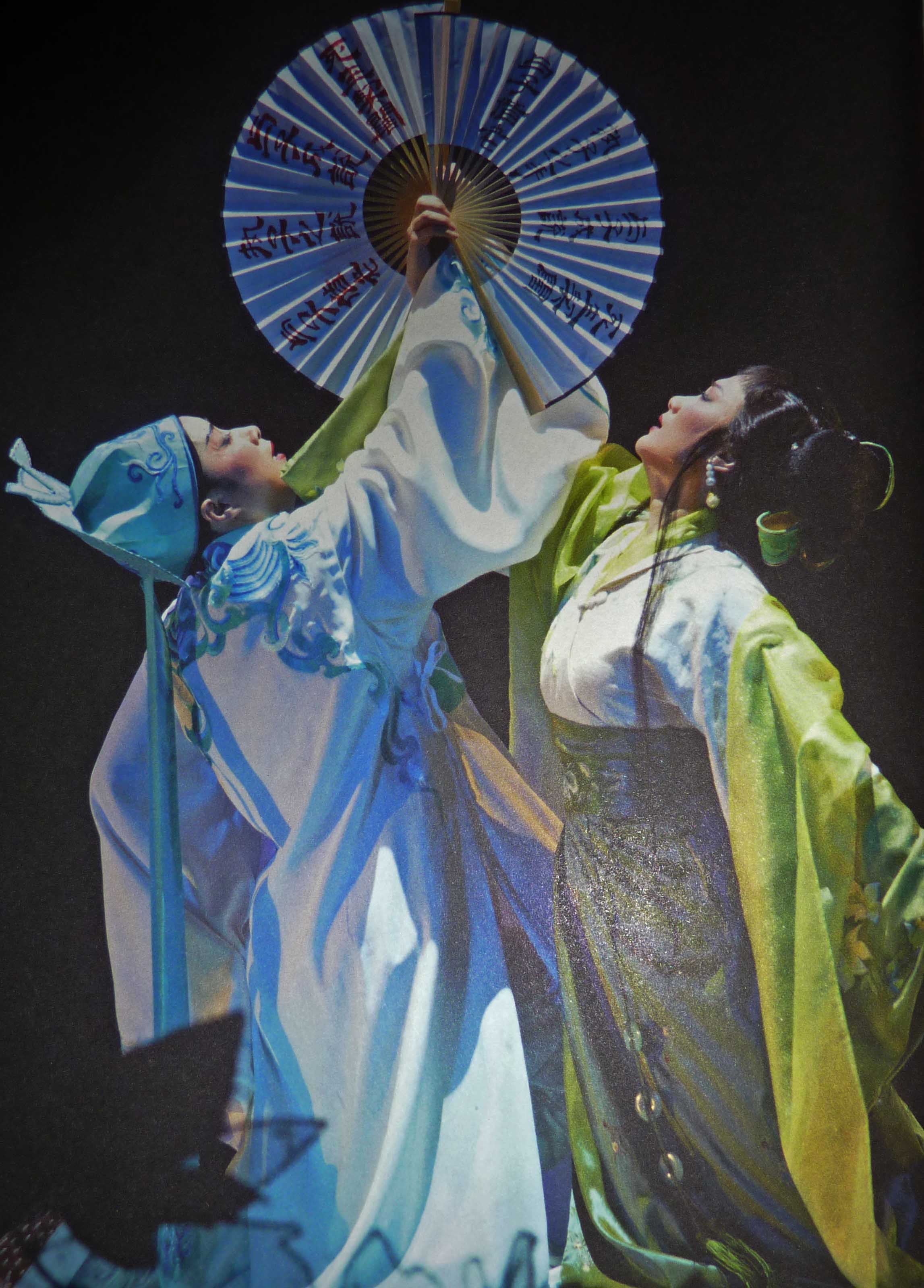
Mao Wei Tao is considered a living treasure in China. She imitates men in the opera roles she plays—a reversal from Imperial China when women were not allowed on stage so men played female roles.

“In 1923, the training of female actors for this art form was set up. Since 1928, the Shaoxing opera troupes, consisting of solely female actors, began their performances in Shanghai. In a few years, females impersonating males had become the most important feature of this opera form, and at the same time the Yue opera became well known all over China.”

East China’s Zhejiang province gave China Shaoxing Opera’s Mao Wei Tao.

In her thirty-year career on the stage, she’s best known as an outstanding male impersonator with a cult following of women.

I was introduced to Yue Opera in Hangzhou, Zhejiang Province about a decade ago.

Mao Wei Tao and her husband have a theater company near the shores of the famous Westlake. My wife translated while I watched the live-opera performance in fascination.

The costumes were lavish and the acting and opera was dramatic while classical Chinese music played in the background.

The challenge today is to keep this form of Chinese opera alive. The audience for opera is shrinking dramatically in China while remaining popular with the older generation.

Television, movies and the Internet are claiming the shorter attention spans of younger Chinese

Mao Wei Tao, considered an innovative genius on stage, adapts and works to keep the art form alive. According to her husband, no two performances are exactly alike.

In November 2010, she performed in Taiwan as a cultural ambassador from the mainland.

This revised and edited post first appeared on March 14, 2010 as Mao Weitao and Yue Opera

______________

Lloyd Lofthouse is the award-winning author of the concubine saga, My Splendid Concubine & Our Hart. When you love a Chinese woman, you marry her family and culture too.


To subscribe to “iLook China”, look for the “Subscribe” button at the top of the screen in the menu bar, click on it then follow directions.


Qin Shi Huangdi – The Man who unified China – (Viewed as Single Page)

June 14, 2011

Professor Jeffrey Riegel, of the University of California, Berkeley traveled to China to unlock the truth behind one of the earth’s greatest legends, a man larger than life, the first emperor of China, Shi Huangdi (259-210 BC). This post comes from the documentary film of China’s first emperor.

The first time we visited his tomb was December 1999.

Shi Huangdi was barely thirteen when his father died (246 BC) after being king of Qin for three years. The legends say Shi Huangdi was a tyrant driven mad by power.

He had a tomb built the likes of which humanity has never seen. When the first emperor died, he was the most powerful man on earth. He created an empire that outlasted Rome by a thousand years, he ruled ten times the population of ancient Egypt, and today’s China owes its existence to this man.

Months after becoming king at thirteen, Shi Huangdi overcomes his mother’s desire to rule in his name and took his nation to war. He was the youngest king to wage war and soon proved he was also the greatest warrior.

He soon becomes known as the Tiger of Qin.

Shi Huangdi wages war against his enemies for ten years. At the time, there were seven countries in China besides Qin. The seven countries in what we know as China today were Zhao, Yen, Wei, Han, Chi, Chu and Qin.

During the war to conquer Zhao, Shi Huangdi’s army took ten thousand prisoners. The rules of war say these prisoners must be fed and sheltered. However, Shi Huangdi changed the rules.

He shows his troops what to do by beheading an enemy troop and calls on his army to do the same.

He says, “There is only one way to treat weakness and that is to exploit it. There is only one way for Qin to survive, and that is to conquer.”

All 10,000 Zhao prisoners were beheaded.

By the time Qin Shi Huangdi turns  twenty, he had captured thirteen cities from the state of Han and twenty from the other states. Huangdi’s rival countries send a combined army to stop him but they are repelled.

Some of Huangdi’s success is because of the precision weapons Qin craftsmen make for his loyal, highly trained army. Discover more of China’s Warrior King

However, while the king of Qin is conquering China, there is an enemy scheming to replace him.

His mother, the dowager queen, has taken a lover, who masquerades as a eunuch. The queen has had two illegitimate sons with this lover, who steals two royal seals that gives him authority to mobilize troops in an attempt to replace Shi Huandgi with one of the king’s half brothers.

Qin’s prime minister discovers the plot and a trap is set to destroy the rebel army. The dowager queen’s lover is captured, tortured and his mangled body pulled apart by four horses while the queen mother is forced to watch.

While the death sentence is being carried out, Huandgi has his two half brothers strangled to remove this threat to his throne.

With this challenge to the throne removed, Shi Huangdi has learned a lesson. He is ruthless and rids himself of his mother and his prime minister.

There is a dramatic scene where the prime minister asks for forgiveness for letting the queen mother do what she did.

The prime minister is exiled and not allowed to see the queen mother again. Within a year, the disgraced prime minister kills himself.

A scholar, who believes in harsh laws, becomes Huangdi’s closest advisor.

By 227 BC, the Qin state has conquered the states of Han, Wei and Zhao.

The state of Yen knows it is next and sends professional assassins disguised as peace emissaries to kill Shi Huangdi. The emissaries arrive in Xian with gifts and an assassin strikes.

Since no weapons are allowed in the throne room, there are no armed guards to protect the king. Only the king has a weapon and only the king can call the troops to save him.

By 223 BC, Shi Huangdi is ready to unify China. Only the states of Chi and Chu are left, but the Chu army destroys his first invasion force.

Shi Huangdi raises another army and invades again. A million troops face each other and it becomes a standoff. To win, Shi Huangdi tricks the Chu generals to make a mistake, and the last great obstacle to the unification of China falls.

Chi is the last country that has not been defeated. To avoid the slaughter, Chi joins Shi Huangdi without a fight.

Qin is now China.

At the age of 34, Qin Shi Huangdi was crowned with a veil of stars as the first god emperor of the Qin people and China.

The system of governance put into place will long outlast the emperor.

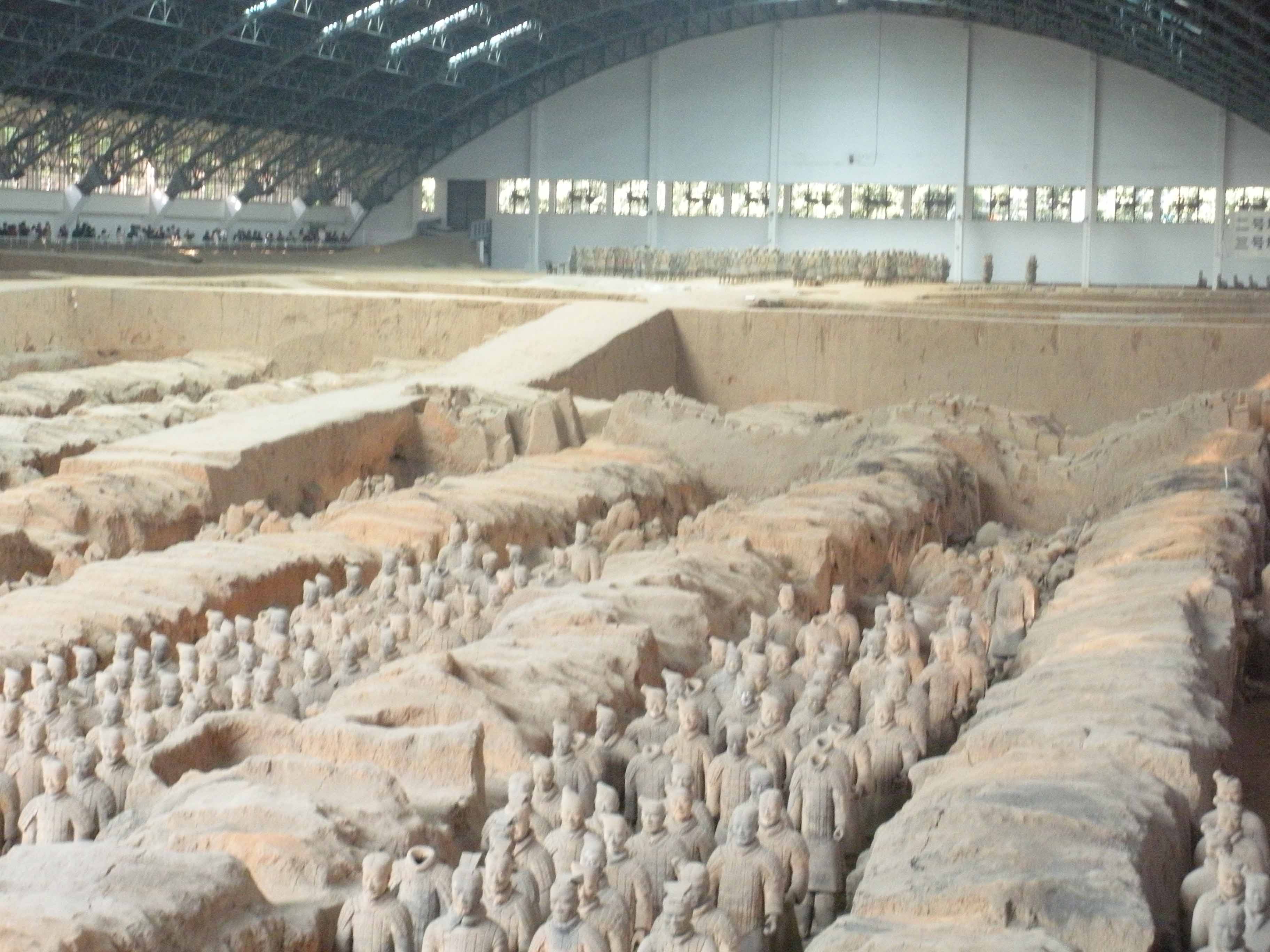
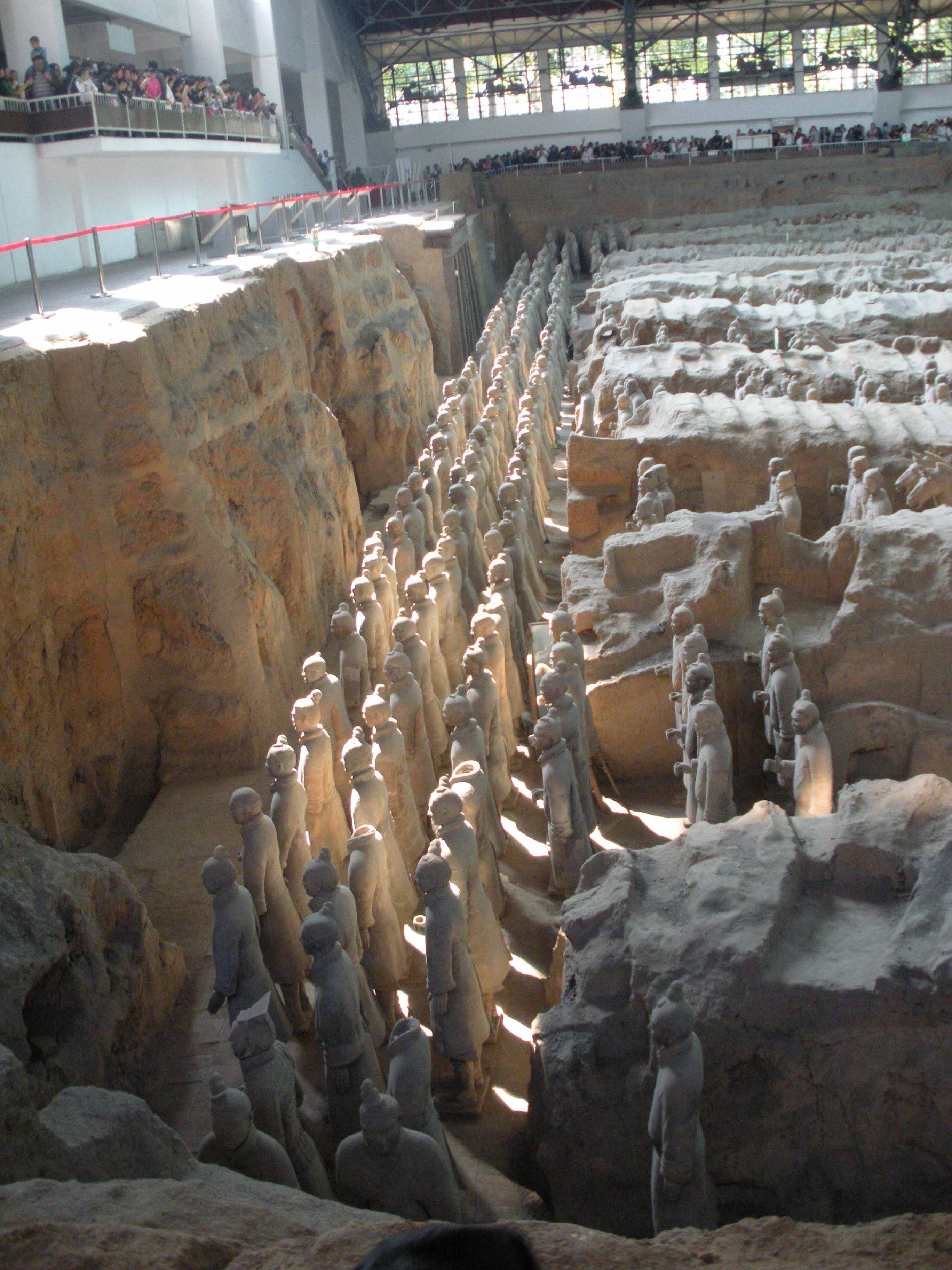
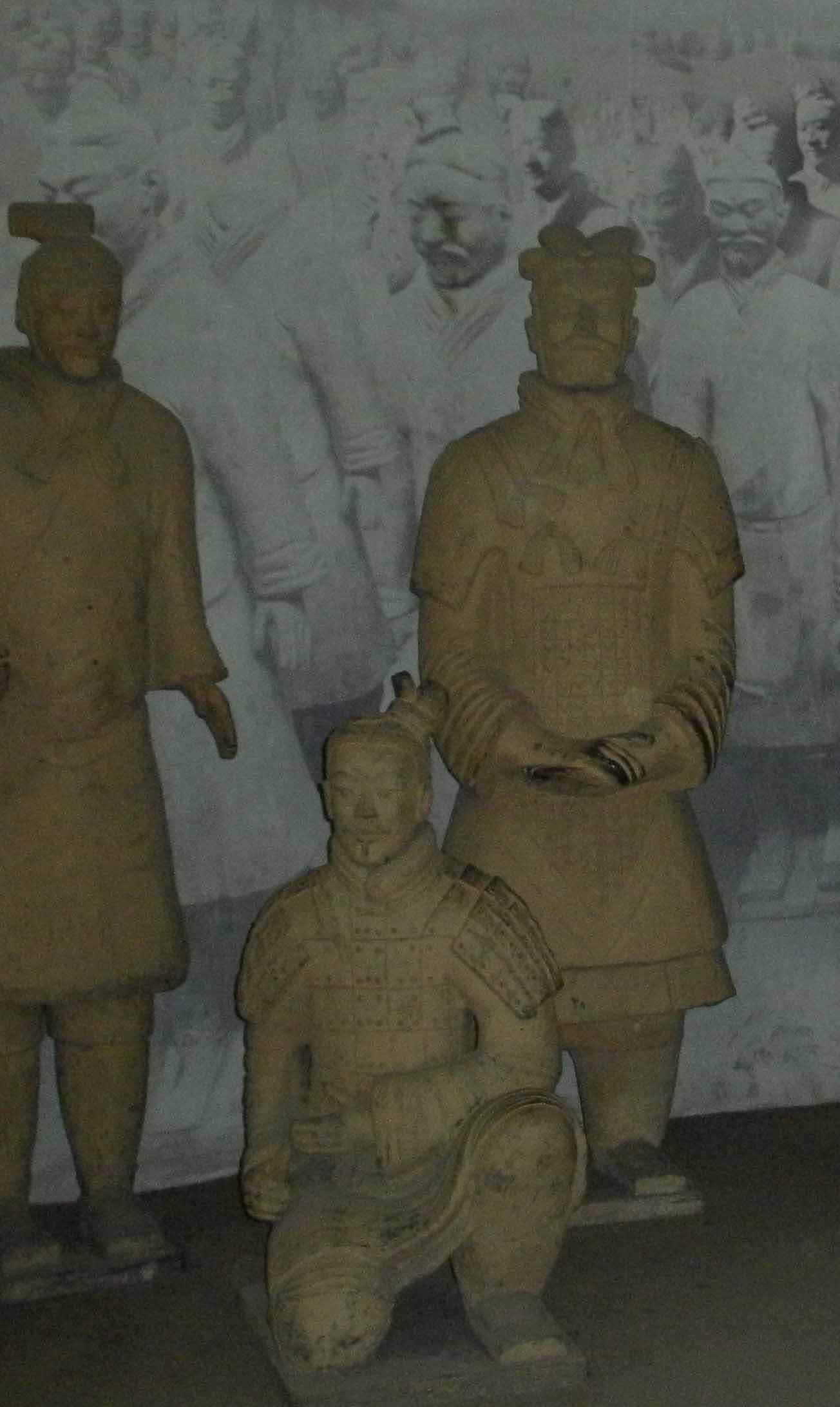
Qin Shi Huangdi commissions a Terra Cotta army that will guard him in death, and the troops are larger than life. In one pit, more than two hundred sets of armor made of stone have been found with no bodies to wear them.

It is believed that the armor may have been made for the spirits of dead soldiers who suffered violent deaths in combat so the dead would not become vengeful spirits.

The totalitarian philosophy in the new Chinese empire was called legalism.

Rules govern every part of every citizen’s daily life with the punishment spelled out. Physical punishment could mean mutilation.

For example, if two are caught having sex, they will be beheaded. Every aspect of private life is part of Qin law.

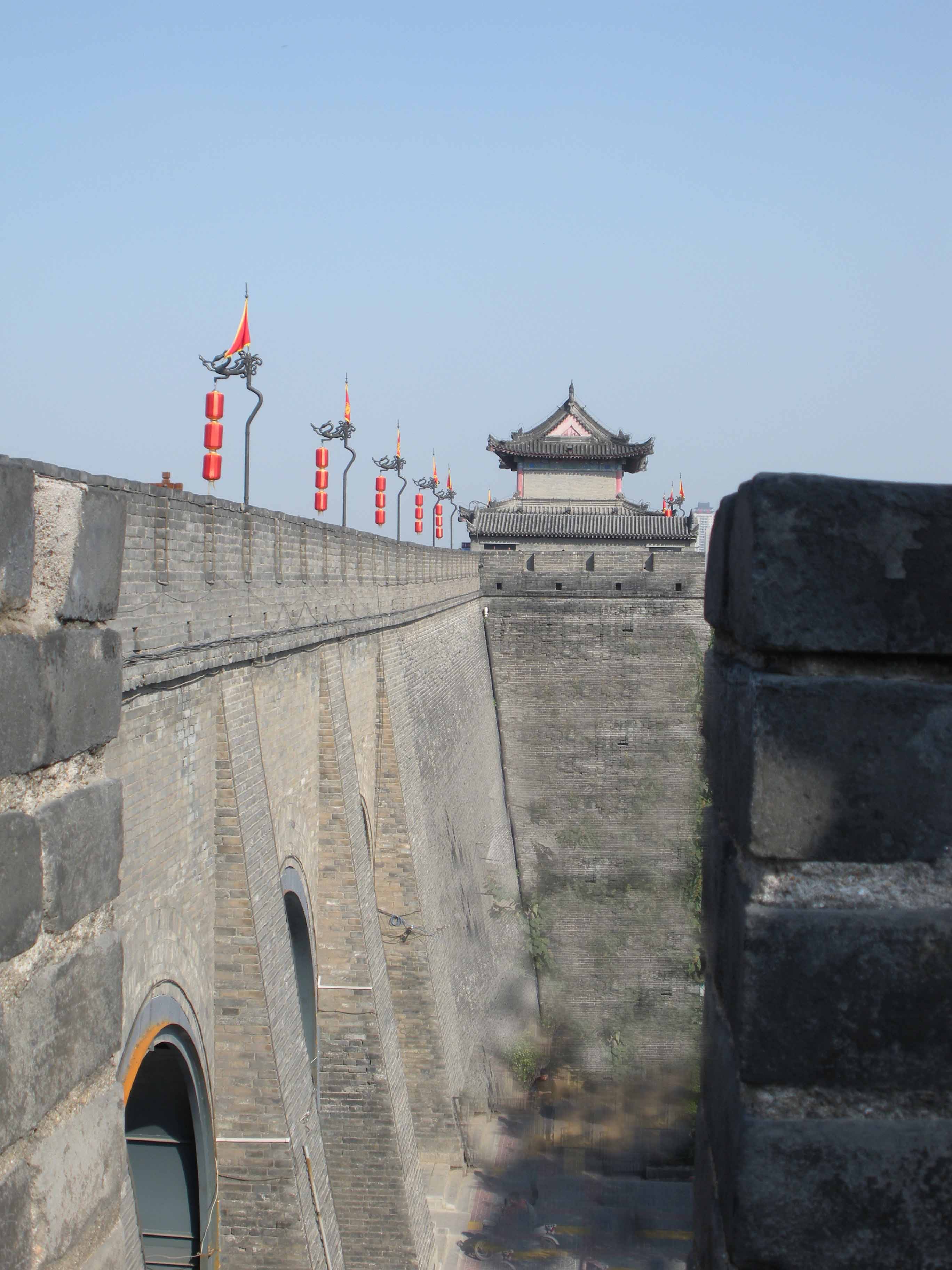
In 220 BC, Emperor Qin Shi Huangdi goes on an inspection tour of his empire. With the major wars over, millions of troops are put to work finishing the Great Wall of China, which was designed to stop the nomadic tribes to the north from raiding into China, which they have done for centuries.

The Great Wall is the greatest engineering project of the ancient world. It is thirty feet high and more than three thousand miles long. At one point, over a million people worked on the wall and about a quarter died.

The emperor makes more demands. He sends hundreds of thousands to build a tomb that fits his rank as the first divine emperor of China.

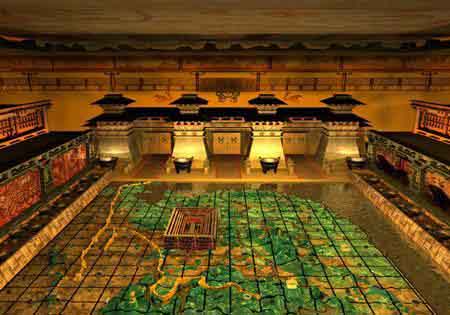
The burial mound, larger than the largest pyramid in Egypt, is at the center of an above ground and underground city. His tomb is made of bronze surrounded by
mercury rivers and oceans.

Recently, using ground penetrating radar and other instruments, a three dimensional model is built of this underground complex.

By 215 BC, Emperor Qin Shi Huangdi’s tomb is almost finished. The chamber where his body will rest is the size of a football field and will be hermitically sealed.

Then the tomb will be covered with a million tons of earth creating the hill we see today.

However, the Emperor doesn’t plan to die. Seeking advice from his doctor, he is given mercury capsules. At the time, it was believed that mercury would increase longevity.

Having lots of sex with multiple partners was also considered another way to increase life. The emperor follows the doctor’s advice and sends his doctor on an expedition to find an elixir for immortality.

The emperor isolates himself and delegates the power to rule the empire to those he trusts most. These men suppress free thought.

Entire libraries are burned. Those who try to hide documents are branded on the face and sentenced to a life of force labor — mostly on The Great Wall. Anyone who resists is buried alive.

Professor Jeffrey Riegel, of the University of California, Berkeley, says that Chinese archeologists have no immediate plans to unearth the tomb, because there is no way to safeguard the contents from decay.

Chinese alchemists knew liquid mercury as the only substance that could dissolve gold. To the ancient mind, that meant mercury had power that might prolong life.

However, the human body cannot absorb pure mercury so the Chinese alchemists made a compound the emperor could digest.

As the mercury is absorbed, it slowly destroyed his nervous system and brain.

Emperor Qin Shi Huangdi becomes aggressive, argumentative and paranoid. He goes into hiding. Anyone revealing his location is killed. His kidneys’ are failing and he starts talking to the gods.

Thirty-five years after becoming the king of Qin at thirteen, he goes on another Imperial tour. But this time, he is blind to a nation that is bankrupt and near famine.

All the emperor can think about is living forever.

He’s told that giant fish guards the island of the immortals. The emperor dreams that he is a sea god who will kill the giant fish.

Near the end of 210 BC, he visits the ocean hunting the giant fish with a crossbow while wading in the surf.

His advisors plan what to do with China once the emperor dies. On the return to the capital, the emperor falls ill and the Imperial convoy stops.

In the seventh month of 2010 BC, the first emperor’s search for immortality ends. At the age of fifty, Qin Shi Huangdi is dead.

While China’s first emperor is being buried according to his wishes, a power struggle rages outside the tomb.

By tradition, the oldest son should have become the emperor but several ministers want a younger son on the throne. The others are assassinated and there is a slaughter.

The emperor will also not go alone to the afterlife.

While his chosen successors are being assassinated, hundreds of his favorite concubines will stay with their master and die with him.

The tomb’s designers and builders will be sealed in the tomb too. Everyone who knows the way dies.

Qin Shi Huangdi left a legacy—a unified nation with a single written language and a system of administration that is still in use today.

_______________

Lloyd Lofthouse is the award-winning author of My Splendid Concubine [3rd edition]. When you love a Chinese woman, you marry her family and culture too. This is the lusty love story Sir Robert Hart did not want the world to discover.

on-sale-october-november-2016

Where to Buy

Subscribe to my newsletter to hear about new releases and get a free copy of my award-winning, historical fiction short story “A Night at the Well of Purity”.

About iLook China

China’s Holistic Historical Timeline