The “Vanishing” Street Art of Chinese Calligraphy

June 19, 2011

Chinese calligraphy is not vanishing. What I’m talking about is demonstrated in the videos included with this post. In China, many artists use sidewalks as a canvas and a brush with water to paint the beauty of calligraphy. As the water evaporates, the art vanishes.

In fact, calligraphy is more popular than ever. After the Cultural Revolution, many people turned to calligraphy in the hope of finding solace in the calm repetition of its exercises. Then, in 1981, the authorities took the lead in setting up a Chinese Calligraphers’ Association, the first such nationwide body ever to be established in the country. Source: Fathom.com, The British Museum

Both a language and an art, Chinese calligraphy has been traced back more than 4,000 years to the crude form called “Jia Gu Wen” found on turtle shells from the Shang Dynasty.

Calligraphy first bloomed as an art during the Han Dynasty but by the time of the Tang Dynasty, it had declined as an art. Source: Chinese Calligraphy History

It would be difficult to talk about Chinese art without understanding Chinese calligraphy and its artistic inspiration. A painting has to convey an object, but a well-written character conveys only its beauty through line and structure.

In Shanghai on sidewalks, or Beijing at The Summer Palace, I’ve watched men with long handled brushes, as seen in the first video, using water for ink and concrete for paper. With grace, they exhibit the skills of a Rembrandt breathing life into the characters.

America’s so called street artists should copy the Chinese that practice calligraphy and trade in their cans of spray paint for brushes and water, which would save US taxpayers much money.

Lin Yutang writes in My Country and My People that Western art is more sensual, more passionate, fuller of the artist’s ego, while the Chinese artist and art-lover contemplates a dragonfly, a frog, a grasshopper or a piece of jagged rock—more in harmony with nature.

Owing to the use of writing calligraphy with a brush, which is more subtle and more responsive than the pen, calligraphy as art is equal to Chinese painting.

Through calligraphy, the scholar is trained to appreciate, as regards line, qualities like force, suppleness, reserved strength, exquisite tenderness, swiftness, neatness, massiveness, ruggedness, and restraint or freedom.

Maybe this helps explain why the Chinese are not as warlike as Christian and Islamic cultures.

This revised and edited post first appeared on July 3, 2010 as Caressing Nature with Chinese Calligraphy

______________

Lloyd Lofthouse is the award-winning author of the concubine saga, My Splendid Concubine & Our Hart. When you love a Chinese woman, you marry her family and culture too.

To subscribe to “iLook China”, look for the “Subscribe” button at the top of the screen in the menu bar, click on it then follow directions.


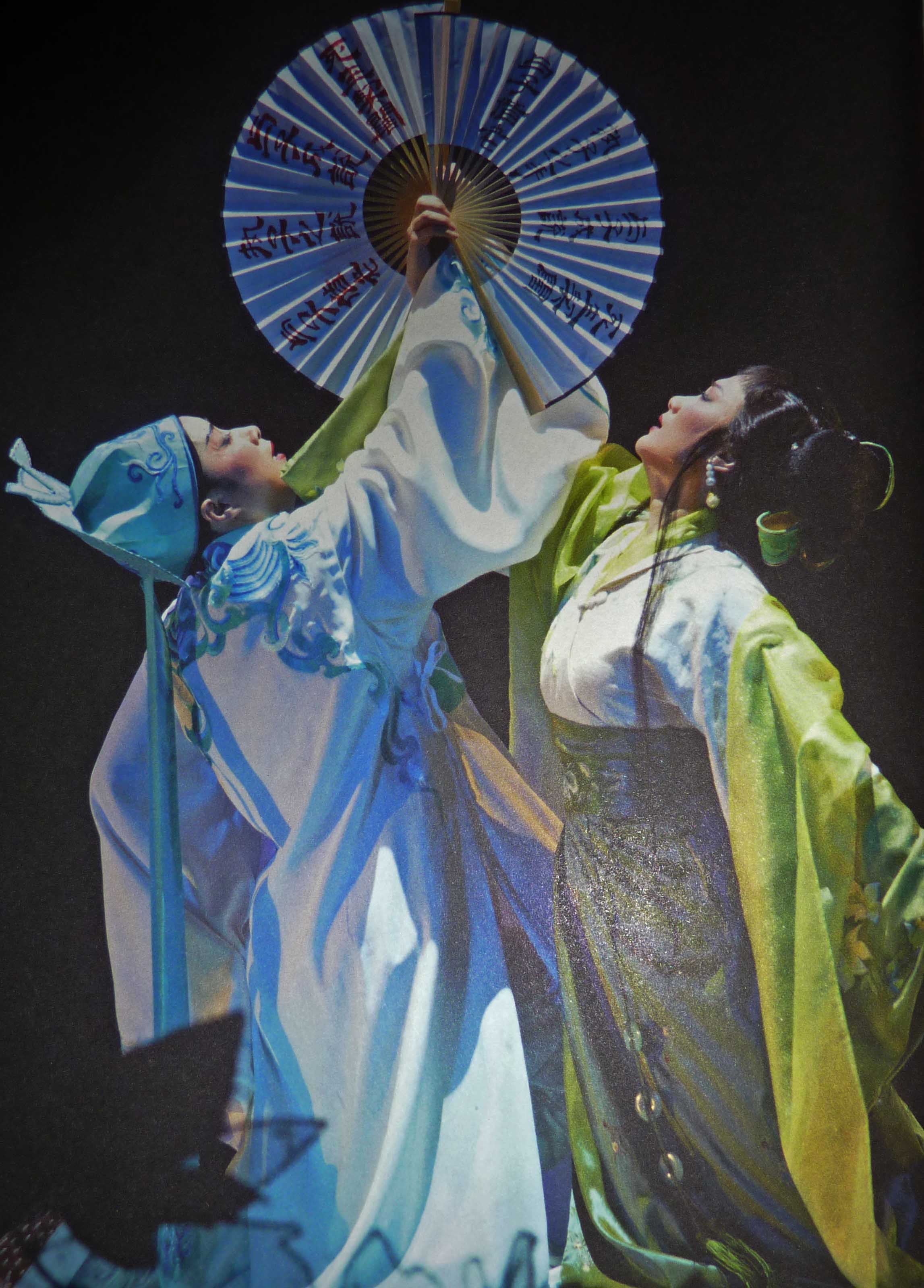
Chinese Opera and Mao Wei Tao, China’s Living Treasure

June 18, 2011

Mao Wei Tao is considered a living treasure in China. She imitates men in the opera roles she plays—a reversal from Imperial China when women were not allowed on stage so men played female roles.

“In 1923, the training of female actors for this art form was set up. Since 1928, the Shaoxing opera troupes, consisting of solely female actors, began their performances in Shanghai. In a few years, females impersonating males had become the most important feature of this opera form, and at the same time the Yue opera became well known all over China.”

East China’s Zhejiang province gave China Shaoxing Opera’s Mao Wei Tao.

In her thirty-year career on the stage, she’s best known as an outstanding male impersonator with a cult following of women.

I was introduced to Yue Opera in Hangzhou, Zhejiang Province about a decade ago.

Mao Wei Tao and her husband have a theater company near the shores of the famous Westlake. My wife translated while I watched the live-opera performance in fascination.

The costumes were lavish and the acting and opera was dramatic while classical Chinese music played in the background.

The challenge today is to keep this form of Chinese opera alive. The audience for opera is shrinking dramatically in China while remaining popular with the older generation.

Television, movies and the Internet are claiming the shorter attention spans of younger Chinese

Mao Wei Tao, considered an innovative genius on stage, adapts and works to keep the art form alive. According to her husband, no two performances are exactly alike.

In November 2010, she performed in Taiwan as a cultural ambassador from the mainland.

This revised and edited post first appeared on March 14, 2010 as Mao Weitao and Yue Opera

______________

Lloyd Lofthouse is the award-winning author of the concubine saga, My Splendid Concubine & Our Hart. When you love a Chinese woman, you marry her family and culture too.


To subscribe to “iLook China”, look for the “Subscribe” button at the top of the screen in the menu bar, click on it then follow directions.


Beware of Biased Rumors Masquerading as Truth

June 16, 2011

A Music Blog Post written by Caryn Ganz (posted May 13, 2011) reveals how often the Western media plays into the hand of rumors and misinformation. Bias has much to do with that as you may discover.

A 2010 Pew Global Attitudes Project revealed that unfavorable views of China in the West are legion.  The question Pew asked was, “Please tell me if you have a very favorable, somewhat favorable, somewhat unfavorable or very unfavorable opinion of China.”

The response—sixty-one percent (50 million) of those that responded in Germany had an unfavorable opinion of China; France 59% (39 million); Turkey 61% (45 million); Spain 38% (17.5 million); United States 36% (112 million), and Britain 35% (22 million).  More than 285 million minds and mouths may have a negative opinion of China. To see the entire list (for other countries), click the link for the Pew Project.


Mao died in 1976 and the Communist Party guided by Deng Xiaoping repudiated Revolutionary Maoism. When anyone mentions Mao, they are talking of history—not today.

Just to make clear what an “opinion” means, here are a few definitions: judgment or belief not founded on certainty or proof; the prevailing or popular feeling or view (public opinion); an opinion formed by judging something

Just because people believe something that does not mean it is a fact.

With this in mind, consider that many of those people that have unfavorable opinions of China are publishers, editors and reporters working in the Western Media spreading rumors and misinformation in what they write and report.

For example the media rumor mill reported Bob Dylan was refused permission to perform in China.

In fact, Western newspapers and magazines made all kinds of incorrect claims that Bob Dylan played to half-empty audiences, and the Chinese government censored what he would play when he performed in China

Bob Dylan was not pleased. In fact, Bob Dylan wrote on his Website, “Allow me to clarify a couple of things about this so-called China controversy which has been going on for over a year. First of all, we were never denied permission to play in China….”

Dylan said, “According to Mojo magazine, the concerts were attended mostly by ex-pats and there were a lot of empty seats. Not true. If anybody wants to check with any of the concertgoers they will see that it was mostly Chinese young people that came.… Out of 13,000 seats we sold about 12,000 of them, and the rest of the tickets were given away to orphanages.”

“As far as censorship goes, the Chinese government had asked for the names of the songs that I would be playing…. If there were any songs, verses or lines censored, nobody ever told me about it and we played all the songs that we intended to play.”

If you are interested in everything Bob Dylan said, I suggest you visit his Website (the link above).

For those readers with open minds, if we are to learn anything from this,
“It is to take with a grain of salt everything you hear or read in the World about China.”  Most of it will be opinions written as fact based on bias, which shows us that Yellow Journalism  is alive and well in freedom land proving that in the West we have the freedom to lie and pretend it is the truth.

To discover the possible truth about other opinions of China, learn from What is the Truth about Tiananmen Square? and/or 2/28 Massacre in Taiwan

______________

Lloyd Lofthouse is the award-winning author of the concubine saga, My Splendid Concubine & Our Hart. When you love a Chinese woman, you marry her family and culture too.

To subscribe to “iLook China”, look for the “Subscribe” button at the top of the screen in the menu bar, click on it then follow directions.


Learning from the Qianlong Emperor at the Met

March 12, 2011

I’ve written of the Qianlong Emperor before. He was one of China’s greatest rulers. During the 18th century, this devout Buddhist was a contemporary of France’s Louis XV, Catherine the Great of Russia and George Washington in America. At the time, he ruled the most powerful, wealthiest country on earth.

In the Qianlong Emperor and Google, I wrote if Google had read what the Qianlong Emperor (1736-1796) wrote in his famous letter to King George the III in 1793 — when China was strong enough to resist external influence — it might understand why China reacted the way it did when Google refused to censor its search engine.

In fact, the Chinese make decisions based on a cultural foundation that many in the West do not understand.

However, we may learn much of China if we pay attention to its history. Although China has changed a lot as it modernizes, the Confucian, Buddhist, Taoist foundation that makes the Chinese unique still exists.

In The Economist’s February 5 issue, Paradise on earth, we learn more of the Chinese and how they honor their ancestors.

The Economist says, “Unwilling to challenge the record of the longest-serving Chinese monarch (his beloved grandfather, the Kangxi emperor) who ruled for 61 years, Qianlong vowed to remain no more than six decades on the throne.”  The Qianlong Emperor kept his word and retired several years before his death.

The Economist’s piece was about The Emperor’s Private Paradise: Treasures from the Forbidden City, which is at the Metropolitan Museum of Art in New York until May 1.  It said, “This exhibition may be the only chance to have a good look at its treasures.”

The Met Museum of Art curator Mike Hearn (in the embedded YouTube video) says, “This exhibition’s real purpose is to teach us more about what is great about China and what we can understand about China. We will then be able to use (this knowledge) in our lives…politically as well as culturally…to recognize both China’s greatness and its potential as a partner.”

Discover China’s Greatest Emperors

______________

Lloyd Lofthouse is the award-winning author of the concubine saga, My Splendid Concubine & Our Hart. When you love a Chinese woman, you marry her family and culture too.

If you want to subscribe to iLook China, there is a “Subscribe” button at the top of the screen in the menu bar.


China’s Invisible Man – Liu Bolin

March 7, 2011

Thirty-eight-year-old Liu Bolin’s photo art reminds me of Bev Doolittle’s paintings.  I have one of Doolittle’s prints. The name Bev Doolittle is synonymous with the word “camouflage art,” which is what Liu Bolin is also known for except in photography.

However, Bolin, of Shandong, China, instead of painting on canvas, is the canvas and the settings are photos of actual locations with him as part of the setting.

Oddity Central says, “Liu works on a single photo for up to 10 hours at a time, to make sure he gets it just right, but he achieves the right effect: sometimes passers-by don’t even realize he is there until he moves.”

Mike Krumboltz writing for Yahoo News Weekend edition says of Liu Bolin, “Aside from looking cool, Bolin’s work does have a deeper meaning. Again, according to the Daily Mail, the living sculptures are ‘designed to show how we all can just disappear in today’s mass production world’.”

How is that different from prior to the industrial revolution and mass production?

I’ll tell you.

Before the industrial revolution when most people were illiterate peasants and invisible, only emperors, kings and robber barons were well known. Today, many common people may gain a worldwide reputation due to the Internet as Liu Bolin has done.

Discover Caressing Nature with Chinese Calligraphy

______________

Lloyd Lofthouse is the award-winning author of the concubine saga, My Splendid Concubine & Our Hart. When you love a Chinese woman, you marry her family and culture too.

If you want to subscribe to iLook China, there is a “Subscribe” button at the top of the screen in the menu bar.