Chocolate Tofu Pie

March 21, 2017

China was making tofu from soybeans more than two thousand years ago.

Shape.com says, ““Generally, less processed soy products, like tofu, are safe and healthy for most people. On the other hand, heavily processed soy-based products should be consumed in moderation, if at all,” advises Ochner, who says edamame, fermented soy, and tofu are considered among the healthiest in the soy family.

When in China, I get up early to go to the nearest market that makes fresh soy juice and I buy it without sugar or sweetener added. There is no comparison. It’s warm. It’s fresh. It’s China. It’s different from the genetically altered, American, factory-farmed soy juice sold in American markets. That stuff is “yuk” and I don’t touch it.

The Chinese invented tofu, but some Americans are reinventing it. For instance, I was introduced to Chocolate Tofu Pie at Mother’s Market in Costa Mesa, California, and I was hooked,.

Back home, I figured out how to make it by experimenting. The following recipe was the result.

Ingredients:

  • Two 10-ounce containers of soft or silken organic tofu
  • Two four-ounce packages of baker’s, unsweetened chocolate—but use only six of the ounces. This chocolate has no milk or sweeteners added.  Use six ounces of the eight.
  • One bag of malt-sweetened chocolate bits. There are no dairy or refined sugars in this chocolate. Use half of this bag. If you skip this ingredient, add more of the baker’s, unsweetened chocolate.
  • Agave nectar. This low absorbing sweetener is absorbed into the body slowly. You can use any sweeter you want.
  • One package of ready-made whole-wheat pie crust (recommended for fiber). You could also make a pie crust out of dates and nuts (see next video)
  • Use one tablespoon of arrowroot for a thickener

Directions:

  • Mix the tofu in a blender with the arrowroot or another natural thickener.
  • Heat the chocolate in a pan (double boiler hopefully) until melted and pour into blended tofu and mix.
  • Add the Agave nectar.
  • Taste to make sure it is sweet enough and that the bitterness from the baker’s chocolate is gone. Add more Agave if desired. Our daughter enjoys this step the most, since she is the taster.
  • Blend until it is all one smooth color.
  • Pour equally into the pie pans.
  • Put pies in oven at 350 degrees for 30 minutes.
  • Let pies cool after cooking; put in refrigerator after they are cool.

The pies will be ready the next day.

Note: I usually shop at Whole Foods and Trader Joe’s for the ingredients used in the tofu chocolate pie.

Lloyd Lofthouse is the award-winning author of My Splendid Concubine, Crazy is Normal, Running with the Enemy, and The Redemption of Don Juan Casanova.
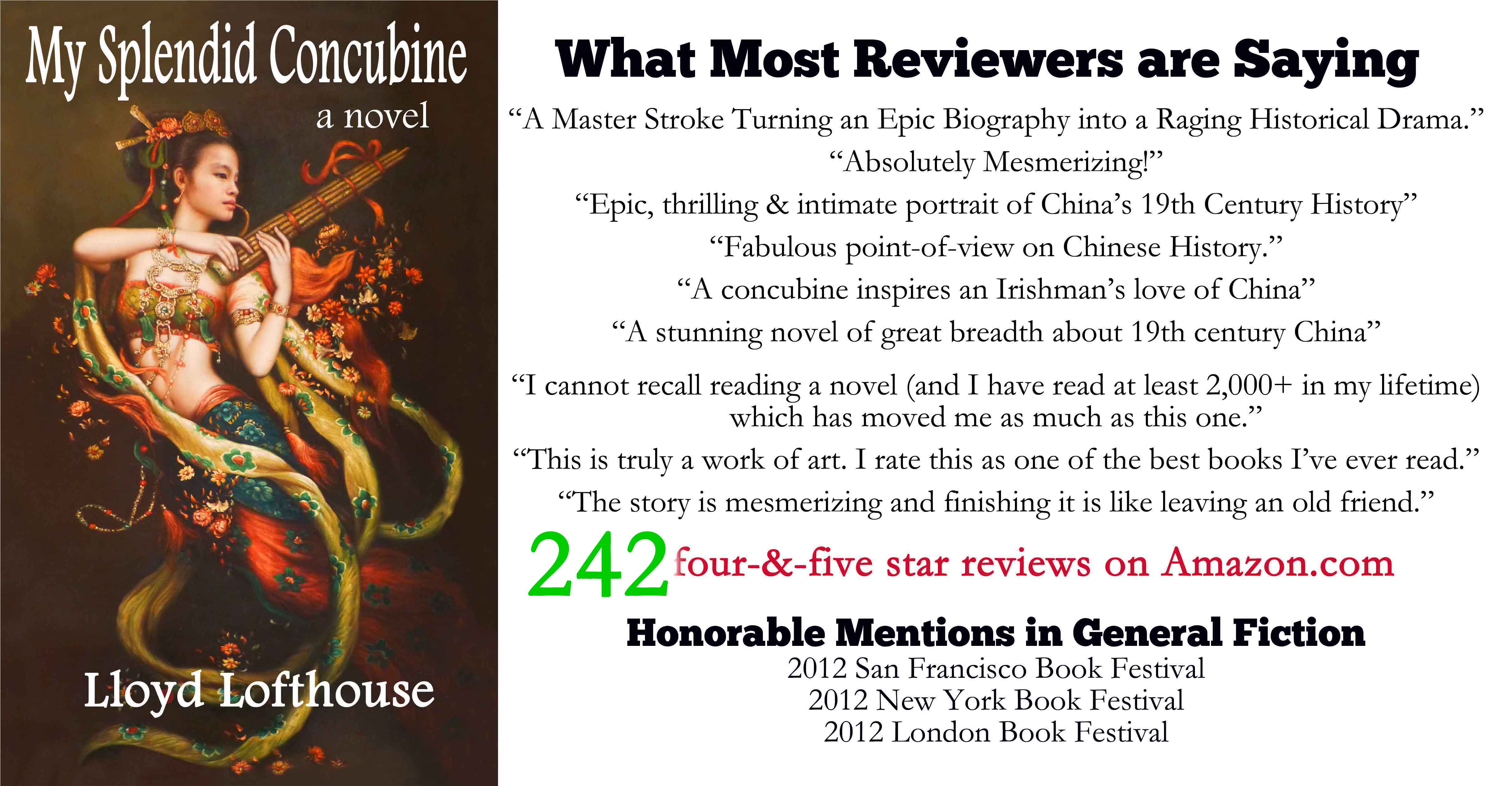
1a-242-what-most-reviewers-are-saying-jan-16-2017

Where to Buy

Subscribe to “iLook China”!
Sign up for an E-mail Subscription at the top of this page, or click on the “Following” tab in the WordPress toolbar at the top of the screen.

About iLook China

China’s Holistic Historical Timeline


Why aren’t we all the same? Part 5 of 5

March 18, 2017

Individuals in a collectivist culture tend to view themselves as members of groups (families, work units, tribes, nations), and usually considers the needs of the group to be more important than the needs of an individual.

Most Asian cultures, including China, tend to be collectivist.

Another example between individualism and collectivism is Piety (respect for elders). In the West, evidence suggests that the young are being spoiled to the point where many Western children are rude to elders expecting them to be invisible and silent, while in China that same behavior is often the reverse—at least it was before Western fast food and consumerism appeared in China.

In China, when there is a conflict of interest between individuals and the collective, individuals are expected to sacrifice their own benefits for the sake of the collective well-being.

On the other hand, an individualist culture is one in which people tend to view themselves as individuals and to emphasize the needs of the individual over the well being of the group. Source: Travel China Guide – a discussion about individualist and Collectivist Cultures

Are there exceptions?  Of course, but those exceptions seldom represent the average or the majority.

Return to Part 4 or Start with  Part 1

Lloyd Lofthouse is the award-winning author of My Splendid Concubine, Crazy is Normal, Running with the Enemy, and The Redemption of Don Juan Casanova.

2a-242-positive-reviews-hall-of-fame-reviewer-jan-16-2017

Where to Buy

Subscribe to “iLook China”!
Sign up for an E-mail Subscription at the top of this page, or click on the “Following” tab in the WordPress toolbar at the top of the screen.

About iLook China

China’s Holistic Historical Timeline


Why aren’t we all the same? Part 4 of 5

March 17, 2017

The Research Digest Blog asks, “Are children from collectivist cultures more likely to say it’s okay to lie for the group?”

The theory says that yes, they might say it’s okay to lie for your team than children from individualistic cultures, such as the US, which places more value on self-interest.

The surprising finding was that children from China actually found lying to protect one’s team less acceptable than children in the US did.

“This is not to suggest that Chinese children were acting in an individualistic manner,” the researchers said, “but rather that they were acting based on what they believed to be a more salient moral aspect of the situation.” Source: Research Digest Blog

Collective cooperation may explain why China has a long history of innovation.

After all, the Chinese invented the compass, paper, the printing press, gunpowder, the multistage rocket and much more.  Source: The Growing Gap Between the US and China

In addition, I read in the September/October 2012 issue of Foreign Policy Magazine that the Chinese are doing it again. for example: inventing a modular method to build energy-efficient skyscrapers —China plans to use this innovative method to built the world’s tallest building (220-stories) in ninety days compared to the current tallest building in Dubai that is 160 stories tall and took six years to build. Other innovations China is developing is the straddling bus in addition to safer, cleaner nuclear energy.

Continued on March 18 in Part 5 or go back to Part 3

Lloyd Lofthouse is the award-winning author of My Splendid Concubine, Crazy is Normal, Running with the Enemy, and The Redemption of Don Juan Casanova.

1a-242-what-most-reviewers-are-saying-jan-16-2017

Where to Buy

Subscribe to “iLook China”!
Sign up for an E-mail Subscription at the top of this page, or click on the “Following” tab in the WordPress toolbar at the top of the screen.

About iLook China

China’s Holistic Historical Timeline


Why aren’t we all the same? Part 3 of 5

March 16, 2017

When I wrote why China is studying Singapore, my goal was to show Westerners why China couldn’t model itself after an individualistic culture such as the United States, because copying the United States wouldn’t fit China’s culture.

Even Dr. Sun Yat-Sen – China’s Democratic Revolutionary, said any democracy in China would have to fit China’s culture saying, “An individual should not have too much freedom. A nation should have absolute freedom.”

Individualism promotes individual goals and encourages each person to express him or herself freely.  Each person is encouraged to be unique. Rules and laws attempt to ensure independence, choices, and freedom of speech. Relying or being dependent on others is often seen as shameful, and people are encouraged to do things on their own, to rely on themselves. Source: Psychology – Collectivist and Individualist Cultures

However, James Surowiecki says, “We once accused the Japanese of being copycats and now we turn on the Chinese. But the truth is that we have all become imitators. … In many situations, collective decisions are better than individual ones.” Source: Co-Society.com

Continued on March 17 in Part 4 or go back to Part 2

Lloyd Lofthouse is the award-winning author of My Splendid Concubine, Crazy is Normal, Running with the Enemy, and The Redemption of Don Juan Casanova.

2a-242-positive-reviews-hall-of-fame-reviewer-jan-16-2017

Where to Buy

Subscribe to “iLook China”!
Sign up for an E-mail Subscription at the top of this page, or click on the “Following” tab in the WordPress toolbar at the top of the screen.

About iLook China

China’s Holistic Historical Timeline


Why aren’t we all the same? Part 2 of 5

March 15, 2017

Even in individualist countries, we find collectivism at work. In business, the collective society is often seen in corporate structure.

New Yorker business columnist James Surowiecki says, “Under the right circumstances, groups are remarkably intelligent and are often smarter than the smartest people in them.”

An example used by Surowiecki shows that “the TV studio audience of Who Wants to Be a Millionaire guesses correctly 92 percent of the time, compared to ‘experts’ who guess only 65 percent correctly.” Source: Co-Society.com

What Surowiecki says explains why China’s top few-hundred officials use the “Red Machine”, an encrypted communication system, for making quick collective decisions.

In The Collective Will, I mentioned the author of a Wall Street Journal piece as an example of how most people in the West have trouble understanding what goes on in China.

Most Chinese understand their government’s  actions and decisions even if a Westerner from an individualist culture doesn’t.

Some Chinese may not like it. Others may not agree with it.

However, Westerners are not always happy with their governments. Just look at Donald Trump in the United States to understand what this means.

Continued on March 16 in Part 3 or Start with  Part 1

Lloyd Lofthouse is the award-winning author of My Splendid Concubine, Crazy is Normal, Running with the Enemy, and The Redemption of Don Juan Casanova.

1a-242-what-most-reviewers-are-saying-jan-16-2017

Where to Buy

Subscribe to “iLook China”!
Sign up for an E-mail Subscription at the top of this page, or click on the “Following” tab in the WordPress toolbar at the top of the screen.

About iLook China

China’s Holistic Historical Timeline