Tibet’s Democracy that Never Was and Never Will Be

April 11, 2017

There are many misleading claims about Tibet. To understand what I mean, Google “Tibet’s Democracy in Exile,” but the historical facts support that Tibet has never been a republic and/or a democracy in its entire history.

One example of a misleading media report said, “Being a Tibetan in exile is a loss that manifests in many forms: the loss of homeland and natural rights fall within that.”

What were the natural rights that were lost?

Most Tibetans in exile (about one-percent of the total Tibetan population) gave up their rights and about ninety-nine percent of the population known as serfs that were often treated no better than slaves. The serfs were left behind as the one-percent who owned the land and held the wealth fled.

Before 1950, when Mao’s Red army reoccupied Tibet for China, there had been no democracy or republic in Tibet in its entire history.

The following quotes show us what Tibet was like before 1950.

“Lamaism is the state religion of Tibet and its power in the Hermit Country is tremendous. Religion dominated every phase of life. … For instance, in a family of four sons, at least two, generally three, of them must be Lamas. Property and family prestige also naturally go with the Lamas to the monastery in which they are inmates.

“Keeping the common people or laymen, in ignorance is another means of maintaining the power of the Lamas. Nearly all of the laymen (serfs) are illiterate. Lamas are the only people who are taught to read and write.”  – October 1912 National Geographic Magazine, page 979.

Under theocratic Lamaism, there was no freedom of religion, no freedom of speech, and no one voted.

Between 1912, when those words appeared in National Geographic, and 1950, Tibet did not change. The only difference was that there was no Chinese governor in Tibet appointed by the Emperor and supported by Chinese troops.

If the majority of Tibetans want to have self-rule, there’s nothing wrong with supporting a separatist movement as long as you know all of the accurate historical facts.

After all, there are at least eight known and active separatist movements in the United States: for instance, the Alaska Independence Party; Hawaiian sovereignty movement; Lakotah Oyate; Puerto Rico Independence Party; League of the South; Texas Secession Movement; Second Vermont Republic, and the Cascadia Independence Movement.

In fact, Tibetans have about the same odds to be free from China as Hawaiians and the Lakota Sioux have of being free of the United States.

It is a historical fact that a reluctant Tibet was ruled over by the Yuan (Mongol), Ming (Han) and Qing (Manchu) Dynasties from 1277 to 1913, when Great Britain convinced Tibet to break from China at the same time the Qing Dynasty was collapsing. Between 1913 and 1950, Tibet was ruled by a Dalai Lama and was an autocratic theocracy, not a democracy. In case you don’t know, a theocracy is a system of government in which priests rule in the name of God or a god. In Tibet’s case, his holiness the Dalai Lama is often called a “God-King”.

Discover The Return of Confucius

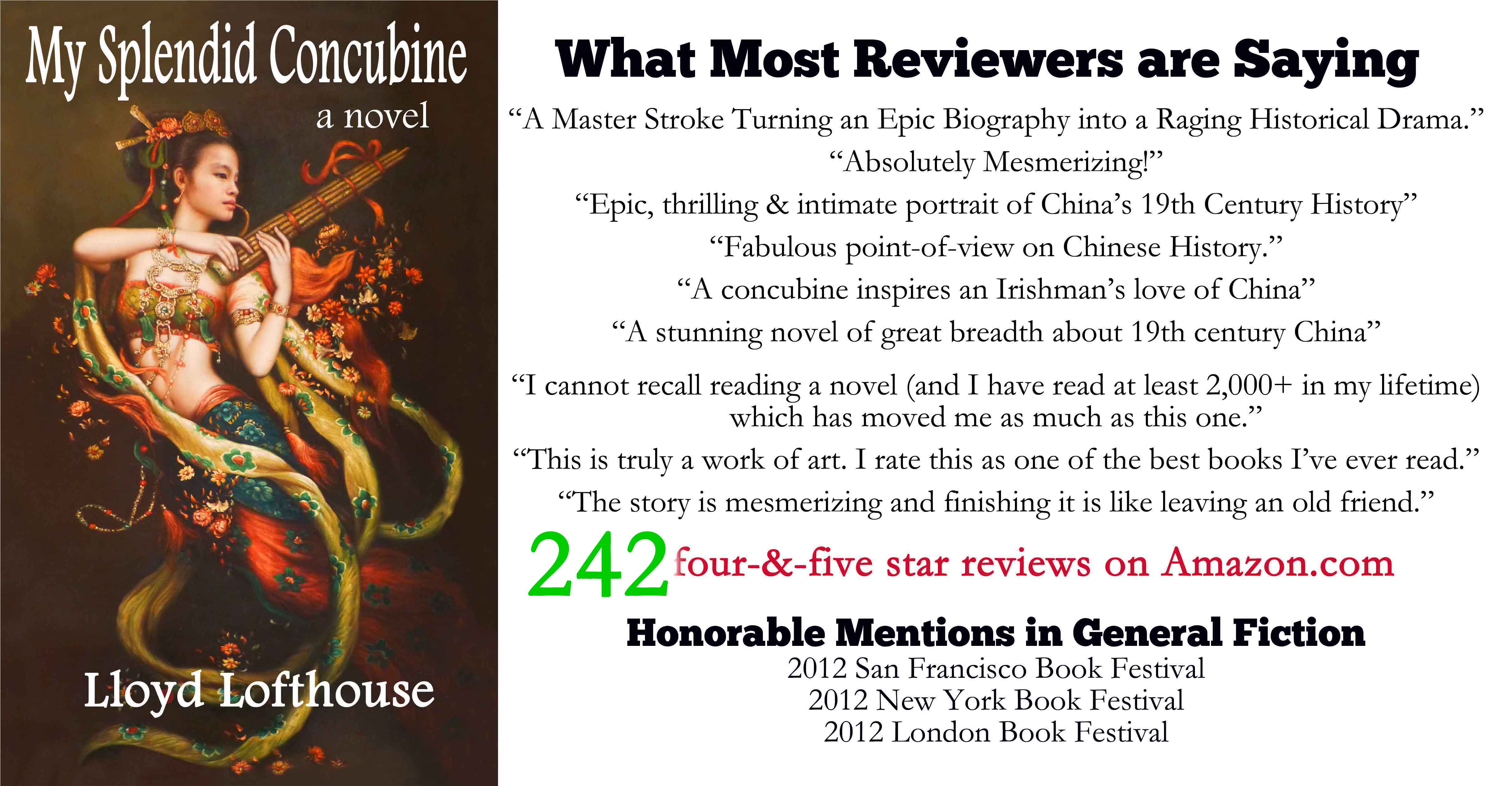
Lloyd Lofthouse is the award-winning author of My Splendid Concubine, Crazy is Normal, Running with the Enemy, and The Redemption of Don Juan Casanova.
Where to Buy

Subscribe to “iLook China”!
Sign up for an E-mail Subscription at the top of this page, or click on the “Following” tab in the WordPress toolbar at the top of the screen.

About iLook China

China’s Holistic Historical Timeline


A Trip to China isn’t Complete until Hangzhou

April 5, 2017

If you ever visit China, plan to see this tourist attraction in Hangzhou. Before 1949, it was the home of a wealthy family but was first owned by Hu Xue-yan (1823-1885). There’s more to Hangzhou than this mansion, but it’s still worth seeing. Watch the 2nd video to discover more about the city.

Hu Xue-yan made his money in banking then expanded into pawn shops, import-export, real estate and made his biggest fortune as the founder of a Chinese herbal medicine company. After he died, his family lost the fortune and sold the house.

The house was built in 1872. After it was renovated in 2008, it was turned into a museum and tourist attraction.

When the Communists won China’s Civil War in 1949, the mansion (covering about two acres) was owned by another family that made its fortune first in the silk industry then banking.

During a visit to Hangzhou, for a few yuan, you will be able to tour most of the mansion and the gardens.

The Hu Xue-yan mansion is in a city with a population of more than eight million, but once inside its walls you have no sense of the crowded city outside. Once the owner was home and the gates closed at night, it was a world-of-tranquility apart from the city.

The city of Hangzhou is more than two-thousand years old and was the capital of the Southern Song Dynasty (1127 – 1279 AD) before Kublai Khan conquered all of China and founded the Yuan Dynasty (1206-1368 AD).

There is a famous Chinese saying:  “In heaven there is paradise, on Earth there is Su and Hang (Hangzhou – Paradise on Earth).

Lloyd Lofthouse is the award-winning author of My Splendid Concubine, Crazy is Normal, Running with the Enemy, and The Redemption of Don Juan Casanova.

Where to Buy

Subscribe to “iLook China”!
Sign up for an E-mail Subscription at the top of this page, or click on the “Following” tab in the WordPress toolbar at the top of the screen.

About iLook China

China’s Holistic Historical Timeline


The differences between Capitalism, Communism, Socialism, and a Social Safety Net

April 4, 2017

Socialism and communism are ideological doctrines that have similarities as well as differences. One point that is frequently raised to distinguish socialism from communism is that socialism generally refers to an economic system, and communism refers to both an economic system and a political system.

The fall of communism in the Soviet Union did not mean socialism failed. It meant the autocratic, one-party state that defined communism failed.

After all, Russia still has a social safety net that funds health care and pension programs.  With at least five years of coverage, men age 60 and women age 55 are covered for old-age pensions. Russia also offers a disability pension and a survivor pension.

Having socialist safety net programs does not mean a country is socialist or communist. For example, the United States is not a socialist country just because it has Medicare, and Social Security. The difference is that the United States has a multi-party political system and still has private ownership of property and a capitalist business system.

China changed in the early 1980s when its Communist Party adopted elements of capitalism and joined the World Trade Organization. It’s true that part of China’s economy is still state-run, but there are not as many social programs as there once were under the previous communist system.

That leads to this question: If China allows capitalism to coexist with socialism, is it still a Communist country? Just to make a point, in 2014 Bloomberg reported that about 75-percent of China’s industrial output came from private businesses and not state-owned enterprises.

While no one in China may own land (yet), private citizens and even foreigners may lease land in urban areas while land in most rural areas is still owned by village collectives in conjunction with the central government and cannot be bought or sold because no one holds the title to most rural land. There is also no property tax, rent, or mortgages that come with interest payments for rural areas. This means being poor in rural China isn’t the same as being poor in the United States, because families can’t lose their homes to a bank.

Imagine what it must be like to not worry about making the rent, mortgage, and property tax payments. There are almost 600-million rural Chinese, and they even get to vote in democratic elections for their village leaders.

Discover The Return of Confucius

Lloyd Lofthouse is the award-winning author of My Splendid Concubine, Crazy is Normal, Running with the Enemy, and The Redemption of Don Juan Casanova.

Where to Buy

Subscribe to “iLook China”!
Sign up for an E-mail Subscription at the top of this page, or click on the “Following” tab in the WordPress toolbar at the top of the screen.

About iLook China

China’s Holistic Historical Timeline


China’s Tobacco Epidemic – Part 2 of 2

March 29, 2017

In 2005, China signed the World Health Organization’s (WHO) global anti-tobacco treaty to cut tobacco use. In fact, WHO even awarded China’s Health Minister Chen Zhu for his efforts to battle tobacco use.

However, in China, tobacco companies sponsor public schools and arrange sponsored tours of cigarette factories for elementary students where the slogans say, “Talent stems from hard work, tobacco helps you become accomplished.”

The JAMA Network reports, “Foreign tobacco companies are mounting massive production and advertising campaigns in China. Government health education programs lack funds to counter these influences …” JAMA  is The Journal of the American Medical Association.

Bloomberg reported, “Philip Morris subsidized two cigarette factories in 1988 and almost a decade later provided corporate jets when China’s top tobacco regulator, Ni Yijin, visited the U.S., according to internal industry memos. The company’s objective was to build its relationship with Ni and to impress upon him that Philip Morris was the ‘preferred partner’ to modernize and restructure China’s tobacco industry. The visit was carefully orchestrated with talking points, seating charts, and gifts for Ni (such as a $700 Steuben crystal eagle) determined months in advance.”

Where was Qin Shi Huangdi, China’s first emperor, when he was needed most? After all, when the first emperor wanted to get something done, nothing stopped him. He unified China after winning wars with several other countries that existed in China at the time.

China first emperor also finished building The Great Wall causing the deaths of hundreds-of-thousands of peasants. He mandated one written language, and had the scholars from the conquered countries that complained dig their own graves before setting them on fire and throwing dirt on the remains.

It is highly unlikely that Qin Shi Huangdi would have liked cigarettes since he ordered his alchemists/scientists to discover an elixir for immortality, unless they thought smoking tobacco was that elixir.

Note that the United States is one of 17-countries that did not join the 180-countries that ratified the WHO’s anti-tobacco treaty.  The U.S. also joined a handful of countries, including Iran and Sudan that did not ratify the Convention on Discrimination against Women.  In addition, the U.S. and Somalia have not ratified the Convention on the Rights of the Child. The U.S. and Turkey are the only nations of NATO that did not sign the Mine Ban Treaty.  – Global Policy Forum, US Position on International Treaties

Return to or start with Part 1

Lloyd Lofthouse is the award-winning author of My Splendid Concubine, Crazy is Normal, Running with the Enemy, and The Redemption of Don Juan Casanova.

Where to Buy

Subscribe to “iLook China”!
Sign up for an E-mail Subscription at the top of this page, or click on the “Following” tab in the WordPress toolbar at the top of the screen.

About iLook China

China’s Holistic Historical Timeline


China’s Tobacco Epidemic – Part 1 of 2

March 28, 2017

The Asia-Pacific Journal reported, “Following Chinese economic reforms of the 1980s, U.S. consumer goods companies were increasingly drawn to China. American companies entered the country by forming joint ventures with a Chinese company or government agency. Early participants included such giants as H. J. Heinz, R. J. Reynolds Tobacco, Coca-Cola, American Express, American Motors, AMF, Inc., General Foods, Beatrice, Gillette, Pepsi-Cola, Eastman Kodak, AT&T, Nabisco, and Bell South.”

In 1970, China produced 785-thouisand tons of tobacco. By 1990 that number more than tripled to more than 2.6-million tons. With an estimated 320-million cigarette smokers in China today, annual consumption of cigarettes by each smoker would be about 240 packs. – Tobacco in the People’s Republic of China

I know firsthand how evil addictive tobacco is.   I witnessed a father-in-law, my brother,  a neighbor, an aunt, and my father die early from the ravages of tobacco.

The last few years of my father’s life, he wore a breathing mask attached to a tank of oxygen.  His freedom was limited to the fifty-foot hose connected to that tank.

The World Health Organization reveals:

  • Approximately one million deaths every year in China are caused by tobacco – around one in six of all such deaths worldwide.
  • Approximately 100,000 people die as a result of exposure to second-hand smoke each year.
  • In other words, someone in China dies approximately every 30 seconds because of tobacco use; or around 3,000 people every day.
  • If the prevalence of tobacco use in China is not reduced, the number of tobacco-related deaths every year in China will increase to 3 million by 2050.3

China’s central government is sort of attempting to end tobacco use in China. China’s 12th Five-Year Plan calls for smoke-free public places as part of the major national goal to increase life expectancy. The “China Report on the Health Hazards of Smoking”, released by the Ministry of Health in May, 2012, outlines the hazards of tobacco use, states the health consequences of second-hand smoke, and emphasizes the importance of smoking cessation.

Part 2 Continued on March 29, 2017

Discover Anna May Wong, the American actress who died a thousand times.

Lloyd Lofthouse is the award-winning author of My Splendid Concubine, Crazy is Normal, Running with the Enemy, and The Redemption of Don Juan Casanova.

Where to Buy

Subscribe to “iLook China”!
Sign up for an E-mail Subscription at the top of this page, or click on the “Following” tab in the WordPress toolbar at the top of the screen.

About iLook China

China’s Holistic Historical Timeline