China’s Middle Class Expanding

April 20, 2010

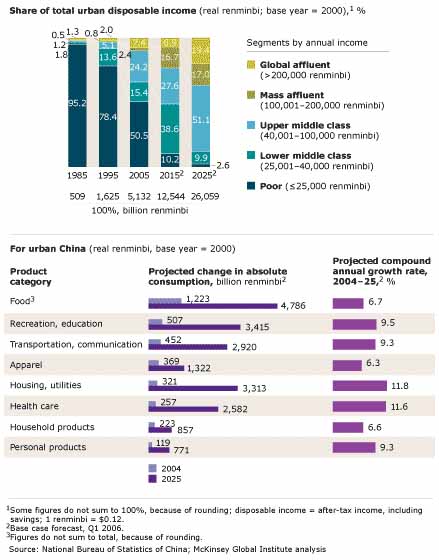
“Present estimates of “middle class” in China range from 100 million to 247 million… Estimates of the size and growth rate of China’s middle class vary. Roughly half of China’s projected urban population will be middle class in 2025.

“Unlike the United States, where income typically peaks between the ages of 45 to 54, it is predicted that the wealthiest consumers in China will be between 25 to 44 years old because the younger generation will be more highly educated.” Source:  Rise of China’s Middle Class

Buying Cars:
“In the first quarter of 2010, Chinese bought 4.61m units, up 71.78 percent year on year, according to the CAAM.” Source: The Truth About Cars

Buying Houses:
“…demand is still strong. A recent survey by the Hong Kong-based brokerage CLSA found that 56 percent of China’s middle-class families are considering buying a new home.” Source: Sinocism

“Furthermore, homebuyers in China put down at least 20 percent as a down payment (30 percent for a first-time buyer and 40 percent for a second-home buyer to damp down speculation). These buyers rarely fall behind on their mortgage payments.” Source: No Housing Bubble in China

Food:
“China’s mass grocery retail is booming and the turnover of both Chinese and foreign supermarket chains are growing.  The middle class’ new consumption patterns and increasing income has been a catalyst for growth and creates new export opportunities for Danish food companies.” Source: Renmin Shimbun

Discover The Reasons Why China is Studying Singapore

_______________

Lloyd Lofthouse is the award-winning author of My Splendid Concubine [3rd edition]. When you love a Chinese woman, you marry her family and culture too. This is the love story Sir Robert Hart did not want the world to discover.

Subscribe to “iLook China”!
Sign up for an E-mail Subscription at the top of this page, or click on the “Following” tab in the WordPress toolbar at the top of the screen.

About iLook China


The First Emperor: The Man Who Made China – Part 4/9

April 20, 2010

With this challenge to the throne removed, Shi Huangdi has learned a lesson. He becomes ruthless and rids himself of his mother and his prime minister.

There is a dramatic scene where the prime minister asks for forgiveness for letting the queen mother do what she has done.  The prime minister is exiled and not allowed to see the queen mother again. Within a year, the disgraced prime minister kills himself.

A scholar, who believes in harsh laws, becomes Huangdi’s closest advisor.

By 227 BC, the Qin state has conquered the states of Han, Wei and Zhao.

The state of Yen knows it is next and sends professional assassins disguised as peace emissaries to kill Shi Huangdi.  The emissaries arrive in Xian with gifts.  The assassin strikes.

Since no weapons are allowed in the throne room, there are no armed guards to protect the king. Only the king has a weapon and only the king can call the troops to save him.

Go to Part 5 of The Man Who Made China or return to Part 3

View as Single Page

_________________________

Lloyd Lofthouse is the award-winning author of the concubine saga, My Splendid Concubine & Our Hart. When you love a Chinese woman, you marry her family and culture too. 

To subscribe to “iLook China”, look for the “Subscribe” button at the top of the screen in the menu bar, click on it then follow directions.


Water – Two Countries Tell a Tale

April 19, 2010

The National Geographic special issue, “Water, Our Thirsty World” (April 2007) compares the world’s largest democracy, India, with China. In “The Big Melt” by Brook Larmer, we see a convincing reason why China’s mix of socialism and capitalism may be the world’s answer to avoid future calamities. Where Western style democracies stall due to partisanship, special interests, religious beliefs and political agendas, China’s government, ruled by engineers and scientists, appears to be planning decades ahead.

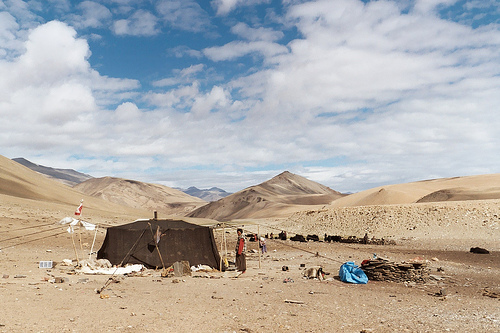
The claims by Tibetan separatists and their supporters that China rules over Tibet with an iron dictatorial fist also appears to be wrong when Larmer visits a family of Tibetan nomads. He writes, “There is no sign of human life on the 14,000 foot high prairie that seems to extend to the end of the world.” Larmer sees “the NOMADS’ tent as a pinprick of white against a canvas of brown.”
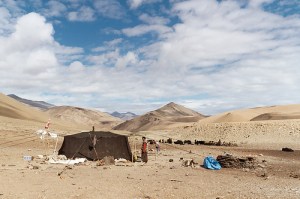
Tibetan Nomads

We meet Ba O, a Tibetan nomad. In Ba O’s tent, “there is a small Buddhist Shrine: a red prayer wheel and a couple of smudged Tibetan texts…” A few years earlier, Ba O had several hundred sheep and the grass was plentiful. Now the Tibetan nomad has about a hundred left and fears this way of life is ending.

Ba O says, “This is the way we’ve always done things. And we don’t want that to change.”

However, change is coming, and there is nothing Ba O can do to stop it. The change is not from China’s government. It is from global warming. The Tibetan grasslands are dying and a way of life that has existed for thousands of years may be dying too.
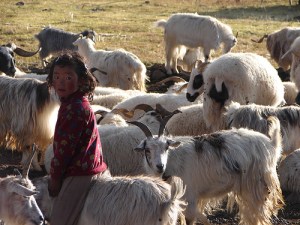
Tibetan girl tending sheep

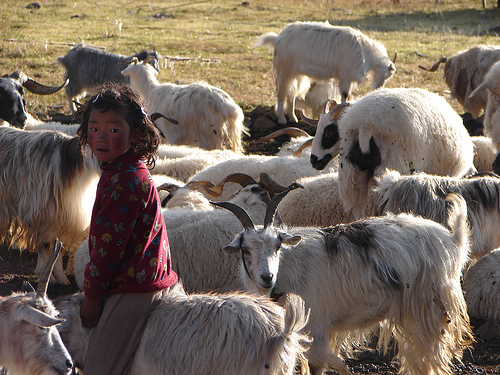
To insure that the Tibetan nomads will have a place to live, China’s government has been building resettlement villages. The “solid built” houses are subsidized. When the Tibetan nomads can no longer survive on the open Tibetan prairie, it is the nomad’s choice to move into the new villages. The government does not force them to give up their old way of life. Nature does that.

Along with the house comes a small annual stipend for each family so they can eat as they find another way to earn a living. The home Larmer visited had a Buddhist shrine and a free satellite dish for a TV and maybe an Internet connection. In addition, the one child policy does not apply to the Tibetan people since they are a minority in China.

To make sure there will continue to be water to drink, China is planning to build 59 reservoirs in Tibet to capture and save glacial runoff.

In India, the young wife of a fortuneteller spends hours each day searching for water. She lives with her husband and five children in Delhi, India‘s capital. There are fights over water. In a nearby slum, a teenage boy was beaten to death for cutting into a water line.  The demand for water in Delhi exceeds the supply by more than 300 million gallons a day.

What happens to life when there is no water?

See Dictatorship Defined

______________

Lloyd Lofthouse is the award-winning author of the concubine saga, My Splendid Concubine & Our Hart. When you love a Chinese woman, you marry her family and culture too. 

If you want to subscribe to iLook China, there is a “Subscribe” button at the top of the screen in the menu bar.
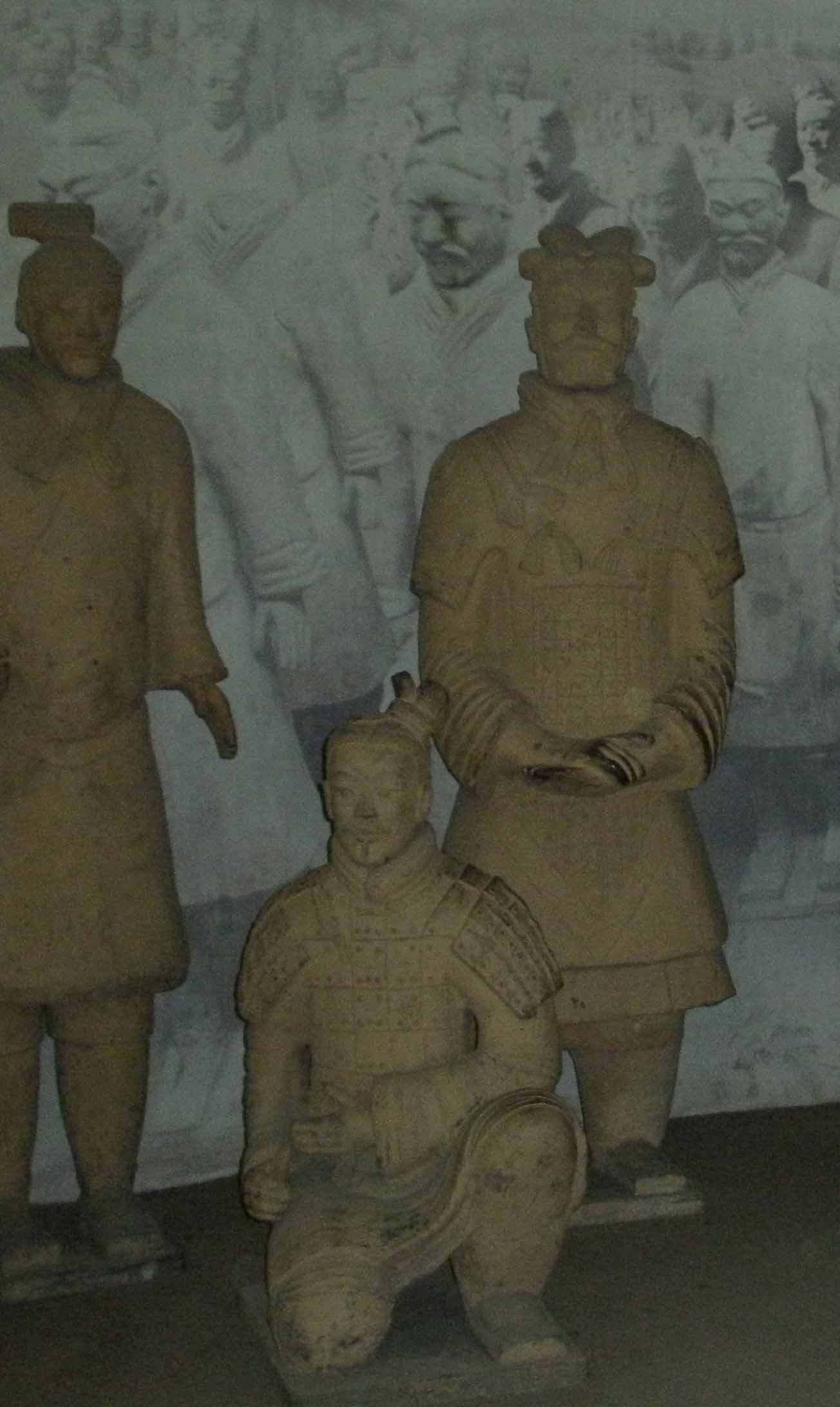

The First Emperor: The Man Who Made China – Part 3/9

April 19, 2010

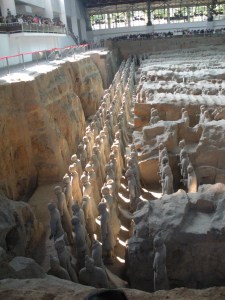
By the time Qin Shi Huangdi is twenty, he has captured thirteen cities from the state of Han and twenty cities from the other states.  Huangdi’s rival countries send a combined army to stop him but they are repelled.

Some of Huangdi’s success is because of the precision weapons Qin craftsmen make for the loyal, highly trained army.

The capital of Qin

However, while the king of Qin is conquering China, there is an enemy scheming to replace him. His mother, the dowager queen, has taken a lover, who masquerades as a eunuch. The queen has had two illegitimate sons with this lover, who steals two royal seals that gives him authority to mobilize troops in an attempt to replace Shi Huandgi with one of the king’s half brothers.

Qin’s prime minister discovers the plot and a trap is set that destroys the rebel army. The dowager queen’s lover is captured, tortured and his mangled body pulled apart by four horses while the queen mother is forced to watch.

While the death sentence is being carried out, Huandgi has his two two half brothers strangled to remove them as a threat to the throne.

Go to Part 4 of The Man Who Made China or return to Part 2

View as Single Page

_________________________

Lloyd Lofthouse is the award-winning author of the concubine saga, My Splendid Concubine & Our Hart. When you love a Chinese woman, you marry her family and culture too. 

To subscribe to “iLook China”, look for the “Subscribe” button at the top of the screen in the menu bar, click on it then follow directions.


The Four Stringed Liuqin

April 19, 2010

The liuqin is a smaller version of the pipa but with four strings and the sound of a soprano range lute. There are two sound holes on each side of the body. By pressing slightly above any of the frets on the instrument, one can vary the pitch.

Liuqin

The liuqin is commonly played using a plectrum like in the guitar. The liuqin is often used to accompany other instruments for folk songs and local opera. It’s translation into English from Chinese means willow-shaped instrument, and it may come with two to five strings. The earliest four-stringed liuqin was popular during the Tang Dynasty (618 – 906 AD). The modern liuqin has four steel strings. 

If you enjoyed hearing the liuqin, see The Yangqin

_________________________

Lloyd Lofthouse is the award-winning author of the concubine saga, My Splendid Concubine & Our Hart. When you love a Chinese woman, you marry her family and culture too. 

Sign up for an RSS Feed for iLook China