Singapore’s Role in the Successful Birth of Modern China

July 10, 2019

Born in 1923, Lee Kuan Yew would become Singapore’s founding father. He was elected its 1st Prime Minister in 1959. After victory in seven elections, Lee stepped down in November 1990, making him the world’s longest-serving prime minister.

In 1978, Deng Xiaoping visited Singapore and Lee offered him advice on how to modernize China, and it wasn’t by following America’s example.


CNN’s Fareed Zakaria talks with Lee Kuan Yew about his life as prime minister of Singapore.

“I want everyone to be a homeowner,” Lee Kuan Yew told CNN’s Zakaria. “I want investments. Do I want to be like America? Yes, in its inventiveness and creativeness, but not like America’s inability to control its drought problem. No! Or the gun problem. No!”

Lee also said, “I believe that during the second half of the 21st century, America will have to share the top spot with China and also India, make space for them, too.”

When Lee is asked by Zakaria if India will have an advantage because it is a democracy and China is not, Lee replies, “Let me put it this way, if India was as well organized as China, it will go a different speed, but it is going at the speed it is because it is India.  It is not one nation. It is many nations. It has 320 different languages and 32 official languages.”

India cannot reach all of its people with one language like Beijing can.

The South China Morning Post reported in 2015, “Singapore’s founder (Lee Kuan Yew) was alone among world leaders in his belief China would emerge as a global power and his views proved prescient. … In his memoirs, Lee makes plain his admiration for the late paramount leader Deng Xiaoping who led China’s opening up in 1978. Lee recalled his conversations with Deng, including one that year when Deng visited Singapore. …

“There was nothing that Singapore had done which China could not do, and do better,” Lee wrote. When Deng Xiaoping told the Chinese people to do better than Singapore, Lee knew he had taken up the challenge he had quietly tossed to Deng 14 years earlier.

Mothership reveals “Singapore was special because it represented the achievement of an estranged relative. Nowhere else outside China was there a country with ethnic Chinese in its majority.

“Lee Kuan Yew told (Deng) that if Singapore Chinese who were the descendants of poorly-educated coolies could make good, how much better mainland China could be if the right policies were adopted. …

“On the economic front, China studied Singapore’s developmental experience to glean lessons for itself. … Deng’s visit to Singapore in 1978 had left an indelible imprint on his mind. That year, some 400 delegations from China visited Singapore (to learn more). …”

In addition, “China’s decision to open up the Internet within China (based on how Singapore managed its internet), (by) … keeping the internal universe separate from the universe outside …. (led to) the vibrant (and controlled) cyberspace we now see in China.

“For many years, Singapore was an inspiration to China … Increasingly, however, Singapore has also much to learn from a China that is breaking new grounds in many fields.” Something that Lee Kuan Yew predicted in 1978 when he met with Deng Xiaoping.

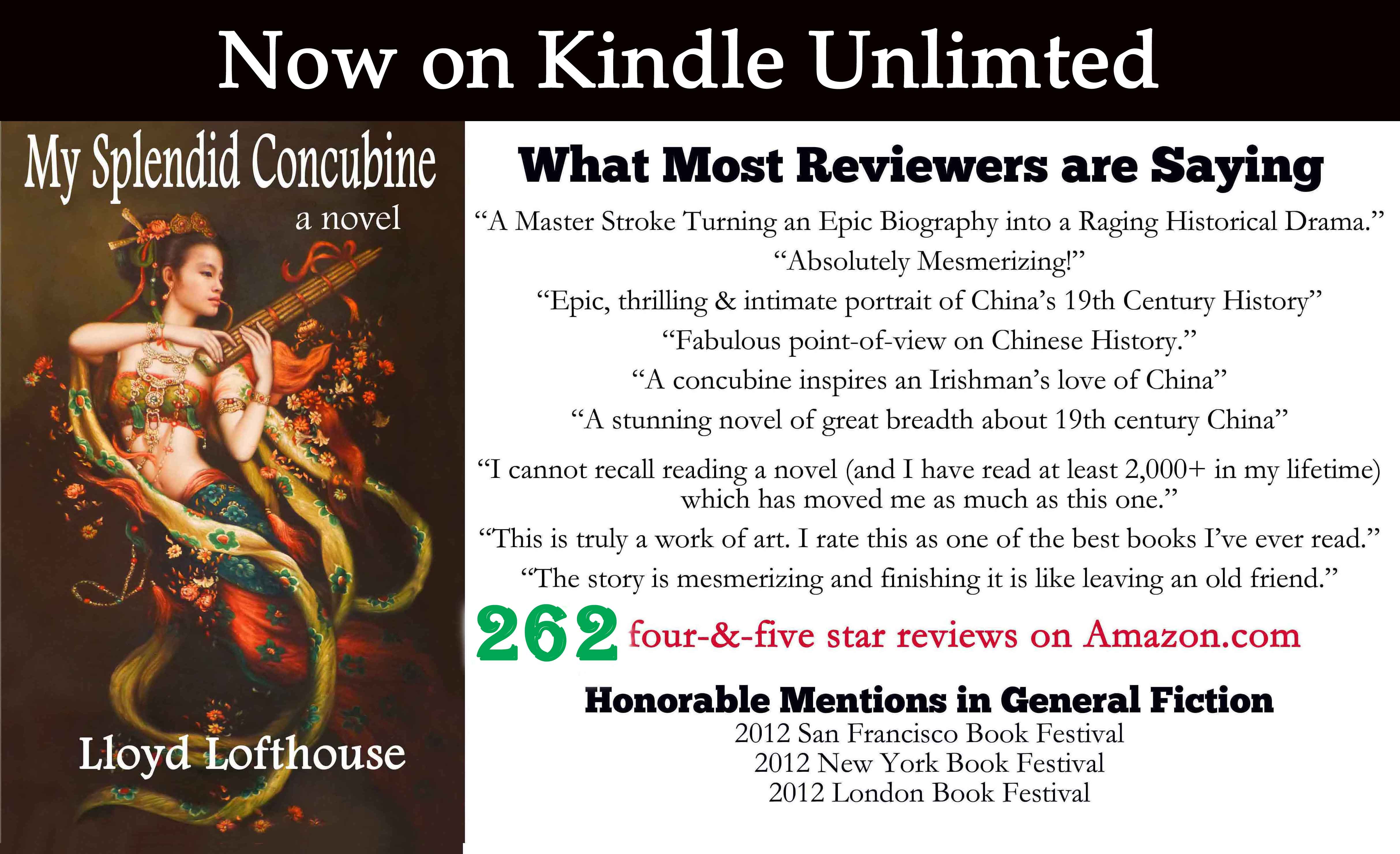
Lloyd Lofthouse is the award-winning author of My Splendid Concubine, Crazy is Normal, Running with the Enemy, and The Redemption of Don Juan Casanova.
Where to Buy

Subscribe to my newsletter to hear about new releases and get a free copy of my award-winning, historical fiction short story “A Night at the Well of Purity”.

About iLook China


The Life of Dogs in China

July 3, 2019

Thought Co says, “Dogs are known the world over as man’s best friend. But in China, dogs are also eaten as food.”

While it is true that dogs are still food for some, most Chinese do not eat dog meat. In fact, ltl-school reveals, “the simple fact is most Chinese adore dogs just like many western households do. The practice of eating dog meat in China is actually much less common than most expats think. …  One thing we can say for sure, eating dog is NOT common practice in China and Chinese restaurantstofu and pretty much anything else is much more common.”

I’m a vegan and visited China several times starting in 1999 and my last trip was in 2008. Not once did I see dog meat offered on any menu, and I also did not see dogs in cages in the farmers’ markets I visited. I saw ducks and chickens in cages waiting to be bought and slaughtered, but there were no dogs or cats.

In fact, China is more vegan and vegetarian-friendly than in the United States.

GBTimes reports China’s love-hate history with dogs. “China began domesticating dogs thousands of years ago, producing many of the breeds that remain popular today. Over the centuries, however, the Chinese have also developed a complicated love-hate relationship with its canine population.” …

“In ancient China, the dog was one of the most honoured and cherished animals.”

Then during Mao’s Cultural Revolution, “Dogs were seen as a symbol of the bourgeois, therefore they were involved in the class struggle,” Marina Shafir explained. “There was a mass extirpation of dogs, and many of the original Chinese dog breeds almost became extinct.”

Then once Mao died along with his Cultural Revolution, dogs made a comeback, not as food but as an honored and cherished family member.

What is it like owning a dog in China today?

The Culture Trip answers that question. “Walk down any street in Shanghai or Beijing and you’re sure to see little brown poodles dressed more extravagantly than their owners, schnauzers with impressive beards, and shiba inus that look like they’ve been ripped straight from a meme. Little old ladies are more likely to be seen with a dog buggy than a baby buggy, and Uncle Ma is able to impress his friends with his samoyed, as if it were a Bulgari watch.” … “Dog ownership is on the rise. There are an estimated 100 million registered dogs in China, with the real number being likely even higher.”

In addition, the BBC reveals that Taiwan has banned the selling and eating of cats and dogs and that in mainland China, “The practice of eating cats and dogs has become less common as pet ownership rises, and new generations have different attitudes to eating domestic animals.”

If you are a hardcore meat eater, hate vegetables and tofu, and want to try out dog, “Each year in June, the city of Yulin in southern China hosts a dog meat festival, where live dogs and cats are sold specifically for eating and an estimated 10,000 are slaughtered for their meat,” but you better hurry because in 2016 there were large protests against this festival throughout China.

However, if eating dog and cat ends in China, never fear, because there is a better country to visit if you want to chow down on dog. South Korea, according to the BBC, has an estimated 17,000 dog farms, and then there is Thailand and Vietnam.

Lloyd Lofthouse is the award-winning author of My Splendid Concubine, Crazy is Normal, Running with the Enemy, and The Redemption of Don Juan Casanova.

Where to Buy

Subscribe to my newsletter to hear about new releases and get a free copy of my award-winning, historical fiction short story “A Night at the Well of Purity”.

About iLook China


China takes the lead in growing indoor crops

June 26, 2019

I recently read a comment on another blog that said Trump was going to win his tariff war with China because of a crop eating pest known as the fall armyworm that is threatening China’s domestic food supply.

So far, this worm has only attacked crops in Southern China.

The flaw in this thinking is the fact that China imports food from other countries. In fact, in 2017, China bought more food products from France than the United States, and World Bank.org lists the countries China buys from and how much China spends. All you have to do is click the World Bank link in this paragraph to discover those facts.

The comment I read mentioned Inkstone News.com, “To compound matters, China’s food supply was already under pressure after it was forced to slaughter millions of pigs with African swine fever affecting all 31 autonomous regions and provinces within just nine months, trimming 20% of the national supply and driving up prices.”

First, China is not going to starve because they lost twenty percent of the country’s pigs, because the Chinese eat a lot more than pork. I’m a vegan and have never had a problem finding a variety of plant foods to eat when visiting China.

Second, Smart Cities Dive reports, “How China Leads the World in Indoor Farming. China is investing significant amounts of effort into developing vertical farming systems to feed its burgeoning urban population. It aims to become a world leader in industrial scale applications of these systems.” …

“Compared to conventional farming, a plant factory with natural solar light can increase productivity per unit area by between two and ten times. With artificial light, this rises to 40 times and by adding vertical farming this goes to 1000 times.”

To learn more, read what Next Shark.com reveals about China’s high-tech indoor farms where “5,000-square-meter (53,819-square-foot) indoor space, produces eight to ten metric tons of vegetables DAILY while requiring only four staff members to manage it. Conventional farmlands would require about 300 farmers to produce the equivalent amount which can feed almost 36,000 people.” …

“The smart farming method involves a strict system that regulates temperature, water source, humidity, nutrients and LEDs that replace sunlight in a confined indoor space. Such regulations allow the firm to significantly save on water, granting each plant only the right amount it needs.”

If bugs, African swine fever, and global warming continue to threaten China’s domestic food supply, how fast will it take China to convert most if not all of its outdoor farms to these high-tech indoor farms?

The answer can be found in China’s high-speed rail network. China’s first high-speed train service was introduced in April 2007. Twelve years later, China has the longest high-speed railway network in the world, 18,000 miles in length, two-thirds of the world’s total, with plans to increase it to 24,000 miles by 2025.

How does China’s high-speed rail development compare to the rest of the world?

Well, the first high-speed rail system started operating in Japan in 1964, and it took the rest of the world 55 years to build one-third of the world’s high-speed railroads. The United States only has one high-speed rail line linking Boston, New York City, Philadelphia, Baltimore, and Washington DC, but those bullet trains cannot take advantage of their maximum speed because some sections along that route are old rail lines that cannot safely support trains moving 150 mph.

When China needs to, it can move fast. For instance, the Chinese government made high-speed rail construction a cornerstone of its economic stimulus program in order to combat the effects of the 2008 global financial crisis and the result was a rapid development of the Chinese rail system into the world’s most extensive high-speed rail network. China moved up its timeline when twenty million Chinese lost their factory jobs because of the global financial crises … and let us not forget that the United States was responsible for that crises due to old fashioned capitalist greed.

One day, pork might not be on the menu in China, but there will still be plenty of fruits, nuts, and vegetables, and if I can survive for thirty-seven years as a vegan, the Chinese can do it too.

Lloyd Lofthouse is the award-winning author of My Splendid Concubine, Crazy is Normal, Running with the Enemy, and The Redemption of Don Juan Casanova.

Where to Buy

Subscribe to my newsletter to hear about new releases and get a free copy of my award-winning, historical fiction short story “A Night at the Well of Purity”.

About iLook China


The History of Democracy in Hong Kong is so Short it Never Happened

June 19, 2019

Recent Western headlines are shouting:

Hong Kong Protesters face a powerful enemy

Hong Kong Protest: ‘Nearly two million’ join demonstration

Huge Hong Kong protests continue after the government postpones controversial bill

Before I focus on the current protests in Hong Kong, first, a small history lesson.

China never willingly gave Hong Kong to the British Empire in 1842. Instead, China lost Hong Kong during the Opium Wars, and later leased adjacent territories to the British under pressure in 1860 at the end of the Second Opium War when the UK gained a perpetual lease over the Kowloon Peninsula that’s across the strait from Hong Kong Island.

This agreement was part of the Convention of Beijing that ended that war, a war started by England and France. In each case the British Empire, France, and sometimes the United States, were victorious and gained commercial privileges and legal and territorial concessions from China.

These conflicts over the opium trade was the start of the era of unequal treaties.

Then in 1898, the British and Chinese governments signed the Second Convention of Peking and “Britain was granted an additional 99-years of rule over the Hong Kong colony.”

Fast forward ninety-nine years and on December 19, 1984, British Prime Minister Margaret Thatcher and Chinese Premier Zhao Ziyang signed the Sino-British Joint Declaration, and Britain agreed to return not only the New Territories but also Kowloon and Hong Kong itself when the lease term expired on July 1, 1997. China promised to implement One Country, Two Systems policy, so for fifty years, Hong Kong citizens could continue to practice capitalism and political freedoms forbidden on the mainland.

However, for most of its history under British rule, executive power in Hong Kong was concentrated in the hands of the colony governor, a position appointed by the British crown without any democratic input from Hong Kong citizens. The introduction of elected representatives determined by local elections was limited to the role of advisory councils, and that didn’t start until after the 1984 agreement by the British to hand Hong Kong over to China.

Today, since Hong Kong has never been a democracy, who fears being extradited to mainland China?

You might want to see the list of crimes in the new extradition law that so many Hong Kong citizens are mad about … or fear.

Number One: Murder or manslaughter, including criminal negligence causing death; culpable homicide; assault with intent to commit murder.

Click the previous link and discover the other thirty-six crimes. You might want to also read the nine that were removed like “offenses involving the unlawful use of computers” or “offenses against the law relating to environmental pollution or protection of public health”.

For hundreds of thousands of Hong Kong citizens to be out in the streets protesting and holding thousands of printed signs that all look the same (really), there must be a lot of frauds and crooks in that city fearing they are going to lose their freedom to commit crimes.

Who paid for all those signs to be printed by the same company – the CIA?

Lloyd Lofthouse is the award-winning author of My Splendid Concubine, Crazy is Normal, Running with the Enemy, and The Redemption of Don Juan Casanova.

Where to Buy

Subscribe to my newsletter to hear about new releases and get a free copy of my award-winning, historical fiction short story “A Night at the Well of Purity”.

About iLook China


Will China rebuild its cities so they become people friendly?

June 12, 2019

Most cities were built to be friendly to cars and not people, but there is a growing movement to change that. The April 2019 issue of National Geographic Magazine (NGM) published “To build the cities of the future, we must get out of our cars

Countries across the world, including the United States and China, or starting to build and/or rebuild cities to turn them people friendly.

The first page of the 20-minute read NGM piece started with, “SHANGHAI, CHINA Near the center of this city of 24 million, China’s largest, the Yanan expressway crosses under the North-South Expressway. The country has gained half a billion city dwellers since 1990—and nearly 190 million cars. ‘It’s truly almost incomprehensible what happened in China,’ says American urban designer Peter Calthorpe, who has worked there extensively. With nearly 300 million more people expected in cities by 2030, Chinese planners say they’re changing course, prioritizing walkable streets and public transit over cars. …

Chinese planners say they’re changing course, prioritizing walkable streets and public transit over cars.

“The key test may come in Xiongan, a 680-square-mile stretch of swampy land, including a heavily polluted lake, about 65 miles southwest of Beijing. In April 2017 President Xi Jinping announced, again to general surprise, that he wanted to build a new city there. Ultimately it could house five million people and relieve congestion and pollution in Beijing.”

The guide for building these people-friendly cities is the Emerald Cities Rule book, and China is in the best position to build these cities.

“Emerald Cities: Planning for Smart and Green China,” published in 2017 lays out green building and sustainability practices for low-carbon city planning and construction in China and abroad. Emerald Cities proposes 10 principles to help set a new development direction for Chinese cities: from urban growth boundaries and transit-oriented development, to small blocks with accessible public space and car control, to green buildings and sustainable infrastructure at constructive detailed planning and community levels. The 10 principles aim to establish green, healthy and economic vibrant cities, while solving pollution and livability challenges faced by China’s cities. Emerald Cities was jointly published by China Sustainable Transportation Center and Glumac with support from Energy Foundation and Energy Innovation.”

What do U.S. President Donald Trump and his administration want to build? Trump wants to build a wall that will divide people and promote hate and segregation while he holds rallies across the U.S. promoting hate and segregation.

However, the U.S. also has the possibility offered by Alexandria Ocasio-Cortez’s Green New Deal that is similar to what Xi Jinping wants to do in China, so there is still hope for America to join China in making the world people friendly instead of focused on hate, segregation, and greed.

Lloyd Lofthouse is the award-winning author of My Splendid Concubine, Crazy is Normal, Running with the Enemy, and The Redemption of Don Juan Casanova.

Where to Buy

Subscribe to my newsletter to hear about new releases and get a free copy of my award-winning, historical fiction short story “A Night at the Well of Purity”.

About iLook China