First, American fast food arrived and now China is having a weight problem leading to poor health and the explosion of China’s Fat Camps.
Then there is America’s car culture, which is catching on fast in a country that doesn’t have the strict environmental pollution laws that exist in the US and rural China is choked with smog.
Now, I learn that romance American style arrived in China as another blow to China’s ability to survive as a civilization. Weren’t the 19th century Opium Wars bad enough?
Eating fast food that destroys bodies, smoking cigarettes, reading Harlequin Romances and driving carbon-spewing cars cannot be a good thing.
Is this how “democracy” is going to make life better for the Chinese?
Since Harlequin romance novels flew into China on collagen-filled lips, attitudes toward love have changed.
“According to Enjoy Reading Era, a Beijing-based cultural company specializing in publishing romantic novels, 1,500 love stories by writers in the mainland were published last year, an all-time high. The company exported 50 romance novels to Hong Kong and Taiwan, while it only imported three novels from Taiwan.” Source: Show China.org
Reading romance novels may explain the increase in the divorce rate in China and the high divorce rate in the US. After all, how can any real man compare to the ink and paper men on the pages of a Harlequin romance?
However, I may be wrong about what the West has exported to China. Thanks to Romance novels, China may no longer need the one-child policy since all those wheezing, unhealthy fat people driving cars instead of riding bicycles or walking will be reading trashy romance novels instead of making love.
This may end China’s population challenge.
In fact, GM and Ford are making huge profits in China as is McDonalds, KFC, Pizza Hut and Starbucks. Even Hooters is in China along with Wal-Mart.
Think of the profits these American corporations are earning to help make the rich richer.
______________
Lloyd Lofthouse is the award-winning author of the concubine saga, My Splendid Concubine & Our Hart. When you love a Chinese woman, you marry her family and culture too.
If you want to subscribe to iLook China, there is a “Subscribe” button at the top of the screen in the menu bar.
Enter Jeannie Lin, Harlequin’s rising red-star of romance writing. She isn’t the first author on Harlequin’s roster to set her books in China (that honor goes to Jade Lee and her infinite “Tigress” series).
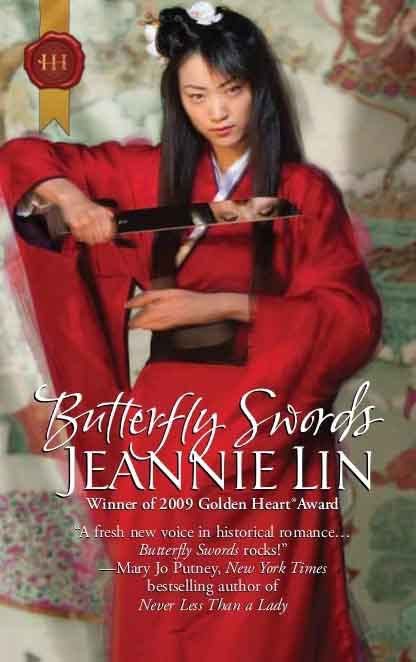
However, Lin’s debut novel, Butterfly Swords, has been attracting a viral buzz louder than a summertime cicada not just for being the first Harlequin novel to NOT feature a man on the cover, but for using an Asian model as the cover girl, another Harlequin first.
The star of Butterfly Swords is a Chinese woman, yes. But to give American readers something that they can relate to, the male love interest of Lin’s novel is not Chinese but a wandering whiteboy from the west.
Ryam is drifting around the Tang (618-906 AD) empire begging for food (this sounds exactly like my own travels across China!) when he spots a disguised female being attacked by a pack of marauding bandits.
The swordsman, who evokes images of bare-chested, fur underwear-wearing Thundarr the Barbarian from the eponymous 80’s cartoon, rescues her, then agrees to escort her home.
Little does Ryam know that young Ai Li is really a princess on the run from an arranged marriage to a dastardly warlord. The two proceed on their journey together across the 7th-century frontier, getting in adventures and slowly but surely falling in love.
Pitting strength, courage and her fabulous butterfly swords against the forces of evil, Ai Li proves herself in the battlefield (“With Ai Li’s swords and determined spirit it was easy to forget that she was innocent”).
However, where the book has significant cultural crossover appeal is in author Jeannie Lin’s ability to keenly capture the multi-dimensional perspectives of both characters throughout their budding interracial relationship.
From Ryam’s course communicative abilities (“Where did you learn how to speak Chinese” Ai Li asks him, laughing. “You sound like you were taught in a brothel”) to his struggles with his inner-white demons as a big, bad bai gui (“It was so much easier to seduce a woman than talk to her”), the reader is introduced not to some empty-headed he-man but a complex male of the species who is genuinely torn between his biological needs and respecting Ai Li’s virtue.
“I don’t understand what she’s talking about half the time,” Ryam grumbles to himself. “Everything is about honor and duty.” Surely even expats living in present-day P.R.C. can relate to this dilemma.
Ai Li, meanwhile, finds herself attracted not only to Ryam’s “musky scent” and “sleek muscles” (Harlequin prerequisites; don’t blame the authoress), but his sincerity (“There was nothing barbaric about him. His manner was direct and honest. It was her own countrymen she needed to be worried about.”).
The protagonist does find herself frustrated with “this swordsman with blue eyes and the storm of emotions that came with him,” but, true to life, Ai Li comes with her own personality flaws as well (“she was being irrational and she knew it”).
Of course, it wouldn’t be a Harlequin without passionate love scenes, something my fiancée missed in the heavily censored Chinese versions.
This Jeannie Lin does in the poetic prose of a Tang Dynasty-era pillow book yet with just enough creatively-provocative language to keep sex-numbed westerners interested (“Ryam slipped his fingers into her silken, heated flesh…her body went liquid and damp in welcome.”). And thankfully without ever once resorting to the word “loin.”
Ryam proves himself to be an ideal lover for nubile Ai Li, “rough enough to make her breath catch, gentle enough to have her opening her knees,” though one can’t help but wonder how these two nomadic warriors can go so long without bathing nor brushing their teeth yet still manage to say things like “her mouth tasted just as sweet as he remembered.”
If only real life were as hygienic as a Harlequin novel.
One of the reasons why Harlequin is able to sell over 100 million units per year (the most profitable publishing company in the industry) is because every book is part of a series.
There are no individual Harlequin titles, which brilliantly leaves the reader yearning for more from the characters they have literally become so intimate with. In this respect, Butterfly Swords concludes with a wide opening that screams sequel, but thankfully lacks the typical Harlequin-happy ending of matrimonial bliss.
One familiar with Chinese culture can’t help but wonder, then, what kind of future Ai Li and Ryam actually have together: in reality, Ai Li would put on weight, cut her hair short and become a shrill nag; her parents and grandparents would all move into their cramped apartment, and a frustrated Ryam, now with beer-belly, would spend more and more time at card games and with karaoke parlor hostesses than at home.
But before the infuriating realties of interracial marriage set in, we hope Jeannie Lin has at least a few more of her trademark sword fights and steamy sensuality in store.
Growing up in a rural, slate-roofed village deep in the countryside of southeast China, the only English books my Chinese fiancée had to read back then were a brittle copy of Tess of the d’Urbervilles and a set of Harlequin novels.
Yes, I’m talking about Harlequin, those pulpy paperbacks found on revolving wire racks at supermarket checkout aisles across North America and the UK. Their enticing cover art – usually, nay, always featuring shirtless, square-jawed men hovering millimeters away from the glistening-red lips of a damsel in distress – and formulaic flirt/fight/fall-in-love storylines mercilessly targeted housewives and secretaries longing for a 200-page escape from the dirty diapers and pot-bellied husbands of their mid-life realities.
As it turns out, it was by reading books like “Stormy Voyage” by Sally Wentworth and Roberta Leigh’s “Two-Timing Man” (bought used for 7 RMB out of a sidewalk vendor’s book cart), amongst other Harlequin classics, that my fiancée managed to teach herself English (which explains her tendency to throw her head back dramatically whenever we kiss).
Curious how Harlequin, the forbidden fruit of literature, could be found anywhere in a Communist republic that has the world’s most strict state-sponsored vetting process for publications, I was surprised to learn that in 1995 (about when my fiancée found her copies) Harlequin received official, red star-stamped permission to place half a million copies of twenty titles in Mandarin and a quarter-million copies of ten English versions on the shelves of Xinhua.
Harlequin’s stated goal: “to bring romance to millions of Chinese Women.”
A China.org article on the increasing popularity of romance books in the P.R.C. concurred with Harlequin’s audacious move: “Chinese women today have new demands for their Prince Charming: first, he must be powerful and distinguished…next, he must unlimited financial resources.”
Wosai! No wonder China has become home to the world’s highest surplus of single men!
Harlequin, which puts out 1,500 new titles annually in over 100 international markets, has yet to think up a romance set in present-day China (Possible storyline: wealthy, second-generation Beijing businessman seduces sexy xiaojie with his shiny black Audie, pleather man-purse and a thick stack of redbacks; he agrees to save her Anhui village from being bulldozed by corrupt cadres if she will become his kept woman.).
Until that day, we will have to entertain ourselves with stories set in China’s olden times starring princesses and concubines.
During the 1990s, Zhou Litai became famous as one of the first lawyers fighting for the rights of workers injured or mistreated by China’s new wave of private enterprises.… Since then, he has handled thousands of workplace injury cases, and even houses and feeds some of his most destitute clients. Source: New York Times
Zhou Litai has been featured in China Daily and on CCTV in China.
In the 2006 documentary, Zhou Litai says, “In Shenzhen every year, 10,000 insured workers get injured. It’s reported that 95% of injured workers do not file lawsuits.”
“After winning cases,” Zhou Litai says, “some clients went back home to buy a house or to open a home business. Also, a few have started self-education in law such as Fu Shulin, who comes from Anhui Province.”
“Before he came to Shenzhen,” Zhou Litai says, “Fu Shulin was a student at a vocational college in Hefei City and he’s been living with me after filing a lawsuit. During the legal process, he realized the power of the law and decided to study after me.”
In May 2006, a short documentary of China’s changing legal system was produced.
Before becoming a law clerk, Fu Shulin had a hand cut off while operating a machine. He was sent to a hospital.
Shulin says, “At first, the doctor told me that my hand was able to be reconnected. However, after my boss talked to the doctor, he told me that my hand wouldn’t be reconnected because the bones had been shattered.”
Shulin had problems with his factory boss so he saw Lawyer Zhou Litai.
After seeing Zhou Litai, Shulin was offered 30,000 yuan by the factory (less than $4,000 US). He turned it down.
Then the boss had him locked up in a factory room, but Shulin managed to get a note to his lawyer, Zhou Litai, who came with the police to free him.
in 1998, the district court ruled in Shulin’s favor and awarded him 160,000 yuan (more than $19,000 US dollars). The factory boss appealed and lost. The final settlement was 168,000 yuan (more than $20,000 US)
Lloyd Lofthouse is the award-winning author of the concubine saga, My Splendid Concubine & Our Hart. When you love a Chinese woman, you marry her family and culture too.
If you want to subscribe to iLook China, there is a “Subscribe” button at the top of the screen in the menu bar.
With amazement, I read a post written by Doug Caverly, a staff writer for WebProNews, about Facebook’s goal to trademark the word “face”.
Doug explains that if Facebook gains control of the use of the word “face” it would only apply to the realm of [t]elecommunication services. Go to Doug’s original post (use link above) for details.
In my opinion, this is a sign of paranoid megalomania on the part of Mark Zuckerberg. How can Zuckerberg look at his “face” in the mirror each morning as he attempts to own a word (at least the virtual use) in the English language?
What’s frightening is the “Untied States Patent and Trademark Office sent Facebook a Notice of Allowance, indicating that it doesn’t take issue with the idea,” Doug says.
Are federal government employees in the US that stupid or are they just brain dead?
Sunil R. Nair defends Mark Zuckerberg (on another issue) at India’s Business Blog, Trak.in. Nair’s conclusion says, “In defense of Mark Zuckerberg, I can say that if I had to do all of what he did to build a great company I could do it without regret and in the same manner that he did.”
I wonder if Sunil still feels that way since Zuckerberg’s move to own the virtual use of the word “face”.
In fact, face is a concept that has been part of Chinese civilization for several thousand years, is still in use today, and has been mentioned on the Internet. The concept of “face” to the Chinese is complicated and is part of China’s culture. If anyone should own the use of “face”, it should be the Chinese—not Facebook.
Mark, you may have gone too far — again.
______________
Lloyd Lofthouse is the award-winning author of the concubine saga, My Splendid Concubine & Our Hart. When you love a Chinese woman, you marry her family and culture too.
If you want to subscribe to iLook China, there is a “Subscribe” button at the top of the screen in the menu bar.


 Posted by Lloyd Lofthouse

 iLook China