Politically Correct in the West but Historically Wrong

October 22, 2013

In the “Contra Costa Times”, I read Tibetan leaders seek East Bay help by Doug  Oakley, May 27, 2010. This was a politically correct news piece that was partially accurate because Oakley only shared part of the history between China and Tibet—the part that favors Tibet’s so-called government in exile, which represents about 1% of all Tibetans—the rest still live in China.

Oakley writes that, “Tibet was invaded by the Chinese army in 1950. After the Tibetan army was defeated, both sides signed a 17-point agreement in 1951 recognizing China’s sovereignty over Tibet.”

These facts were correct, but they did not tell the whole story.

Any historian who checks primary-source material that does exist outside of Communist China will discover that Tibet was ruled by three Chinese dynasties: The Yuan, Ming and Qing Dynasties from 1277 – 1911.  Even after Sun Yat-Sen’s so-called Republic replaced the Qing Dynasty in 1911, Tibet was considered part of China.

Primary sources like the October 1912 issue of The National Geographic Magazine—with a piece written by a Chinese doctor who was sent to Tibet by China’s emperor in 1907— and more than fifty letters written by Sir Robert Hart during the 19th century support the fact that Tibet was part of China for more than six centuries prior to 1913 when the British Empire convinced Tibet to break free for political reasons. [Note: I have an original copy of that issue of NGM, and copies of Hart’s letters]

The so-called Tibetan government in exile says they are seeking autonomy within China. In fact, China does offer a form of autonomy to the 56 minorities that live in China, but this isn’t the level of autonomy that the Dalai Lama demands, which is a return to the old Tibetan ways described in that 1912 issue of National Geographic, which is unacceptable to China.

Tibet has never been a democracy or a republic. And the average life expectancy for Tibetans increased from 35 years in 1950 to over 65 years by the 2000s while China has ruled the region, and going to school is mandatory for children. Source for life expectancy facts: Tibet from the U.N. Economic and Social Commission for Asia and the Pacific.

Between 1913 and 1950, life expectancy in Tibet did not improve during the few decades that the Dalai Lama ruled the region. In fact, little to nothing changed and most Tibetans were mostly illiterate serfs/slaves of wealthy and powerful landowners. In fact, every family had to send a son/s to become Tibetan Buddhist lamas. There was no choice and there was no educational system for children. The Tibetan people have more freedom of choice today—even under CCP leadership—than at any time in recorded history.

_______________

Lloyd Lofthouse is the award-winning author of My Splendid Concubine [3rd edition]. When you love a Chinese woman, you marry her family and culture too. This is the love story Sir Robert Hart did not want the world to discover.

His latest novel is the multiple-award winning Running with the Enemy.

Subscribe to “iLook China”!
Sign up for an E-mail Subscription at the top of this page, or click on the “Following” tab in the WordPress toolbar at the top of the screen.

About iLook China

China’s Holistic Historical Timeline


Lin Yutang explains Christianity from a Chinese viewpoint

September 26, 2013

Lin Yutang (1895 – 1976) was a Chinese writer, translator, linguist and inventor. He was one of the most influential writers of his generation. In 1933, he met Pearl S. Buck in Shanghai and she introduced him, and his writings to her American publisher.

For most Chinese the end of life lies not in life after death, for the idea that we live in order to die, as taught by Christianity, is incomprehensible, nor in Nirvana, for that is too metaphysical, not in the satisfaction of accomplishment, for that is too vainglorious, nor yet in progress for progress’ sake, for that is meaningless.

The true end, the Chinese have decided in a singularly clear manner, lies in the enjoyment of a simple life, especially the family life, and in harmonious social relationships.

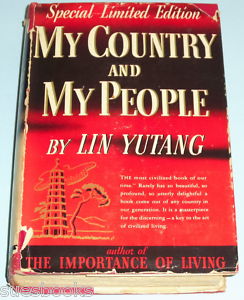
My Country and My People by Lin Yutang

“The Chinese are a nation of individualists. They are family-minded, not social-minded…. It is curious that the word society does not exist as an idea in Chinese thought. In the Confucian social and political philosophy we see a direct transition from family, ‘chia’, to the state, ‘kuo’, as successive stages of human organization.…

lin-yu-tang

Lin Yutang

“The Chinese, therefore, make rather poor Christian converts, and if they are to be converted they should all become Quakers, for that is the only sort of Christianity that the Chinese can understand. Christianity as a way of life can impress the Chinese, but Christian creeds and dogmas will be crushed, not by a superior Confucian logic but by ordinary Confucian common sense. Buddhism itself, when absorbed by the educated Chinese, became nothing but a system of mental hygiene, which is the essence of Sung philosophy.” Source: My Country and My PeopleLin Yutang. Halcyon House, New York. 1938. Pgs 94; 101; 103; 172, and 108

Discover China’s Holistic Historical Timeline

_______________

Lloyd Lofthouse is the award-winning author of My Splendid Concubine [3rd edition]. When you love a Chinese woman, you marry her family and culture too. This is the love story Sir Robert Hart did not want the world to discover.

His latest novel is the multiple-award winning Running with the Enemy.

Subscribe to “iLook China”!
Sign up for an E-mail Subscription at the top of this page, or click on the “Following” tab in the WordPress toolbar at the top of the screen.

About iLook China

China’s Holistic Historical Timeline


China’s Holistic Historical Timeline

August 3, 2013

This holistic timeline in no way represents all of China’s history. This menu of China’s history is here for individuals who want to learn about China and the Chinese from near the beginning to today.

What I’ve done is provide links in chronological order—or as close as possible—to posts on this site that offer a look at China’s long history and her people. Click on the links [in red] to discover some of China’s historical, cultural and artistic evolution.

If you see a post that you feel is in the wrong time slot, let me know and I will look into it. New links may be added at any time.


6987 BC

The Ancient Yue


3000 BC

The Discovery of Silk

God, Ancient Astronauts and China’s Yellow Emperor


2256 – 2205 BC

ShangDi, China’s God of Creation


2205-1783 BC

The Xia, China’s Oldest Known Dynasty


1783 – 1123 BC

Shang Dynasty

The Mandate of Heaven

Links to the Stars – Ancient Astronomy

Spring Festival, Year of the Tiger

The Vanishing Street Art of Chinese Calligraphy

Chinese Drums

The Sheng, one of China’s Oldest Musical Instruments


1126 – 222 BC

China’s Spring and Autumn Period

Emperor Wu of Zhou Dynasty

Guqin means Ancient Musical Instrument

China Points the Way

Sun Tzu’s “The Art of War”

The Bodhidharma

The Life of Confucius

The Influence of Confucius

The two-faces of Confucius

Confucius Returns

Confucius with Chow Yun Fat

A short history of Taoism and its meaning

Yin Yang

China’s Grand Canal

China’s Ancient Chimes


259 – 210 BC

The First Emperor, Qin Shi Huangdi, the man who unified China

Xian, China’s Ancient Capital

The Search for the Tomb of Cao Cao

The Seven Wonders of China starting with the Qin Shi Huangdi

Tea for Emperors and Tibet


206 BC – 219 AD

The Han Dynasty

Buddhism in China

With or Without Paper

Measuring Earthquakes


Near the end of the Han Dynasty to 280 AD

Romance of the Three Kingdoms


300 – 644 AD

A Millennia of History at a Silk Road Oasis

[youtube-http://www.youtube.com/watch?v=R29A0GyLYlE]


596 – 644 AD

Hsuan-tsang – From China to India for Enlightenment


618 – 906 AD

The Tang Dynasty

Wu Zetian, China’s only Female Emperor and an early feminist

Ancient Feminism in China

Tang Dynasty Poetry

The Accidental Discovery of Gunpowder

Ice Cream from China – Myth or Fact

The First Cinderella was Chinese

The Tea Horse Road

Chinese Crossbow and other Inventions

Quyi: Chinese Singing and Storytelling

Christianity and Islam in China

The Kaifeng Jews


925 – 1279 AD

Sung Dynasty

China’s Imperial Encyclopedia

China’s Bound-Feet Women

The Machines of China


1279 – 1368 AD

Yuan Dynasty: Kublai Khan’s Mongol Empire [China conquered]

Shanghai’s History & Culture

China’s Real Karate Kids

The Millennium Cult

The White Lotus Mutation


1368 – 1643 AD

The Ming Dynasty Part 1

The Ming Dynasty Part 2

Emperor Yangle of the Ming Dynasty

Ruling the Oceans

China’s Romeo and Juliet


1644 – 1911 AD

The Qing Dynasty

China’s Last Dynasty

China’s Last Empress Dowager-Regent

The Prince’s Garden

The Qing Dynasty’s Elite Troops

For All the Tea in China

The Connection between Opium, Christianity, Cults and Cannon Balls

The Roots of Madness

The Opium Wars

The Taiping Rebellion; the Kingdom of Heavenly Peace (1845-1864)

A Forbidden City Connection to Tibet Revealed

Dream of the Red Chamber

Jingyun Dagu, Beijing’s Story Telling Opera

Peking Opera

The Importance of Guanxi to Chinese Civilization

Jack London in China

Discrimination against the Chinese in America


1912 to present

Dr. Sun Yat-Sen, the father of China’s Republics

Sun Yat-sen’s Last Days

Yuan Shikai, the general who became China’s president for life

Chiang Kai-shek, brutal dictator and America’s friend

America’s Angel Island

Massacre in Taiwan and America says nothing

Mao’s Long March

China’s Communist Revolution or Civil War

Mao and Snow

World War II and The Rape of Nanking

Japan’s war of lies about atrocities in China

The Rape of Nanking with Iris Chang

China’s Health Care During Mao’s Time

Mao Zedong, the Poet

Xiu Xiu: The Sent Down Girl

From Mao to the Met

Mao’s Last Dancer

The Founding of a Republic

Ah Bing and “Reflection of the Moon”

Balzac and the Little Chinese Seamstress

Tibet Inside China

China’s Sensitivity over Tibet

Tibet as a Province of China – the unresolved issue

No Way is Tibet a Democracy in Exile!

Chinese Gold from Dead Tibetan Caterpillars

China in Korea Protecting the Teeth

China’s Great Leap Forward

China’s Great Famine (1959 – 1961)

Mao’s ‘alleged’ Guilt in the Land of Famines

Mao and Complex Post Traumatic Stress Disorder

China and India at War – 1962

The KMT-CIA Heroin, Cocaine Pipeline to the US

Pearl S. Bucks’ China Predictions – 1966

Nixon in China

Deng Xiaoping

The Sino-Vietnam War of 1979

The Controversy, Complexity and Reality behind China’s One-Child Policy

The Tiananmen Square Hoax

Tiananmen Square Revisited

What is the truth about Tiananmen Square?

On the trail of Dr. Li’s illusive Memories

Water: the Democracy versus the Authoritarian Republic

Greenpeace and the growth of environmentalism in China

China’s Educated Women Work to Bring about Change from Within

China’s Stick People – the rural urban divide

China’s Porn War

Evil Tobacco

Joining the Party

Communism and Socialism are NOT the SAME

Country Driving with Peter Hessler

Oprah Times Four in China

Hooters in China

What do Shanghai’s IKEA and Cupid have in common?

Macao Bringing in the Cash

Falun Gong’s Media Machine

The differences between Individualism and Collective Cultures


_______________

Lloyd Lofthouse is the award-winning author of My Splendid Concubine [3rd edition]. When you love a Chinese woman, you marry her family and culture too. This is the love story Sir Robert Hart did not want the world to discover.

His latest novel is the multiple-award winning Running with the Enemy.

Subscribe to “iLook China”!
Sign up for an E-mail Subscription at the top of this page, or click on the “Following” tab in the WordPress toolbar at the top of the screen.

About iLook China


Talking about Sung Dynasty Philosophy

July 23, 2013

China may be the only ancient culture that survived the spread of Islam and Christianity and managed to keep its unique identity. The following passage comes from My Splendid Concubine’s 3rd edition. My first novel has picked up fifteen literary awards. In the novel, Guan-jiah is Robert Hart’s servant.

________________________________

“Guan-jiah,” Robert said, “before I came to China I read The Travels of Marco Polo. Do you know who he was?”

“No, Master,” Guan-jiah replied.

“He came to China from Europe more than six hundred years ago and served under Kublai Khan during the Yuan Dynasty. Polo wrote that Hangzhou was the finest and noblest city in the world.”

“Hangzhou was the capital of the Southern Sung Dynasty, Master,” Guan-jiah said. “I’ve heard it is beautiful. Sung philosophy says that we have the power in our minds to overcome our emotions.”

“Marco Polo believed it was God’s will that he came back from China so others in the West might know what he’d seen.” Robert turned to his servant, who was the last in line. “Do you believe in this Sung philosophy, Guan-jiah?”

Sir Robert Hart working long hours at his standing desk.

“The Sung said that if you know yourself and others, you would be able to adjust to the most unfavorable circumstances and prevail over them.”

“That’s admirable, Guan-jiah. You never mentioned you were a scholar. If the Sung Dynasty was that wise, I want to see Hangzhou one day.”

“I am no scholar, Master, but I must believe in the Sung philosophy to survive. I have read and contemplated much literature. However, I am like a peasant and have never mastered calligraphy. It is a skill that has eluded me.”

“How old were you when you studied this philosophy?”

“I was eleven, Master, two years after I was sent to Peking.”

Source: From Chapter 4 of My Splendid Concubine

And Discover The Influence of Confucius

_______________

Lloyd Lofthouse is the award-winning author of My Splendid Concubine [3rd edition]. When you love a Chinese woman, you marry her family and culture too. This is the love story Sir Robert Hart did not want the world to discover.

His latest novel is the multiple-award winning Running with the Enemy.

Subscribe to “iLook China”!
Sign up for an E-mail Subscription at the top of this page, or click on the “Following” tab in the WordPress toolbar at the top of the screen.

About iLook China


A short history of Taoism and its meaning: Part 2/2

May 14, 2013

The video’s narrator, Jean Delumeau (born 1923) is a professor of history at the College of France in Paris and is widely regarded as one of the leading historians of Christianity. Sin and Fear, one of his books, is a monument of flawless scholarship, says Wendy Doniger for the New York Times

Delumeau says that Taoism was a philosophy and a religion, which offered salvation for the individual and responded to the need for the immortality of its followers.

Confucianism, however, was somewhat abstract and didn’t offer a reward of immortality since ancient China did not have a concept of a spiritual soul that survives a physical death.

Taoism believed that the physical body only contains the personality. There were rules for food, hygiene, breathing techniques and different forms of gymnastics, which were designed to suppress the causes of death and allow each follower to create an immortal body to replace the mortal one.

After the mortal body died, the immortal body went elsewhere to live.

In ancient China, the pathway of sanctity preached by Taoism evolved in Chinese Yoga and was recognized some 500 years before the birth of Jesus Christ.

In the second century AD, Taoism became a true church venerating immortals as saints.

About 200 AD, a Taoist scholar taught that virtue, avoidance of sin, confessions of sins and good works were the most important aspects and took precedence over diet and hygiene.

One major difference from religions in the West is that Taoism does not have leaders on a national scale—like the Catholic Pope—and is more like a federation of linked communities.

In 110 BC, Emperor Wu of the Han Dynasty made Confucianism the state religion to strengthen and centralize his power.

Nevertheless, Taoism continued to be practiced as a parallel popular religion.

Religious Tolerance.org says there are about 225 million followers but the exact number is impossible to estimate since many Taoists also identify with other regions such as Buddhism and Confucianism.

Return to A short history of Taoism and its meaning: Part 1

_______________

Lloyd Lofthouse is the award-winning author of My Splendid Concubine [3rd edition]. When you love a Chinese woman, you marry her family and culture too. This is the love story Sir Robert Hart did not want the world to discover.

Subscribe to “iLook China”!
Sign up for an E-mail Subscription at the top of this page, or click on the “Following” tab in the WordPress toolbar at the top of the screen.

About iLook China