Does Shanghai Really have the World’s Best School System? Part 1 of 3

August 16, 2016

In 2012 Shanghai earned 1st place in the world on the International PISA test. Its score was 613 in math, 570 in reading, and 580 in science. Second place went to Singapore: 573 in math, 542 in reading, and 551 in science. The mean score for all the countries that took part in the PISA was 494 in math, 496 in Reading and 501 in Science.

Around 510 000 students between the ages of 15 years 3 months and 16 years 2 months participated in PISA 2012 as a whole representing about 28 million 15-year-olds globally.

All 34 OECD member countries and 31 partner countries and economies participated in PISA 2012, representing more than 80% of the world economy. The U.S. was ranked #36 compared to the 65 countries/cities listed.

But Shanghai is not a country. It is a city and so was Hong Kong and Macao. Even the Principality of  Liechtenstein, a landlocked microstate that is one of Europe’s most affluent (wealthiest) communities, with a population of almost 37,000, was ranked in the top 10 right behind Japan. At least Shanghai has a population of more than 20 million.

The United States with 314.1 million people in 2012 was ranked much lower when the average scores were compared to all the other countries, but America’s ranking was flawed and misleading because of an error when the test was taken in the U.S.  To discover more, click the following link:  Poor ranking on international test misleading about U.S. student performance, Stanford researched finds.

At this point, you might be thinking, why is he mentioning America’s PISA score when this post is about Shanghai. In Part 3, the ironic answer to that question will be answered.

Continued with Part 2 on August 17, 2016

Lloyd Lofthouse is the award-winning author of My Splendid Concubine [3rd edition]. When you love a Chinese woman, you marry her family and culture too. This is the unique love story Sir Robert Hart did not want the world to discover.
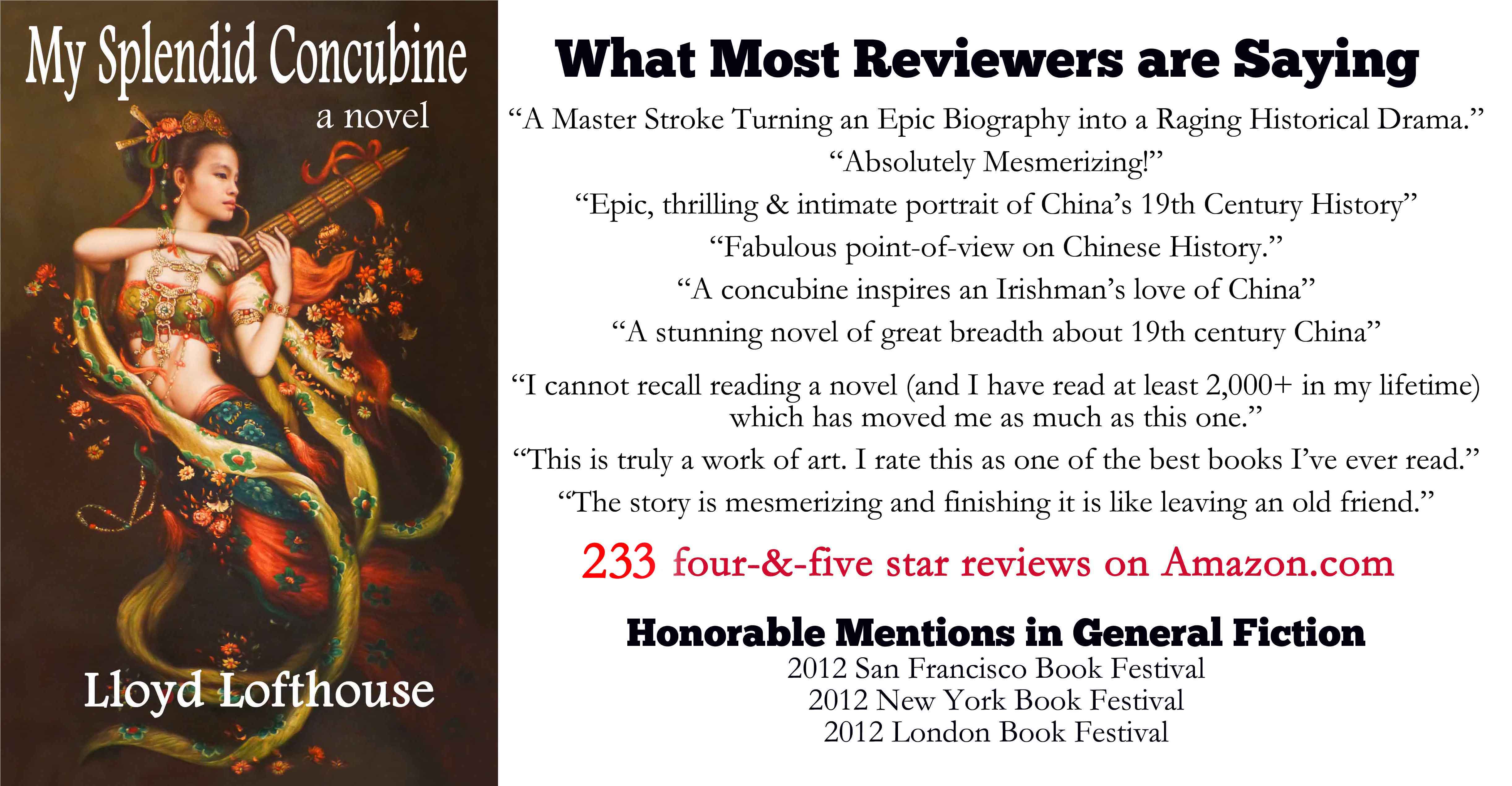
A1 on June 22 - 2016 Cover Image with BLurbs to promote novel

Where to Buy

Subscribe to “iLook China”!
Sign up for an E-mail Subscription at the top of this page, or click on the “Following” tab in the WordPress toolbar at the top of the screen.

About iLook China

China’s Holistic Historical Timeline


What would a Republic in China Look Like? Part 3 of 3

August 11, 2016

To determine what a republic in China would look like, we must also ask how many Chinese would have been allowed to vote in Sun Yat-sen’s republic.

To find out we need to take a closer look at who was eligible to vote in the United States during Sun’s life to discover that most minorities [China has 56] and women in the United States were not allowed to vote. In addition, some American states at the time had literacy laws in place and eligible adult men [mostly minorities] had to pass a literacy test to be able to vote. The first literacy test for voting was adopted by Connecticut in 1855. In fact, ten of the eleven southern states had subjective literacy tests that were used to restrict voter registration, but some of those states used grandfather clauses to exempt white voters from taking literacy tests.

Knowing this, it is highly likely that Sun Yat-sen would have created a republic in China that only allowed educated and wealthy Han Chinese men to vote. Women and children would have remained chattel, the property of men to be bought and sold for any reason as they had for thousands of years, and China’s minorities would have had no rights.

Therefore, once we subtract children, women, minorities, Han Chinese adult males who did not own property and any of those who were illiterate from the eligible voting population, what’s left is less than five percent of the adult population—and the educated Han elite adult males who owned property would have ruled the country. Most of the people in China would have had no voice; no vote.

What about today’s China?

Six-hundred million rural Chinese are allowed to vote in local elections. Only Chinese Communist Party (CCP) members vote in national elections but at last count, there were more than 80 million CCP members; China’s leader—with limited powers—may only serve two five-year terms.

And China has its own form of an electoral college. The President of China is elected by the National People’s Congress [NPC] with 2,987 members [dramatically more than the Electoral College in the United States with its 538 electors]. The NPC also has the power to remove the President and other state officers from office. Elections and removals are decided by a simple majority vote.

There is another significant difference between China’s NPC and America’s Electoral College—members of China’s NPC are elected but members of America’s Electoral College are appointed. This process varies from state to state. Usually, political parties nominate electors at their state conventions. Sometimes that process occurs by a vote of the U.S. party’s central committee. The electors are usually state-elected officials, party leaders, or people with a strong affiliation with the presidential candidates. This means that the American people have no say when those hand-picked 538 electors decide who the next U.S. President will be.

Then there is this fact: China’s culture is influenced by Buddhism, Daoism and Confucianism — not Christianity, Islam or Judaism — and all three of these Asian religions/philosophies emphasizes harmony with little or no focus on individual rights as practiced in Europe and North America. Knowing that, it is highly likely that Sun Yat-sen would have supported some form of censorship over individuals in China when too much freedom of expression threatened the nation’s harmony.

But the pressure on China to become a democracy is for China to copy the United States with no consideration for its history and unique cultural differences. I wonder why.

Return to Part 2 or start with Part 1

Lloyd Lofthouse is the award-winning author of My Splendid Concubine [3rd edition]. When you love a Chinese woman, you marry her family and culture too. This is the unique love story Sir Robert Hart did not want the world to discover.

A1 on June 22 - 2016 Cover Image with BLurbs to promote novel

Where to Buy

Subscribe to “iLook China”!
Sign up for an E-mail Subscription at the top of this page, or click on the “Following” tab in the WordPress toolbar at the top of the screen.

About iLook China

China’s Holistic Historical Timeline


What would a Republic in China Look Like? Part 2 of 3

August 10, 2016

Sun Yat-sen [1866 – 1925] was considered the father of China’s republic both on the mainland and Taiwan, and he was introduced to the United States in 1882 when he attended a Christian school in Hawaii. That experience exposed him to American politics, and later he wrote that he wanted to model China’s government after America but by combining Western thought with Chinese tradition.

To learn about the United States that Sun Yat-sen discovered, we must step back in time and examine America’s political structure then.

William P. Meyers.org says, “After the British were defeated a centralized, national government was seen by George Washington and company not as a method of extending freedom and the right to vote, but as a way of keeping control in the hands of rich. They wrote several anti-democratic provisions into the U.S. Constitution. Slavery was institutionalized. The Senate was not to be elected directly by the people; rather Senators were to be appointed by state legislatures. The President was not to be directly elected by the voters, but elected through an electoral college. The Supreme Court was to be appointed. Only the House of Representatives was elected directly.”

But by 1920, five years before Sun died, the right to vote was extended to women in the United States in both state and federal elections, but where was Sun Yat-sen when this happened? He was in China leading a rebellion and struggling to build a multi-party republic that included the Communist and Nationalist parties, and his ideas of what a republic would look like in China had formed decades before women got the vote in the U.S.

The political climate that existed in the United States in the late 19th and early 20th centuries will show us what Sun learned about politics in America. For instance, there was the Chinese Exclusion Act passed by Congress in the spring of 1882 that was still in force. It wouldn’t be until 1942, years after Sun’s death, that the act would be repealed.

In addition, in 1922, the US Supreme Court ruled that people of Japanese heritage could not become naturalized citizens. The following year the Supreme Court ruled that Asian Indians also could not become citizens, and the law that barred Native American’s from voting wasn’t removed until 1947.

How about the way children were treated in the United States?

Well, children could be sold into slavery by their parents and end up working in factories, coal mines and even whore houses as young as seven. It wouldn’t be until 1938 that a federal law stopped this form of child slavery in the United States. America’s Civil War [1861 – 1865] may have ended black slavery but it didn’t free women and children of any race, and the Equal Rights Amendment has still not passed.

Continued with Part 3 on August 11, 2016 or start with Part 1

Lloyd Lofthouse is the award-winning author of My Splendid Concubine [3rd edition]. When you love a Chinese woman, you marry her family and culture too. This is the lusty love story Sir Robert Hart did not want the world to discover.

For August 2016 Promotion

Where to Buy

Subscribe to “iLook China”!
Sign up for an E-mail Subscription at the top of this page, or click on the “Following” tab in the WordPress toolbar at the top of the screen.

About iLook China

China’s Holistic Historical Timeline


What would a Republic in China Look Like? Part 1 of 3

August 9, 2016

The mainland Chinese have many choices to choose from when it comes to a democracy. They could copy the first democracy in Athens, but the Athenian democracy had slavery and women couldn’t vote. In the 4th and 5th century BC, all male citizens (about 40,000 to 60,000) in Athens had equal political rights, freedom of speech, and the opportunity to participle directly in the political arena, but women, slaves (as many as 80,000) and foreign residents were excluded.  – Athenian Democracy: a brief overview

What about the United States at its birth as a republic? Well, only white men who owned property and were not Jews were allowed to vote. That was about 10 percent of the population, and in 1790 there were 697,897 slaves in America. – Slave Population of United States: 1790 – 1860

Around that time, the U.S. resident population in 1790 was about 3.9 million. If we subtract the slaves, that leaves 3.2 million meaning that about 300,000 men were allowed to vote.

There are 192 countries in the world and only 123 (or 64 percent) are considered democracies, but China is often criticized the most for not being what is considered a democracy. Why aren’t the other 68 countries that are not democracies criticized: for instance, Saudi Arabia, Turkmenistan, Uzbekistan, Tajikistan, Bahrain, Oman, Jordan, the United Arab Emirates, Equatorial Guinea, Chad, Uganda, Rwanda, Thailand, Vietnam, Brunei, Singapore, Kazakhstan, and Azerbaijan – maybe it is because these authoritarian regimes are all supported by the United States but mainland China isn’t?

However, China might already be a democratic republic, because few if any outside of China considers that the political structure of today’s China might be closer to Sun Yat-sen’s vision than the democracy we find in the United States. After all, Sun Yat-sen is considered the father of China’s republic by both Taiwan and Beijing. In fact, mainland China, ruled by the Chinese Communist Party (CCP), may offer the Chinese people more of a voice than the republic Sun Yat-sen was building before his death.

Continued with Part 2 on August 10, 2016

Lloyd Lofthouse is the award-winning author of My Splendid Concubine [3rd edition]. When you love a Chinese woman, you marry her family and culture too. This is the lusty love story Sir Robert Hart did not want the world to discover.

For August 2016 Promotion

Where to Buy

Subscribe to “iLook China”!
Sign up for an E-mail Subscription at the top of this page, or click on the “Following” tab in the WordPress toolbar at the top of the screen.

About iLook China

China’s Holistic Historical Timeline


Vietnam versus China – 207 BC to Today

June 21, 2016

Compared to China, the few years the U.S. fought in Vietnam is insignificant, and based on history, the United States learned its lesson to get out in a much shorter time span than it took China. And the French learned this lesson in a much shorter time span between 1946 and 1954.

China’s most recent conflict with Vietnam started on February 15, 1979, when China invaded Vietnam to teach it a lesson.

Why did China do this? Well, after the death of Stalin, relations between the Soviet Union and China turned sour while the Russians and the Vietnamese developed a closer relationship.

To counter this perceived threat, China encouraged Cambodia to take aggressive action against Vietnam. Near the end of 1978, the Cambodians under the leadership of Pol Pot launched a series of attacks along the Vietnam border.

The Vietnamese retaliated with armored units and captured the capital of Cambodia on January 7, 1979.

Since ten-thousand Chinese military advisers in Cambodia became prisoners, China lost face, and invaded Vietnam to “teach it a lesson”.

The Vietnamese decided to hold back their regular army and defend the border with militia units using guerilla tactics in the hills and rainforest similar to how they fought America, the French and China in the past.

China took heavy casualties after attacking and soon pulled its troops out 3 weeks and 6 days after crossing the border.  Both sides declared victory. Border clashes between Vietnam and China would continue until 1990.

One would think that China would have learned its lesson long ago, because China has a long and bloody history with Vietnam. The first Chinese invasion and occupation of Vietnam took place in 207 BC to 39 AD. The second occupation was from 43 to 544 AD.  The third was from 602 to 905 AD.  The fourth event was between 1407 to 1427 AD. During this long history of invasions and occupations by China, the Vietnamese rebelled repeatedly to drive the Chinese out and regain their independence as a country.

France ruled over Vietnam from 1862 until the Japanese invaded during World War II. The French would return in 1946 and fight the Vietnamese until 1954.

The US and Vietnam, once enemies during the American-Vietnam War (1961 – 1975), are now allied to block China’s territorial claims in the South China Sea.  – Goldsea Asian American News

I seriously think many leaders do not study history to avoid repeating the same mistakes made by others before them.

Lloyd Lofthouse is the award-winning author of My Splendid Concubine [3rd edition]. When you love a Chinese woman, you marry her family and culture too. This is the unique love story Sir Robert Hart did not want the world to discover.

A1 on March 13 - 2016 Cover Image with BLurbs to promote novel

Where to Buy

Subscribe to “iLook China”!
Sign up for an E-mail Subscription at the top of this page, or click on the “Following” tab in the WordPress toolbar at the top of the screen.

About iLook China

China’s Holistic Historical Timeline