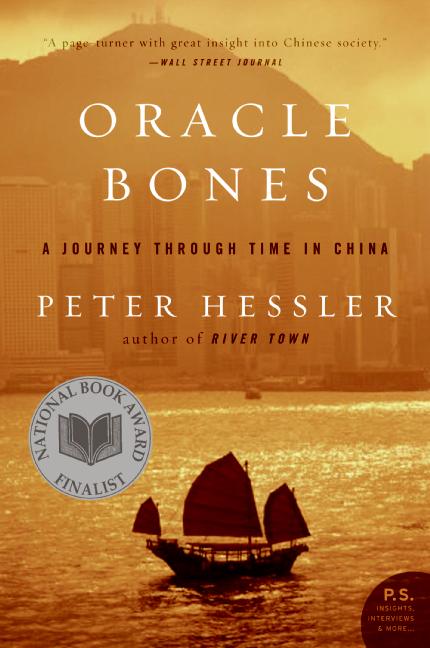
Peter Hessler, an expatriate, on China

March 30, 2010

Peter Hessler is a Beijing correspondent for the New Yorker. He has lived in China for fifteen years. After leaving the Peace Corps, Hessler freelanced for Atlantic Monthly and the New York Times before returning to China in 1999 as a Beijing-based freelance writer.

I agree with Hessler when he said in a CNNGo interview, “People in China are not forthcoming like Americans; they don’t like to tell you their personal story. It’s a type of modesty, I think, in a culture where people are not encouraged to see themselves as the center of the universe.”
I have an American born-again Christian friend who has bragged about Christianity being the fastest growing religion in China. I wonder what he’d say if he read what Hessler had to say here, “The Chinese relationship with religion is pragmatic and fluid; people often change their faith very quickly. And I don’t see them following religion to a degree where it’s clearly not in their self-interest….”

On happiness, Hessler says, “At this particular moment I think that Americans…might be less happy than Chinese people. The Chinese can roll with the punches…. Everybody in China has seen ups and downs; if they get laid off from the factory, they just go back to the village and play mah-jong….”

Discover The Influence of Confucius

______________

Lloyd Lofthouse is the award-winning author of the concubine saga, My Splendid Concubine & Our Hart. When you love a Chinese woman, you marry her family and culture too.

If you want to subscribe to iLook China, there is a “Subscribe” button at the top of the screen in the menu bar.


From the Bottom Up

March 29, 2010

America may be learning something from China’s stimulus plan—spending hundreds of billions of dollars from its cash reserves to keep people working. This is called bottom-up economic growth and the gap between the rich and working poor shrinks instead of expands. The opposite is trickle-down economics from the Reagan era where the gap widens.

Chinese jobs

China’s bottom-up plan makes sense. After all, how much can one rich person consume compared to hundreds of millions of people—a little spending from each person at the bottom adds up and is better for long-term economic survival instead of short-term corporate profits. Who cares if the wealthy grow their fortunes slower? Well, the rich do. I’m sure they love having that money filling Wall Street vaults.

It appears that President Obama has the same idea. During the presidential campaign, he said.  “The project of the next president  is figuring out how you create bottom-up economic growth, as opposed to the trickle-down economic growth.” It seems that with the passing of the health care bill (that has upset so many of the trickle-down people), President Obama is putting his words into action and following China’s example.

To learn more about China’s economy see “Why China is Studying Singapore” http://wp.me/pN4pY-2z


Super Power Dawn

March 29, 2010

Alan Caruba writes about Super Power China at “Speak Without Interruption”. “As the sun begins to set on an America whose dollar set the standard and whose capacity for manufacturing was unchallenged, a new superpower is emerging and it is China.”

Two notable individuals from history predicted more than a century ago what is taking place in China—the first was a young Irishman from Belfast who arrived in China in 1854 and left in 1908.  His name was Robert Hart and to historians, he’s known as the Godfather of China’s modernization.

Hart wrote near the end of the 19th century that in a hundred years China would be a superpower again. Jack London, who visited China and wrote about it, made the same prediction.

The way the government has decentralized power in China is not new. Imperial China did the same. The Emperor appointed the governors to the provinces based on who earned the highest scores in the Imperial exams and they ruled like kings. 

As for a market economy, China may have invented this on a national scale more than a millennia ago proving that it doesn’t take a democracy or republic to prosper.

If you spend time in China, you will discover that the Chinese are born entrepreneurs, who find ways to get around government restrictions to make money. Sadly, this has led to the pollution in China today—something the central government is struggling to deal with as they transition to green power.

As for long term planning, consider that the top men in China’s government are engineers or scientists compared to America’s leaders who are mostly lawyers. After Mao, China implemented term and age limits for government positions, something America does not have.

______________

Lloyd Lofthouse is the award-winning author of the concubine saga, My Splendid Concubine & Our Hart. When you love a Chinese woman, you marry her family and culture too.

If you want to subscribe to iLook China, there is a “Subscribe” button at the top of the screen in the menu bar.


Saying Goodbye

March 28, 2010

To the Chinese, the hardest goodbye is when white hair buries dark. This week, a  friend of our daughter’s died a tragic death at 17. The lost daughter’s name was Faith. Her story, like so many, was told in The Lost Daughters of China by Karin Evans, a book about abandoned girls and their journeys to American homes with loving adopted parents.

The phone call arrived at midnight from Faith’s mother. When my wife answered, I could hear and feel the grief like a bullet—my eyes filled with tears and an ache formed where my heart beats. No mother should suffer the loss of a child.

On the way to the airport, I listened to a memory about our daughter and Faith when they were in preschool together and a boy took a toy from our daughter. He refused to give it back. Faith came to the rescue.  She was only four or five. She demanded the toy be returned. The boy refused and Faith attacked biting him on the elbow.

You see, she had learned to survive in an orphanage in China where life can be a challenge. She was loyal to those she loved, who loved her. As long as those memories are shared and kept alive, she will always be with those who knew her.

The rest of Faith’s tragic journey may be discovered at Earth to Earth, Dirt to Dirt, Ashes to Ashes

2a-242-positive-reviews-hall-of-fame-reviewer-jan-16-2017

Where to Buy

Subscribe to “iLook China”!
Sign up for an E-mail Subscription at the top of this page, or click on the “Following” tab in the WordPress toolbar at the top of the screen.

About iLook China

China’s Holistic Historical Timeline


Walking Barefoot on a Double Edged Blade

March 27, 2010

From what I’ve learned, when Mao died, many Chinese were tired of the Communists because of  the Cultural Revolution. If Deng Xiaoping hadn’t introduced a market economy resulting in decades of growth and prosperity, China may have fallen into chaos to emerge with a dictator similar to what they had with the Kuomintang.

Nichols Kristof

Nicholas Kristof wrote, China & Google (New York Times, March 24, 2010), an opinion piece that gets closer to the truth about China. Kristof seems to know what he is talking about when he said, “They (ordinary Chinese) don’t gripe  a lot about the regime imprisoning dissidents, who mostly have a negligible following around the country.”

It’s probably true that many in China want to have free access to the Internet, but I doubt it is serious enough to cause concern. The biggest concern is raising the standard of living for the 800 million rural Chinese who have not cashed in on the prosperity.

When there are accusations from Washington that China isn’t playing fair with currency control, China has a choice. Give in and wait for hundreds of millions of unhappy Chinese to rebel or stand firm and continue to grow the economy.

As far as Google is concerned, China has Baidu (with more than 60% of the market) and shedding Google probably feels like passing gas in public.