The Life of Confucius – Part 4/5

May 4, 2010

His success and radical ideas were making him dangerous enemies.  The three warlords of Lu formed an alliance to get rid of Confucius.

They found the most beautiful girls in the state and sent them to the young ruler, who spent his days and nights with the beauties, and Confucius was forgotten.  Stunned and humiliated, Confucius took his loyal students and left the state of Lu to find another ruler to support his ideas.

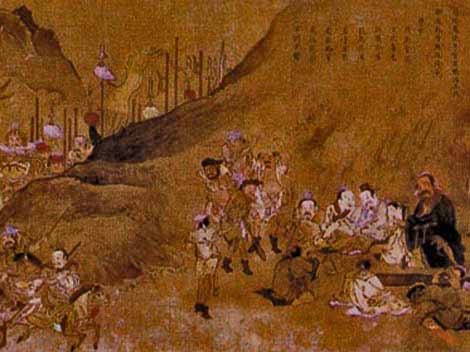
Confucius traveling with his students.

At fifty-four, Confucius was tough. From 497-484 BCE, he walked great distances from state to state.

During this journey, he and his students witnessed the suffering of the peasants. He knew that only the nobility could end the suffering, but none of the rulers would listen to him.

It was during this time that Confucius met the philosopher Lao Tse, who warned him to keep quiet or he was going to be killed.

Return to Part 3 of “The Life of Confucius” or go  to Part 5

_______________

Lloyd Lofthouse is the award-winning author of My Splendid Concubine [3rd edition]. When you love a Chinese woman, you marry her family and culture too. This is the love story Sir Robert Hart did not want the world to discover.

Subscribe to “iLook China”!
Sign up for an E-mail Subscription at the top of this page, or click on the “Following” tab in the WordPress toolbar at the top of the screen.

About iLook China


Getting the Job Done

May 4, 2010

How can America stay competitive in the global marketplace when the infrastructure in America is wearing out, and it’s time consuming and frustrating to get anything done?

John Hockenberry–a former ABC and NBC reporter and now the host for a New York public-radio morning talk show–had the answer. He said on his show that he was yearning for a Chinese dictatorship in America to get things done.

John Hockenberry

What Hockenberry said was true. The Chinese do get things done. He was wrong about one thing. China is not a dictatorship.

A few years into the 21st century, we were in China sleeping on the blanket-covered floor of my father-in-law’s flat in the old French sector of Shanghai. His three rooms were on the second floor of a three-story building that once belonged to a French family prior to World War II. Now seven families lived in that building. What had been a walk-in-closet had been converted into a kitchen/bathroom. The balcony had been closed in—that’s where we were sleeping.

High block walls surrounded the houses in the French sector. When we woke up and left the flat to visit the local farmer’s market, the walls were gone as if they’d never been. 

Later, we learned that the Shanghai city government decided to open the city and the best way to do that was to remove the walls. An army of workers came in the night and removed the walls without waking us up.

That’s what John Hockenberry was talking about. The ability of China’s government to move fast.

Follow this link to learn more about high-speed rail in China.


The Life of Confucius – Part 3/5

May 4, 2010

Confucius dreamed of becoming a great minister of state and putting an end to corruption and bloodshed. He spent much of his free time between the age of 19 to 30 in the libraries of Chufu reading.

He said, “When people are educated, the distinction between classes disappears…. If the sons of emperors and princes are without quality, they should be reduced to the ranks of the common people. If the sons of the common people have quality, they should be elevated to the ranks of the rulers.”

Confucius with students

Confucius was the first teacher in China to start a school that accepted students from every class.  The sons of peasants and powerful families mingled and formed friendships.

Confucius demanded absolute honesty, total self-control and unyielding virtue from his followers. “A superior man thinks about what is right. A small man thinks about what is profitable.  A superior man demands much of himself.  A small man demands much of others. A superior man accepts his lot in common.  A small man is full of complaints.”

One goal remained—a position of power. In 501 BC when Confucius was fifty, the young leader the Duchy of Lu begged Confucius to give up his teaching.

Confucius said, “Do unto others as you would have them do unto you.… You should give education and knowledge to the common people instead of ignoring or subjugating them.” The Duke made Confucius the governor of Lu and while Confucius governed, the streets were safe, crime almost vanished and merchants stopped cheating their customers.

Return to Part 2 of “The Life of Confucius” or go to Part 4

_______________

Lloyd Lofthouse is the award-winning author of My Splendid Concubine [3rd edition]. When you love a Chinese woman, you marry her family and culture too. This is the love story Sir Robert Hart did not want the world to discover.

Subscribe to “iLook China”!
Sign up for an E-mail Subscription at the top of this page, or click on the “Following” tab in the WordPress toolbar at the top of the screen.

About iLook China


Chinese Poetry

May 3, 2010

Traditional Chinese Poetry is very similar to Western poetry.  Lines in Chinese poetry may have a fixed number of syllables and rhyme was required, so ancient Chinese poetry resembles traditional English verse and is not at all like the free verse in today’s Western culture.

Modern Chinese poets have written in free verse, but many still write with a strict form.

In the end, the form is not as important as what the poem says. Western poetry often focuses on love while painting an image of the poet as a lover.

Influenced by Confucius and Taoism, the ancient Chinese poet shows he or she is a friend—not a lover and often paints a picture of a poet’s life as a life of leisure without ambitions beyond writing poetry and having a good time.

Chinese Dragon Boat Races

According to legend, this Chinese poet killed himself to protest the corruption of the time, and it is said that the Dragon Boat Festival was named to honor his sacrifice.

Battle
By Qu Yuan (332-295 B.C.)

We grasp our battle-spears: we don our breastplates of hide.
The axles of our chariots touch: our short swords meet.
Standards obscure the sun: the foe roll up like clouds.
Arrows fall think: the warriors press forward.
They menace our ranks: they break our line.
The left-hand trace-horse id dead: the one on the right
is smitten.
The fallen horses block our wheels: they impede the
yoke-horses?”

Translated by Arthur Waley 1919

If interested in Chinese art and/or opera, see Peking Opera.


The Life of Confucius – Part 2/5

May 3, 2010

Life was hard for Confucius and his mother, who struggled to grow vegetables on a small plot of land. To survive, he helped by working as a common laborer, and his mother spent hours making sure Confucius had an education so he might have a better future.

A Chinese peasant grinding rice

Ugly, awkward and shy, Confucius had few friends, so he did not experience a normal childhood. By the time he was a teen, he had read the great classics of Chinese civilization and discovered that learning never stops.

Then his mother died. The grief almost destroyed him, because she had been the only person who loved him.  By the time he buried her near his father’s grave, he had lived through hardships that would break most men. Instead, he turned these survival lessons into strengths. With his mother gone, he realized that a family’s love was greater than gold.

Confucius was a poor, ugly giant—an illegitimate child with no family connections. His only advantage was his extraordinary mind, but fate was going to smile on him.

He lived in Chufu, the capital of the Duchy of Lu. One of three powerful warlords of Lu recognized his talent and gave him an important job. At 19, he married, but no one knows who she was. They had a son followed by other children.

Return to Part 1 of “The Life of Confucius” or move on to Part 3

_______________

Lloyd Lofthouse is the award-winning author of My Splendid Concubine [3rd edition]. When you love a Chinese woman, you marry her family and culture too. This is the love story Sir Robert Hart did not want the world to discover.

Subscribe to “iLook China”!
Sign up for an E-mail Subscription at the top of this page, or click on the “Following” tab in the WordPress toolbar at the top of the screen.

About iLook China