Getting Around China’s Net Nanny

May 6, 2010

Eric at Amplify.com has a right to his opinion, but that opinion was wrong. Amplify.com says “Google’s Decision Re: China Fails to Knock Giant Off Its Perch.” and applauds Google’s decision to take a stand on China.

This post from Amplify was off the mark.  Google was making a profit everywhere but China.  Baidu, China’s Google, with more than sixty percent of the market share, was cleaning Google’s clock, because Google didn’t know how to serve the people properly. Google wasn’t alone. E-bay and PayPal made similar mistakes and lost money in China too.

There is no mention that Microsoft’s Bing may be quietly slipping into China to replace Google figuring that 30% of more than three hundred million people are worth the risk. Meanwhile, Google moves to Hong Kong with tail between legs. Oh well, Google can’t win all the time.

Besides, what is this big deal about censorship in China? Anyone who lives in China and surfs the net knows how to get around the Chinese Net Nanny by using proxy servers. I have friends in China who do it daily.

See more at Google Recycled.

Lloyd Lofthouse is the author of the award winning novels My Splendid Concubine and Our Hart. He also Blogs at The Soulful Veteran and Crazy Normal.

Sign up for an RSS Feed for iLook China


Where Does the Money Go?

May 6, 2010

“China doesn’t keep all the money paid for products made in China. Everyone in the supply chain shares.” I heard Zachary Karabell say this at the 2010 Los Angeles Times Festival of Books.

Today, I read a post in Bind Apple that emphasized the fact that Apple products are made in China but didn’t mention that Apple also manufactures in the United States, Malaysia and Indonesia and other countries. The post also emphasized the sixty-hour workweek and low pay as if it were a bad thing.

In fact, Apple says, “Their products and components are manufactured by a wide variety of suppliers around the world.  The final assembly of most products occurs in China.”

Most Chinese do not mind working sixty-hour weeks and the money earned may be low by American standards but is higher than most rural Chinese earn. 

These factory workers also send money home and manage to save, since China’s average saving rate is 40%. China’s culture is based on Confucianism, which focuses on collective rights instead of the individual.  Those workers are not working for themselves. They are working for their family and that includes parents and grandparents, who are contributing too.

Learn more about who Confucius was, or see what was going on at Apple’s Foxconn facility in Guanlan, China.

Lloyd Lofthouse is the author of the award winning novels My Splendid Concubine and Our Hart. He also Blogs at The Soulful Veteran and Crazy Normal.

Sign up for an RSS Feed for iLook China


Jing-Hu

May 5, 2010

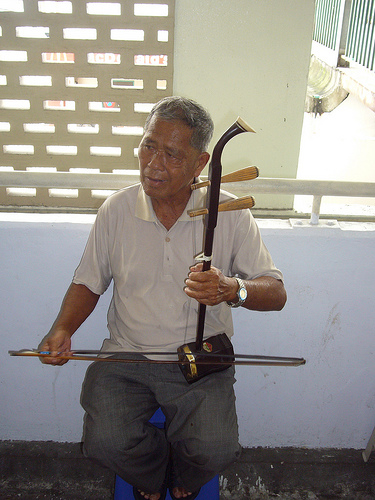
If you Google the name for this two stringed instrument, you may find the same name is used for girls names and a railroad that runs between Beijing and Shanghai. Jing is for the capital and Hu for Shanghai.

Man playing Jing-Hu.

Since Chinese is a tonal language, each word is pronounced in a different tone.  The word is also written differently in Chinese when used for a girl’s name or the railroad.

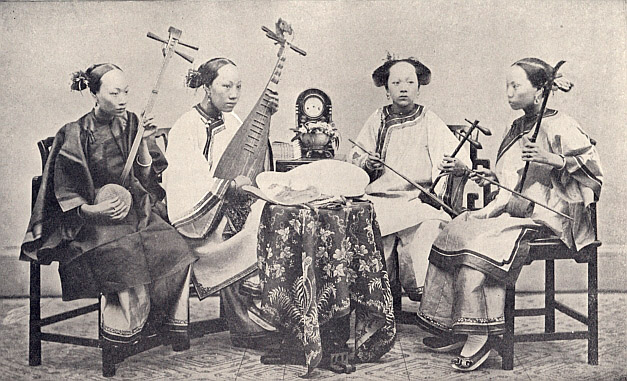
girl to right of clock/table playing Jing-Hu

The Jing-Hu I’m writing about is a two stringed instrument often used with Beijing Opera. The Jing-Hu first appeared during the Qing Dynasty.  At that time, the strings were made of silk. Today, they are often made of steel or nylon. 

If you are interested in Chinese music, read about and listen to The Four Stringed Liuqin.

_________________________

Lloyd Lofthouse is the award-winning author of the concubine saga, My Splendid Concubine & Our Hart. When you love a Chinese woman, you marry her family and culture too. 

Sign up for an RSS Feed for iLook China 


The Life of Confucius – Part 5/5

May 5, 2010

In 484 BC, a former student convinced the rulers of Lu to call Confucius home.  He returned to Chufu still believing he would find a ruler who would listen to him.  The ruling warlords asked him how to find honest officials.

Confucius replied, “Be honest yourself.”

He was ignored and retired to edit the poetry and books he loved. From his study, he watched the powerful leaders fight horrible wars among themselves and witnessed the Chinese people suffering. His daughter was married. His son, who died young, was lazy and hated learning.

In his old age, his students were his family. Claims say that he had about three thousand followers but only seventy-two were devoted to him. One student was his favorite.  Yen Hui reminded Confucius of his own youth. He believed that Yen Hui would carry on his work but at forty-one, Yen Hui died. Confucius wept saying, “Heaven has turned against me.”

Confucious grave for tourists

Depressed, Confucius thought, “Now I know that heaven has a will of its own.” In 479 BC, Confucius died. His last words were bitter. “Will no ruler come forward and take me as his master.”  He saw himself as a failure. He had no idea that his thoughts would become the dominate philosophy of China for centuries.

Today, billions work hard, value an education and believe that every person has a chance at success.

Return to Part 4 of “The Life of Confucius” or go here to learn more about The influence of Confucius.

_______________

Lloyd Lofthouse is the award-winning author of My Splendid Concubine [3rd edition]. When you love a Chinese woman, you marry her family and culture too. This is the love story Sir Robert Hart did not want the world to discover.

Subscribe to “iLook China”!
Sign up for an E-mail Subscription at the top of this page, or click on the “Following” tab in the WordPress toolbar at the top of the screen.

About iLook China


The U.S. China Media Divide

May 5, 2010

Zachary Karabell, who was on the “China: The Next Super Power?” panel at UCLA, April 24, said that there is a perception problem ( due to ignorance) between the citizens of the United States and China. 

For more than two millennia, Chinese society has been based on collective rights—not individual rights. When there is a piece in the People’s Daily, the Chinese people know that the collective voice of their government is speaking. If a Chinese citizen disagrees, they usually keep their opinion to themselves and it is not for public consumption as in America.

China's Pvailion at World Expo in Shanghai

Most Chinese cannot understand that in America there are many individual, outspoken voices and opinions in the media.  If a senator or congressional representative is quoted in the media blaming China for poisoned infant formula or drywall or taking jobs away from Americans, many Chinese see this as the voice of America’s leadership even if it isn’t.

The reporters and editors for China’s state media do not need to be told what to write or say.  Since they are Chinese with the same collective cultural beliefs, they know what is unacceptable without being told. The only way these perceptions change is if the leadership at the top signals a change by telling the state media to cover stores that were off limits. This is alien to American citizens who grew up in a culture based on individual rights.

That does not mean the Chinese people do not have a voice. To understand, read the Power of Public Debate in China.

______________

Lloyd Lofthouse is the award-winning author of the concubine saga, My Splendid Concubine & Our Hart. When you love a Chinese woman, you marry her family and culture too.

If you want to subscribe to iLook China, there is a “Subscribe” button at the top of the screen in the menu bar.