Sun Tzu’s “The Art of War” – 5/10

August 21, 2010

It is about 500 BC in China and Sun Tzu’s hit-and-run campaign against the state of Chu is working.  The Chu prime minister is starting to lose support and the moral of his troops is dropping.

Throughout the countryside of Chu, there is fear of where Sun Tzu will strike next. When the larger Chu army threatens one of Sun Tzu’s allies, Sun Tzu uses another rule of war, “To move your enemy, entice him with something he is certain to take.”

Then, when his own forces are surrounded, Sun Tzu says, “Put the army in the face of death where there is no escape and they will not flee or be afraid – there is nothing they cannot achieve.” See The Long March

What happened to Sun Tzu in China when his small army was surrounded also happened on June 6, 1944 when allied troops in World War II invaded Europe during D-day.

Sun Tzu says, “All warfare is deception. If you can deceive your enemy before battle, you are more likely to win.”

That’s what General Eisenhower did before the invasion of Normandy. To succeed, the allies used deception to convince the Germans the attack would not take place in Normandy.

Go to Sun Tzu’s “The Art of War” – Part 6 or return to Sun Tzu’s The Art of War – Part 4

Lloyd Lofthouse is the award-winning author of My Splendid Concubine [3rd edition]. When you love a Chinese woman, you marry her family and culture too. This is the unique love story Sir Robert Hart did not want the world to discover.
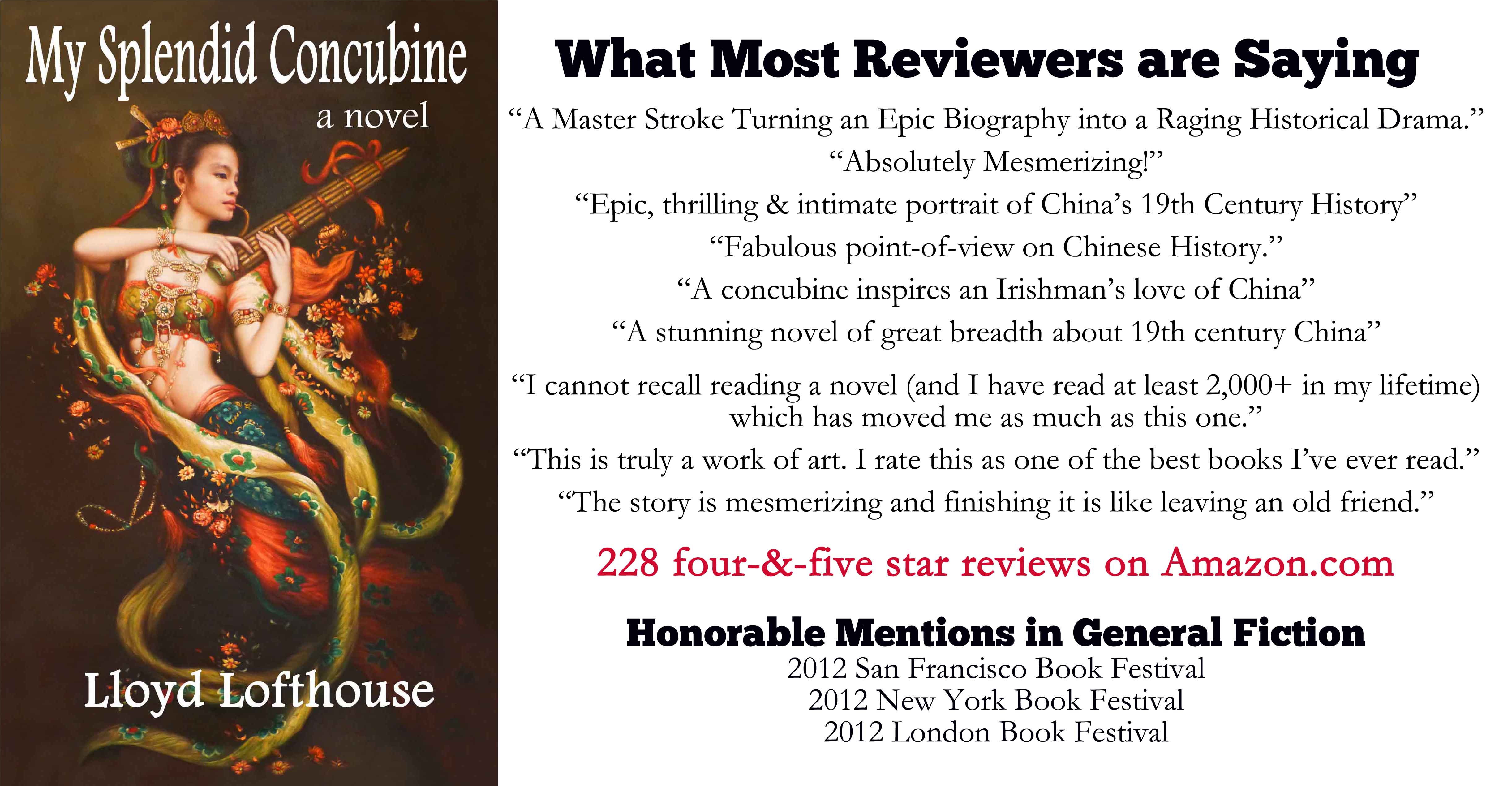
A1 on March 13 - 2016 Cover Image with BLurbs to promote novel

Where to Buy

Subscribe to “iLook China”!
Sign up for an E-mail Subscription at the top of this page, or click on the “Following” tab in the WordPress toolbar at the top of the screen.

About iLook China

China’s Holistic Historical Timeline


China Securing Its Future (2/3)

August 14, 2010

China is a nation where most of the people do not belong to any organized religion. Yet, in the 19th century, two other religious revolts besides the Taiping Rebellion led to another 13 million civilian and military deaths.

Then in 1937 (four years before Pearl Harbor was bombed and the US entered the war), the Japanese invaded China. By the time World War II ended, 20 million more Chinese civilians and troops had been killed and murdered.

About now, you may understand what was going through the minds of Mao and the other leaders of the Communist Party when the Korean (1950 – 1953) and Vietnam (1955 – 1975) Wars broke out soon after the Communists came to power in China.

After all, the US sided with and armed the brutal Nationalist dictator, Chiang Kai-shek—the Communist’s enemy. Today, the US still supports Taiwan and recently sold billions of dollars of advanced weaponry to mainland China’s enemy. Source: Washington Post

See The Roots of Madness or return to China Securing Its Future – Part 1

_______________

Lloyd Lofthouse is the award-winning author of the concubine saga, My Splendid Concubine & Our Hart. When you love a Chinese woman, you marry her family and culture too. 

Sign up for an RSS Feed for iLook China


The Long March Part 2 (1/4)

July 28, 2010

In June 1935, eight months and over three-thousand miles into the Long March, Mao’s Red Army moved into Western Sichuan Province.  For a time, Mao’s troops were safe from Chiang Kai-shek’s Nationalists. 

Meanwhile, the Japanese launched an attack on another northern Chinese province.  The Japanese now occupied most of Northern China and the Chinese there knew little about the struggle between Mao and Chiang Kai-shek. Feeling abandoned, they were alienated from the Nationalist government.

However, the Red Army had to cross the Snowy Mountains with peaks as high as 15,000 feet.  Because these mountains were so rugged and dangerous, the Nationalist Army stopped the pursuit and waited for the mountains to kill Mao.

Some historians believed crossing these mountains was a blunder, but Mao had no choice. Only defeat waited behind him. There was no turning back. 

The thin air and the steep, snow-covered mountains exhausted the troops. A shortage of food, lack of firewood, snow blindness all contributed to the challenge. While crossing the mountains and linking up with the Fourth Red Army, thousands were lost. Once joined, the combined armies number 100,000 troops.

The next challenge was the deadliest obstacle of all—a high-desert grassland. There was no choice. All the easy routes were controlled by Chiang Kai-shek’s troops. Then heavy rains came, which turned the grassland into a swamp.

Return to The Long March – Part 1/6 or go on to The Long March – Part 2/2

______________________

Lloyd Lofthouse is the award-winning author of the concubine saga, My Splendid Concubine & Our Hart. When you love a Chinese woman, you marry her family and culture too. 

Sign up for an RSS Feed for iLook China


The Rape of Nanking with Iris Chang

July 22, 2010

One of the greatest atrocities in history was the rape of Nanking.  All humans are capable of great evil and this is an example. Thousand were murdered and tossed into the Yangtze River. There were so many bodies, the water turned red. Others were buried alive after digging their own graves.

For her book, Iris Chang went to China and interviewed the few hundred survivors still living to document the horrible crimes the Japanese committed.  She talked to one man who, as a child, watched his mother and little brothers being murdered.

Another witness tells Chang how she found her dead grandparents, mother and little sisters naked and raped.

There is a scene showing Chang transcribing taped interviews and it is mentioned that she had nightmares from this project. Chang said, someone had to listen, to record and validate the experience of the survivors and make it public.

The Rape of Nanking Movie Trailer

The Rape of Nanking was published November 1997 and became a bestseller while Japan tried to discredit the book. Iris Chang committed suicide on November 10, 2004. She was 36 and left behind a husband and two-year-old child.

See The Rape of Nanking

_________________________

Lloyd Lofthouse is the award-winning author of the concubine saga, My Splendid Concubine & Our Hart. When you love a Chinese woman, you marry her family and culture too. 

Sign up for an RSS Feed for iLook China


The Rape of Nanking

July 22, 2010

Warning, the video linked to this post may be disturbing. 

Although China and Nanking suffered from internal war and strife, China never invaded another nation in its four-thousand year history. China had always been self-sufficient and never needed anything from other countries. To wage war on its neighbors was not part of the Chinese character. 

Nanking was the capital of China from the third to the 6th century. In the 14th century, the first Ming Emperor made Nanking the capital again. To protect the capital, the largest city wall in the world was built. It was fifty -feet high, forty-feet wide and more than twenty-five miles long.

On July 1937, Japan attacked China. Chiang Kai-shek made himself the commander of China’s army and navy.  The battle for Shanghai came first. Tens of thousands of innocent Chinese were killed while 300 thousand Chinese troops died. After losing Shanghai, the Chinese army retreated to Nanking.

The Japanese soldiers were ordered to burn all, steal all, and kill all as they advanced through the countryside toward Nanking. It is estimated that 300 thousand innocent Chinese were murdered. 

For over one-hundred days, Japanese bombers bombed Nanking, while Chinese troops fought fiercely defending the city. Eventually, Chang Kai-shek fled with most of his generals and government officials, but ordered one general to stay behind with the army and fight.

As Nanking fell to the Japanese, mostly women, children and the elderly were killed by the tens of thousands. 

Part 2 continues the Rape of Nanking and it is so shocking and disturbing, you must go to YouTube and sign in showing that you are at least 18. If you do not wish to watch Part 2, the next post will continue to report about the Rape of Nanking, and it will not be as disturbing.

Go to Part 2, The Rape of Nanking

Also see The Roots of Madness

______________

Lloyd Lofthouse is the award-winning author of the concubine saga, My Splendid Concubine & Our Hart. When you love a Chinese woman, you marry her family and culture too.

If you want to subscribe to iLook China, there is a “Subscribe” button at the top of the screen in the menu bar.