Mao born in 1893 grew up during a period of madness in China’s history. To learn more, I suggest reading The Roots of Madness.
The Chinese Civil War lasted from 1926 to 1949 with a few years out to fight the horrors of the Japanese invasion of China during World War II.
The horrors of Mao’s Long March by itself was enough to cause PTSD in all 6,000 of its survivors from the more than 80,000 troops that started the year-long journey of retreat, battle, and severe suffering that was threatened by death on a daily basis.
After Mao was China’s leader, there was an assassination attempt by one of his most trusted generals, Lin Biao, a man Mao had named as his successor after he died. In addition, during China’s Civil War, Chiang Kai-shek ordered more than one failed assassination attempt on Mao.
However, the threats and violence that shaped Mao’s life began before The Long March and before he was a leader in the Chinese Communist Party.
As a child, he grew up among farmers and peasants with an average expected life span in China of 35 years. In the 1920s, as an idealist and a sensitive poet, he believed in helping the worker and led several labor movements that were brutally subdued by the Nationalist government led by Chiang Kai-shek.
Once, Mao barely escaped with his life.
In 1930, Yang Kaihu, his wife at the time — Mao was married four times — was arrested and executed. In addition, Mao had two younger brothers and an adopted sister executed by Chiang Kai-shek’s troops.
If you had several close calls with death; lost a wife, two younger brothers and an adopted sister in this way, how would that affect you?
To judge Mao by today’s Politically Correct Western values is wrong, because he grew up in a world ruled by a completely different set of values that shaped him to be tough enough to survive.
Anyone that survived and went on to rule China at that time would have been judged as brutal by today’s Politically Correct Western values. In fact, Chiang Kai-shek was a brutal dictator who ruled Taiwan — after he fled mainland China in 1949 — under military marshal law until his death in 1976. But Chiang didn’t have as many people to rule over so the death count he caused was smaller but no less significant.
The History of Humanitarianism shows us that this concept was born and nurtured in the West and developed slowly over centuries with the result that the individual was made more important than the whole.
However, in China, the whole is still more important than one person as it was during Mao’s time. If you were to click on the link to the History of Humanitarianism and read it, you would discover that China was not part of this movement while Mao lived. (Discover more about China’s Collective Culture)
PTSD as a war wound and a trauma was not recognized or treated until well after America’s Vietnam War. Prior to its discovery, it was known as shell shock. The diagnosis of PTSD first appeared in the 1980s, and Mao died in 1976.
In fact, if Mao were alive today he would not be alone. In the United States, it is estimated that 7.8% of all Americans suffer from PTSD, and among that segment of the population, more than 300,000 Iraq and Afghanistan military veterans have PTSD in addition to 1.7 million Vietnam veterans.
Return to or start with Part 1
中
Lloyd Lofthouse, a former U.S. Marine and Vietnam combat vet, is the award-winning author of My Splendid Concubine [3rd edition]. When you love a Chinese woman, you marry her family and culture too. This is the unique love story Sir Robert Hart did not want the world to discover.

Subscribe to “iLook China”!
Sign up for an E-mail Subscription at the top of this page, or click on the “Following” tab in the WordPress toolbar at the top of the screen.


 Posted by Lloyd Lofthouse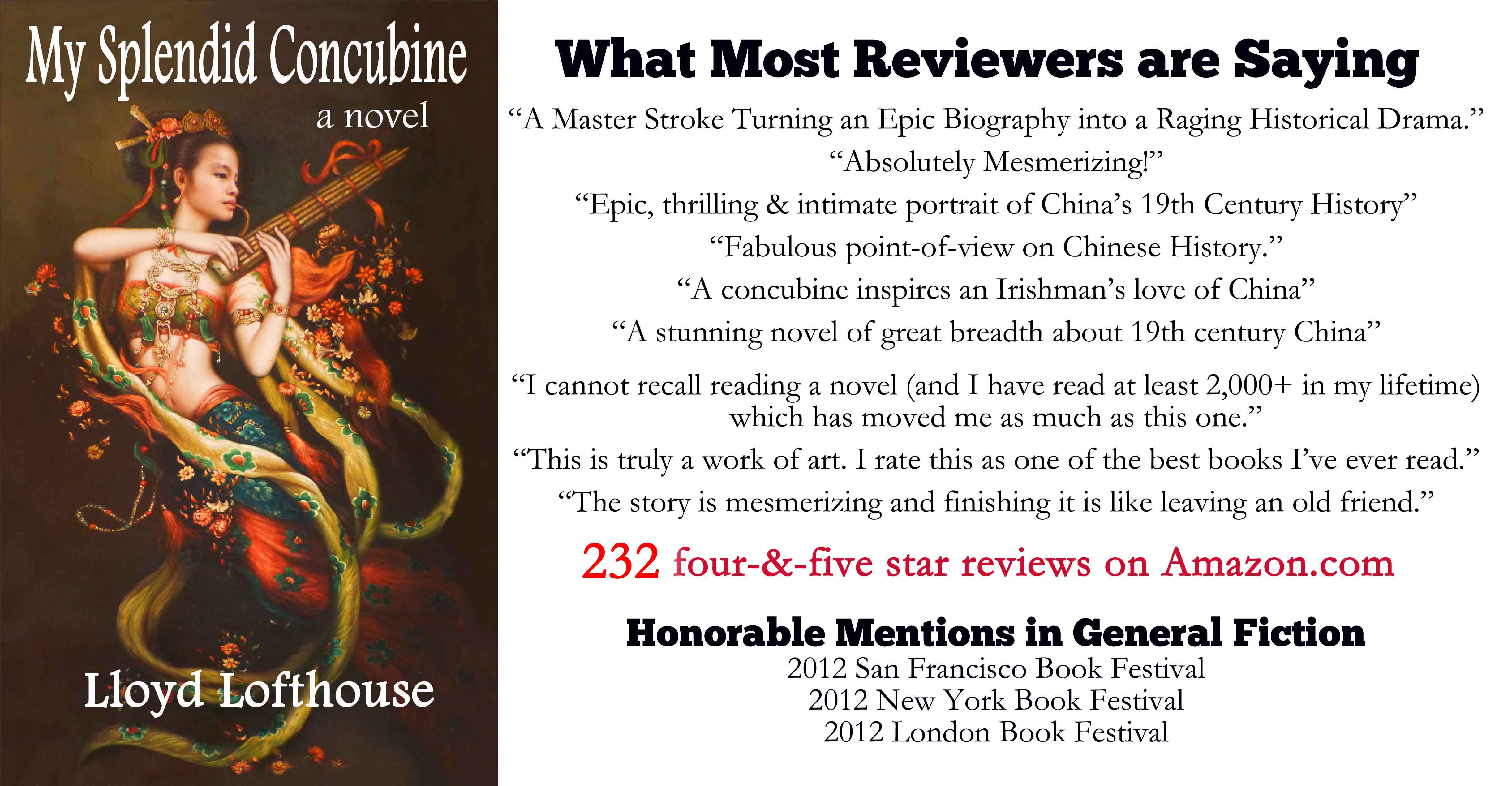
 iLook China