Putnam wrote, “White miners soon arrived and pushed the Chinese out…”
The first major wave of Chinese immigrants came to the US after the California gold rush of 1849.
Then in 1882, The Chinese Exclusion Act formalized an ugly American prejudice. In fact, there are still Americans who feel this way evidenced by a few comments left on this Blog. However, we are fortunate that more Americans appear open minded and accepting than those who do not feel that way.
This act stayed in effect de facto until 1965, when racist provisions of U.S. immigration law were removed during the Civil Rights era, liberalizing immigration by all non-European groups.
Most of these Chinese immigrants worked hard in industries like railroads, mines and canneries. The Chinese were willing to work for lower wages than European immigrants were demanding.
When there were labor strikes, companies often used Chinese workers as strikebreakers. This led to hate among European immigrants and demands that led to the Chinese Exclusion Act, which banned Chinese laborers from entering the US.
This was the first time the US passed a law to bar a specific race or ethnicity from entering the country. Source: Tenement Museum
Lloyd Lofthouse is the award-winning author of the concubine saga, My Splendid Concubine & Our Hart. When you love a Chinese woman, you marry her family and culture too.
To subscribe to “iLook China”, look for the “Subscribe” button at
the top of the screen in the menu bar, click on it then follow directions.
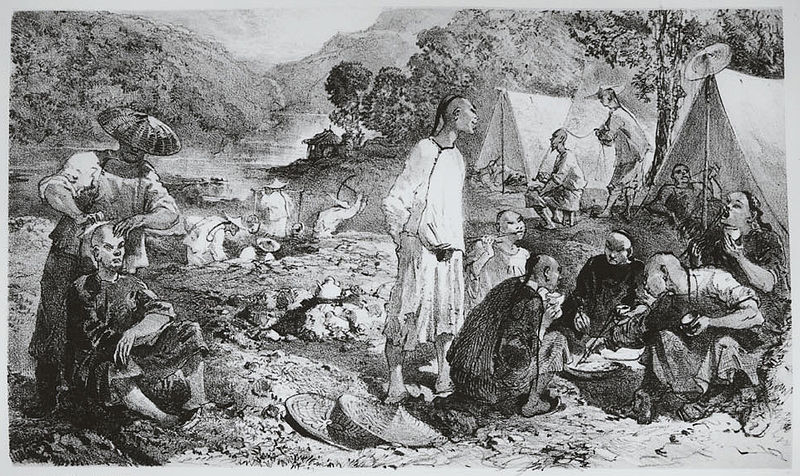
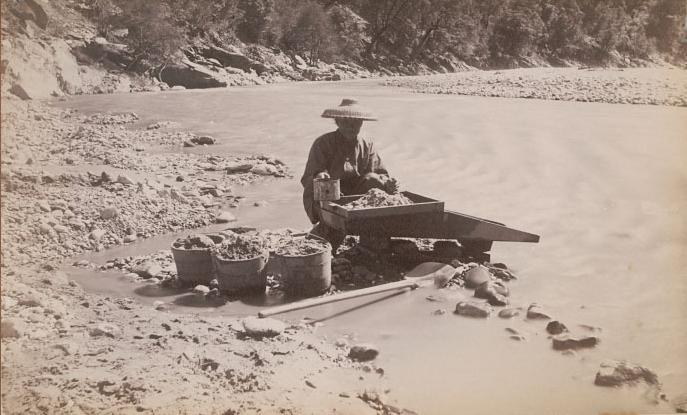
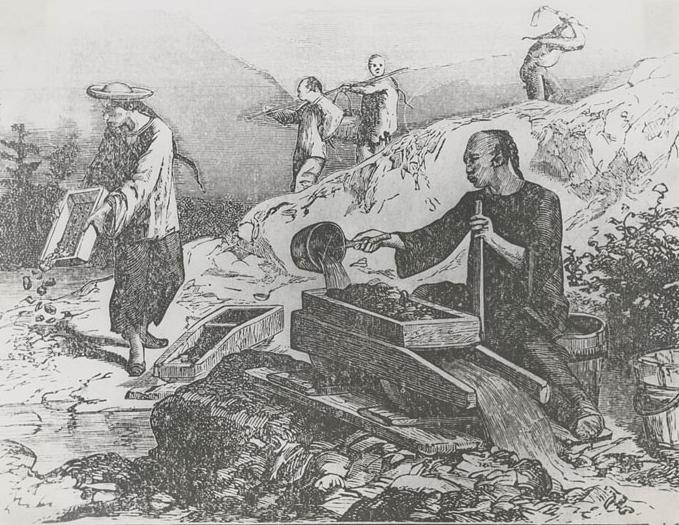
In the mines the Chinese were often forced to work sites that others had abandoned as no longer productive and, by hard work, made these claims pay.
As more men arrived in the gold fields and the amount of surface gold dwindled, tensions increased. Thirty-five Chinese showed up at Camp Salvado in 1849 where men from El Salvador had worked and here they found rich placer deposits.
White miners soon arrived and pushed the Chinese out, but they were taken in at another nearby site called Camp Washington where still more gold was found
Chinese flocked to a place where they were accepted and Tuolumne County’s Chinese Camp survives to this day.
But by 1850, a $20 per month tax on each foreign miner was imposed.
By 1852 Chinese were forced from Mormon Island and Horseshoe Bar along the American River, then from Colombia in the southern mines and Yuba City in the northern.
In 1856 Chinese paid $70,000 for the right to mine in Mokelumne Hill.
By 1868 almost all Chinese had left the mines to work on the transcontinental railroad or in Chinese operated businesses.
Of all the diverse peoples that poured into California after the discovery of gold, none stood out more than the Chinese. Radically different in dress, language and culture these new men were first welcomed because of their willingness to work hard for low wages at any task presented them.
John McDougall, the 2nd Governor of California, described them as “one of the most worthy of our newly adopted citizens.”
At the start of 1849 only 54 Chinese were in California. By1852 there were nearly 12,000 living here and only seven of them women. Because of turmoil in Canton another 20,000 would arrive that same year.
A community of Chinese Americans quickly grew in San Francisco. They marched in Fourth of July parades and rejoiced at California’s statehood, but celebrated their lunar new year in their traditional way.
In 1852 a Cantonese opera was performed at the American Theater and in 1854 a Chinese language newspaper began publishing.
The Kong Chow Association formed to help the new arrivals adapt to their new home. Then another, the Chew Yick, elected Norman As-sing, an English speaking owner of the Macao and Woosung Restaurant as their leader. Soon there were six associations called tongs that combined to form the Six Companies to better represent Chinese interest.
Recently, a friend sent me a link to news that warned of new US government regulations on hydraulic fracturing that could stop shale exploration. If this happened, what the consumer would lose is access to the natural gas produced from shale. Source: Natural Gas for America
Earlier this week, the White House said the natural gas industry should support “common sense” regulation to ease public worry about potential water contamination from fracturing, a drilling practice vital to the U.S. shale gas boom.
In fact, according the Natural Gas.org, the US has about 100 years of supply (if developed) at current rates of consumption, while Reason.com reports that the IEA says world natural gas supplies could last more than 250 years.
While development of natural gas from shale may come to a stop in the US due to environmental concerns, China is looking at the production and resources of shale gas in the United States and is learning from America.
China’s technically recoverable resources of shale gas are estimated to be about 50 percent higher than those in the United States.
EIA.DOE.gov says, “The outlook for unconventional natural gas production is more positive in China than in OECD Europe first and foremost because China’s geology suggests a greater unconventional resource potential than in Europe. Further, although natural gas production from conventional resources in China, as in Europe, cannot keep up with domestic demand, China’s government strongly supports unconventional gas development, and public resistance is likely to be less of an impediment in China than in OECD Europe and the US.”
While developing natural gas resources in China, there is also Biogas development in rural China, which the two embedded videos talk about. China is taking advantage of waste to produce energy, which results in higher standards of living for those involved.
Imagine the biogas from 1.3 billion people and the animals raised to feed those people.
Lloyd Lofthouse is the award-winning author of the concubine saga, My Splendid Concubine & Our Hart. When you love a Chinese woman, you marry her family and culture too.
To subscribe to “iLook China”, look for the “Subscribe” button at the top of the screen in the menu bar, click on it then follow directions.
For centuries, China was the world’s largest economy (from tenth to fifteenth century) and if experts at the International Monetary Fund and others are correct, China will soon regain the title as the world’s largest (healthy) economy.
However, it is confusing. If we listen to The Economist in The X Factor, we are told that India’s economic growth may soon outpace China’s.
The Economist says, MORGAN STANLEY thinks it could happen in 2013; the World Bank thinks it might happen next year. Many pundits have speculated about when India’s growth might outpace China’s.
However, the International Monetary Fund’s (IMF) World Economic Outlook says that has already happened since China grew by 10.3% in 2010 and India by 10.4%.
Then from Yahoo Financewe learn the IMF says, “According to the latest IMF official forecasts, China’s economy will surpass that of America in real terms in 2016.”
After reading the previous paragraphs, it sounds as if India will grow its economy past China and China will outgrow the United States leaving the US in third place.
In fact, India is far from growing a larger economy than China or the US.
In 2010, India’s economy ranked 10th globally or fourth depending how you stack the numbers.
India’s nominal GDP was placed tenth at $1.53 trillion, while another way of looking at the numbers says India ranked fourth at $4.06 trillion, but its public debt was $758 billion or 55.9% of GDP with $201 billion in exports and $327 billion in imports and a credit rating of $1.164 trillion.
This means India, like the US, is spending more than it earns.
China, on the other hand, had a nominal GDP of $5.88 trillion but a GDP (based on PPP) of $10.08 trillion placing it 2nd globally. China’s public debt was 17.5% of GDP, which is a long way from India’s 55.9%. Everything else about China leaves India far behind China’s economy.
India’s exports were more than seven times lower than China’s $1.506 trillion while its imports were almost four times lower than China’s $1.307 trillion and China has a credit rating of $8.156 trillion—much higher than India.
China is likely to resume its role as the world’s largest economy by 2015.
Any way we look at it, how can India beat China unless they are talking about the annual percent of economic growth?
Considering how much smaller India’s economy is, they would have to have a lot more growth to equal China dollar for dollar. If India’s economy grew by 10.4% and its economy was either $1.53 trillion or $4.06 trillion (depending how one looks at it), that is still a far cry from China’s 10.3% economic growth based on a much larger GDP.
On the other hand, America, the world’s largest economy, looks like a cancer patient with six months to live.
America may have the world’s largest GDP at $14.66 trillion but having $14 trillion in public debt at 93% of GDP just about cancels that out. Even India is doing better.
Then America’s exports were $1.280 trillion compared to $1.948 trillion for imports telling us more money is pouring out than coming in. How will America pay off its debt if losses outpace earnings?
The Economist seems to want people to think India is beating China but the numbers tell a different story. To beat China, India has to grow a much larger economy and reduce its public debt while erasing an illiteracy and poverty rate that’s embarrassing for a country touted as the world’s largest democracy.
Anyone that studies history knows that a democracy survives if the citizens are literate and understands the issues.
Lloyd Lofthouse is the award-winning author of the concubine saga, My Splendid Concubine & Our Hart. When you love a Chinese woman, you marry her family and culture too.
To subscribe to “iLook China”, look for the “Subscribe” button at the top of the screen in the menu bar, click on it then follow directions.


 Posted by Lloyd Lofthouse

 iLook China