Tibet Inside China – 4/5

April 12, 2010

From recent news, it appears that rough times may be ahead for the People’s Republic of China (PRC). In China sees US as hedge for Taiwan, Tibet (Asia Times) by Peter Lee, the author says, “After the Dalai Lama is gone, there is a strong possibility that motivated and organized pro-independence activists (militants) will be able to win power in the Tibetan government in exile.”

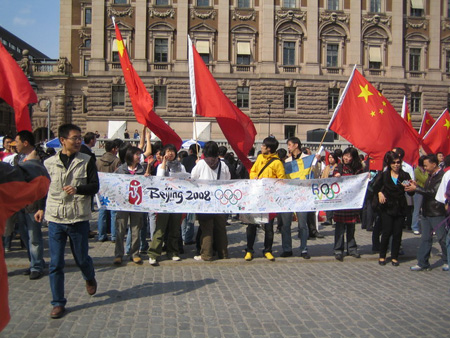
Chinese Protesting Against Tibetan Supporters

Militant Tibetan separatist groups have not been happy with the Dalai Lama’s call for autonomy talks with China instead of calling for a fight to gain independence. Tibetan militant groups want Tibet to break from China even if it means taking a violent path—one the Dalai Lama does not advocate.

What would Tibet be like if the separatists had their way and broke free from China?

Would they return to the system of landowners and serfs (slaves)?

Would the Tibetan Buddhists require that every family send at least one son to become a Buddhist monk as before?

Would mandatory schooling (as we have in the United States) be shut down so the literacy rate would plummet from the high 90% back to a single digit like it was prior to 1950?

Would the wealth and the land be returned to the one percent that had it all before Mao’s troops occupied Tibet?

Learn about the Media Slugfest Using Taiwan or go to Tibet Inside China – Part 5

View as Single Page

_______________

Lloyd Lofthouse is the award-winning author of My Splendid Concubine [3rd edition]. When you love a Chinese woman, you marry her family and culture too. This is the love story Sir Robert Hart did not want the world to discover.

Subscribe to “iLook China”!
Sign up for an E-mail Subscription at the top of this page, or click on the “Following” tab in the WordPress toolbar at the top of the screen.

About iLook China


Tibet Inside China – Part 3/5

April 12, 2010

The most damaging evidence against Rinpoche’s claims come from the October 1912 issue of The National Geographic Magazine (I have a copy—it cost me $20 on e-bay). Since the earliest evidence of Communists in China was about 1920, and it wasn’t until 1949 that the Communists came to power under Mao, there is no way the Chinese doctor who wrote that 1912 piece could have lied for the Communists.

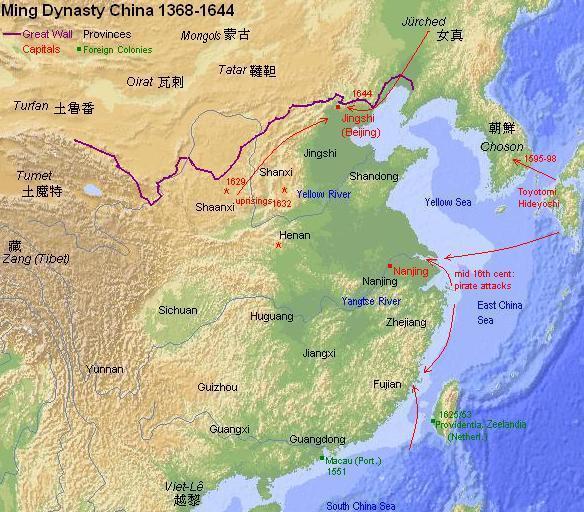
Ming Dynasty 1368-1643

On page 979, Dr. Shaoching H. Chuan wrote, “Tibet is governed by the Dalai Lama as politco-religous head and two “Ambans” as the political dictators. The Ambans are appointed by the Chinese Emperor every four years. All governmental affairs have to undergo examination by the two Ambans, and all government policy must be sanctioned by them before it can be put into operation. Literally, the Dalai Lama is under the authority of the two Ambans…” (Page 979)

Go to Tibet Inside China – Part 4

View as Single Page

_______________

Lloyd Lofthouse is the award-winning author of My Splendid Concubine [3rd edition]. When you love a Chinese woman, you marry her family and culture too. This is the love story Sir Robert Hart did not want the world to discover.

Subscribe to “iLook China”!
Sign up for an E-mail Subscription at the top of this page, or click on the “Following” tab in the WordPress toolbar at the top of the screen.

About iLook China


Tibet Inside China – 1/5

April 11, 2010

In 2008, I wrote a post about Tibet on another forum. Someone with a Tibetan sounding name left a comment in crude English calling me a “Communist rabbit”.

Name-calling seems to be popular these days. In America, people like Glenn Beck (FOX network), Rush Limbaugh (600 radio stations) and the Tea Baggers have developed name-calling into an art form—not much substance but colorful and angry.

The Tibetan government in exile’s Prime Minister Samdhong Rinpoche was quoted in “Good” magazine’s May/June 2008 Issue that six-million Tibetan Buddhists still lived in Tibet. He also said that Tibet has never historically been part of China. That isn’t true. Tibet was ruled by three of China’s Imperial Dynasties.

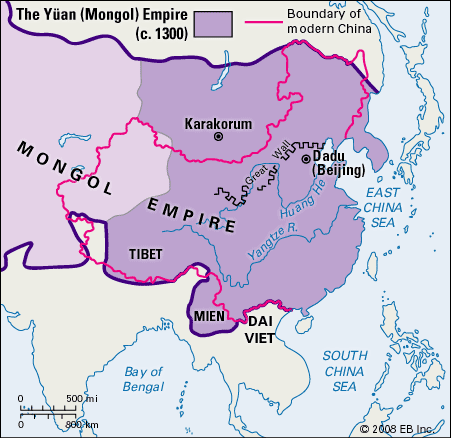
Yuan (Mongol) Dynasty 1277 – 1367

Tibet was first ruled by China during the Yuan Dynasty (1277-1367). Then, when the Ming Dynasty (1368-1643) reclaimed China, a Ming Imperial army was sent to Tibet to drive out the last of the Mongols–holdovers from the Yuan Dynasty. The Ming emperor ordered his army to stay.

When the Ch’ing (Manchu) Dynasty (1644-1911) came to power, the Chinese empire expanded further and Tibet remained in China. Later, I’ll provide evidence from a 1912 National Geographic magazine as proof.

Discover Wearing China’s Shoes or go to Tibet Inside China – Part 2

View as Single Page

_______________

Lloyd Lofthouse is the award-winning author of My Splendid Concubine [3rd edition]. When you love a Chinese woman, you marry her family and culture too. This is the love story Sir Robert Hart did not want the world to discover.

Subscribe to “iLook China”!
Sign up for an E-mail Subscription at the top of this page, or click on the “Following” tab in the WordPress toolbar at the top of the screen.

About iLook China


Every Kind of Beauty Under Heaven

March 7, 2010

When emperors ruled China, those men often wanted to be seen as benevolent—embracing every kind of beauty under heaven. To do this, the emperors encouraged minorities to stay where they had lived for centuries if not millennia. Even in Tibet, China has not driven out or slaughtered in mass (http://wp.me/pN4pY-6S) the minorities as Europeans did to North American natives, who lived off that land for more than ten thousand years.


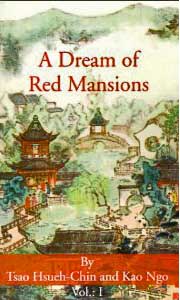
History shows that the Chinese emperors did not force minorities from their land with false promises followed by broken treaties. In China, if a minority king proposed a marriage alliance with the Emperor, the Emperor adopted a Chinese beauty as his daughter and sent her to the minority king. This is portrayed in The Dream of Red Mansions, a Chinese classic written in the 18th century.


China: Portrait of a People–a book review

March 2, 2010

Most tourists travel by jet or bus and spend nights in four or five star hotels sleeping on plush beds. They eat at only the best restaurants. Only a few visit countries like Sir Richard Francis Burton, the famous nineteenth century explorer and adventurer. Tom Carter is one of those few. Imagine backpacking for two years and walking 35,000 miles to capture the heart and soul of a nation. That’s what Tom Carter did to create China: Portrait of a People.

The consensus among ‘backpackers’ is that China is probably the single most challenging country in the world to visit on foot. That by itself should tell you a lot.

There are more than 1.3 billion people in China. Besides the majority Han Chinese, the population includes fifty-six ethnic groups numbering over one hundred million. Carter saw it all from the teenage girl living in Chengdu dressed like an American punk rocker to the soot covered coal miner in Southern Shanxi. Carter’s camera lens captured the complexity and diversity of China.

Tom Carter is a guerrilla hit and run photojournalist with a camera instead of a grenade launcher.  To take the up close and personal pictures in ‘Portrait of  a People’, Carter risked jail; almost froze on the way to Tibet; faced exhaustion and hunger; was beaten by drunks; plagued by viral infections, and risked being shot by North Korean border guards.  The hundreds of photos in ‘Portrait’ are priceless. I doubt if there will ever be another book about China like this one. From Inner Mongolian nomads to newlyweds in Hong Kong, Carter saw it all.

There is an old saying that a picture is equal to a thousand words. Great pictures tell stories.

In ‘China: Portrait of a People’, each picture is worth ten thousand words or maybe more. Carter’s photojournalist study of China stands alone in its genre as it focuses expressly on the Chinese people. Carter  backpacked to remote areas to visit China’s minorities like the thousand year old Phoenix Village perched over the Tuo Jiang River or the seventy-five year old Pai Yao minority farmer in his red turban.

To reach some locations, Carter had to travel on foot into some seriously rugged terrain. To get an idea what I’m talking about, consider that China, almost the size of the United States, has only sixteen percent of its land for growing crops. The rest is either mountains or deserts.

Between the covers of ‘Portrait’, you will see what happens when a modern day Sir Richard Francis Burton spends two years backpacking through China’s thirty-three provinces and autonomous regions, not once but twice. During this odyssey, Carter discovered that the Chinese are a friendly, open hearted people.

If you plan to visit China, buy this book before you go. On the other hand, if you are an armchair tourist that never strays far from home, Carter’s Rembrandt ‘Portrait’ of China will not disappoint. You will chuckle when you see the young, twin boys walking out of the river after a swim or watch the eight year old acrobat student at Wuqiao bending herself like a folded sheet of paper.

Between the covers of ‘Portrait’, you will start a vicarious journey visiting China like few have done even among the Chinese. You will travel on this 35,000 mile journey without leaving your house, bus or jet seat.

There is no way that this review can do justice for ’China: Portrait of a People’. To try would require millions of words. Seeing is believing. What are you waiting for? Take that first step.

Discover Tom Carter’s Guest Post at 24 Hours in Qiannianyaozhai

______________

Lloyd Lofthouse is the award-winning author of the concubine saga, My Splendid Concubine & Our Hart. When you love a Chinese woman, you marry her family and culture too. 

If you want to subscribe to iLook China, there is a “Subscribe” button at the top of the screen in the menu bar.