China’s Capitalist Revolution (Part 1 of 9)

June 30, 2010

When Chairman Mao died in 1976, he left China in chaos due to the Cultural Revolution. Under Mao, who led the revolution and built the People’s Republic, millions had starved and died (due to poor decisions, droughts, floods, crop losses and a complete embargo by the United States). Deng Xiaoping, who overturned Maoism and taught the Chinese to love capitalism, succeeded him but not without a struggle.

Today, China has transformed the lives of many of its citizens and is challenging the world.  This BBC series is the story of how Communist China learned to love capitalism.  It is also the story of Deng Xiaoping—a survivor often punished by Mao, who refused to quit.

Unfortunately, for all the success Deng had in transforming China into a modern nation, his reputation was stained by what happened during the Tiananmen Square incident. During the demonstrations, Deng, who had been a military man most of his life, was faced with a choice between his modernizing instincts and his commitment to national stability to the party he had served for seventy years since 16.

By bringing wealth and stability to China, Deng defied those who said capitalism could not succeed without Western style politics.  He often said, “Our system has its advantages. We can make decisions quickly.”

If you enjoyed this, see The Roots of Madness or go to Part 2 of China’s Capitalist Revolution.

_________________________

 Lloyd Lofthouse is the award-winning author of The Concubine Saga. When you love a Chinese woman, you marry her family and culture too. This is the love story Sir Robert Hart did not want the world to discover.

To subscribe to “iLook China”, look for the “Subscribe” button at the top of the screen in the menu bar, click on it then follow directions.


Propaganda Masquerading as a Movie Review

June 7, 2010

I found another example of media propaganda in a movie review. In June 1989, the Tiananmen Square incident took place in China and “hundreds” of demonstrators died in what started as peaceful demonstrations “demanding” changes in China.

A few months later, a New York Times review made comparisons between the first emperor and China’s modern government. “The depiction of Qin’s bonfire and of his soldiers pushing his flailing enemies (they weren’t the emperor’s enemies) into a ditch caused the American Museum of Natural History to cancel its planned opening of ”The First Emperor of China” last July, when the news was still full of the Chinese Government’s violent suppression of student protests.… This re-enactment of the faraway Qin’s often despotic and often enlightened rule becomes more believable and complex in view of the parallels with recent events.”

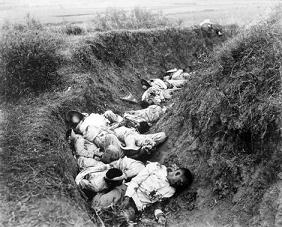
The New York Times made a comparison with an event that took place more than two millennia ago but made no mention of the 2/28 Massacre in Taiwan by a US ally where almost thirty thousand noncombatants were killed by Kuomintang troops. There was also no mention of the almost 70,000 U.S. troops in the Philippians, who slaughtered hundreds of thousands of Filipino freedom fighters and non-combatants between 1898 and World War II.

Filipinos killed by US troops before World War II

The New York Times does not review every movie or documentary produced so it is questionable why they would review this lackluster 38-minute documentary about China’s first emperor. Was there another motive behind this review—to remind Americans of the Tiananmen Square incident? After all, let’s not forget anything bad that Communist China does while forgetting worse historical sins committed by American troops and its allies.

See What is the Truth about Tiananmen Square?

_____________________

Lloyd Lofthouse is the author of the award winning novels My Splendid Concubine and Our Hart. He also Blogs at The Soulful Veteran and Crazy Normal.

Sign up for an RSS Feed for iLook China