Recently, I received a comment on my Romeo and Juliet in China post. Y Chan wrote that there were two Chinese tragic love stories similar to Romeo and Juliet.
Chan said, “You probably cannot be regarded as knowing Chinese culture if you do not know these two love stories.”
One of the stories Chan mentioned was The Butterfly Lovers. The other was “the story of Lady White Snake“, which first appeared in 618 AD during the Tang Dynasty.
I’ve heard of The Butterfly Lovers before. The basic premise is of a young woman in China wanting to go to school. Since boys were the only ones allowed to attend school, this young woman, like Barbara Streisand in the movie Yentl (1983), disguised herself as a boy.
Yentl was based on Isaac Bashevis Singer’s (1902 – 1991) short story Yentl the Yeshiva Boy.
When I mentioned what Chan wrote in the comment, my wife found her copy of a popular theme song of The Butterfly Lovers played as a violin solo by Yu Lina. As the house filled with the music, which may also be found on the following embedded YouTube video, my wife started to dance.
She said, “This is one of my favorites. I cannot resist dancing when I hear it.”
In fact, Yentl the Yeshiva Boy and Shakespeare’s (1564 – 1616) Romeo and Juliet must be combined to become The Butterfly Lovers. In The Butterfly Lovers what begins as a charade becomes a love story ending in the suicide of two young lovers.
The legend of The Butterfly Lovers first appeared during the Jin Dynasty 1600 years ago. The love story of Liang Shanbo and Zhu Yingtai is one of four Chinese folk legends and one of the most influential and best known in China.
China has traded with the West since the Han Dynasty (206 BC – 219 AD). There was an overland route in the north and a sea route in the south, which the Roman Empire used around the time of Christ.
Since China has traded with the West for more than two thousand years, it is conceivable The Butterfly Lovers reached the West and was adapted by Shakespeare and Singer after being exposed to the plot.
______________
Lloyd Lofthouse is the award-winning author of the concubine saga, My Splendid Concubine & Our Hart. When you love a Chinese woman, you marry her family and culture too.
If you want to subscribe to iLook China, there is a “Subscribe” button at the top of the screen in the menu bar.
There’s much about China that I did not know when we started this journey on January 28, 2010.
We visited China’s early dynasties (the Xia, Shang and Zhou) before Qin Shi Huangdi became the first emperor and unified China.
Then we visited the Han, Tang, Sung, Ming and Qing Dynasties while learning of the chaos and anarchy between the dynasties.
We met Confucius and Wu Zetian, China’s only woman emperor during the Tang Dynasty.
We discovered China’s music, art and opera while meeting one of China’s national treasures, Mao Wei-Tao.
Learning about the 19th century Opium Wars started by the British and French opened my eyes to evils I had not known of.
What shocked me most was how the West forced China to allow Christian missionaries into China along with opium.
One reader challenged me in a comment saying that couldn’t be true then didn’t respond when I provided links to the evidence that missionaries and opium were included in the same treaty, which forced the emperor to accept against his will.
Then I sat spellbound as I joined Mao and the Communists on the Long March where more than 80,000 started out and about 6,000 survived — the only choice was to fight or die.
Along the way, I learned that Sun Yat-sen was the father of China’s republic and how Chiang Kai-shek started the Civil War in 1925 when he ordered his army to slaughter the Chinese Communists.
I didn’t know that the Communist and Nationalist Parties were the two political parties of China’s first republic and how it was the US supported Nationalists that fired the first shot that shattered Sun Yat-sen’s dream for China.
After the Communists won the Civil War in 1949, I saw the suffering and death from Mao’s mistakes during the Great Leap Forward and the Cultural Revolution that ended in 1976.
And there was my continued attempt to explain China’s Collective Culture. One comment basically said, “Yea, sure!” as if there were no such thing as cultural differences such as this.
We also were introduced to other Blogs about China such as the China Law Blog.
Of course, with more than a thousand posts in a year, what I have mentioned here is but a small part of the 2010 journey of China.
______________
Lloyd Lofthouse is the award-winning author of the concubine saga, My Splendid Concubine & Our Hart. When you love a Chinese woman, you marry her family and culture too.
If you want to subscribe to iLook China, there is a “Subscribe” button at the top of the screen in the menu bar.
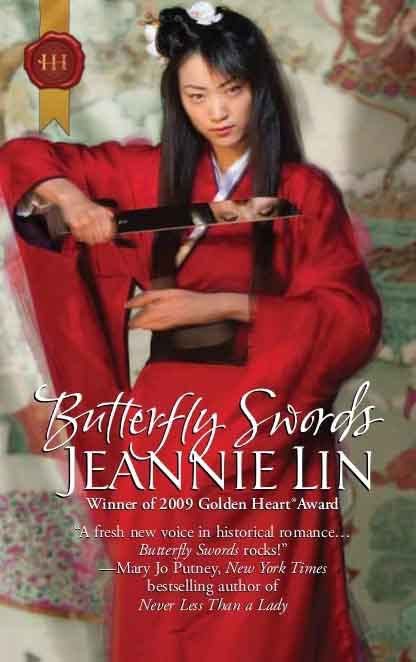
Enter Jeannie Lin, Harlequin’s rising red-star of romance writing. She isn’t the first author on Harlequin’s roster to set her books in China (that honor goes to Jade Lee and her infinite “Tigress” series).
However, Lin’s debut novel, Butterfly Swords, has been attracting a viral buzz louder than a summertime cicada not just for being the first Harlequin novel to NOT feature a man on the cover, but for using an Asian model as the cover girl, another Harlequin first.
The star of Butterfly Swords is a Chinese woman, yes. But to give American readers something that they can relate to, the male love interest of Lin’s novel is not Chinese but a wandering whiteboy from the west.
Ryam is drifting around the Tang (618-906 AD) empire begging for food (this sounds exactly like my own travels across China!) when he spots a disguised female being attacked by a pack of marauding bandits.
The swordsman, who evokes images of bare-chested, fur underwear-wearing Thundarr the Barbarian from the eponymous 80’s cartoon, rescues her, then agrees to escort her home.
Little does Ryam know that young Ai Li is really a princess on the run from an arranged marriage to a dastardly warlord. The two proceed on their journey together across the 7th-century frontier, getting in adventures and slowly but surely falling in love.
Pitting strength, courage and her fabulous butterfly swords against the forces of evil, Ai Li proves herself in the battlefield (“With Ai Li’s swords and determined spirit it was easy to forget that she was innocent”).
However, where the book has significant cultural crossover appeal is in author Jeannie Lin’s ability to keenly capture the multi-dimensional perspectives of both characters throughout their budding interracial relationship.
From Ryam’s course communicative abilities (“Where did you learn how to speak Chinese” Ai Li asks him, laughing. “You sound like you were taught in a brothel”) to his struggles with his inner-white demons as a big, bad bai gui (“It was so much easier to seduce a woman than talk to her”), the reader is introduced not to some empty-headed he-man but a complex male of the species who is genuinely torn between his biological needs and respecting Ai Li’s virtue.
“I don’t understand what she’s talking about half the time,” Ryam grumbles to himself. “Everything is about honor and duty.” Surely even expats living in present-day P.R.C. can relate to this dilemma.
Ai Li, meanwhile, finds herself attracted not only to Ryam’s “musky scent” and “sleek muscles” (Harlequin prerequisites; don’t blame the authoress), but his sincerity (“There was nothing barbaric about him. His manner was direct and honest. It was her own countrymen she needed to be worried about.”).
The protagonist does find herself frustrated with “this swordsman with blue eyes and the storm of emotions that came with him,” but, true to life, Ai Li comes with her own personality flaws as well (“she was being irrational and she knew it”).
Of course, it wouldn’t be a Harlequin without passionate love scenes, something my fiancée missed in the heavily censored Chinese versions.
This Jeannie Lin does in the poetic prose of a Tang Dynasty-era pillow book yet with just enough creatively-provocative language to keep sex-numbed westerners interested (“Ryam slipped his fingers into her silken, heated flesh…her body went liquid and damp in welcome.”). And thankfully without ever once resorting to the word “loin.”
Ryam proves himself to be an ideal lover for nubile Ai Li, “rough enough to make her breath catch, gentle enough to have her opening her knees,” though one can’t help but wonder how these two nomadic warriors can go so long without bathing nor brushing their teeth yet still manage to say things like “her mouth tasted just as sweet as he remembered.”
If only real life were as hygienic as a Harlequin novel.
One of the reasons why Harlequin is able to sell over 100 million units per year (the most profitable publishing company in the industry) is because every book is part of a series.
There are no individual Harlequin titles, which brilliantly leaves the reader yearning for more from the characters they have literally become so intimate with. In this respect, Butterfly Swords concludes with a wide opening that screams sequel, but thankfully lacks the typical Harlequin-happy ending of matrimonial bliss.
One familiar with Chinese culture can’t help but wonder, then, what kind of future Ai Li and Ryam actually have together: in reality, Ai Li would put on weight, cut her hair short and become a shrill nag; her parents and grandparents would all move into their cramped apartment, and a frustrated Ryam, now with beer-belly, would spend more and more time at card games and with karaoke parlor hostesses than at home.
But before the infuriating realties of interracial marriage set in, we hope Jeannie Lin has at least a few more of her trademark sword fights and steamy sensuality in store.
China’s longest lasting dynasties survived due to one or more great emperors.
After China was unified by Qin Shi Huangdi (221 – 207 BC), there were only five dynasties that survived for long periods — the Han, Tang, Sung, Ming, and Qing Dynasties.
Although China’s civilization survived, the country’s history is rampant with rebellions, palace coups, corruption among palace officials, and insurrections. Between the five longest dynasties, the country usually fell apart into warring states as it did after 1911.
The most successful emperors managed to stabilize the country while managing wisely as the Communist Party has done since 1976.
EmperorHan Wudi (ruled 141 – 87 B.C.) of the Han Dynasty (206 B.C. – 219 A.D.) was fifteen when he first sat on the throne.
Wudi is considered one of the greatest emperors in China’s history. He expanded the borders, opened the early Silk Road, developed the economy, and established state monopolies on salt, liquor and rice.
After the Han Dynasty collapsed, China fell apart for almost 400 years before the Tang Dynasty was established (618 -906). The Tang Dynasty was blessed with several powerful emperors.
The first was Emperor Tang Taizong (ruled 627-649).
According to historical records, Wu Zetain, China’s only woman emperor also ruled wisely.
Emperor Tang Zuanzong , Zetain’s grandson, ruled longer than any Tang emperor and the dynasty prospered while he sat on the throne.
After the dynasty fell, there would be short period of about 60 years before the Sung Dynasty reestablished order and unified the country again.
The second emperor of the Sung Dynasty, Sung Taizong (ruled 976 – 997) unified China after defeating the Northern Han Dynasty. The third emperor, Sung Zhenzong (ruled 997-1022) also deserves credit for maintaining stability.
The Sung Dynasty then declined until a revival by Sung Ningzong (ruled 1194 – 1224) After he died, the dynasty limped along until Kublai Khan defeated the last emperor in 1279.
After conquering all of China, Kublai Khan founded the Mongol, Yuan Dynasty (1277-1367). Not long after Kublai died, the dynasty was swept away.
In 1368, a peasant rebellion defeated the Yuan Dynasty and drove the Mongols from China.
The Ming Dynasty (1271 – 1368) is known for rebuilding, strengthening and extending the Great Wall among a list of other accomplishments.
Historical records show that the rule of the third Ming Emperor, Ming Chengzu (ruled 1403 – 1424), was the most prosperous period.
After Chengzu, the dynasty would decline until 1567 when Emperor Ming Muzong reversed the decline.
His son, Emperor Ming Shenzong, also ruled wisely from 1573 to 1620.
After Shenzong’s death, the Ming Dynasty quickly declined and was replaced by the Qing Dynasty in 1644.
The Opium Wars started by England and France and the Taiping Rebellion led by a Christian convert in the 19th century would contribute to the fall of the Qing Dynasty in 1911.
The Qing Dynasty was fortunate to have three powerful, consecutive emperors: Emperor Kangxi (1661 – 1722), Yongzhen (1722-1735) and Qianlong (1735-1796). For one-hundred-and-thirty-five years, China remained strong and prosperous.
After the corrupt Qing Dynasty was swept aside in 1911 by a rebellion led by Dr. Sun Yat-sen, China fell apart and warlords fought to see who would rule China.
When Sun Yat-sen died, the republic he was building in southern China fell apart when Chiang Kai-shek broke the coalition that Sun Yat-sen had formed between the Nationalist and Communist Parties. Mao’s famous Long March shows how the Communists survived.
Then Japan invaded, and China would be engulfed in war and rebellion until 1945 when World War II ended. After World War II, the rebellion between the Nationalist and Communists ended in victory for the Communists in 1949.
This victory was made possible because the Communists were supported by China’s peasants that hated, despised and distrusted the Nationalist Party, which represented China’s ruling elite.
The Communists gained the support of the peasants by treating the peasants with respect and promising reforms that would end the suffering.
Then Mao’s Great Leap Forward and the Cultural Revolution extended the peasants suffering.
However, since the early 1980s, the Communist Party has been working to fulfill the promises made during the revolution, and the lifestyles of China’s peasants are slowly improving.
There are many impatient voices in the West and a few in China that are not happy with the speed of China’s reforms or how the Party has handled them.
In fact, China has modernized and improved lifestyles in China since the early 1980s at a pace that has never been seen before in recorded history.
_______________
Lloyd Lofthouse is the award-winning author of My Splendid Concubine [3rd edition]. When you love a Chinese woman, you marry her family and culture too. This is the love story Sir Robert Hart did not want the world to discover.
His third book is Crazy is Normal, a classroom exposé, a memoir. “Lofthouse presents us with grungy classrooms, kids who don’t want to be in school, and the consequences of growing up in a hardscrabble world. While some parents support his efforts, many sabotage them—and isolated administrators make the work of Lofthouse and his peers even more difficult.” – Bruce Reeves.
Subscribe to “iLook China”!
Sign up for an E-mail Subscription at the top of this page, or click on the “Following” tab in the WordPress toolbar at the top of the screen.
As a woman Emperor, Wu Zetian ruled with an iron fist as if she were a man. However, her decisions show she was intelligent but also passionate and tender at times.
There is a collection of fifty-eight of Wu’s poems. Most of her poetry was written for temple ceremonies and some for travel.
She also wrote many books and collected art. Wu edited the Book of Agriculture, which influenced agricultural development during the Tang Dynasty.
In fact, there is evidence that Wu respected decisive men such as her Prime Minister De Renji. She often talked about Li Shimin, her first husband, with respect.
The historical record shows that she respected men who dared to speak up about issues concerning principles regardless of the risk to his life.
Mandarin with English Subtitles
After her death, her son and heir was removed as emperor due to a plot.
In 710, Wu’s grandson, Li Longji, defeated the enemy that intended to take over the dynasty and returned his father to the throne. Eventually, Longji would become Emperor Tang Xuanzong.
Under Emperor Yuanzong, the Dynasty continued to prosper.
However, when Yuanzong grew old, he neglected his duties and spent too much time with his favorite concubine. The officials became corrupt and this led to the Shi Rebellion, which his son, the next emperor, had to suppress.
Next, the eunuchs began to gain too much power. The next fourteen emperors from 756 to 907 were weak and the Tang Dynasty continued to unravel until it collapsed.
The historical evidence says Wu Zetian should have earned praise for her insights and ambition since she did a better job as Emperor than most of the men that ruled the Tang Dynasty (618 – 907).
Lloyd Lofthouse is the award-winning author of the concubine saga, My Splendid Concubine & Our Hart. When you love a Chinese woman, you marry her family and culture too.
If you want to subscribe to iLook China, there is a “Subscribe” button at the top of the screen in the menu bar.


 Posted by Lloyd Lofthouse

 iLook China