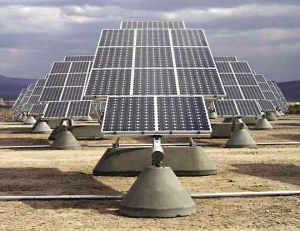
Bloomberg reported on China’s Datang Corp starting construction on a rooftop solar power plant in Jiangsu province as another step in China’s goals to cut carbon emssions. Plans are for this power plant to generate 6.2 gigawatt hours of power reducing the need for coal-powered generating plants.
This plant is not the only one under construction. China is already the world’s leading producer of solar panels, and China is also building a 2,000-megawatt project in the Mongolian desert, which is planned for completion in 2019, and may be the largest solar power facility on the globe. Along with solar power, China plans to install 100 gigawatts of wind power by 2020. Source: World Changing
Lloyd Lofthouse is the award-winning author of My Splendid Concubine [3rd edition]. When you love a Chinese woman, you marry her family and culture too. This is the love story Sir Robert Hart did not want the world to discover.
Subscribe to “iLook China”! Sign up for an E-mail Subscription at the top of this page, or click on the “Following” tab in the WordPress toolbar at the top of the screen.
This post is taken from China’s 360 Series and is about Zhongguancun, China’s Silicon Valley, which is located in Beijing’s Haidian District and was first developed in the late 1990s.
Prior to this post, I’ve read several times in the Western media that China doesn’t have a chance to match California’s Silicon Valley because China lacks freedom. This is simplistic thinking.
The Chinese have every economic freedom that many Americans do except two — total freedom of religion and limited political expression if it is considered a threat to the central government and the stability of China’s economic progress.
It isn’t as if these few limits to freedom are a secret since they are part of China’s Constitution, which is taught in the public schools.
Other than that, since money and freedom are linked, the growing Chinese middle class has as much freedom to live the same consumer lifestyle many Americans do.
In fact, a 2010 survey by the California Voter Foundation found that 51 percent of nonvoters (in the US) grew up in families that did not often discuss political issues and candidates.
This is evidence that total freedom of religion and/or political expression is not necessary for entrepreneurial innovation to improve lifestyles and consumer freedom.
If you still doubt that China can compete with America, I remind you of the recent PISA results where China’s Shanghai teens earned first place in every category tested while the US ranked 23rd of about 65 nations tested.
Time magazine reported, “Chinese classrooms have more students, but teachers make more money than in the United States and there is a huge emphasis on problem-solving skills.”
This 2008 video takes us to a lab in Tsinghua University in Beijing where students are discussing solar technology.
Ye Yuming, an award-winning student at Tsinghua University said, “China lags behind other countries in the solar power industry. The solar PV will help us improve and break the monopoly held by foreign businesses. The solar PV has great market potential, especially in China. The market size is huge.”
What Ye Yuming said was true at the time but two years after he made that statement, China became the world’s largest solar power manufacturer.
Feng Jun, a Chinese entrepreneur, set up one of China’s first private high-tech companies. Today he is president of AIGO. He says, “1992 was the year the real reform of China began.” By 2008, AIGO was one of the top ten camera manufacturers in China. He says that 20% of profits go to profit sharing and the other 80% goes into research and development.
______________
Lloyd Lofthouse is the award-winning author of the concubine saga, My Splendid Concubine & Our Hart. When you love a Chinese woman, you marry her family and culture too.
If you want to subscribe to iLook China, there is a “Subscribe” button at the top of the screen in the menu bar.
China already leads the world in high-speed rail, solar power and wind turbine manufacturing.
Now, Spencer Swartz and Shai Oster report in the Wall Street Journal that “China has passed the U.S. to become the world’s biggest energy consumer, according to new data from the International Energy Agency (IEA), a milestone that reflects both China’s decades-long burst of economic growth and its rapidly expanding influence as an industrial giant.”
China disagrees with the IEA’s announcement but that doesn’t matter.
Even if China were correct, it wouldn’t be long before China did pass the US in energy consumption since the latest five-year plan is extending the electrical grid into rural China to send electricity to 700 million more people.
In fact, as China modernizes and catches up with the US and Europe, more energy will be required to power all those rural homes. Even if the Chinese do not consume as much as those in the US, that is still a lot of electricity.
This begs an answer for the question the Slate asks with How Communist is China? After all, General Motors sold more cars in China than in the US in the first half of 2010. And let’s not mention the Golden Arches, KFC, Pizza Hut and Starbucks.
Since China abandoned Maoism and Marxism, the Middle Kingdom has been rewriting the rules for capitalist growth. The irony is that politically, China is ruled by a single political party with an unpopular name in the West—a name that doesn’t fit any longer.
Maybe China’s government should call itself the People’s Collective Party.
Lloyd Lofthouse is the award-winning author of the concubine saga, My Splendid Concubine & Our Hart. When you love a Chinese woman, you marry her family and culture too.


 Posted by Lloyd Lofthouse
  iLook China