Does Shanghai Really have the World’s Best School System? Part 3 of 3

August 18, 2016

According to World Education News & Reviews, in 2010, senior high schools [in China] accommodated 46.8 million students (23.4% of the  199.5 million students attending K to 9). But 48 percent of that 46.8 million students were in vocational senior high schools — not academic high schools, and only 15 year olds in academic high schools took the PISA test.

That leaves 21.2 million enrolled in the senior high school academic track designed to prep kids for college—that’s 10.6% of the total number of K to 12 students in China. This means that the fifteen-year-old students who take the international PISA in China are the elite of the elite attending China’s best public schools.


Students in China are taught from a very early age how to beat tests.

In addition, what country’s public schools have been used as a role model for China’s public school system?

Solutions Journal.com  reports, “What the Chinese found valuable in American education is the result of a decentralized, autonomous system that does not have standards, uses multiple criteria for judging the value of talents, and celebrates individual differences. Recognizing the negative consequences of ‘test-oriented education,’ China has launched a series of national reforms to cultivate more creative citizens. In 1999 China’s Central Committee sought to reform testing, abolish middle school exams, and encourage local provinces to experiment with their own examination regimens. This was followed by further decrees in 2001, encouraging more diverse curricula, and greater choice for students in subject matter—although any new material used must still ‘equip students with patriotism, collectivism, a love for socialism, and the Chinese cultural traditions, as well as moral-ethic values, democratic spirits with Chinese characteristics.’”

While China is moving closer to what the American public education system was like before 1999, the U.S. with NCLB, RTTT, and the Common Core and its high stakes tests has been moving away from the model China admired, and 13 years later, China’s 15 year old high school students in 10th grade in Shanghai earned 1st place in the 2012 international PISA test.

Return to Part 2 or start with Part 1

Lloyd Lofthouse is the award-winning author of My Splendid Concubine [3rd edition]. When you love a Chinese woman, you marry her family and culture too. This is the unique love story Sir Robert Hart did not want the world to discover.
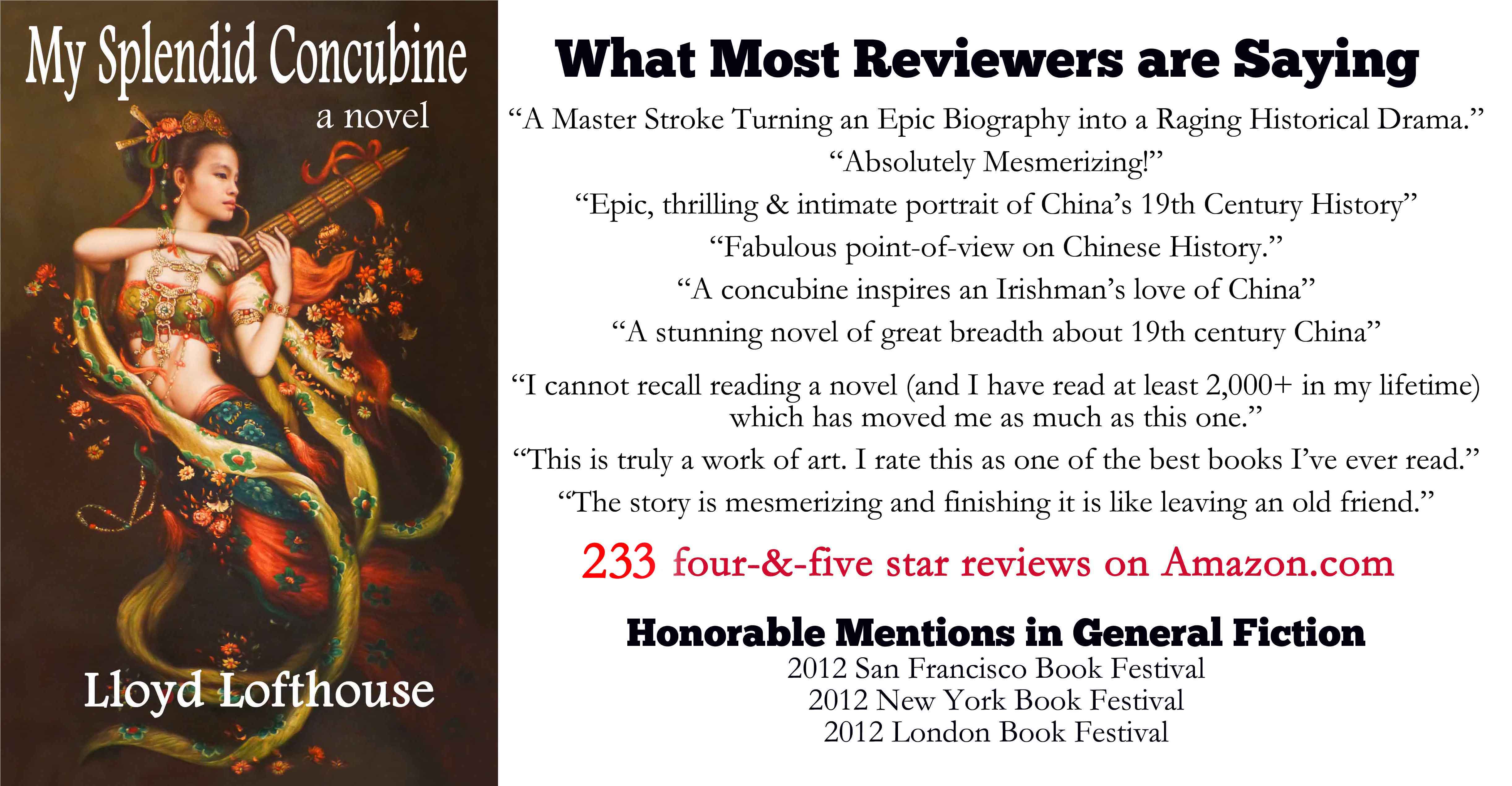
A1 on June 22 - 2016 Cover Image with BLurbs to promote novel

Where to Buy

Subscribe to “iLook China”!
Sign up for an E-mail Subscription at the top of this page, or click on the “Following” tab in the WordPress toolbar at the top of the screen.

About iLook China

China’s Holistic Historical Timeline


Does Shanghai Really have the World’s Best School System? Part 2 of 3

August 17, 2016

How did China’s city of Shanghai beat out everyone else in the world with such a dramatic 1st place average on the 2012 international PISA test?

First, the 15 year olds in Shanghai that took the PISA test had to rank high on another test just to get into high school (grades 10, 11 and 12) so they were already great test takers, the best in their generation and China has almost 200 million students in its public schools.

You see, students that graduate from middle school (grades 7, 8 and 9) in China have to take the senior high school entrance exam known as Zhongkao. Students that fail this high school entrance exam are not allowed to graduate from junior high school, and they do not get into any academic senior high schools.

Second, Asia Society.org reports that Shanghai has the world’s best school system. “China has a long tradition of respect for education. In fact, there is much societal and family pressure to do well academically. This has fostered education reform throughout history at many levels. While the entire country has made strides in education, Shanghai is at the forefront as it has been given special authority to experiment with reform before the rest of the country. … One interesting strategy employed by Shanghai (that the United States is not doing) to improve weak schools is the commissioned education program. Under this scheme, top performing schools are assigned a weak school to administer. The ‘good’ school will send a team of teachers and a principal to lead the school and improve it.”

To explain how this works, the Chinese Communist Party (CCP) has acknowledged a “9-6-3 rule”. This means that nine of ten children began primary school between the ages of 6 and 7; six complete the first five years and three graduate from sixth grade with good performance. The 3 of 10 that graduate from 6th grade are allowed to go on to grades 7, 8 and 9.

For a comparison to the United States, in the U.S. in 2015, 82 percent of 17/18 year olds graduated on time from academic high schools, because education is mandatory to 12th grade instead of 9th grade like it is in China.  Students that continue beyond 9th grade in China want to keep learning. To be clear, it isn’t mandatory past 9th grade.

By the time a student reaches senior high school—grades 10, 11, and 12—most enrollment is in the cities and not in rural China. Many rural Chinese don’t value education as much as urban Chinese do. Many of the migrant urban workers from rural China still have some family back in the village where they often leave their younger children. In fact, many of the migrant workers, when they retire from factory work, return to the village and the family home.

The United States, by comparison, keeps most kids in school until the end of high school at age 17/18, and another 10 percent earn a high school diploma or equivalent GED by age 24. This all takes place in academic schools, because there are no vocational public schools in the U.S.

Continued with Part 3 on August 18, 2016 or start with Part 1

Lloyd Lofthouse is the award-winning author of My Splendid Concubine [3rd edition]. When you love a Chinese woman, you marry her family and culture too. This is the unique love story Sir Robert Hart did not want the world to discover.

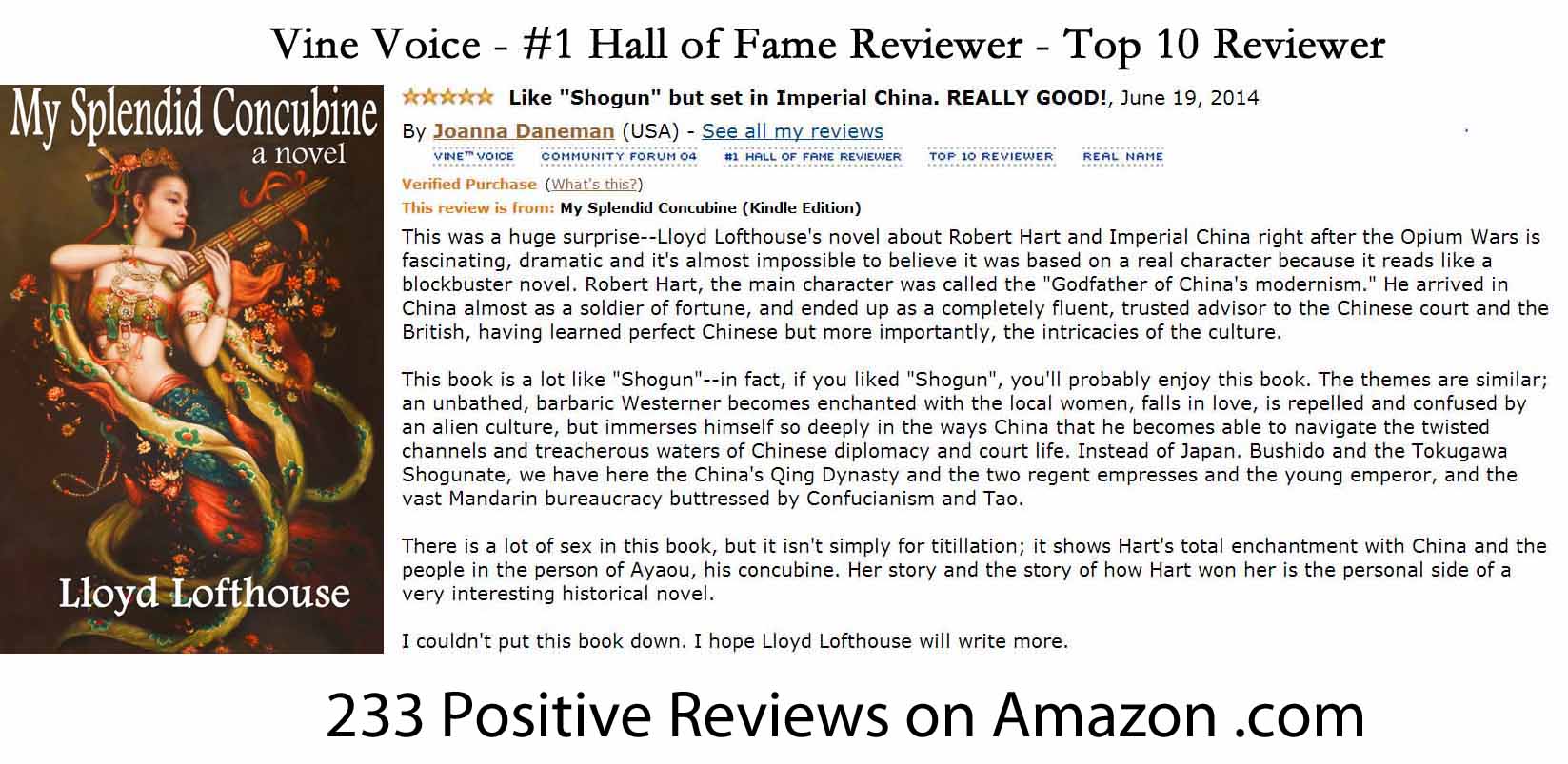
#1 - Joanna Daneman review posted June 19 2014

Where to Buy

Subscribe to “iLook China”!
Sign up for an E-mail Subscription at the top of this page, or click on the “Following” tab in the WordPress toolbar at the top of the screen.

About iLook China

China’s Holistic Historical Timeline


Does Shanghai Really have the World’s Best School System? Part 1 of 3

August 16, 2016

In 2012 Shanghai earned 1st place in the world on the International PISA test. Its score was 613 in math, 570 in reading, and 580 in science. Second place went to Singapore: 573 in math, 542 in reading, and 551 in science. The mean score for all the countries that took part in the PISA was 494 in math, 496 in Reading and 501 in Science.

Around 510 000 students between the ages of 15 years 3 months and 16 years 2 months participated in PISA 2012 as a whole representing about 28 million 15-year-olds globally.

All 34 OECD member countries and 31 partner countries and economies participated in PISA 2012, representing more than 80% of the world economy. The U.S. was ranked #36 compared to the 65 countries/cities listed.

But Shanghai is not a country. It is a city and so was Hong Kong and Macao. Even the Principality of  Liechtenstein, a landlocked microstate that is one of Europe’s most affluent (wealthiest) communities, with a population of almost 37,000, was ranked in the top 10 right behind Japan. At least Shanghai has a population of more than 20 million.

The United States with 314.1 million people in 2012 was ranked much lower when the average scores were compared to all the other countries, but America’s ranking was flawed and misleading because of an error when the test was taken in the U.S.  To discover more, click the following link:  Poor ranking on international test misleading about U.S. student performance, Stanford researched finds.

At this point, you might be thinking, why is he mentioning America’s PISA score when this post is about Shanghai. In Part 3, the ironic answer to that question will be answered.

Continued with Part 2 on August 17, 2016

Lloyd Lofthouse is the award-winning author of My Splendid Concubine [3rd edition]. When you love a Chinese woman, you marry her family and culture too. This is the unique love story Sir Robert Hart did not want the world to discover.

A1 on June 22 - 2016 Cover Image with BLurbs to promote novel

Where to Buy

Subscribe to “iLook China”!
Sign up for an E-mail Subscription at the top of this page, or click on the “Following” tab in the WordPress toolbar at the top of the screen.

About iLook China

China’s Holistic Historical Timeline