The Qing Dynasty’s Banner Armies

February 14, 2011

I have a book on the elite troops of China’s Qing Dynasty, and used The Manchu Way for research (along with lots of other work) while writing My Splendid Concubine and Our Hart. I spent from 1999 to late 2007 researching, writing, revising, editing and rewriting the manuscript.

I wanted 19th century China to come alive and be another character in Hart’s Concubine Saga.

Mark C. Elliott wrote The Manchu Way. I was attending a NCIBA Trade Show in Oakland, California several years ago and met Elliott.  When I expressed interest in the book due to my project, he gave me a copy.
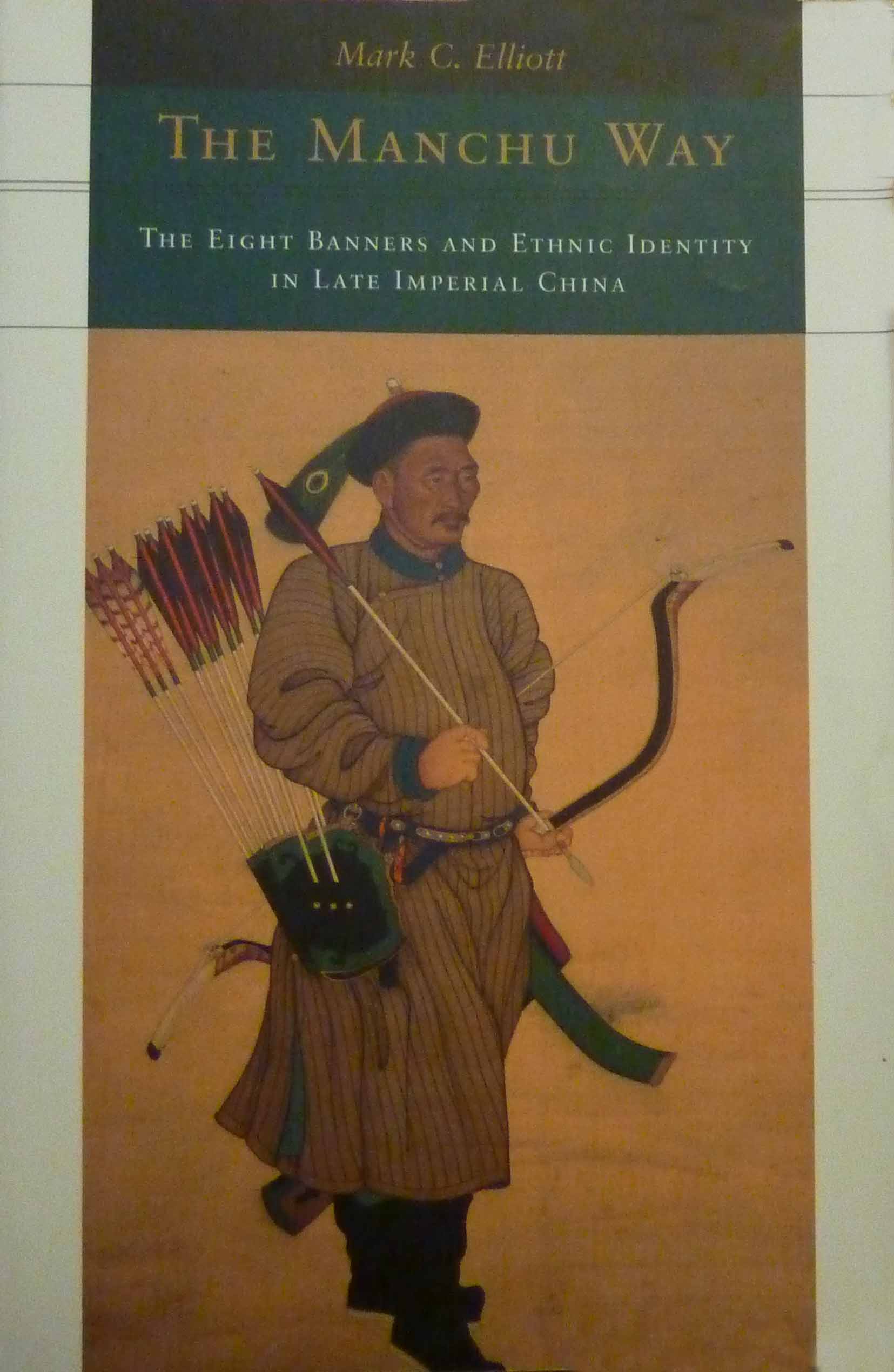
History Today said of Elliott’s book, “This is a wide-ranging and innovative book. Furthermore, it is written in a lively, accessible style… Overall, it is undoubtedly a scholarly achievement of the highest order.”

I was fortunate to have this resource while writing of Robert Hart’s early years in China. In fact, Hart was the only foreigner the emperor trusted and Hart worked for Qing Dynasty for most of his life.

The Qianlong emperor (pronounced “chien-lung”) was the fourth monarch of the Qing dynasty (1644-1911) who reigned from 1736 to 1795.

The four-minute video starts by saying that during the reign of the Qianlong Emperor there were several rebellions in Sichuan province.

The Qing banner armies fought wars against the Uyghurs, Kazakhs, Kyrgyzs, Evenks and Mongols. Unsuccessful costly wars were also fought with Vietnam and Myanmar.

Although millions of square miles or kilometers were brought into the empire, the strain on China’s treasury and military due to casualties and deaths resulted in a military decline.

This decline contributed to China’s weakness a few decades later when the British Empire and France invaded China to force the Qing Dynasty to allow opium to be sold to the Chinese people and give missionaries total freedom to convert the population to Christianity, which caused more wars and tens of millions of deaths during the 19th century.

The Qing army was divided into eight banners. Each banner had its own color scheme, which was reflected in their clothing, armor and flags. There were eight Manchu banners, eight Mongolian banners and eventually eight Han Chinese banner armies for twenty-four armies. In 1648, there were between 1.3 and 2.44 million people in the Chinese, Manchu and Mongol Banner armies.  By 1720, the numbers were estimated at between 2.6 and 4.9 million.

China has a history of maintaining large armies for more than two thousand years mostly for defense.

Discover China’s Greatest Emperors

______________

Lloyd Lofthouse is the award-winning author of the concubine saga, My Splendid Concubine & Our Hart. When you love a Chinese woman, you marry her family and culture too.

If you want to subscribe to iLook China, there is a “Subscribe” button at the top of the screen in the menu bar.


New Year’s Recap

January 1, 2011

There’s much about China that I did not know when we started this journey on January 28, 2010. 

We visited China’s early dynasties (the Xia, Shang and Zhou) before Qin Shi Huangdi became the first emperor and unified China.

Then we visited the Han, Tang, Sung, Ming and Qing Dynasties while learning of the chaos and anarchy between the dynasties.

We met Confucius and Wu Zetian, China’s only woman emperor during the Tang Dynasty.

We discovered China’s music, art and opera while meeting one of China’s national treasures, Mao Wei-Tao.

Learning about the 19th century Opium Wars started by the British and French opened my eyes to evils I had not known of.

What shocked me most was how the West forced China to allow Christian missionaries into China along with opium.

One reader challenged me in a comment saying that couldn’t be true then didn’t respond when I provided links to the evidence that missionaries and opium were included in the same treaty, which forced the emperor to accept against his will.

Then I sat spellbound as I joined Mao and the Communists on the Long March where more than 80,000 started out and about 6,000 survived — the only choice was to fight or die.

Along the way, I learned that Sun Yat-sen was the father of China’s republic and how Chiang Kai-shek started the Civil War in 1925 when he ordered his army to slaughter the Chinese Communists.

I didn’t know that the Communist and Nationalist Parties were the two political parties of China’s first republic and how it was the US supported Nationalists that fired the first shot that shattered Sun Yat-sen’s dream for China.

After the Communists won the Civil War in 1949, I saw the suffering and death from Mao’s mistakes during the Great Leap Forward and the Cultural Revolution that ended in 1976.

Then we learned how Deng Xiaoping saved China from the Revolutionary Maoists and launched the Capitalist Revolution, which led to the Tiananmen Square incident then China’s Sexual Revolution.

And there was my continued attempt to explain China’s Collective Culture. One comment basically said, “Yea, sure!” as if there were no such thing as cultural differences such as this.

We also were introduced to other Blogs about China such as the China Law Blog.

Of course, with more than a thousand posts in a year, what I have mentioned here is but a small part of the 2010 journey of China.

______________

Lloyd Lofthouse is the award-winning author of the concubine saga, My Splendid Concubine & Our Hart. When you love a Chinese woman, you marry her family and culture too.

If you want to subscribe to iLook China, there is a “Subscribe” button at the top of the screen in the menu bar.


The Last Empress Dowager

December 14, 2010

The Last Empress of China ruled the Qing Dynasty as a coregent after her husband, The Xianfeng Emperor died in 1861, and her son, The Tongzhi Emperor (1856 – 1875), was too young to rule China.

Technically, The Empress Dowanger Tzu Hsi (Cixi) wasn’t the last empress.

However, she was the last empress to rule China as a regent for her son then her nephew after her son died at 19.

Sterling Seagrave, the author of Dragon Lady, writes, “absurdly little was known about her life. The New York Times printed a long, error filled obituary calling her Tzu An, the title of her coregent who had died twenty-seven years earlier.”

Many current history texts have slandered the Dowager Empress Tzu Hsi (1835 – 1908) without much evidence as one of history’s most monstrous women—a ruthless Manchu concubine who seduced and murdered her way to the throne in 1861 to rule China through prevision, corruption and intrigue.

This is how many still think of Tzu Hsi.

She has been accused of murdering her son then years later her nephew, who died the day before she did.

Instead, her son may have died of syphilis because it was rumored he preferred prostitutes to his virgin concubines.

Some rumors claim that Tzu Hsi had her nephew poisoned, but Yuan Shikai may also have poisoned him. There is no evidence to support either theory.

How did the Tzu Hsi earn such a bad reputation? It seems that she earned this reputation similar to how today’s China has been smeared in the Western media.

To understand how this came about, I will make a comparison to Jayson Blair, a young reporter for the New York Times that wrote more than 600 articles for the newspaper. During his short career with the New York Times, Blair committed repeated “acts of journalistic fraud”, including stealing material from other papers and inventing quotes.

Blair’s fraud was revealed in 2003 while he still worked for the newspaper. Source: BBC News 

However, Jayson Blair was not the first reporter to commit “acts of journalistic fraud”.

Edmund Backhouse did the same writing about the Tzu Hsi at the beginning of the 20th century, and his lies and deceit wouldn’t be discovered until Sterling Seagrave was researching Dragon Lady decades later.

Backhouse’s journalistic fraud served as the foundation for most history texts that have slandered Tzu Hsi.

To do Tzu Hsi justice and to discover the truth, one should read Seagrave’s Dragon Lady, The Life and Legend of the Last Empress of China

To learn whom the real woman was we may want to consider what Robert Hart had to say about Hzu Hsi in his letters and journals.  Robert Hart arrived in China from Ireland in 1854. He returned to England in 1908.

For most of his stay in China, Hart was Inspector General of Chinese Maritime Customs and worked closely with the Imperial ministers and Manchu princes. Before returning to England, Hart met with the Dowager Empress in a private audience.

Hart referred to Tzu Hsi as “the Buddha” and later “the old Buddha” since she was a devout Buddhist and it is obvious that he thought of her with affection and admiration.

In fact, Hart, who is considered the Godfather of China’s modernization, at no time indicated in anything he wrote that Tzu Hsi was conspiratorial, sinister or manipulative. However, he did indicate that she was strong-willed and hot-tempered but she was clever and had ability.

Tzu Hsi died in 1908 a few weeks after Robert Hart left China. The Qing Dynasty collapsed in 1911.

Discover more of The Qing Dynasty (1644 – 1911)

______________

Lloyd Lofthouse is the award-winning author of the concubine saga, My Splendid Concubine & Our Hart. When you love a Chinese woman, you marry her family and culture too.

If you want to subscribe to iLook China, there is a “Subscribe” button at the top of the screen in the menu bar.


The Qing Dynasty (1644 – 1911) – Part 2/2

December 14, 2010

The Yongzheng Emperor ruled from 1722 to 1735. He was frugal like his father, the Kangxi Emperor.

Yongzheng created an effective government and used military force to preserve the dynasty’s position as his father had. Under his leadership, he continued the era of peace and prosperity by cracking down on corruption and waste while reforming the financial administration of the empire.

The Qianlong Emperor (birth/death 1711 – 1799) ruled China for much of the 18th century (1735 – 1796). He subdued about ten rebellions known as the “ten successful campaigns”, which drained the Qing Dynasty’s treasury. These rebellions stretched from 1747 to 1792.

However, when the Qianlong Emperor died, China was unified, at peace and strong. He was a brilliant military leader and expanded the empire further into Mongolia and Tibet.

During the rule of the Qianlong Emperor, Manchu and Chinese armies proved the Qing sovereignty over Burma and Nepal.

Chinese settlers in Yunnan, Guizhou, Sichuan and Taiwan dealt with rebellions of the aboriginal tribes that could only be subdued by military force. Muslim people also resisted the Qing regime in Gansu and Xinjiang.

During the 19th century, the two Opium Wars started by Britain and France weakened the Qing Dynasty.

Besides the Opium Wars, there was also the Taiping Rebellion, which lasted more than a decade and cost about 20 million lives.

In 1900, The so-called Boxer Rebellion (known as “I-ho Chuan” or the “Righteous and Harmonious Fists”) was originally started against the Manchu Qing Dynasty but the Qing government managed to redirect this rebellion against the foreigner invaders that had defeated China during the earlier Opium Wars.

This ended in a worse defeat after the foreign powers formed an alliance and marched on Beijing slaughtering the rebels.

The driving force behind the revolution of 1911 that ended the Qing Dynasty was Dr. Sun Yat-sen.

However, once the Qing Dynasty fell, warlords tore China apart and it would take years of struggle to reunify China under one government in 1949 after the Communist Party defeated the Nationalists, who fled to Taiwan with much of China’s imperial treasures and gold.

Return to The Qing Dynasty (1644 – 1911) – Part 1

______________

Lloyd Lofthouse is the award-winning author of the concubine saga, My Splendid Concubine & Our Hart. When you love a Chinese woman, you marry her family and culture too.

If you want to subscribe to iLook China, there is a “Subscribe” button at the top of the screen in the menu bar.


The Qing Dynasty (1644 – 1911) – Part 1/2

December 13, 2010

Since the Qing Dynasty was the last imperial dynasty to rule China, I searched for a YouTube video that would do it justice.

A student for a history class produced the best YouTube video I discovered. 

The student narrator spends about two-and-a-half minutes in the first segment summarizing China’s history from Qin Shi Huangdi, China’s first emperor, to the fall of the Ming Dynasty.

The Qing Dynasty had its roots from the 1580s when a Manchurian chieftain Nurachi (1558–1626) unified the Jurchen tribes of the region.

Over the next several decades, Nurachi took control over most of Manchuria.

In 1616, he declared himself khan, and founded the Later Jin Dynasty (which his successors renamed in 1636 to the Qing Dynasty).

The Chinese peasant revolt that ended the Ming Dynasty (1368-1643) was quickly defeated by the Manchurian Qing Dynasty in 1644.

However, the Chinese fought hard to drive the Manchurians from China and continued resistance in southern China until crushed.

The Kangxi Emperor (1654 – 1722) ruled for 62 years and is considered by many historians one of the ablest emperors to govern the vast Chinese empire. He laid the foundation for a long period of political stability and economic prosperity for China.

The rebellions he put down was called the Rebellion of the Three Feudatories, which lasted from 1673 to 1681.

Then there was the pirate-merchant Zheng Chenggong, who set up an independent kingdom on the island of Taiwan. Eventually, that kingdom was defeated and brought back into the Qing empire.

The Kangxi emperor also fought wars with Russia from 1685 until 1689 when the Treaty of Nerchinsk was signed.

Then there were campaigns against the Mongols until they were defeated. In 1720, the Qing Dynasty occupied Tibet and incorporated that country into the empire.

However, even in times of war, the Kangxi emperor provided tax relief for the people, and he was a frugal and wise leader. He left China strong and in good financial condition.

Discover more about the lifestyles of The Qing – China’s Last Dynasty

______________

Lloyd Lofthouse is the award-winning author of the concubine saga, My Splendid Concubine & Our Hart. When you love a Chinese woman, you marry her family and culture too.

If you want to subscribe to iLook China, there is a “Subscribe” button at the top of the screen in the menu bar.