The Fear of Mao Buying the World

November 22, 2010

The cover of The Economist’s November 13 issue plays on fear to sell magazines.

I haven’t read Buying up the world, The coming wave of Chinese takeovers yet, which is the feature piece. I’ll probably write another post about that once I do.

Instead, I’m writing about the magazine’s cover, which is taking advantage of the West’s PTCSD (Post Traumatic Chinese Stress Disorder) that has roots in the “history” of a fear of the word “Communist”, the Korean Conflict and the Cultural Revolution.

I’m sure most Sinophobes that see this cover will have flashbacks of the People’s Liberation Army (PLA) and the rest of China dressed in drab Mao jackets marching across the world to take possession of everything China buys.
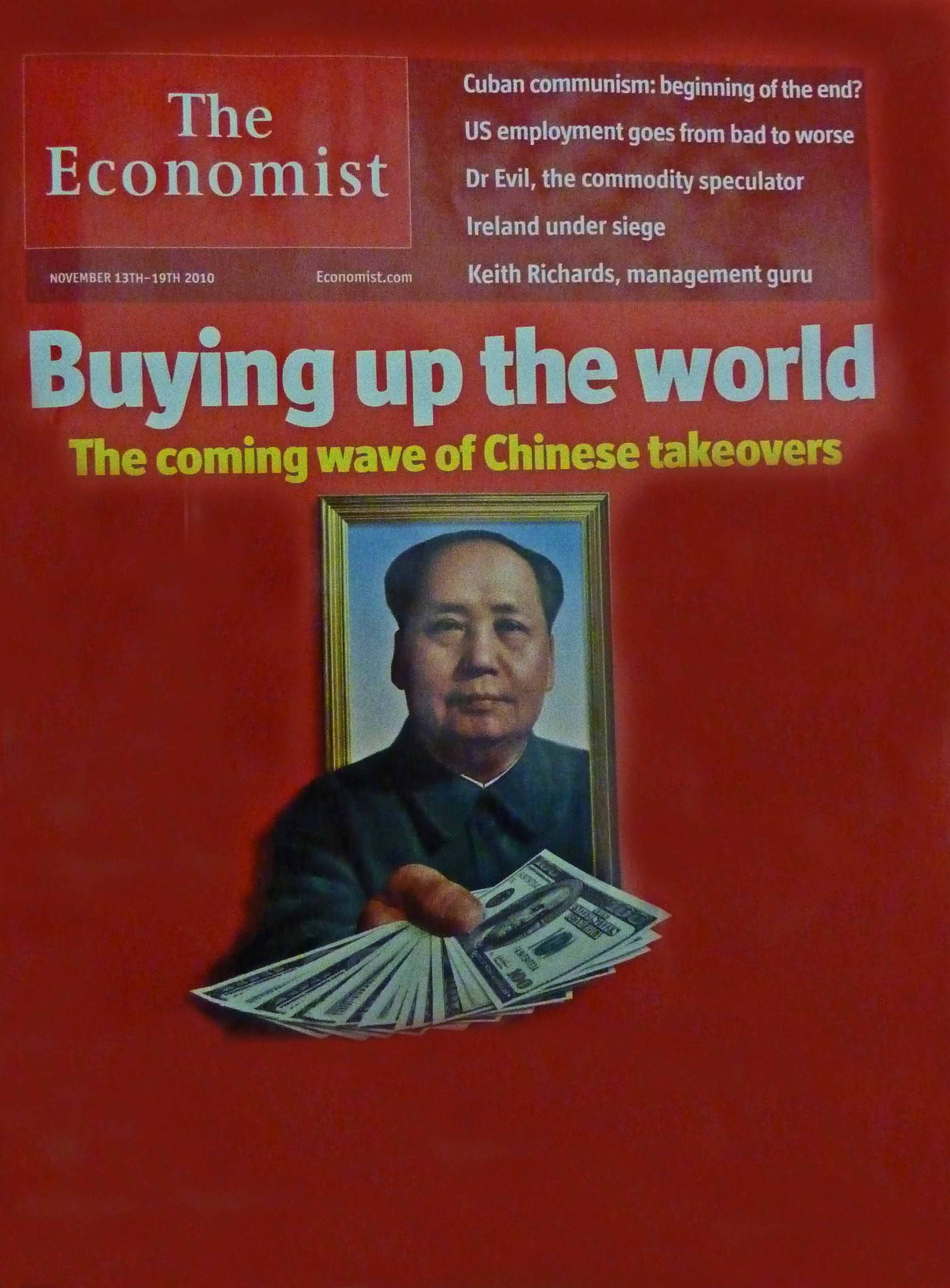
However, Mao isn’t the proper man to adorn The Economist’s cover.

Deng Xiaoping or one of China’s recent presidents (there have been four since the 1982 Constitution) would have been more appropriate.

Why? Because after Mao died in 1976, Deng Xiaoping and his allies rejected Maoist Revolutionary thought and embraced CAPITALISM in a very big way.

In fact, surviving Maoists consider the Party that rules China today to be traitors to Mao and the revolution.

Do you remember the 1980s, when wealthy Japanese spent billions buying property in America then a real estate bubble burst, Japan lost a lot of money, and its economy has been limping since?

If anyone should be afraid, it should be the Chinese fearing spending habits in the US, Canada and Europe where debt and plastic rule.

______________

Lloyd Lofthouse is the award-winning author of the concubine saga, My Splendid Concubine & Our Hart. When you love a Chinese woman, you marry her family and culture too.

To subscribe to iLook China, look for the “Subscribe” button at the top of the screen in the menu bar, click on it then follow directions


China and India at War ­in 1962 – Part 3/4

October 11, 2010

The Chinese moved their Eleventh and Fifty-fifth divisions to the front.

The Indian army had four brigades set up defensive positions along the only mountain road leading south through the harsh terrain.

At the same time, India was planning to attack the Chinese army.

In a risky flanking maneuver, the Chinese sent 1,500 troops along a dangerous mountain trail to attack India’s Army in the rear and cut them in half.

The Chinese troops succeeded, and the Chinese army launched an attack from the north along the road.

India’s Sixty-second Brigade collapsed the first day. Soon after, India’s Sixty-fifth Brigade abandoned their positions without a fight.

News of the Indian army’s defeat reached New Delhi.  The Indian people panicked. Large numbers of refugees started to flow south.

Chinese army troops had advanced into India past the disputed territory. China declared a unilateral cease fire.

There were abandoned Indian weapons everywhere and the Chinese troops gathered the weapons, which were returned to India. Then the Indian troops that were prisoners of war were released.

China’s army withdraw to the 1959 border keeping the disputed territory. The war ended without a treaty to resolve the border dispute.

India’s Casualties

Killed = 4,885
POW = 3,968
Wounded = 1,697

China’s casualties
Killed 722
Wounded 1,696

Go to China and India at War – Part 4 or return to Part 2 of China and India at War in 1962

______________

Lloyd Lofthouse is the award-winning author of the concubine saga, My Splendid Concubine & Our Hart. When you love a Chinese woman, you marry her family and culture too. 

If you want to subscribe to iLook China, there is a “Subscribe” button at the top of the screen in the menu bar.


Defector / Traitor (3/4)

August 5, 2010

The most famous Chinese defector/traitor may have been Sun Tianqin, a fighter pilot in the People’s Liberation Army Air Force, who flew to South Korea in 1983 in an advanced fighter aircraft.

From there, Sun went to Taiwan to live. He left behind his mother, Mrs. Liu, his 18-year-old son and 13-year-old daughter.

While Americans see these defectors as heroes, the Chinese see dishonorable and selfish individuals. While Americans help one Chinese man or woman defect, an entire village in China pays the price.

Before defecting, Sun’s mother was so proud of her son that she displayed a large picture of him in uniform at their home and after learning of her son’s defection, she was so devastated that she fell ill and never recovered, finally dying, for which Sun’s family members put the blame on him.

Sun eventually married another defector, Ms. Li Tianhui, a musician. The sad fact is that all Chinese defectors leave knowing that those left behind related to them will pay a price. After all, they are Chinese and they grew up in the same collective culture.


Chen Yonglin, a former Chinese Diplomat, defected and liberated his spirit, but how many suffered in China for that act?

Sun Tianqin was not the first PLA fighter pilot to defect. Soon after the 1989 Tiananmen Square protest, Jiang Wenhao, defected to Taiwan. Wiki lists the first PLA pilot defecting on January 12, 1960 and the last in August 1990. Source: Wikipedia

Since the standard of living has improved in China and people have more personal freedom, defections have decreased and it is much easier to travel to the US.

Return to Defector/Traitor – Part 2 or go to Part 4

______________

Lloyd Lofthouse is the award-winning author of The Concubine Saga. When you love a Chinese woman, you marry her family and culture too. This is the love story Sir Robert Hart did not want the world to discover.

To subscribe to “iLook China”, look for the “Subscribe” button at the top of the screen in the menu bar, click on it then follow directions.


China’s Capitalist Revolution (Part 9 of 9)

July 6, 2010

Because of what happened in Tiananmen Square, foreign investors pulled out of China. Western businessmen fled. Foreign leaders and Deng’s Western friends criticized him.

The Maoists were back in power. Jiang Zemin said private companies had benefited from the reforms but in the turmoil, they supported the students against the government. We need to destroy them.

Deng Xiaoping was forced into retirement and his policies were reversed. Peasants were encouraged to reform collectives and private business was banned from competing with state enterprises.   The Maoists decided to clean house and close China’s doors to the West.

Desperate to save his reforms, at 87, Deng set out to save his reforms.  He went to Shanghai to encouraged supporters there to speak out.  When they did, the Maoists wanted to know who was criticizing them in the newspapers. Deng said he was responsible—don’t attack anyone but me.  Then Deng met with his old comrades in the People’s Liberation Army and the army announced they would protect Deng’s reforms and anyone who resisted would be dealt with.

Deng said, “Without reform and the Open Door policy, economic growth and improved living standards —any path for our country will be a dead end.” Deng’s call to arms worked.  In 1994, Jiang Zemin switched sides to support Deng. It was okay to get rich again.

Deng Xiaoping died in 1997. The country he inherited from Mao was the one of the world’s poorest. Today, it is one of the wealthiest.

Return to China’s Capitalist Revolution Part 8 or start with Part 1

_________________________

Lloyd Lofthouse is the award-winning author of The Concubine Saga. When you love a Chinese woman, you marry her family and culture too. This is the love story Sir Robert Hart did not want the world to discover.

To subscribe to “iLook China”, look for the “Subscribe” button at the top of the screen in the menu bar, click on it then follow directions.