On our way back to Beijing from the Great Wall at Mutianyu, our driver stopped at a factory-showroom where we learned about the manufacturing techniques for Cloisonné brass vases.
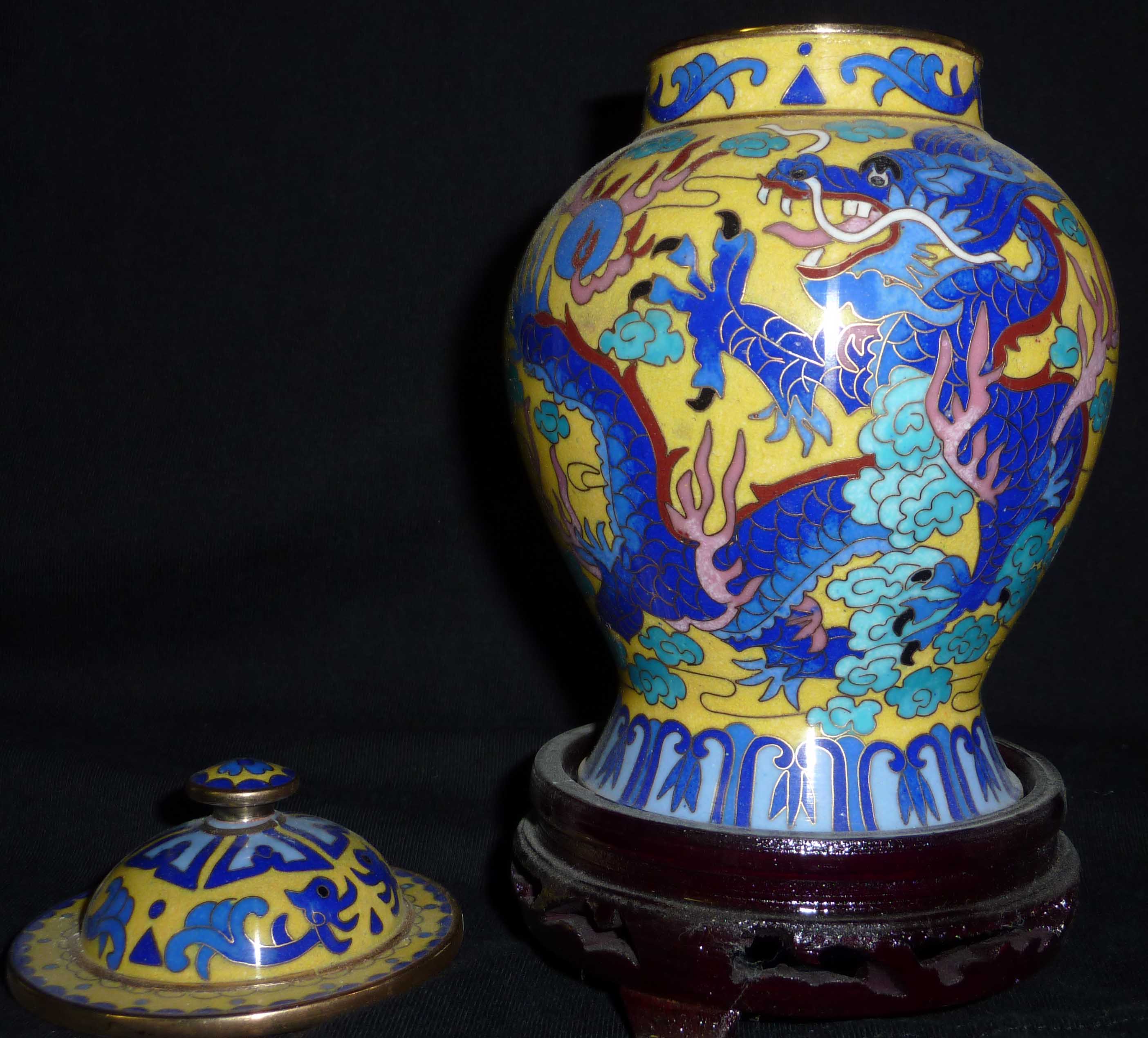
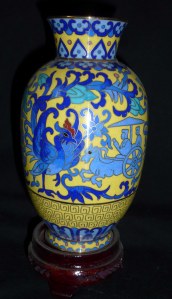
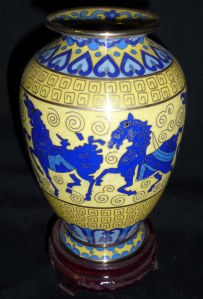
I’ve read some tourists/expatriates complain of these sort of stops, but I enjoy window shopping and this was something new—sometimes I even buy something. In this case, I bought three vases (photos are included here).
First, we went on a tour where we watched men and women creating vases. Once the tour was over, we went into the showroom.
The vases I bought (after negotiating the price) are yellow with a blue trim. One has a blue dragon on it, the second a phoenix beside a chariot, and the third running horses. Each one is about the size of my hand (see photos)
The cloisonné process is enamel on copper craftwork. It first appeared in Beijing in the Yuan Dynasty (1271-1368) and continued during the Ming Dynasty (1368-1644). Cloisonné vases are crafted by using a copper porcelain process. The vase is made from copper with brass wires soldered to the body. Then a porcelain glaze is applied to cells between the brass wires.
After a series of complex procedures, such as burning, burnishing and gilding, the cloisonné vase is done. Chinese name: 景泰蓝(jǐng tài lán)
Lloyd Lofthouse is the award-winning author of The Concubine Saga. When you love a Chinese woman, you marry her family and culture too. This is the love story Sir Robert Hart did not want the world to discover.
Subscribe to “iLook China”!
Sign up for an E-mail Subscription at the top of this page, or click on the “Following” tab in the WordPress toolbar at the top of the screen.
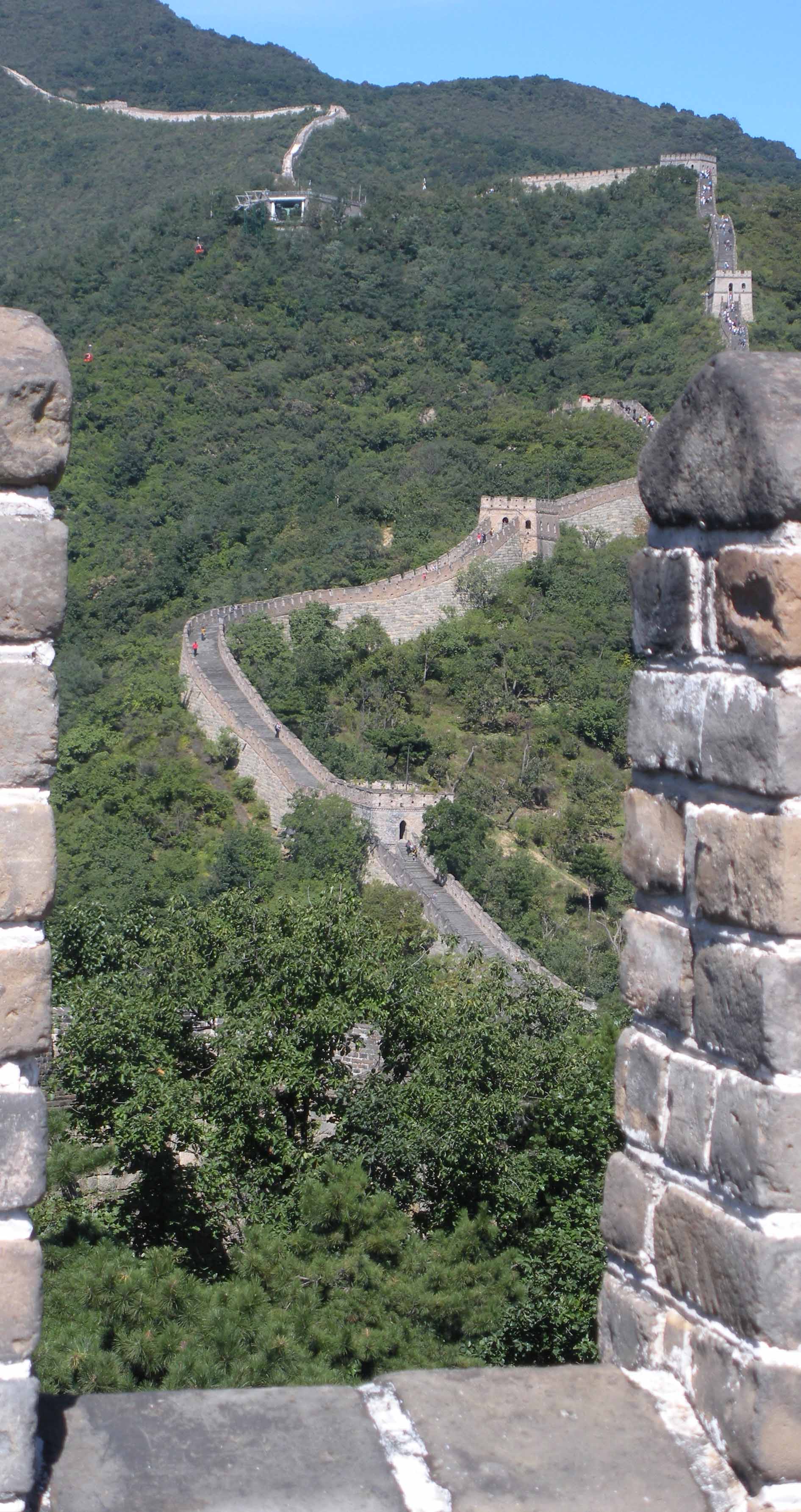
In 1999, I visited the The Great Wall for the first time. We returned to visit a different section in 2008. The second time, I carried a digital camera (a few of those photos appear with this post)
Smithsonian Magazine reported, “Few cultural landmarks symbolize the sweep of a nation’s history more powerfully than the Great Wall of China. Constructed by a succession of imperial dynasties over 2,000 years, the network of barriers, towers and fortifications expanded over the centuries, defining and defending the outer limits of Chinese civilization. At the height of its importance during the Ming dynasty (1368-1644), the Great Wall is believed to have extended some 4,000 miles, the distance from New York to Milan.
The sections of the Great Wall we visited are about an hour out of Beijing. The most popular site is at Badaling. The second choice, Mutianyu, is more dramatic. This portion of the Great Wall runs along the ridge of a mountain range. Badaling, meanwhile, is in a mountain pass.
The best way to reach the Great Wall is by taxi or bus. After you get there, you will discover the usual tourist shops. Since I enjoy haggling, I spend time shopping.
At Badaling, there were camels and horses you could pay a fee to sit on while having your photo taken.
Once you reach Mutianyu, you have a choice—take a few hours to climb the mountain to The Wall or ride a ski lift to the top in fifteen minutes.
China’s Great Wall was not built by one emperor. It was built in segments by the kings of several nations over a period of centuries. In addition, the wall was completed and linked together by China’s first emperor in 221 BC.
When you are on the wall, if you get thirsty or yearn for a snack, there are venders that carried their goods often using horses.
Once you are ready to leave the Great Wall at Mutianyu, the toboggan ride is worth the price.( see the embedded video with this post)
Lloyd Lofthouse is the award-winning author of The Concubine Saga. When you love a Chinese woman, you marry her family and culture too. This is the love story Sir Robert Hart did not want the world to discover.
Subscribe to “iLook China”!
Sign up for an E-mail Subscription at the top of this page, or click on the “Following” tab in the WordPress toolbar at the top of the screen.
Like so much about China, The Great Wall is also the victim of myths and lies.
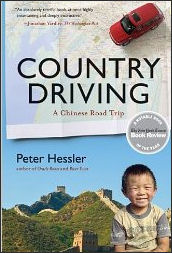
I’m reading Peter Hessler’s “Country Driving“, which is a great book that I plan to review when I finish it. However, his first chapter covers the months he spent driving the length of the Great Wall all the way to Tibet.
In fact, before there was one wall, there were many—all built by different kingdoms before China was unified under Qin Shi Huangdi in 221 BC.
Although I’m enjoying all of Hessler’s memoir, the hundred and twenty-two pages that focus on the Great Walls are the best part of the book.
Before reading Hessler’s memoir, I wrongly believed, as so many others do, that The Great Wall was a failure as a defense against invaders. However, Hessler proves that myth wrong. For the most part, the wall did keep marauders out.
In fact, on page 116 of the paperback, he quotes David Spindler who found evidence that the Ming Great Wall actually worked as a defensive structure.
The Wall failed when the unified Mongols invaded China in the 13th century but it didn’t happen overnight. It took sixty years for the Mongols to conquor all of China.
Before Genghis Khan unified the Mongols, there was no unified Mongolia—only nomadic tribes that fought amongst each other and raided into China whenever one or more tribes decided on a whim—that is if they could fight their way past the Great Wall guarding China’s heartland.
In section one of “Country Driving”, The Wall, Hessler points out that no archeologists/historians have studied the history of The Great Wall but there are amateurs that have, both Western and Chinese and these Great Wall amateur (experts) have discovered original documents written by Ming Dynasty military officers and troops detailing the defense of the wall against nomads intent on raiding into China to loot, rape and steal. According to this information, the wall served its purpose more often than not.
Note: I wrote this post about two months ago and scheduled it to appear July 23 before I finished reading Hessler’s memoir. Then after I wrote the review, I scheduled it to appear before this post appeared. You may find the review here: Country Driving in China with Peter Hessler
I often write and schedule posts weeks in advance with the goal to stay one month ahead. That way I may take a few days off now and then from writing posts.
______________
Lloyd Lofthouse is the award-winning author of The Concubine Saga. When you love a Chinese woman, you marry her family and culture too. This is the love story Sir Robert Hart did not want the world to discover.
Subscribe to “iLook China”!
Sign up for an E-mail Subscription at the top of this page, or click on the “Following” tab in the WordPress toolbar at the top of the screen.
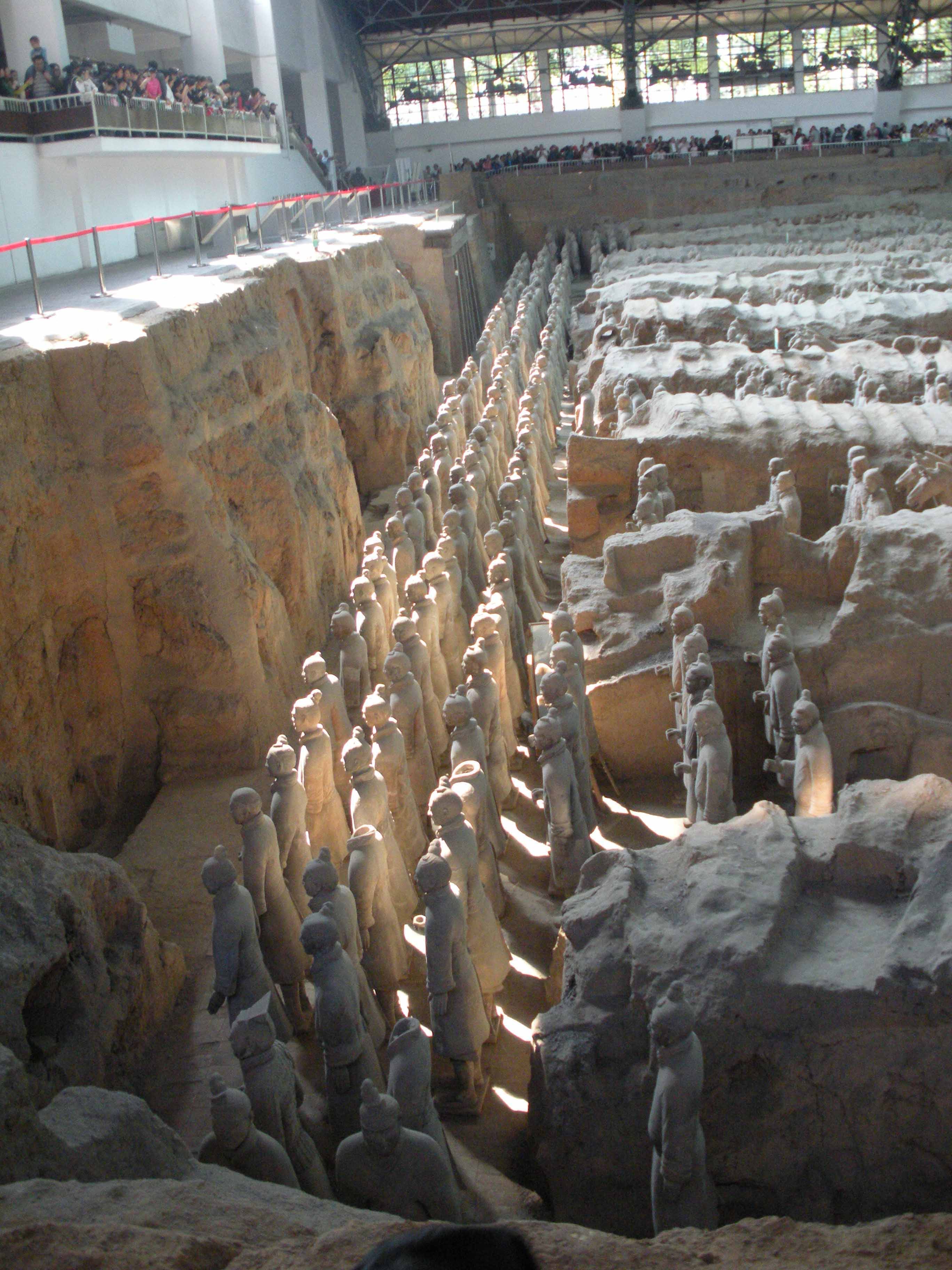
We are taking a quick trip to Xian (in pictures that is). Xian was China’s ancient capital for more than a thousand years before being moved to Beijing.
After landing in Xian in 2008, (our third visit to the city since 1999) we found a great driver. He was honest and knowledgeable. Here’s the cell phone number he had at the time (136-0916-251). If you visit Xian, I recommend you book him for the entire stay. He also introduced us to some experiences we’d never had on previous trips.
The Famous Terra Cotta warriors were created to guard China’s first emperor Qin Shi Huangdi (221-204 B.C.). Qin Shi Huangdi made Xian China’s first capital until Kublai Khan moved the capital to Beijing where he ruled his Khanbalik Empire, from 1264 to 1267.
Xian was known as Chang’an before the Ming Dynasty and is one of the four great ancient capitals of China having held that distinction under several of the most important dynasties in China’s history. In fact, Xian was a cultural center more than a thousand years before Jesus Christ was born.
______________
Lloyd Lofthouse is the award-winning author of The Concubine Saga. When you love a Chinese woman, you marry her family and culture too. This is the love story Sir Robert Hart did not want the world to discover.
Subscribe to “iLook China” Sign up for an E-mail Subscription at the top of this page.
Did you know Dennis Prager wrote on Creators.com that, “Consider the facts (I’m surprised he used this word): Tibet, at least 1,400 years old, is one of the world’s oldest nations, has its own language, its own religion and even its own ethnicity. Over 1 million of its people have been killed by the Chinese, its culture has been systematically obliterated, 6,000 of its 6,200 monasteries have been looted and destroyed, and most of its monks have been tortured, murdered or exiled.”
All of Prager’s emotionally driven claims such as “killed, obliterated, looted, destroyed, tortured, murdered or exiled” have been proven wrong, but most of Prager’s Parrots are not interested in the facts. I say that Prager owes China an apology.
In fact, Tibet was not a nation until 1911 when the British convinced the Dalai Lama to declare freedom from China, after having been ruled by China since 1279 AD during the Yuan Dynasty, then the Ming Dynasty starting in 1368 AD and last the Qing Dynasty until its collapse.
All the “facts” are there for anyone willing to trust the experts and sources such as Sir Robert Hart (1835 – 1911) and a piece written for the October 1912 National Geographic Magazine by an expert Western trained medical doctor named Shaoching H. Chuan, M.D. that happened to spend two years in Tibet starting in 1907 after the last Qing emperor ordered him there to deal with a cholera epidemic.
In addition, Prager forgot to mention that there are more than sixty spoken languages in China and one written one. China has 56 minorities and each has its own language as the Tibetan minority does. It’s been this way in China for more than 2,000 years.
In fact, by not mentioning America’s native minorities, it is my opinion that Dennis Prager is a hypocrite and deceitful.
North American native tribes and nations were free and governed themselves for more than ten thousand years (much longer than the 1,400 years he claims Tibet governed itself before 1950) before Europeans arrived and drove them from their land.
If you visit Native American Nations, you will discover how many spoke their own languages and many still do — the only difference is today native Americans live on reservations and the US Department of the Interior is responsible for the administration of programs relating to Native Americans, Alaska Natives and Native Hawaiians.
One example is the Navaho Nation, the largest Native American reservation in the United States, which is in Arizona. The Navaho Nation covers 27,425 sq miles (71,000 km2) with a population of about 174,000.
The Navajo Nation, like Tibet, is a semi-autonomous Native American-governed territory within the United States.
Another example is the Cherokee Nation, which had its own written language developed early in the 19th century by a mixed-blood Cherokee called Se-Quo-Yah, so the Cherokee Nation would be considered educated, literate and capable of governing itself as an equal, independent nation.
However, this did not stop the United States from breaking treaties and waging war with the Cherokee Nation to exploit the natural resources of their land. It’s called conquest and anyone that studies history knows this is a natural part of the evolution of all species including man.
How is this situation different from Tibet and China? Native Americans had their own religions too and were not allowed to practice them by the United States, while China allows Tibetan Buddhists to practice their religion within a semi autonomous territory, which is administered by a CCP government agency similar to the US Department of the Interior.
Another fact that Prager conveniently left out of his opinionated rant of an essay is that after 1976, China rebuilt many of the Buddhist temples in Tibet that were destroyed during Mao’s Cultural Revolution when religions in China were banned and the entire population suffered.
Today, there are seven-major religions in China including Christianity and Islam.
Rush Limbaugh, the host of the number-one conservative talk-radio show, explains how talk-radio works.
Michael Orion Powell writes, “Prager is a good example of what happens when a commentator ties himself to one side of the political spectrum permanently.” By Seattle standards, Michael Powell calls himself a conservative, but by actual conservative standards (as defined by talk show hosts such as Dennis Prager), he says he is a raving liberal.
In addition, decades ago, I too listened to Rush Limbaugh and then deserted him for Dennis Prager.
I eventually fled Prager too, after I questioned his emotionally driven opinions and compared them to the facts of experts discovering that he was often wrong and misleading. Now that I’m an ex-Prager Parrot, I guess that makes me a leftist-liberal prone to hysteria that fears death even though I support the Second Amendment to the US Constitution, which guarantees the right to bear arms (weapons such as rifles and pistols).
So, we either trust the emotionally-driven opinions of conservative talk show hosts such as Dennis Prager (with a major in Middle Eastern Studies and History who also studied about Russia), or trust 1,500 of the world’s most distinguished senior scientists, including the majority of Nobel laureates in science.
And the truth is, there is a chance the experts could be wrong about Global Warming, since it is only a theory supported by facts, but are we willing to risk ignoring them as Prager and his Parrots argue?
Lloyd Lofthouse is the award-winning author of The Concubine Saga. When you love a Chinese woman, you marry her family and culture too. This is the love story Sir Robert Hart did not want the world to discover.
To subscribe to “iLook China”, sign up for an E-mail Subscription at the top right-hand side of this page and then follow directions.


 Posted by Lloyd Lofthouse