An interesting post at The Globalist says, “Many regard China’s economic powerhouse as a new phenomenon. But a thousand years ago, Chinese merchants ruled the seas of Asia.”
The post goes on to point out how China’s Song Dynasty promoted international trade and that Chinese merchants expanded foreign trade rapidly but with Chinese government control over trade as in China today.
The Song Dynasty also kept a close watch on exports as in China today.
The Globalist said, “Even 1000 years ago, China’s government kept a close eye on trade. If a ship was blown off course, its captain had to report it promptly (on his return to China) — and produce evidence.”
In fact, Merchants from all over the world came to China at that time just as they are doing today.
Therefore, it should be no surprise when The Economist says, “China’s overreaction to a Japanese ‘provocation’ has set its regional diplomacy back years. … China sneezes, Asia shivers.”
I don’t believe China cares if diplomacy suffered. China is more concerned with not letting anyone step on its toes again.
When I say that, I’m talking about the Opium Wars then Western domination of China’s politics for close to a century before World War II when Japan invaded and killed about 30 million Chinese.
If we are to believe Marco Polo (1254 – 1324), who said China could have conquered the world, then we should also breathe a sigh of relief that China didn’t want to do that then when it could have and still doesn’t.
However, China’s desires to control events that affect China have not changed. Japan sneezed and China roared back. It’s all about harmony—in China.
______________
Lloyd Lofthouse is the award-winning author of the concubine saga, My Splendid Concubine & Our Hart. When you love a Chinese woman, you marry her family and culture too.
If you want to subscribe to iLook China, there is a “Subscribe” button at the top of the screen in the menu bar.
Marco Polohad no doubt that China was the world’s greatest civilization. He wrote that if the Chinese were war like, they would conquer the world.
He said, “Thank goodness, they are not.”
During the Song Dynasty, the standard of living in China was the highest in the world.
The key concept of Chinese civilization was the search for harmony and during the Song Dynasty this balance was achieved for a few centuries.
Writing was considered a tool that provided access to the ancestors until writing became civilization itself.
However, the way China saw the world started to change after Chinese Admiral Zheng Hesailed from China with a huge armada in the fifteenth century.
Zheng He’s ships were eventually broken up and the logbooks destroyed.
Western thinkers have a simple explanation that the end of Zheng He’s explorations was proof that the Chinese were backward and ignorant and had no desire for new knowledge.
However, there is another explanation.
After all, at the time, the Chinese were the most advanced technological nation on the globe.
Therefore, perhaps it is a difference of how different civilizations believed technology should be used and the Chinese may have realized that their real interests were in China — not in the world.
In Europe, however, Western philosophers, leaders and writers were not concerned with perfecting the past but how to control the world’s future.
Lloyd Lofthouse is the award-winning author of the concubine saga, My Splendid Concubine & Our Hart. When you love a Chinese woman, you marry her family and culture too.
If you want to subscribe to iLook China, there is a “Subscribe” button at the top of the screen in the menu bar.
While researching topics about China, I kept running into claims that ice cream was invented in China, and Marco Polo brought the recipe back to Italy.
To discover the facts, I did some virtual sleuthing and discovered that immigrants arriving in Ellis Island were treated to a bowl of ice cream upon arrival.
I wonder if the Chinese arriving at Angel Island in San Francisco Bay got ice cream. Considering the way the Chinese were treated then—probably not.
Ice Cream History and Folklore says, “Most books are full of myths about the history of ice cream. According to popular accounts, Marco Polo (1254-1324) saw ice creams being made during his trip to China, and on his return, introduced them to Italy.”
In fact, “During China’s Tang Dynasty (618-907 A.D.) something vaguely on the order of ice cream was made from cow, goat and buffalo milk, flavored with camphor and thickened with flour.” Source: The History of Ice Cream
More details came from Wonderquest. “The first concoction resembling ice cream was made in China during the Tang period…. Ice-cream makers … heated buffalo, cow, and goat milk together then fermented the brew to form yogurt. They thickened the yogurt with flour and flavored it with camphor (an insect repellant, of all things). Refrigerating first, they served the confection to the king.”
______________
Lloyd Lofthouse is the award-winning author of the concubine saga, My Splendid Concubine & Our Hart. When you love a Chinese woman, you marry her family and culture too.
If you want to subscribe to iLook China, there is a “Subscribe” button at the top of the screen in the menu bar.
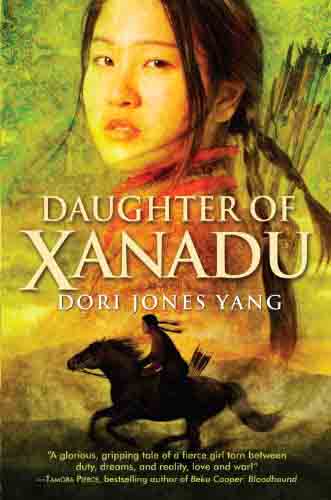
Who would win in a fight: Mulan or Emmajin Beki or Teenage Angst, Mongolian-style? “Can you imagine, a mere girl fighting on the battlefield?”
The role of females in combat is a debate as timeless as war itself, and one that remains divisive and unresolved to this century.
While present-day arguments for and against allowing women in the military revolve around psychological and biological issues, back in olden times, one needed only cite “tradition” and “familial roles” to silence the detractors.
The teenaged heroine of Dori Jones Yang’s new 13th-century historical fiction novel, Daughter of Xanadu, is one such detractor, albeit immutable.
Often imagining herself on the battlefield, “the son my father never had,” Emmajin Beki, the granddaughter of Mongolian king (and emperor of China’s Yuan Dynasty) Khubilai Khan (1215-1294), learned to ride a horse before she could walk and can outshoot all her cousins in archery. She confidently and outspokenly aspires to emulate her female ancestors who assisted Chinggis Khan in conquering Asia (“the blood of all these earlier strong women flowed in my veins”).
Unfortunately, for this princess, “the days of strong women had ended once luxurious court life had begun.”
The Mongols, fattened, lazy and resting on their laurels, now prefer to tell stories of battles-past over lavish “orgies of excess” rather than engage in new wars, much to Emmajin’s restless discontent.
When she makes known her desire to “become a legend” like real-life women warriors Aiyurug Khutulun and Hua Mulan of China, the great Khan placates her by sending her on a secret mission to spy on a family of foreign merchants currently visiting the Mongol court.
The merchants’ young son turns out to be one Marco Polo, the now-legendary Venetian journeyer credited for introducing Asian culture to the west.
To Emmajin, however, he is just another “colored-eye man,” a court curiosity from Christendom whose gallantry and romantic gestures are as ridiculous to the manly Mongolians as his facial hair (“his beard was so thick I could imagine food sticking in it”).
Try as she might, however, Emmajin, caught in the peak of puberty, is unable to resist Marco’s western charm, and quickly finds herself enamored by his worldly vision (“I had learned to see the world through Marco’s eyes”) as well as his pelt.
“What would the hair on his arm feel like?” she often fantasized about at night.
But she was a Mongolian first, and reluctantly sacrifices her blossoming relationship with the foreigner to complete her spy mission (“He was not a friend but a source of information.”).
Authoress Dori Jones Yang is a Caucasian American, yet she is no stranger to writing from the perspective of conflicted adolescent Chinese girls, as evinced in her previous, award-winning novel, The Secret Voice of Gina Zhang.
In Daughter of Xanadu, she hones in even deeper into the physiological confusion and emotional conflictions that make youth such a joy, turning Emmajin into such a hormonal wreck that this male reviewer often found himself gritting his teeth in frustration at such contradictive revelations as, “if he had pursued me, I would have rebuffed him. By holding himself aloof, he challenged me to win back his esteem.”
Daughter of Xanadu is not all-teenage angst. As our protagonist matures, so does the content of the story.
Emmajin eventually persuades Khubilai Khan to allow her to train for war against the Burmese at the Battle of Vochan (present-day Yunnan province), where the embarrassment of getting her period in front of the all-male troops is a bloody omen for what’s to come.
Upon seeing her cousin slain, innocent Emmajin is transformed into a “mindless killer.”
Bloodlust unleashed, the young princess swings her sword indiscriminately (“the hatred pounded in my ears…killing him felt good”), resulting in hundreds of men dead by her hand alone.
One can only imagine all the Mulan vs. Emmajin fan fiction that this novel will inspire!
By story’s conclusion, Messer Polo, who witnessed and wrote about the Mongols’ real-life battle against the Burmese in his book, The Travels of Marco Polo, has elevated “Emmajin the Brave” into the living legend she wanted to be, though she now regrets it.
“These men needed a hero, but I no longer needed to be one.” She resigns her sword and rank, and departs with Polo back to Europe as the Khan’s emissary of peace, leaving the literary door wide open for a sequel.
Dori Jones Yang, who also penned the best-selling Pour Your Heart Into It: How Starbucks Built a Company One Cup at a Time, is a skilled historian.
In researching Daughter of Xanadu, Yang, fluent in Putonghua, traveled all the way to the ruins of Xanadu in remote Inner Mongolia, which this itinerant backpacker can personally attest is no easy journey.
The short chapters and brief sentences, edited with razor precision for a younger audience, along with a helpful glossary for ESL students, make reading Daughter of Xanadu a breeze, though adults will admittedly want to beg this book back afterwards from their tweens.
This post first appeared as a four-part (guest author) series starting April 17, 2011 at Daughter of Xanadu – Part 1


 Posted by Lloyd Lofthouse
 iLook China